The Decade as Threshold
Subscribe
https://meridian-archive.com/feed.xmlOpen in your app, or paste the link above into any other:
The Dates
Not quite twelve years separate the evening of November 9, 1989, from the morning of September 11, 2001, and no other stretch of the American century is bracketed the same way: at either end, a single event, live on television, reorganizing the world. Between the two broadcasts, more quietly, everyday life crossed from analog to digital — the last years in which information was heavy, slow, expensive, and physical, and the first in which it was none of those things.
On the first date the East German Politburo’s spokesman, reading from a note he had not been briefed on, told a press conference that the new travel regulations took effect “immediately, without delay,” and by midnight the border crossings of Berlin had given way.1 The interval that opened that night acquired its name almost before it began. Francis Fukuyama’s essay “The End of History?” had appeared that summer,2 and for the following decade American culture believed — briefly, sincerely, and wrongly — that the large arguments were settled and that what remained to be sorted was lifestyle, taste, and money.
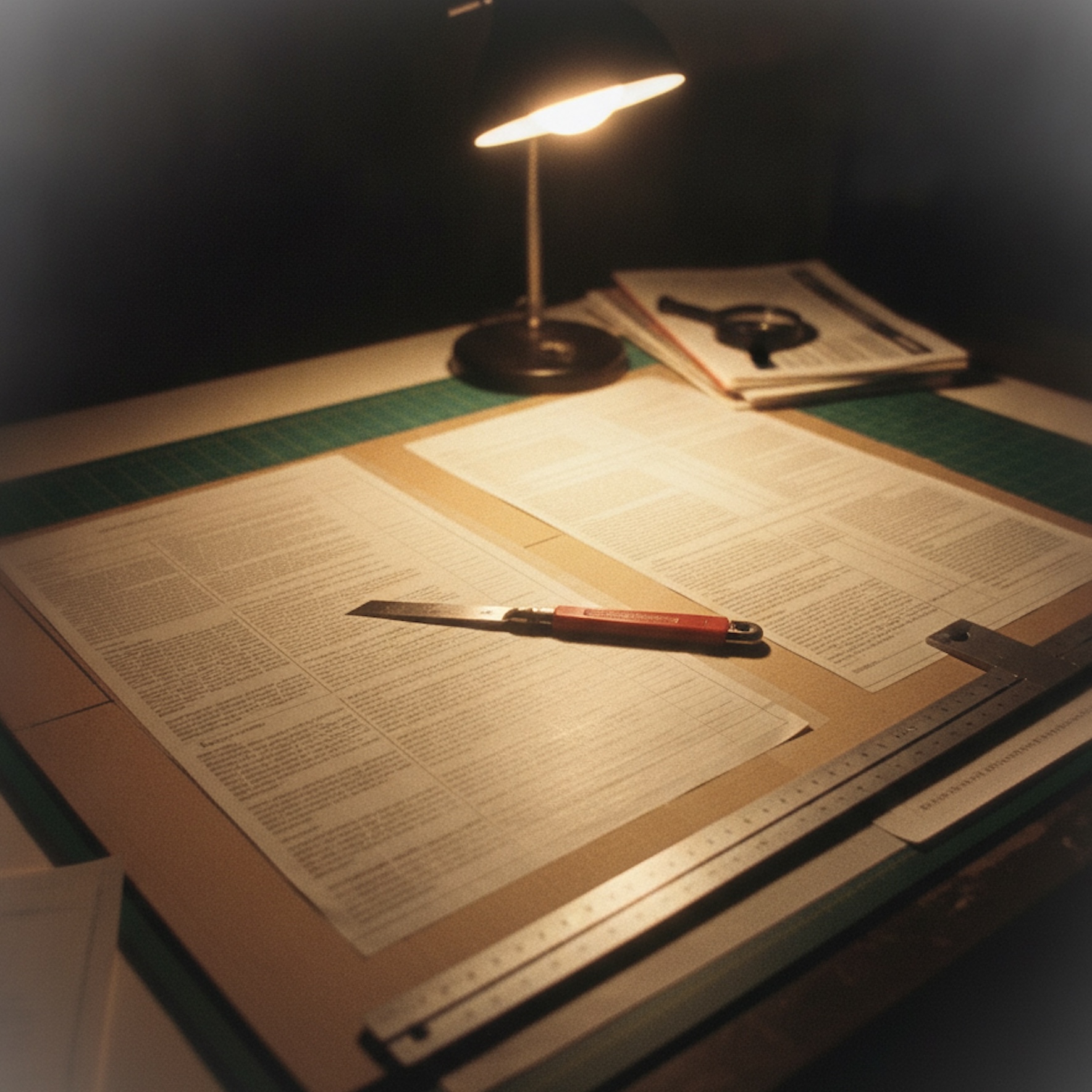
The crossing was made of small things. In 1989 a magazine page was a physical object, assembled by hand with wax and a blade and corrected on galley proofs; the fastest document in New York traveled by bicycle messenger or fax; a subway ride was a token in the pocket; a person out of the office was unreachable. By 2001 the page was a file, the clippings morgue was a database,the mobile phone had replaced the subway token as the essential item in an American’s pocket, and reachable had become the default state of an American professional. The change arrived one purchase and one upgrade at a time.
The dates matter because the decades on either side make the wrong frame. The excess of the 1980s was too neatly defeated, its villains too legible; after 2001 the irony was over. Between them sits the one American decade in which a generation of ambitious people believed their work could be both serious and rewarded — and was proven half right and half wrong, often inside the same career.
The City
New York in this interval was simultaneously the most dangerous and the most expensive American city in which to be young and ambitious. In 1990 the police recorded 2,245 murders, the most in the city’s history; in 2001 they recorded 649.3 London in the same years had its own renaissance but no equivalent epidemic of death; Los Angeles had the industry but not the density — not the compression that forces strangers into the same elevator on the way to the same memorial service. New York was the one American place where a twenty-seven-year-old fact-checker, a Washington Heights drug dealer, an investment banker, and an HIV-positive performance artist could plausibly share a subway car at one in the morning. The writer’s job was to notice.
The first thing to understand about that city is that its catastrophe was already old. By the autumn of 1989 the AIDS epidemic was eight years deep. Gay Men’s Health Crisis had been answering its hotline for seven years; ACT UP had been marching for two; the bathhouses had been closed for four; St. Vincent’s had been running the East Coast’s first AIDS ward for five. In these pages the epidemic is not a subject taken down from a shelf on designated occasions. It is weather — the funeral attended on Sunday before the Monday story meeting, the desk that empties, the party whose host does not appear — present in every year of the interval, foregrounded only when a chapter demands it.
The second thing is the trade the city made. The crack market peaked in the same years the murder count did, roughly 1989 through 1991, and its geography — which corners, which blocks, which boroughs — was the city’s actual map of whose emergencies counted; powder cocaine ran through the media world’s own parties, the same trade at a different price and a different sentencing exposure. Then, across the interval, the numbers fell — the murder count by more than two-thirds — and the money rose, and the city that emerged at the far bracket was cleaner, safer, vastly more expensive, and easier to sell; by the end of the interval there was a Disney marquee on Forty-second Street.
The Magazine
The vantage is a magazine because the magazine, in these years, was the last analog medium through which a single editor’s taste could remake a culture in under three years. Tina Brown took over The New Yorker in the summer of 1992; by the spring of 1995 it had won the first National Magazine Award for General Excellence in its seventy-year history.4 A newspaper is too institutional for that kind of authorship, a network too corporate, a book publisher two years behind the present. A monthly is fast enough to be present-tense and slow enough to be edited.
A magazine is also an instrument for reading a culture. What it covers is one kind of evidence. What it debates in the room and declines to assign is a second. What its staff lives — the funerals, the rents, the substances, the hours — without anyone thinking to pitch it as a story is a third, and the most reliable of the three, because nobody was performing it. An archive built around an editorial floor collects all three. It also collects the decade’s particular bargain with work: these were people who found direct expression harder than precise expression, whose care arrived as an edit and whose arguments arrived as assignments, and the devotion that made the work excellent was the same substance that wore its makers down — an attachment later scholarship named cruel optimism.5
Meridian is invented. A general-interest monthly on an editorial floor in Midtown, somewhere on the shelf between Vanity Fair, Esquire, and The New Yorker — it is this archive’s only fiction, and the rules around it are strict. Every other claim in these pages is sourced or absent; every number is carried by a named source or hedged. Where the invented magazine acts, the mood is subjunctive: what its editors would have covered, what they would have argued over and declined, what they would have lived without recognizing as material. The fiction supplies a fixed floor to observe from. It is never permitted to manufacture a fact.
The Vantage
The reader stands on the far side of the second bracket. Asked by Gallup whether the mass media could be trusted to report the news fully, accurately, and fairly, 55 percent of Americans said yes in 1999; by the early 2020s the figure was roughly a third.6 The kind of authority an editorial floor embodied — the confidence that a monthly could tell a country what mattered, and that the country would listen — has been dismantled, and what the authority provided was not passed down.
None of this makes the archive an elegy, because the coherence of that world depended on exclusion. The same editorial confidence that produced the authoritative work produced an account of America in which some lives were narratable and others were not, and the not-being-narrated registered as natural to the people doing the narrating. Both facts hold at once. The archive’s standing question is what, exactly, was traded away — the slow edit, the closed-door argument, the eleven-hour fight over a sentence — and which parts of the trade were replaceable. Nostalgia would settle it in advance, so these pages do without it.
The archive publishes in fragments. Chapters appear as they are written, in no required order; each stands alone; there is no spine. And past this page the prose keeps period discipline — past tense, period vocabulary, no knowledge of anything after September 2001. The people in what follows are stranger than memory has made them, because memory keeps recruiting them as early versions of the present, and they were not that. They do not know how the decade ends. Only this page does.
Footnotes
-
Mary Elise Sarotte, The Collapse: The Accidental Opening of the Berlin Wall (Basic Books, 2014). ↩
-
Francis Fukuyama, “The End of History?,” The National Interest, Summer 1989; expanded as The End of History and the Last Man (Free Press, 1992). ↩
-
New York City Police Department, citywide historical crime statistics. The 1990 count of 2,245 is the highest recorded in the city’s history; the 2001 count of 649 excludes the deaths of September 11. ↩
-
National Magazine Awards, American Society of Magazine Editors, 1995. ↩
-
Lauren Berlant, Cruel Optimism (Duke University Press, 2011). ↩
-
Gallup, “Media Use and Evaluation,” annual trend series. Trust in the mass media stood at 55 percent in 1998 and 1999 and at 34 percent in 2022. ↩