
The Institutions, 1982–1995
Subscribe
https://meridian-archive.com/feed.xmlOpen in your app, or paste the link above into any other:
A Movement That Had to Build Its Own City
Through most of the epidemic’s first decade, most funeral homes in New York City would not accept a body that had died of AIDS: undertakers who handled remains from every other cause of death simply declined to bring these through the door, a refusal practiced routinely enough that families arranging a burial treated it as a known condition of the search rather than a scandal to report. The one funeral home reliably identified as willing was Catholic, on Fourteenth Street, and it took the cases the rest of the trade turned away.1 Cremation became the city’s de facto standard for the AIDS dead as a consequence of that refusal more than of any preference, and what mourners gathered for afterward was, in the overwhelming majority of cases, a memorial service rather than a funeral, because there was no body left to bury. By 1989 the response to AIDS in New York was eight years old, and in that time it had produced not one agency but an entire private civic sector, staffed largely by people who also expected, not unreasonably, to be among its clients before long. On January 4, 1982, six men — the journalist Nathan Fain, Larry Kramer, Lawrence Mass, the former Green Beret and investment banker Paul Popham, the attorney Paul Rapoport, and the novelist Edmund White — met at Kramer’s apartment and formally founded Gay Men’s Health Crisis. Its first office was two rented rooms in a Chelsea rowhouse at 318 West Twenty-Second Street, owned by Mel Cheren of West End Records; that April the organization held its first major fundraiser, “Showers,” at Cheren’s own Paradise Garage on King Street, and raised fifty thousand dollars. The following month Rodger McFarlane installed an answering machine in his own apartment as the country’s first AIDS hotline; it took more than a hundred calls its first night.2 The organization’s central invention, the Buddy program, paired a volunteer with a single dying stranger for shopping, hospital visits, bathing, and the paperwork a death required; by 1986 the program counted more than five hundred volunteers, each pairing a private arrangement the agency’s staff introduced and then left alone.2
The organization coexisted uneasily with the movement it later helped seed. GMHC delivered meals, filed benefits paperwork, and ran a legal clinic; ACT UP, once it existed, confronted the same city and federal agencies GMHC quietly negotiated with; and members of the two bodies described the relationship, depending on who was asked, as complementary or as a running argument that never fully broke off — the traffic between them carried in one direction by resignation letters and in the other by obituaries.2
The organization’s other product was blunter. Through the mid-1980s GMHC produced safer-sex education material, including illustrated booklets called Safe Sex Comix that described, without euphemism, which acts carried the virus and which did not — material aimed at an audience the public-health establishment had mostly declined to address directly.3 In 1987 Senator Jesse Helms read from the booklets on the floor of the United States Senate as evidence of obscenity funded by the taxpayer. His amendment barred federal money from any AIDS-education material that could be read as promoting, encouraging, or condoning homosexual activity, and in October it passed, ninety-four to two.3 The near-unanimity said less about the argument’s merits than about the cost, in 1987, of being counted among the two.
A different kind of care had organized itself further downtown. In 1983 the Reverend Mead Miner Bailey founded the AIDS Resource Center out of a handful of scattered Chelsea and Village apartments, housing people the hospitals discharged and the shelters would not take.4 The congregate residence the organization opened at Christopher and West Streets in 1986 carried two names, Bailey-Holt House, the second honoring the Broadway producer Fritz Holt.4 Renamed Bailey House in 1995, the organization had by then grown from that single downtown address into a network of residences across several boroughs — the corner familiar to anyone who had walked the highway since 1986 was no longer the whole of what the name meant.
The Movement’s Design Shop
Where GMHC organized care, the AIDS Coalition to Unleash Power — founded in March 1987 out of the same Monday-night room at the LGBT Community Center — organized confrontation, and it organized itself deliberately without a hierarchy to confront. There was no president and no board in the ordinary sense, only the floor itself and a system of affinity groups that formed, dissolved, and re-formed as a given fight required — the Marys, Wave 3, and, most durable of the three, the Treatment & Data Committee, which ran its own meetings and answered to no one else in the room.5 A member could belong to as many groups as she had evenings for.
The structure was built to resist capture. Meetings were run not by a president but by a facilitator and a facilitator-in-training, both positions rotating so no single voice could set the floor’s agenda for long; proposals were argued from the floor and settled by a show of hands, sometimes over hours when the vote was close, and any member could stand to speak. The leaderlessness did not erase the coalition’s fault lines: caucuses formed by women and by members of color fought their own running arguments with the larger core of the membership over which fights the floor prioritized in a given week, arguments that rarely reached the movement’s public-facing image.5
One affinity group made objects rather than actions. Gran Fury, a half-dozen designers and artists working anonymously under a single collective name, treated the crisis as a problem of graphic design: an argument that had to fit on a card the width of a subway seat-back and read from across the car. Between 1987 and 1989 the group produced, in quick succession, a poster naming the Reagan administration by name as a party to the deaths, black-and-red T-shirts printed with two men kissing and worn to a presidential debate, and the bus and subway card described in the cold open, its line reading in full: “Kissing Doesn’t Kill: Greed and Indifference Do.”6
The group’s own members were often the same people staging the actions its cards advertised. On September 14, 1989, ACT UP members entered the visitors’ gallery of the New York Stock Exchange, chained themselves to a railing, and unfurled a banner over the trading floor, disrupting the exchange’s opening bell for the first time in its history.5 Burroughs Wellcome, maker of AZT, the only antiretroviral then approved, had priced a year’s treatment at roughly ten thousand dollars; within days of the demonstration the company cut the price by more than a third, to about sixty-four hundred dollars.5 It was one of the rare instances in which a Monday-night meeting’s work translated directly into a lower number on an invoice.
The Fission
By 1990 the movement had begun to divide the way any large improvised institution eventually does — not chiefly in anger, but by specialization. ACT UP’s Housing Committee, which had pressed the city on shelter policy for people with AIDS since the coalition’s early years, spun off that year into an independent organization, Housing Works, founded by four of the committee’s members: Keith Cylar, Charles King, Eric Sawyer, and Virginia Shubert.7 The new organization’s funding model was its own invention — a chain of thrift stores across Manhattan and Brooklyn, their revenue underwriting housing the city itself had been unwilling to provide. One of the stores, on Crosby Street in SoHo, sold used and donated books alongside the clothing racks and, with a café attached, became a literary fixture of the neighborhood in its own right, apart from the cause that had opened its doors.7
Much of the labor that kept organizations like this running was not the labor the movement’s own iconography advertised. Lesbians in particular carried a disproportionate share of the unpaid caretaking behind the Buddy program, the thrift stores, and the hospital advocacy that kept dying men fed, bathed, and out of institutional care — work that rarely made the posters and rarely made the obituaries, performed by women whose own political priorities were not always the ones the movement’s public face represented.5
A second division followed in 1992, less amicable at the time than it later read. The Treatment & Data Committee — the affinity group that had spent years teaching itself the statistical language of clinical trials well enough to argue with the biostatisticians at the Food and Drug Administration — left ACT UP to form the Treatment Action Group, under Mark Harrington and Peter Staley, both veterans of the Stock Exchange action three years earlier.8 The split tracked a real division of temperament as much as of tactics: the treatment activists were, disproportionately, the members willing to sit across a table from the regulators they had spent years chaining themselves to a railing to embarrass, and the parent organization kept the street. TAG’s founding mandate was procedural rather than dramatic — to push the Food and Drug Administration toward parallel-track access and accelerated approval based on surrogate markers rather than completed trials — the kind of regulatory-mechanics fight that produced no chant and no photograph but changed, over the years that followed, how quickly a drug could reach a dying patient.8
Both new organizations, and GMHC before them, absorbed a suspicion that had circulated inside the movement since its earliest meetings: that the network of nonprofits, foundations, and agencies the crisis had produced might, in time, develop an institutional interest in managing the emergency rather than ending it. The critique was aimed inward as often as outward, sharpened by every annual report that arrived with a corporate logo newly printed on the cover, and it never resolved into a verdict. Some of what the movement built to survive the crisis outlasted any argument about whether the building of it had been a form of surrender.
The Cultural Institutions
Not every organization the crisis produced was built to fight or to house. Visual AIDS, founded in 1988 by a group of curators and artists, worked the cultural flank: it introduced the folded red ribbon at the Tony Awards in June 1991, the first symbol of its kind to enter American public life at that scale, and it organized Day With(out) Art each December first, in which participating museums covered or removed a work from view to mark the year’s cultural losses — a gesture adopted, within a few years, by museums, schools, and libraries well beyond New York, asking a visitor to register a specific absence rather than a specific object.9
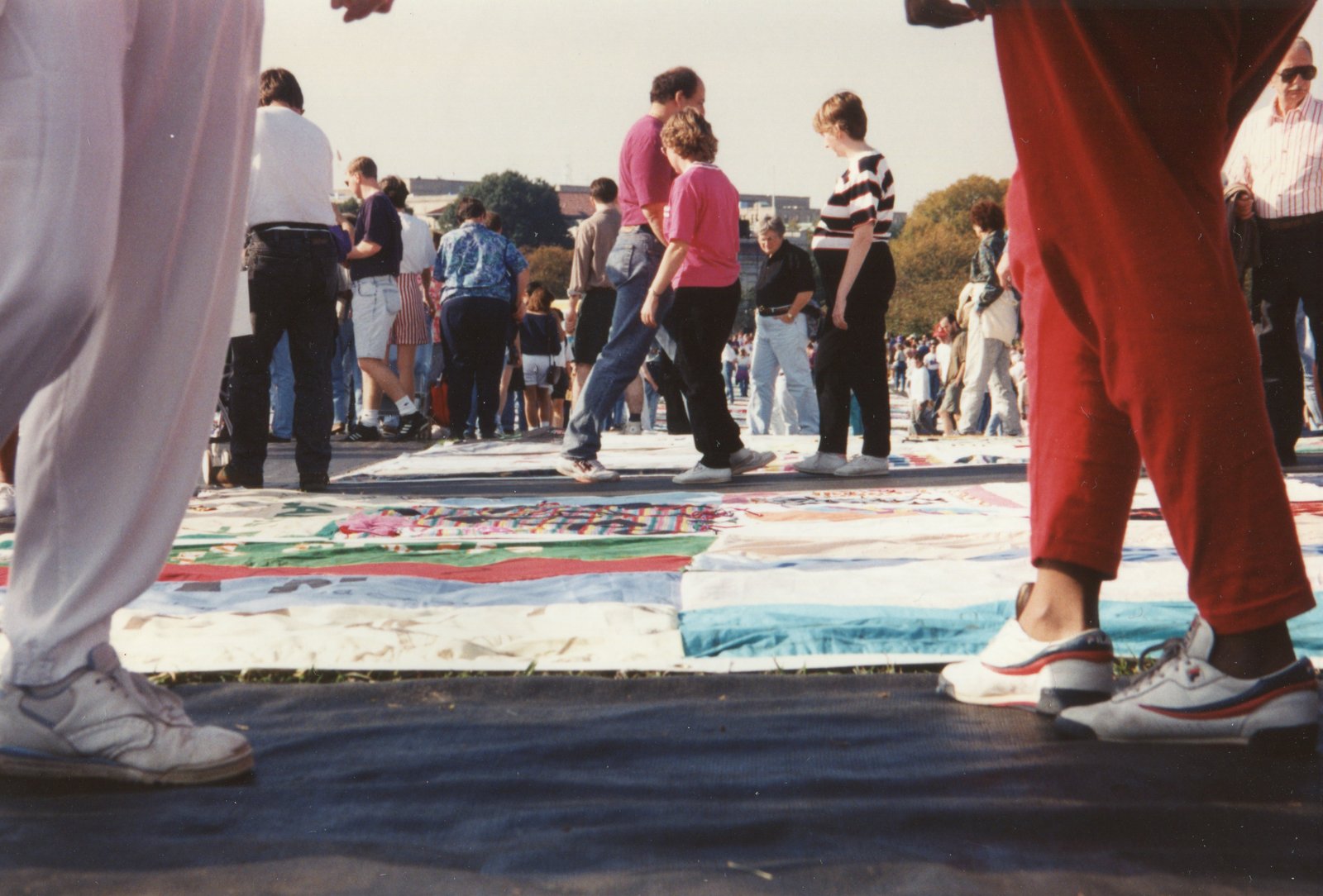
The largest single commemorative object the crisis produced had not started in New York. Cleve Jones conceived the NAMES Project in San Francisco in 1985; its unit was a panel three feet by six, the dimensions, deliberately, of a grave, sewn by anyone for anyone they had lost. New York supplied a substantial share of the panels that accumulated over the years that followed, and in October 1992 the full quilt was laid out on the National Mall in Washington: more than twenty thousand panels, covering ground that ran past the Mall’s own borders, weighing an estimated twenty-six tons.10 By tonnage it was one of the largest single acts of collective mourning ever assembled in the country, and no agency, foundation, or government body had built it.
The crisis produced, finally, a magazine of its own. In 1994 Sean Strub, a longtime activist who had spent the 1980s in and around the same rooms as the rest of this history, founded POZ — a general-readership title written by and for people living with HIV, covering treatment, politics, and culture from inside the fact the rest of the press covered from outside it.11 At its peak the magazine reached a circulation of roughly seventy-five thousand,11 with a newsstand presence alongside the glossies whose own coverage of the epidemic it was, in effect, auditing. A copy of POZ on a coffee table said something specific about the apartment it sat in, in the exact grammar — masthead, cover line, newsstand rack — that every other magazine on the table also spoke.
What the Institutions Bought
By the middle of the 1990s the apparatus had a balance sheet. GMHC’s budget, which had started with the fifty thousand dollars raised at the Paradise Garage in the spring of 1982, had grown into the tens of millions of dollars, funded increasingly by corporate sponsors who had not existed as donors to the cause a decade earlier; by 2000 the organization counted more than one hundred thousand New Yorkers it had served since its founding.2 Some of the new money came from constituencies the six founders in their two rented rooms could not have imagined: pharmaceutical manufacturers whose pricing ACT UP had once picketed, fashion houses whose ranks the epidemic had thinned by the dozen, investment banks whose junior associates now sat on benefit committees. None of it arrived as an apology, and none of it was refused.
The Institutions
| Institution | Founded | Founders / origin | Primary work |
|---|---|---|---|
| Gay Men’s Health Crisis | 1982 | Fain, Kramer, Mass, Popham, Rapoport, White | Buddy program, hotline, safer-sex education |
| AIDS Resource Center (Bailey House) | 1983 | Rev. Mead Miner Bailey | Housing for people with AIDS |
| ACT UP | 1987 | The Monday-night floor, LGBT Community Center | Direct-action protest |
| Visual AIDS | 1988 | Curators and artists | Red Ribbon, Day Without Art |
| Housing Works | 1990 | Keith Cylar, Charles King, Eric Sawyer, Virginia Shubert | Thrift-store-funded housing |
| Treatment Action Group | 1992 | Mark Harrington, Peter Staley | Treatment and regulatory activism |
| POZ | 1994 | Sean Strub | Magazine for HIV-positive readers |
What the roster shared was less an ideology than a habit: each new organization answered a piece of the emergency too specific for the others to hold, and each, in solving its piece, became a fixture the emergency’s end did not remove. By the late 1990s the Monday-night meeting that had produced most of the roster above had thinned from the roughly one thousand who filled the room at its 1989–1990 peak to a small room that met out of habit and history as much as urgency;5 POZ was still on the newsstand; Housing Works was still running its stores; and the corporate logos on GMHC’s annual report had multiplied past the number the six founders, in two rented rooms in 1982, had ever had reason to add.
No single body decided to build any of this. A crisis the government mostly declined to fund produced, piece by piece and often in visible reaction to the piece before it, a hotline, a residence, a design collective, a thrift-store chain, a treatment-research group, a red ribbon, a quilt the size of an argument, and a magazine — each one an answer to a specific failure of the others, each one staffed for the most part by people who also expected to be dead within the decade. The multiplication was itself the achievement, though it rarely felt like one from inside a Monday-night meeting arguing about whether the meeting’s own growth was a betrayal of what had made it necessary. A movement that fissions into institutions this durable has, in the ordinary sense, won; it has also stopped being only a movement, and no one who lived through the fissioning ever fully settled which of those two facts mattered more. The roster the crisis left behind outlasted the emergency that built it, which is what a city’s actual infrastructure — the kind nobody plans and everybody eventually depends on — tends to do.
The Back would have carried a short item on the folded red ribbon’s debut at the Tony Awards in June 1991 — a paragraph on a pin with no patent, no manufacturer, and no royalty, folded and pinned by volunteers who would have gone unnamed in the copy. The item would have logged the ribbon as a design note, the small mechanics of an object that spread without anyone owning it, rather than as the movement’s history.
The Front would have carried more space, sixteen months later, for the Quilt’s full display on the National Mall in October 1992. A staff writer would have flown down for the weekend and returned with an essay built on walking distance rather than argument, the kind of assignment a photographer would have shaped as much as a reporter would have written it. The panels that October would have run past the Mall’s own borders and weighed, by the estimate the piece would have used, some twenty-six tons.
Footnotes
-
Fran Lebowitz, interview, Commonweal, 2019. ↩
-
Jennifer Brier, Infectious Ideas: U.S. Political Responses to the AIDS Crisis (University of North Carolina Press, 2009). ↩ ↩2
-
Bailey House, “History,” baileyhouse.org/about-us/history/. ↩ ↩2
-
Sarah Schulman, Let the Record Show: A Political History of ACT UP New York, 1987–1993 (Farrar, Straus and Giroux, 2021). ↩ ↩2 ↩3 ↩4 ↩5 ↩6
-
Douglas Crimp with Adam Rolston, AIDS Demo Graphics (Bay Press, 1990). ↩ ↩2
-
Treatment Action Group, “History,” treatmentactiongroup.org. ↩ ↩2
-
NYC AIDS Memorial, “The AIDS Memorial Quilt,” nycaidsmemorial.org. ↩
-
Sean Strub, Body Counts: A Memoir of Politics, Sex, AIDS, and Survival (Scribner, 2014). ↩ ↩2