The Activism, 1987–1995
Subscribe
https://meridian-archive.com/feed.xmlOpen in your app, or paste the link above into any other:
The Order of Business
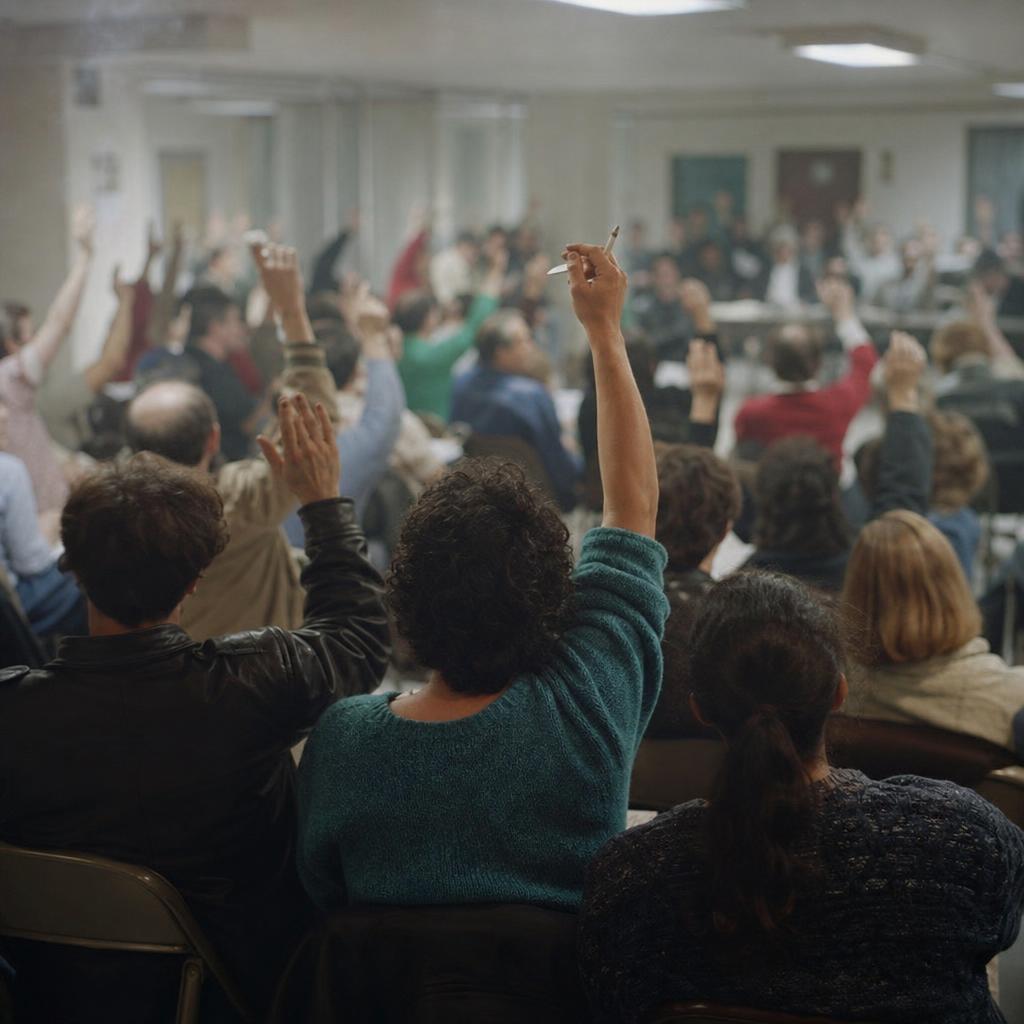
Every Monday night the AIDS Coalition to Unleash Power convened at the Lesbian and Gay Community Services Center on West 13th Street, and it did so on a fixed order of business. Doors opened at seven; the meeting began at seven-thirty. First on the agenda was not a proposal but a roll: members stood to read aloud the names of the people who had died that week. Then came committee reports, then affinity-group reports, then action proposals, then a vote by show of hands, sometimes lasting hours when a proposal was contested.1 The meeting had a facilitator, and beside the facilitator a “facilitator-in-training” being groomed to take the chair; both positions rotated on a schedule, so that a movement organized around having no leader produced, week after week, an apprenticeship in how to run one.1
On March 12, 1987, the writer Larry Kramer gave a speech in the same building. He asked one half of the audience to stand, and told the people standing that they would be dead in five years unless they did something the existing organizations were not doing. Two days later some three hundred people came back, and named what they were forming the AIDS Coalition to Unleash Power.2
By the spring of 1987 the epidemic in New York was six years old and had already killed thousands. The federal response had for most of that span been close to silence — the president had barely spoken of the disease in public — and the money, the research, and the drug trials arrived at a pace that bore no relation to the rate of the dying. The one approved antiviral, AZT, was both punishing to take and, at ten thousand dollars a year, out of reach for many of the people it might have helped. What Kramer’s speech proposed was that the epidemic had a second body — the policy, the pricing, the approval timetable — and that this body, unlike the virus, could be operated on directly.
The organizations he was measuring against were not idle. Gay Men’s Health Crisis, which Kramer had co-founded in 1982 and left in a dispute over exactly this question, ran the hotline, the food deliveries, the legal clinics, and the Buddy program that paired volunteers with the dying. That was the service model, and it was indispensable, and it was — in the judgment of the people who filled the Monday meeting — insufficient to a government that priced the only approved drug beyond most patients’ means and approved new ones on a schedule measured against nothing but its own procedures. The service model kept people alive one at a time. The Monday meeting proposed to change the rules under which they were dying.
Work happened in committees and in affinity groups — the Treatment & Data Committee, the Marys, others — that acted semi-autonomously and reported back to the Monday floor. Anyone could speak. At its 1989 and 1990 peak the meeting drew close to a thousand people on a Monday night, more than the room could seat.1
What the structure produced was not only tactics. It produced a scene. Many of the period’s most talented writers, artists, and designers found the Monday meeting more interesting than any other room available to them, and said so; it was theatrical, argumentative, erotic, and funny in exact proportion to how unbearable the week outside it had been.1 The urgency was real and the deaths were constant, and the meeting was, much of the time, a pleasure. It was where a person went to be alive in a city where a great many people were dying.
The Actions
The public face of the movement was the demonstration, and the demonstrations were engineered. The first, on March 24, 1987, put roughly two hundred fifty people on Wall Street to demand access to AZT and a national policy; the police made seventeen arrests. Kramer’s op-ed, “The F.D.A.’s Callous Response to AIDS,” had run in the New York Times the morning before, so the argument reached the paper before the bodies reached the street.3 On October 11, 1988, some fifteen hundred activists surrounded the Food and Drug Administration headquarters in Rockville, Maryland, in an action widely credited with pushing the agency toward the parallel-track and accelerated-approval mechanisms that followed.2
The tactic that most clearly announced the movement’s method came on September 14, 1989. Seven activists in business suits, carrying forged credentials, entered the New York Stock Exchange, chained themselves to the VIP balcony, and unfurled a banner reading SELL WELLCOME — the manufacturer of AZT — as the opening bell was disrupted for the first time in the exchange’s history. Within days Burroughs Wellcome cut the price of AZT from ten thousand dollars a year to sixty-four hundred.2 The lesson was not lost on anyone in the Monday meeting: a well-planned action of a few people, aimed at the right pressure point, moved a price that petitions had not.
The Actions, 1987–1993
The New York chapter’s major demonstrations moved from Wall Street to the cathedral to the White House.21
| Date | Action | Outcome |
|---|---|---|
| Mar. 24, 1987 | First Wall Street demonstration | ~250 protesters, 17 arrests; demand for AZT access |
| Oct. 11, 1988 | Seize Control of the FDA, Rockville, MD | ~1,500 activists; credited with speeding parallel-track approval |
| Sep. 14, 1989 | New York Stock Exchange | 7 infiltrate the balcony; “SELL WELLCOME”; AZT cut $10,000 → $6,400 |
| Dec. 10, 1989 | Stop the Church, St. Patrick’s Cathedral | 4,500–5,000 outside; die-in inside; 111 arrests |
| May 1990 | Storm the NIH, Bethesda, MD | ~1,000 at the National Institutes of Health |
| Jan. 1991 | Day of Desperation | disruption of the CBS Evening News; “Fight AIDS Not Arabs” |
| Oct. 11, 1992 | Ashes Action, the White House | mourners throw the ashes of the dead over the fence |
| Nov. 2, 1992 | Mark Lowe Fisher political funeral | open coffin carried up Sixth Avenue in the rain |
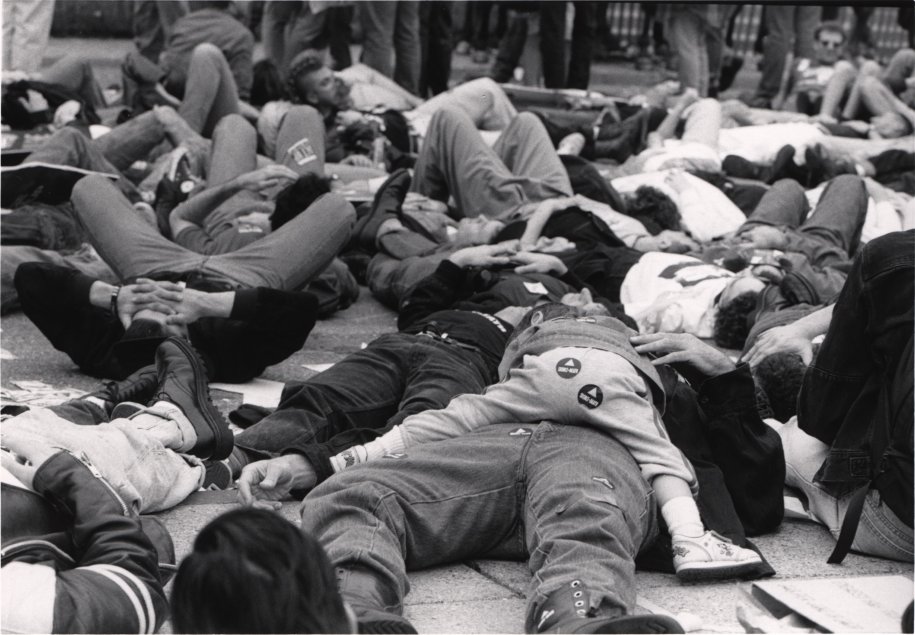
The most controversial action was Stop the Church, on December 10, 1989, when between forty-five hundred and five thousand demonstrators surrounded St. Patrick’s Cathedral on Fifth Avenue over Cardinal John O’Connor’s opposition to condoms and safe-sex education. Inside, during the Sunday Mass, a small contingent staged a die-in in the aisles; one activist stood on a pew and shouted “You’re killing us!” at the altar. The police arrested a hundred and eleven people, more than half of them inside the church.1 It was condemned by the mayor, the governor, the Times, and much of the gay-rights establishment, and it put O’Connor’s positions on the front page of every paper in the country, which was the point. A performer named Ray Navarro covered the protest costumed as Jesus Christ, interviewing demonstrators as though reporting for what he called the Fire and Brimstone Network; he was dead of AIDS within the year, at twenty-six.1
The visual argument the actions carried was itself designed. An anonymous collective inside ACT UP called Gran Fury produced the posters, stickers, and advertisements that gave the movement a graphic language as disciplined as any ad agency’s — a language built to be legible from across a street and unanswerable once read.
The Political Funeral
By 1992 the movement had refined a second form, harder to look at than the demonstration and impossible to argue with. On July 29, after the painter David Wojnarowicz died in his East Village loft, mourners carried a banner through the neighborhood declaring that he had died of AIDS due to government neglect — the first of what ACT UP called political funerals.1 They were funerals in fact: people grieved, sang, held one another. They were also actions, with route surveys, media advance, and banners. The combination of high political theater and unfaked private grief has almost no precedent in American protest; its nearest ancestors are the civil-rights funerals of the 1950s and 1960s.
The form reached its fullest expression twice that autumn. On October 11, during the last full display of the AIDS Memorial Quilt on the National Mall, mourners marched from the Capitol to the White House and threw the cremated ashes of their dead over the fence onto the lawn — the Ashes Action, organized in part by David Robinson, who argued that the Quilt had become too beautiful to disturb anyone and that the country needed to be shown what it was refusing to see.5 Three weeks later, on the rainy night of November 2, the eve of the presidential election, mourners carried the open coffin of Mark Lowe Fisher up Sixth Avenue, forty blocks from Judson Memorial Church to George H. W. Bush’s reelection headquarters. Fisher had written his own instructions before he died: “I want my own funeral to be fierce and defiant, to make the public statement that my death from AIDS is a form of political assassination… We are taking this action out of love and rage.”6 At the campaign office, in the rain, Bob Rafsky delivered the eulogy: “George Bush, we believe you’ll be defeated tomorrow.”7 Bush was defeated. The following July, the “Marys” affinity group tried to carry Tim Bailey’s coffin to the White House itself, and the Park Police boxed the procession into a parking lot and would not let it pass.5
A demonstration could be dismissed as a stunt; a funeral could not. The political funeral worked because it collapsed the distance that coverage of the epidemic depended on — between the movement as a political actor and the movement as a population of people actually dying — and put the two in a single procession, the coffin real and the target chosen. It asked the onlooker to decide, in the moment, whether what was passing was grief or protest, and then refused to let the question be settled, because it was both at once.
The political funeral did not survive the decade. After the protease inhibitors of 1996, fewer people were dying, and fewer of the dying demanded that their bodies be marched anywhere. The disappearance of the form is one of the clearest markers of the change.
Treatment and Data
The activists who forced the price of AZT down were, for the most part, not the activists who designed the FDA actions, and neither group was the group that produced the funerals. The movement ran on a division of labor and temperament that it did not always manage gracefully. The Treatment & Data Committee — the wing that read the trial protocols, learned the pharmacology, and sat across the table from federal researchers — was more scientifically literate, more detail-obsessed, and more willing to work with the establishment than the street-protest wing, and the relationship between the two was frequently acrimonious and always necessary.2
The disagreement was real and ran deep. To parts of the street-protest wing, sitting across a table from federal researchers looked like the beginning of capitulation — the establishment absorbing its critics by giving them chairs. To the treatment activists, the die-in had done what a die-in could do, and the remaining fight was inside the science, where a banner was of no use. Both readings were correct, which was why the argument never resolved and why the movement needed both wings to be right at once.
In 1992 the treatment wing formalized the split. Mark Harrington, Peter Staley, and others took the Treatment & Data Committee out of ACT UP and made it the Treatment Action Group, a smaller organization built to negotiate rather than to demonstrate.2 The pressure the two wings had applied together, over the preceding five years, reorganized how the country approved drugs: parallel track, accelerated approval on the strength of surrogate markers, and direct patient participation in the design of trials. The protease inhibitors that arrived at the end of 1995 reached patients years earlier than the pre-1987 approval regime would have delivered them. A meaningful number of people were alive to see the change because of decisions the Monday meeting had forced.
The Establishment and the Erased
The victories built institutions, and the institutions became a target of the movement’s own suspicion. By the mid-1990s Gay Men’s Health Crisis had grown from a hotline run off an answering machine into an organization with a budget in the tens of millions, a roster of corporate sponsors, and an executive director fluent in the language of foundation grants. Inside the Monday meeting, a recurring argument named this development “the AIDS establishment”: the network of nonprofits, agencies, and pharmaceutical companies that had grown up around the epidemic and that, some argued, had institutional reasons to manage the crisis as a permanent condition rather than to end it. The critique aged unevenly. Some of it was paranoid. Some of it was exactly right.
The standard account of the movement has its own establishment, and it erases in its own way. The version most often told — white gay men, mostly in New York, fight the government and win the drugs — underweights the people who made the version possible and were written out of it. Women, and lesbians in particular, supplied enormous quantities of unpaid labor to both the movement and the deathbeds: buddying, hospital advocacy, cooking, the cleanup after a death that a man’s biological family would not perform. The chapters and caucuses of people of color fought the white-male core continuously over whose priorities the organization served.1 And the numerically larger New York epidemic — intravenous drug users, women, and children in the Bronx and central Brooklyn, most of them Black or Hispanic — was harder to organize, harder to photograph, and largely absent from the Monday meeting that the writers and artists found so alive. Most people who died of AIDS in New York were not artists or activists. They had jobs and apartments and families they had often not told, and they left no memoir. The canon that remembers the movement remembers the people who were already inside the machine that produces memory.
By the middle of the decade the peak had passed. The treatment wing had won its central targets; the drugs it had fought for were arriving; the government it had trained itself to negotiate with was, after 1992, less reliably an enemy. The Monday meeting, which had strained the room in 1990, drew a fraction of that by the late 1990s. The movement did not end. Its highest pitch had a specific span, and that span closed inside the years the epidemic itself began, at last, to relent.
The movement invented forms, and the forms are what lasted. A room with no president, where anyone could speak and the vote was a show of hands. A demonstration engineered like an advertising campaign, aimed at a single price or a single procedure. A funeral that was also an action, the coffin carried up the avenue in the rain. A committee of laymen who taught themselves enough pharmacology to redesign a clinical trial. None of these were obvious in 1987; all of them were built, in a hurry, by people who did not expect to live to use them twice. What is striking is not only that the forms worked — that a handful of people in suits could move the price of a drug, that a committee of the sick could change how a government approved medicine — but that the room where they were made was, by the testimony of the people in it, a good place to be. The grief was total and the pleasure was real, at the same meeting, on the same Monday night, and the people who were there have spent the years since insisting that both were true.
Stop the Church would have reached The City, and by the time the December close would have arrived the argument over how to frame it would already have run its course on the floor. The die-in inside St. Patrick’s would have split the room the same way it split the paper of record — whether to write the disruption of a Mass as trespass against the Cardinal or as a movement’s exact appropriate weapon — and The City would have carried whichever piece would have won that argument, dated into the following February’s issue.
Not everything so contested would have reached print. Word of David Wojnarowicz’s funeral through the East Village would have reached a writer who would already have had the contacts for it, and who, that particular summer, would have owed a colleague a debt paid better in silence than in a byline; the pitch would have lapsed rather than been called in, and no one outside the two of them would ever have known why. The Ashes Action at the White House fence would have arrived at the desk with its moment already spent — three weeks gone by the time an issue could close around it, and nothing else in that month’s report standing ready to give a late piece a reason to exist. When the Marys tried to carry Tim Bailey’s coffin to the White House the following July, no one on the floor would have been tracking the group’s summer actions closely enough that summer to have heard the attempt had even been made.
Footnotes
-
Sarah Schulman, Let the Record Show: A Political History of ACT UP New York, 1987–1993 (Farrar, Straus and Giroux, 2021). ↩ ↩2 ↩3 ↩4 ↩5 ↩6 ↩7 ↩8 ↩9
-
David France, How to Survive a Plague: The Inside Story of How Citizens and Science Tamed AIDS (Alfred A. Knopf, 2016). ↩ ↩2 ↩3 ↩4 ↩5 ↩6
-
Larry Kramer, “The F.D.A.’s Callous Response to AIDS,” New York Times, March 23, 1987. ↩
-
Douglas Crimp with Adam Rolston, AIDS Demo Graphics (Bay Press, 1990). ↩
-
ACT UP Oral History Project (Sarah Schulman and Jim Hubbard), interviews on the political funerals and the 1992 Ashes Action, actuporalhistory.org. ↩ ↩2
-
Mark Lowe Fisher, manifesto on his own political funeral, New York, 1992. ↩
-
Bob Rafsky, “Bury Me Furiously,” eulogy for Mark Lowe Fisher, New York, November 2, 1992. ↩