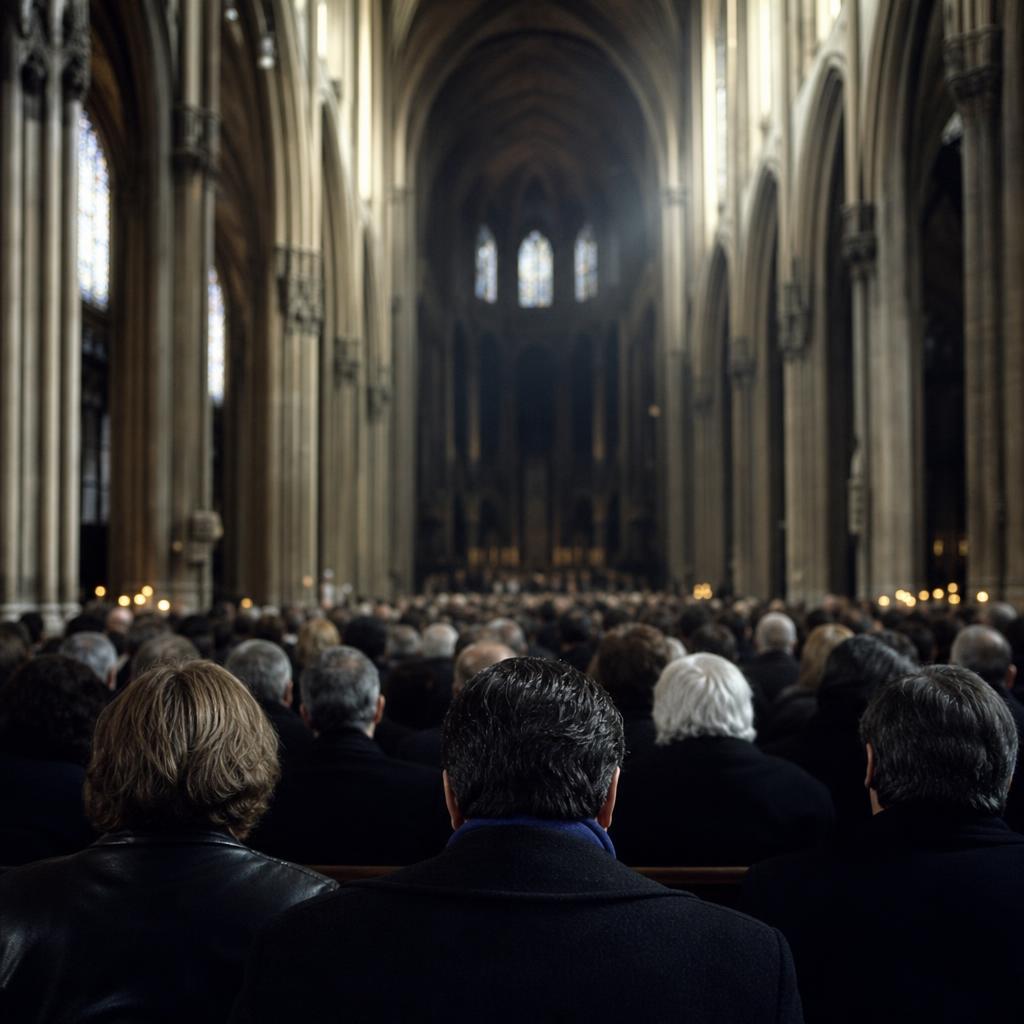
The Later Peak, 1993–1995
Subscribe
https://meridian-archive.com/feed.xmlOpen in your app, or paste the link above into any other:
Seven Thousand a Year
By 1992 the Food and Drug Administration had created a formal category for approving a drug against evidence no other disease was ever judged by: not proof that a patient lived longer, but a change in a number drawn from a blood sample — the CD4 count — treated by regulation as a stand-in for that proof. The agency called it accelerated approval, a track built specifically for AIDS drugs and administered as routine business by 1993, on the reasoning that a trial run long enough to show survival would outlast a large share of the patients enrolled in it.1 The mechanism had been forced onto the agency, not volunteered: ACT UP’s Treatment and Data Committee had spent five years arguing, inside FDA hearing rooms and advisory-committee meetings, that a disease killing this fast could not be regulated on the timetable used for drugs treating diseases that killed slowly.2
The disease had already, by the end of the 1980s, become the leading cause of death among the city’s young men. What these years added was magnitude, not a new category: the annual count rose to its maximum and stayed there. The toll that had reached roughly sixty-five hundred in New York City in 1992 did not level off. In 1993 the city recorded approximately seventy-five hundred dead of the disease, and it held near that figure again the following year.3
By 1995 the annual figure settled at 7,046 — the highest single-year total in the city’s record4 — and the dead the disease had claimed in the city since 1981 ran to tens of thousands. The same year, the reach widened past the young men who had carried the count for a decade: nationally, AIDS became the greatest killer of all Americans aged twenty-five to forty-four.5 These were the deadliest years of the entire epidemic in New York, and they arrived without any single event to mark them — no protest, no famous diagnosis, no front page. The count had risen every year since the early 1980s, and now it held near its highest for three years together.
The Toll, 1993–1995
| Year | Figure |
|---|---|
| 1992 | ~6,500 deaths in New York City (the prior year’s baseline)3 |
| 1993 | ~7,500 deaths in New York City3 |
| 1994 | Annual toll holds near the 1993 figure3 |
| 1995 | 7,046 deaths in New York City — the historical single-year peak4; cumulative city deaths since 1981 in the tens of thousands |
| 1995 | AIDS becomes the greatest killer of all Americans aged 25–44 nationally5 |
The Service
For a New Yorker connected to the downtown art, theater, or fashion worlds, the calendar in these years carried a dozen or more of these obligations, and in the worst stretches several in a single week.
The city had a circuit of rooms for this, set by the services held for the decade’s first prominent dead. Robert Mapplethorpe’s memorial had taken the Whitney in May 1989; Keith Haring’s, the following spring, filled the Cathedral of Saint John the Divine on the birthday he had not lived to see, the actor Dennis Hopper among those who spoke; Halston’s tribute that June took Alice Tully Hall at Lincoln Center, organized by Liza Minnelli. Judson Memorial Church on Washington Square South was the downtown standard for the dance and theater worlds, and Frank E. Campbell, the funeral chapel on Madison Avenue at Eighty-first Street, handled the moneyed end. A working editor came to know these rooms by their acoustics and their coat closets.
The etiquette was, by then, fixed. Mourners arrived on time and wore dark colors but not the black and white of a funeral, because this was understood to be a different kind of occasion. The speakers came in a settled order — a partner or family member, then the oldest friend, then a professional collaborator, then someone unexpected — and the slideshow ran either to a torch song, a Cole Porter or a Sondheim, or to whatever the dead person had loved in life, which could be a Bach mass as easily as a downtown band no one in the pews had heard of. A regular could expect to recognize half the room, and to have sat in a room just like it, for someone else, within the past few months.
And then, at the top of the curve, people could no longer keep it up. People who had gone to everything started going to less. They sent flowers. They sent a card. They told themselves they would hold the private dinner in the dead friend’s honor, and did not hold it. This was not callousness but exhaustion. Past a certain number in a single year, the body refused to keep the appointments the datebook had made.
The Broadway Show and the Movie
The strangeness of these particular years is that they were also the years the disease became mainstream American culture. The same span in which the city buried more people than in any other saw AIDS arrive, for the first time, as mass entertainment aimed at an audience that had lost no one.
Tony Kushner’s two-part play reached Broadway in 1993 and delivered the subject to a mainstream theatergoing public more effectively than a decade of magazine coverage had managed. That December, a major Hollywood studio released Philadelphia, Jonathan Demme’s courtroom drama with Tom Hanks as a lawyer dying of the disease and suing the firm that fired him for it — the first big-budget studio film built on the subject, made for an audience that needed the lesson and structured to teach it: a sympathetic protagonist, a clear injustice, a resolution. Hanks won the Academy Award for it the following spring. The red ribbon, first pinned on at an awards ceremony in 1991, was by 1993 fixed to every lapel on every telecast — a small loop of grosgrain that cost the wearer nothing and named no one.
The representation that reached the country was redemptive, sympathetic, and safe. The film resolved: it gave the audience a hero to grieve and an ending. The downtown calendar had none of that, only the next name and the next room. The country was being taught the story in the same season the city was living the largest share of it, and the two versions never met.
Pedro Zamora
The national story and the local one came closest in a single house in San Francisco. In early 1994, Pedro Zamora, twenty-two years old and openly HIV-positive, moved into the shared apartment of a new kind of MTV documentary series, one that filmed a cast of strangers living together — the first openly HIV-positive person to appear in one, an AIDS educator since seventeen, when he had tested positive after trying to give blood at his Florida high school. His commitment ceremony with his partner Sean Sasser, broadcast as part of the season, was the first same-sex commitment ceremony aired on American television.6
A film lasted two hours; the series ran a full season. Viewers who had lost no one followed a specific young man, week over week, through the ordinary business of a shared house — the arguments about dishes, the romance, the job — with the diagnosis present in the room the entire time and explained to no one, because by 1994 it did not need explaining.
In August 1994, on a speaking tour, he grew disoriented at the network’s New York offices and could not recognize where he was. He checked into Saint Vincent’s Hospital, at Seventh Avenue and Eleventh Street — the same ward the downtown dead had been passing through for a decade. He died in Miami on November 11, 1994, at twenty-two, hours after the season’s final episode aired the night before.6 President Clinton, his health secretary Donna Shalala, and Tipper Gore, the vice president’s wife, each issued a statement. He had died thirteen months before the approval of the first drug that might have altered his trajectory. A nation had watched a young man with the disease conduct his ordinary life on a television screen in the same season that the hospital he collapsed into ran at capacity with men no camera followed and no president named.
December
Even at the peak, the disease was still spreading into groups that had thought themselves untouched. In March 1995 Eazy-E, a founder of the group N.W.A, died of the disease in Los Angeles, and the story became, visibly and for the first time, a hip-hop story — reaching another public that had assured itself the disease belonged to someone else.
And then, at the close of the worst year the city had counted, the turn. On December 7, 1995, the Food and Drug Administration approved saquinavir, the first of the protease inhibitors, ninety days after the manufacturer filed the application — a compression the agency had never before granted a drug of this kind.7 The approval arrived in a city that had just recorded 7,046 dead in a single year. No one attending a service that December could have said which of the two facts on that month’s calendar described their own future: the count, which was the largest ever, or the small item in the drug news, which almost no one at the services had heard discussed. Both were true, on the same page, at the same time.
The years in which AIDS became a national story were the years it killed the most New Yorkers. This is not a paradox so much as a lag: the country tends to learn a thing at scale only once the thing has grown too large to ignore, and by the time the play is on Broadway and the film is in theaters and the ribbon is on every lapel, the people the story is about have been dying for a decade and are dying, in that exact season, faster than ever. The gap between the representation and the arithmetic was not a failure of anyone’s sympathy. It was the ordinary shape of how a large society comes to know a hard thing — from the outside in, through a hero it can afford to grieve, arriving at the door years after the people inside have learned to keep a datebook of the dead. What makes these particular years worth holding still to look at is that the two clocks were, for once, briefly legible at the same time: the highest count the city ever recorded and the first of the drugs that broke the curve, both landing inside the same twelve months, neither one yet able to see the other.
Kushner’s two-part play reaching Broadway and Demme’s film reaching every multiplex in the same season would have given The Essay its subject for the February 1994 issue: the argument that the country had finally agreed to watch, in redemptive shape and at safe distance, what the floor would have been watching without a script for a decade. A house writer would have made the case that the ribbon on every lapel and the Oscar for the leading man were arriving a full decade behind the disease itself, and the piece would have run under that frame.
A harder case would have died the same year in the room. A cable network’s youth documentary had put an HIV-positive twenty-two-year-old in a shared house on national television, through his commitment ceremony and into his death, in front of an audience larger than any Meridian would ever have reached with the subject; to print that comparison under the masthead would have been to say the piece’s real argument aloud, that a channel built for teenagers would have covered the epidemic more directly than a magazine of this standing would have managed in ten years, and no one above the assigning editor would have wanted that sentence set in type.
A third case would not have reached the room at all. When a founding member of a prominent rap group died of the disease that March, the hip-hop press and the daily papers would have owned the story for weeks before the next close, and the floor would have had no writer with any standing in that world to bring a later angle to it; the item would have gone no further than the water cooler.
By December, The Essay would have had one more subject waiting: the Food and Drug Administration’s approval, on the seventh, of the first of the protease inhibitors, cleared in ninety days where the agency had never before moved that fast. The February 1996 issue would have carried it.
Footnotes
-
Steven Epstein, Impure Science: AIDS, Activism, and the Politics of Knowledge (University of California Press, 1996). ↩
-
“HIV/AIDS and Public Broadcasting: Act Up! Direct Action,” American Archive of Public Broadcasting. ↩
-
“Your Local Epidemiologist: HIV Rising, Funding Cuts,” Healthbeat, December 12, 2025 — citing historical New York City AIDS mortality figures for the early 1990s. ↩ ↩2 ↩3 ↩4
-
M. A. Chiasson et al., “Declining HIV/AIDS Mortality in New York City,” Journal of Acquired Immune Deficiency Syndromes 21, no. 1 (1999): 59–64. ↩ ↩2
-
“LGBTQ History Month: The Early Days of America’s AIDS Crisis,” NBC News, October 15, 2018. ↩ ↩2
-
Judd Winick, Pedro and Me: Friendship, Loss, and What I Learned (Henry Holt, 2000). ↩ ↩2
-
“Protease Inhibited,” POZ magazine. ↩