
The Inherited Crisis, 1981–1989
Subscribe
https://meridian-archive.com/feed.xmlOpen in your app, or paste the link above into any other:
The Order to Close
In December 1985 the State of New York shut down the city’s gay bathhouses by emergency regulation — the administrative instrument ordinarily reserved for a contaminated water supply or a restaurant with a rodent problem, not for an epidemic already four years old. Governor Mario Cuomo’s health department classified the bathhouses as a public health nuisance and closed them by category rather than by inspection of any single business’s practices; the largest and best known, the St. Mark’s Baths on St. Mark’s Place, went first, and the closures spread through the empire Bruce Mailman had built around bathhouses and discos and the smaller Paradise Garage operation Mel Cheren ran alongside it. The order ended, in one filing, the gay sexual economy the 1970s had produced — the Mineshaft, the Anvil, the baths themselves, the International Stud — all of it processed through the same regulatory category a health inspector would use to shutter a diner. Gay New Yorkers split over the order as soon as it was posted: some organized to defend it as the first real public-health measure the state had taken against the disease; others fought it as the state laundering a moral judgment through the paperwork of a sanitary code. Neither side changed the outcome. The bathhouses closed, and the argument over whether the epidemic was to be met with medicine, with individual liberty, or with the power of the state — the argument that would recur for the rest of the decade — had its first full airing over a set of padlocked doors.
The first published account of what would produce those dead appeared in a gay biweekly. On May 5, 1981, the New York Native ran a medical column under the headline “Disease Rumors Largely Unfounded”; its author, a physician named Lawrence Mass, had telephoned the city health department and the federal disease agency in Atlanta and been told there was no cause for alarm. Eight weeks later, on July 3, the New York Times published its own first report — “Rare Cancer Seen in 41 Homosexuals,” a single column on an inside page, describing an outbreak of Kaposi’s sarcoma, a slow skin cancer previously seen mostly in elderly men, now appearing in young ones and killing them within months.1 The phrase that entered circulation that summer was gay cancer. There was, as yet, no other name.
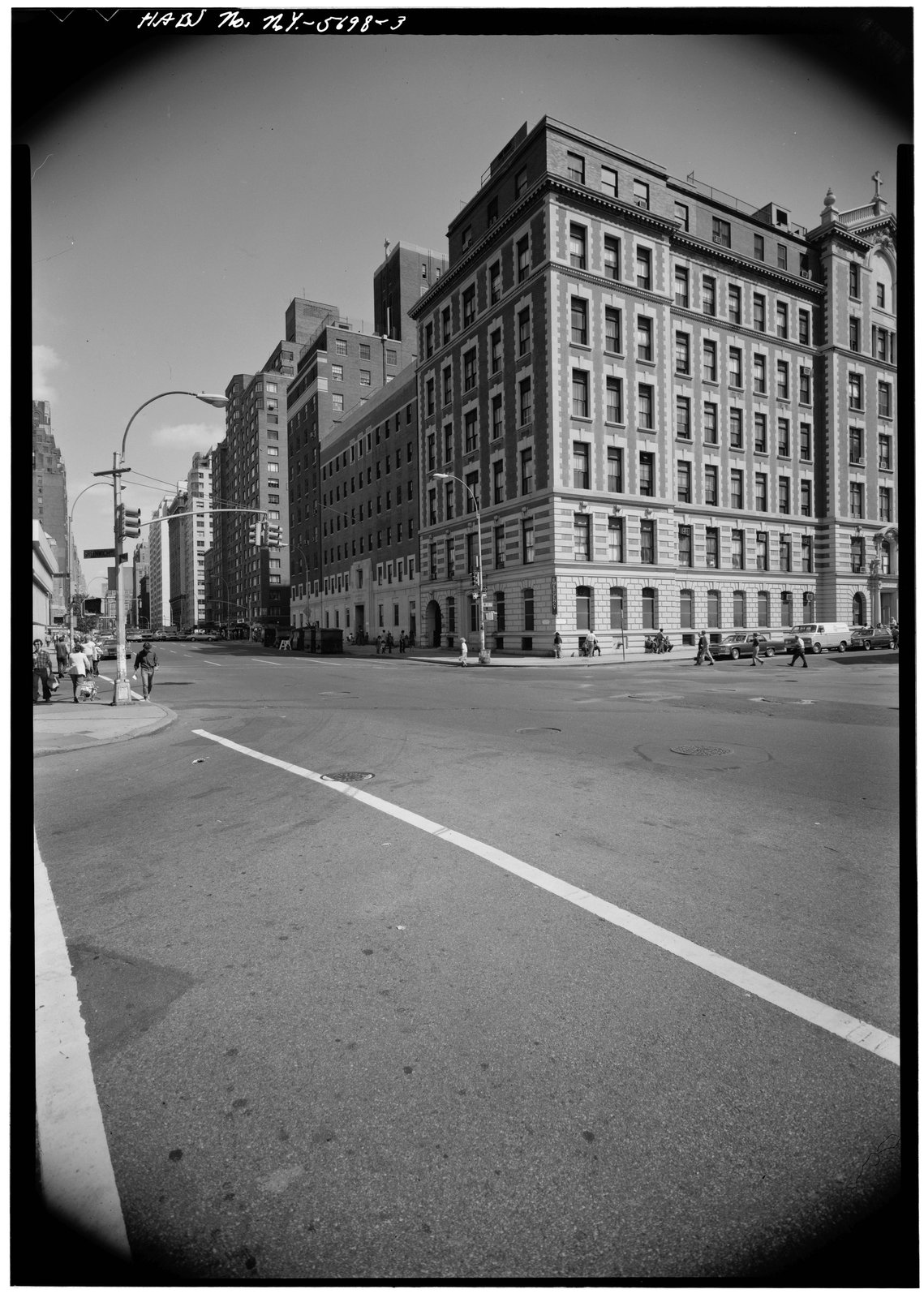
That August, some eighty men crowded into the writer Larry Kramer’s apartment on lower Fifth Avenue to hear a New York University dermatologist, Alvin Friedman-Kien, describe what he was seeing in his examining rooms. They passed a hat and raised $6,635 — the first money collected anywhere against the disease.2 By the fall the emergency room at the Catholic hospital at Seventh Avenue and Eleventh Street in Greenwich Village was admitting enough of these patients — young men with the lesions, with a rare pneumonia the doctors abbreviated PCP, with immune systems that had simply stopped defending them — that the pattern was recognized on the ward before it was named in the literature. A name arrived in September 1982, when the federal agency settled on acquired immunodeficiency syndrome, AIDS, retiring an earlier acronym, GRID, for gay-related immune deficiency, that the caseload had already outrun.
The Machinery of Care
The response the sick received in the first years came almost entirely from the people already dying. In January 1982, six men — Larry Kramer, Lawrence Mass, the novelist Edmund White, the journalist Nathan Fain, the former Green Beret Paul Popham, and the lawyer Paul Rapoport — met in Kramer’s apartment and founded Gay Men’s Health Crisis; its first office was two rented rooms in a Chelsea rooming house. The organization’s earliest hotline was the home answering machine of a volunteer, Rodger McFarlane, which took more than a hundred calls the first night it was switched on. That spring it held its first benefit at a SoHo discotheque then near the center of gay nightlife and raised some fifty thousand dollars. Its most durable invention was the Buddy: a volunteer paired with a single dying stranger to shop, to bathe him, to sit in the hospital room, to manage the paperwork and then the funeral. Many buddies, in time, were buddied to in their turn.
The institutions accumulated faster than the coverage did. In the spring of 1984, the hospital at Seventh and Eleventh opened the East Coast’s first dedicated AIDS ward — twenty beds at the start, later the whole of a floor, with patients eventually waiting for beds in the hallways. That same year, 1985, the city opened the country’s first municipal agency to write rental checks for people with the disease. In 1986 a congregate residence for the homeless with AIDS opened on a corner of Christopher Street visible from the West Side Highway, its address itself an argument against hiding. The private grief was building a public apparatus because no one else would.
For most of those first years the dying were, to the country beyond the affected neighborhoods, an abstraction and a downtown one. That changed in October 1985, when the actor Rock Hudson died in Los Angeles and the disease, in the language of Shilts’s account, had at last struck “people who counted.”2 The attention that followed was national and came late, and it came to a city that had already been counting its own dead for four years.
Kramer was not built for the apparatus. In March 1983 he published “1,112 and Counting” in the Native, a five-thousand-word polemic that attacked the disease agencies, the cancer establishment, the mayor, and the gay leadership by name, and opened with a sentence telling readers that if they were not scared they were fools.3 His own board, finding him too combative, forced him out of the organization he had founded later that year. He spent four years offstage. Then he came back.
The First Eight Years
| Year | In the record |
|---|---|
| 1981 | First reports in the Native (May) and the Times (July); the Village emergency room begins seeing cases. |
| 1982 | Gay Men’s Health Crisis founded; the federal agency names the syndrome AIDS. |
| 1983 | Kramer’s “1,112 and Counting” runs in the Native. |
| 1984 | The city’s Catholic hospital opens the East Coast’s first dedicated AIDS ward. |
| 1985 | New York State closes the bathhouses; the city opens its first AIDS-services agency; the antibody test becomes available. |
| 1986 | A congregate residence for people with AIDS opens on Christopher Street; the first AIDS Walk; the Silence=Death poster appears. |
| 1987 | ACT UP is founded; its first Wall Street action; the Memorial Quilt’s first display in Washington. |
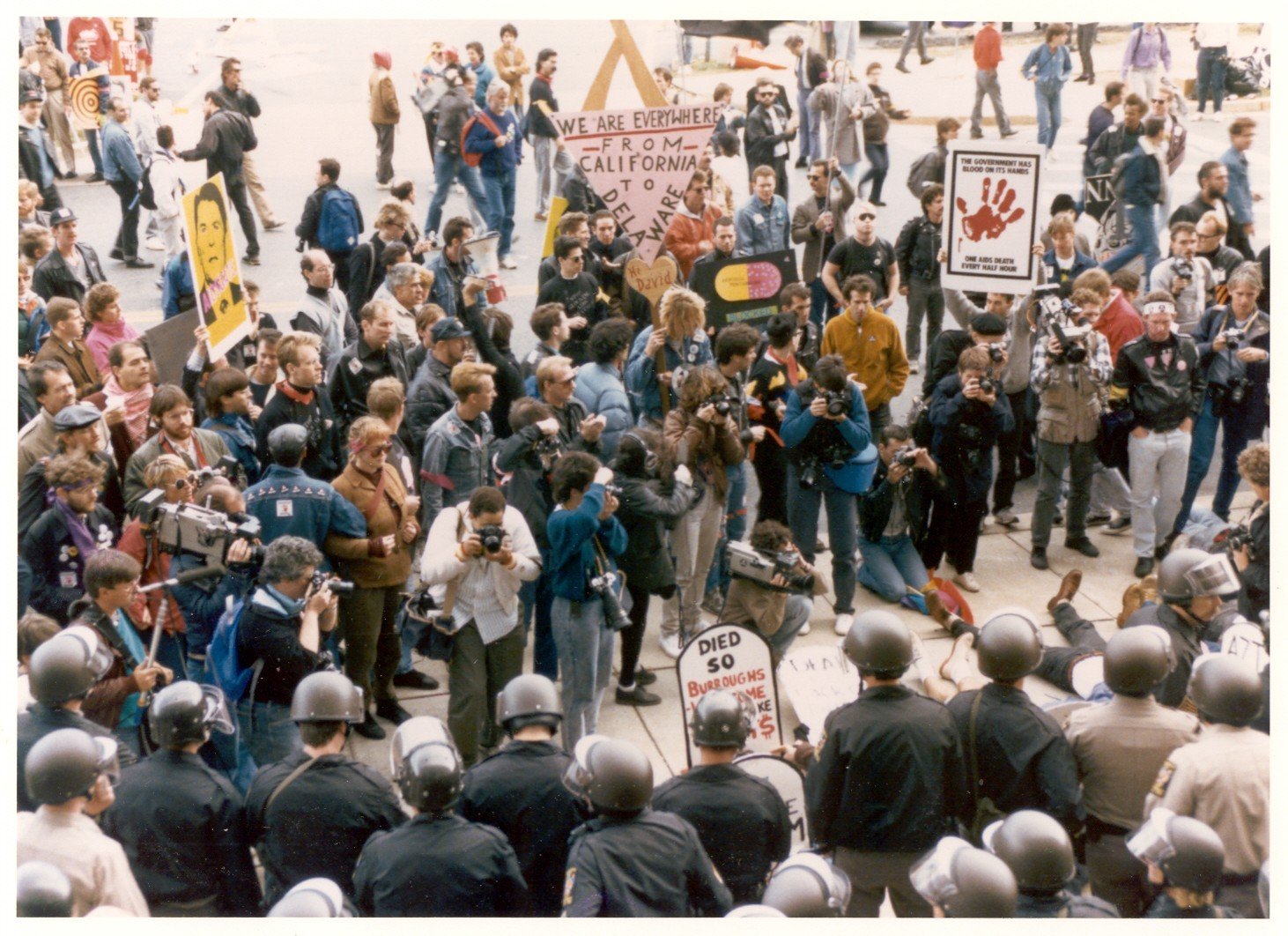
| 1988 | ACT UP’s first national action, at the federal drug agency in Maryland. |
The Politics of Rage
The image came before the movement. In 1986 a collective that called itself the Silence=Death Project produced a poster — a pink triangle, inverted from its orientation in the Nazi camps, on a black field, over the words SILENCE=DEATH — and posted it around lower Manhattan months before there was an organization to carry it.4 The organization arrived in March 1987, when Kramer, returned to the podium, gave a speech at the community center on West Thirteenth Street in which he asked one side of the room to stand and told them that most of them would be dead within five years. Two days later three hundred people came back and formed the AIDS Coalition to Unleash Power — ACT UP.5
Its method was the disruption, staged for the cameras. The first action, that same month, put two hundred and fifty demonstrators onto Wall Street to protest the price of AZT; seventeen were arrested. AZT was the only thing the pharmacy had — approved in 1987, hard on the body, quick to fail as the virus outran it — and its manufacturer had set the price at roughly ten thousand dollars a patient a year, out of reach of the uninsured. The premise of the demonstration was that the dying were being charged for the privilege of a few more months. The group met every Monday night at the center, a room that ran to a thousand people before a major action, and that observers described as furious, funny, sexually charged, and unlike any other room in the city — the place people went to be alive where so many were dying. Its vocabulary — PWA for person with AIDS, drugs into bodies, the exact distinction between an action and a demonstration — was a working language, not a slogan set. By October 1988 it could put fifteen hundred people at the gates of the federal drug agency in Maryland, an action credited with accelerating the approval of the drugs that came later.
Grief was finding public forms of its own. In October 1987 a memorial quilt had been spread for the first time in Washington — roughly nineteen hundred panels, each three feet by six, the dimensions of a grave, each sewn for one of the dead.
The disease was entering the language of the people who made the culture. Susan Sontag, who had turned the metaphors around cancer inside out a decade before, published AIDS and Its Metaphors in 1989 and had already written, in 1986, the single story — “The Way We Live Now” — that fixed the early epidemic’s shape for the reading class: a man in a hospital bed, described only through the talk of the friends circling him.6 Randy Shilts’s And the Band Played On, in 1987, gave the epidemic its first mass narrative and, with it, the false and durable figure of a single foreign carrier who had supposedly brought the disease to America — a piece of salesmanship its author later regretted, and which outran his corrections for years.2
The Vanishing
The losses the magazine world could see were concentrated in the trades it lived beside. Fashion went first and hardest: Perry Ellis in 1986, Willi Smith — the most successful Black American designer of his generation — in 1987, the illustrator Antonio Lopez the same year. The theater and dance worlds lost Michael Bennett, who had made A Chorus Line, and Charles Ludlam of the Ridiculous Theatrical Company, both in 1987. The downtown music scene lost the performer Klaus Nomi as early as 1983 and the disco singer Sylvester in 1988. The photographer Peter Hujar died in November 1987; his protégé David Wojnarowicz photographed him in the hospital bed and afterward wrote the decade’s angriest first-person account of the dying around him.7 Robert Mapplethorpe died in March 1989, and the cancellation of his retrospective in Washington that June opened the culture-war fight over federal arts money that ran through the summer’s headlines.
The obituaries of the period were an education in what was not being said. They gave the cause as pneumonia, as cancer, as a long illness, as complications; the trades read them correctly and counted anyway. A working writer or editor with downtown connections could keep a calendar in which memorial services competed with lunches, in which the question of which service one could get to on a given Thursday was a real scheduling problem — a memorial service, and rarely a funeral, since so few of the trade would take the case at all.
What accumulated was not only the dead but the acceleration. The people left standing stepped into vacated positions before they were ready — assistants running departments because the editors were gone, sections handed up a generation early, the working memory of a magazine or a studio or a dance company held in fewer heads each season — and a share of them were themselves already positive and waiting, holding a two-week test result they had heard read aloud in a closed room. The photograph Wojnarowicz had taken of Hujar became one of the images the period made of itself: the dead man, and the man who had loved him and photographed him and was, by 1989, himself already positive.8
The Other Epidemic
None of this was the largest part of the epidemic in the city, only the most visible. Across the East River and up the Grand Concourse, AIDS wore a face the downtown story did not include. In the Bronx, the majority of AIDS patients were intravenous drug users; most were Black or Latino; a fifth were women; and a growing number were children who had been infected before birth.9 The transmission routes were the needle and the delivery room, not the bathhouse. The first pediatric cases in the country had been identified in 1981 by Dr. Arye Rubinstein at the borough’s Montefiore and Albert Einstein hospitals, in wards where the patients were infants and the mothers were often sick themselves. The women had mostly been infected by partners who used needles; the infants, before they were born. The weeklies that chased the city carried some of this — the Village Voice, the Nation; the national monthlies, which processed the city from a distance rather than chasing it, largely did not.
The neighborhoods were Mott Haven, Hunts Point, Morrisania, Morris Heights — the same blocks the arson years had gutted, the same blocks the crack trade was then crossing. Across the river in Bedford-Stuyvesant and Bushwick the pattern held. The hardest-hit blocks of the South Bronx and central Harlem carried a density of cases that no Manhattan neighborhood below Ninety-sixth Street approached, and they carried it without the hospices, the buddies, the political funerals, or the coverage. The dying artist left a monograph and a memorial at a downtown church. The dying addict, the dying mother, the dying infant left a line in a hospital discharge record and a place in a statistic that few outside the borough’s own doctors were reading.
The apparatus downtown had built for itself did not cross the river with the caseload. There was no congregate residence on a Bronx corner, no Monday-night room off the Grand Concourse, no quilt panel for the man whose family had stopped speaking to him. What there was, mostly, was the public hospital — Bronx-Lebanon, the wards at Montefiore — running well past the beds it had, taking in a population that arrived sicker, later, and with less to fall back on than the men downtown.
Much of the borough’s dying was folded into an emergency the papers had already named. The crack trade ran the same corners; the women who sold sex to feed it were infected through it; the grandmothers raising the children of the dead were a documented feature of the neighborhoods by the late eighties. A child born with the virus in the South Bronx entered a category the city had learned to count and had not begun to treat as a story with a face.
By the close of the decade both epidemics were running at once, on separate tracks, in the same city, and among the city’s men between twenty-five and thirty-four the disease had become the leading cause of death. That was the inheritance: not a beginning, but a settled condition, eight years deep, with its own hospitals and its own hotline and its own protest calendar and its own two-week wait — and with a line already drawn through it, between the dying who were counted and the dying who were merely counted up.
By the time the decade turned, AIDS in New York was not news and not new. It was eight years old, older than some of the assistants newly arrived to edit around it, and the city had already built the whole apparatus a long emergency requires: the ward with too few beds, the answering machine that became a hotline, the residence on the visible corner, the Monday-night room, the calendar in which a memorial was a scheduling conflict. What a person inherited in 1989 depended entirely on where in the city they stood. Downtown, the epidemic had a canon, a set of names, a wall of images, a literature. In the Bronx it had a discharge record and a silence. The disease was the same disease; the two epidemics were not the same epidemic, and the distance between them was not medical. It was the oldest distance the city keeps — between the dying it chooses to see and the dying it does not — and in 1989 the epidemic had arranged itself along that line and settled in to stay.
A magazine at Meridian’s standing would have been covering the epidemic for most of the decade — it would have taken its 1988 National Magazine Award for Public Interest on the strength of that coverage — and the coverage would have looked like the downtown canon. It would have run the profiles of the dying photographers and designers, the essay on the Mapplethorpe cancellation and the money that funded it, the piece on the closed discos and the emptied front rows of the fashion shows. The dead in these pieces would have been the magazine’s own kind: legible, monographed, mourned in rooms the editors also stood in.
The other piece would have surfaced and been set down. Someone would have proposed the Bronx — the needle, the ward of infants, the mothers — and the room would have found reasons that were also true: no writer on the floor worked north of Ninety-sixth Street with any authority, the story read as public health rather than culture, it belonged to a paper that chased the city rather than a magazine that processed it. The proposal would have been interesting for the length of a lunch. It would not have become an assignment.
A clerk in accounts payable on the ninth floor would have seen more of it than the well ever did. She would have processed a kill fee made out to an estate instead of a writer, and a stylist’s invoices that stopped arriving in March, and a photographer’s day rate payable, by June, to a name with executor after it. She would have opened the files, and closed the files, and started the folders that replaced them. No one would have asked her to keep a count, and she would not have kept one on paper; but she would have known, by the fall of 1989, roughly how many folders had closed that year, and the count would have run ahead of anything the floors above her had said aloud. An editor authorizing the payments would have signed the forms she prepared without a second look. The epidemic would have entered the arithmetic before it entered the well, and the only person reading the arithmetic whole would have been a woman no editor upstairs could have named.
Footnotes
-
Lawrence K. Altman, “Rare Cancer Seen in 41 Homosexuals,” New York Times, July 3, 1981. ↩
-
Randy Shilts, And the Band Played On: Politics, People, and the AIDS Epidemic (St. Martin’s Press, 1987). ↩ ↩2 ↩3
-
Larry Kramer, “1,112 and Counting,” New York Native, March 14, 1983. ↩
-
Douglas Crimp with Adam Rolston, AIDS Demo Graphics (Bay Press, 1990). ↩
-
Sarah Schulman, Let the Record Show: A Political History of ACT UP New York, 1987–1993 (Farrar, Straus and Giroux, 2021). ↩
-
Susan Sontag, AIDS and Its Metaphors (Farrar, Straus and Giroux, 1989). ↩
-
David Wojnarowicz, Close to the Knives: A Memoir of Disintegration (Vintage Books, 1991). ↩
-
Cynthia Carr, Fire in the Belly: The Life and Times of David Wojnarowicz (Bloomsbury, 2012). ↩
-
Drucker et al., American Journal of Epidemiology 130, no. 1 (July 1989): 133–142. ↩