Crack: The Wave, 1985–1991
Subscribe
https://meridian-archive.com/feed.xmlOpen in your app, or paste the link above into any other:
Ten Dollars a Vial
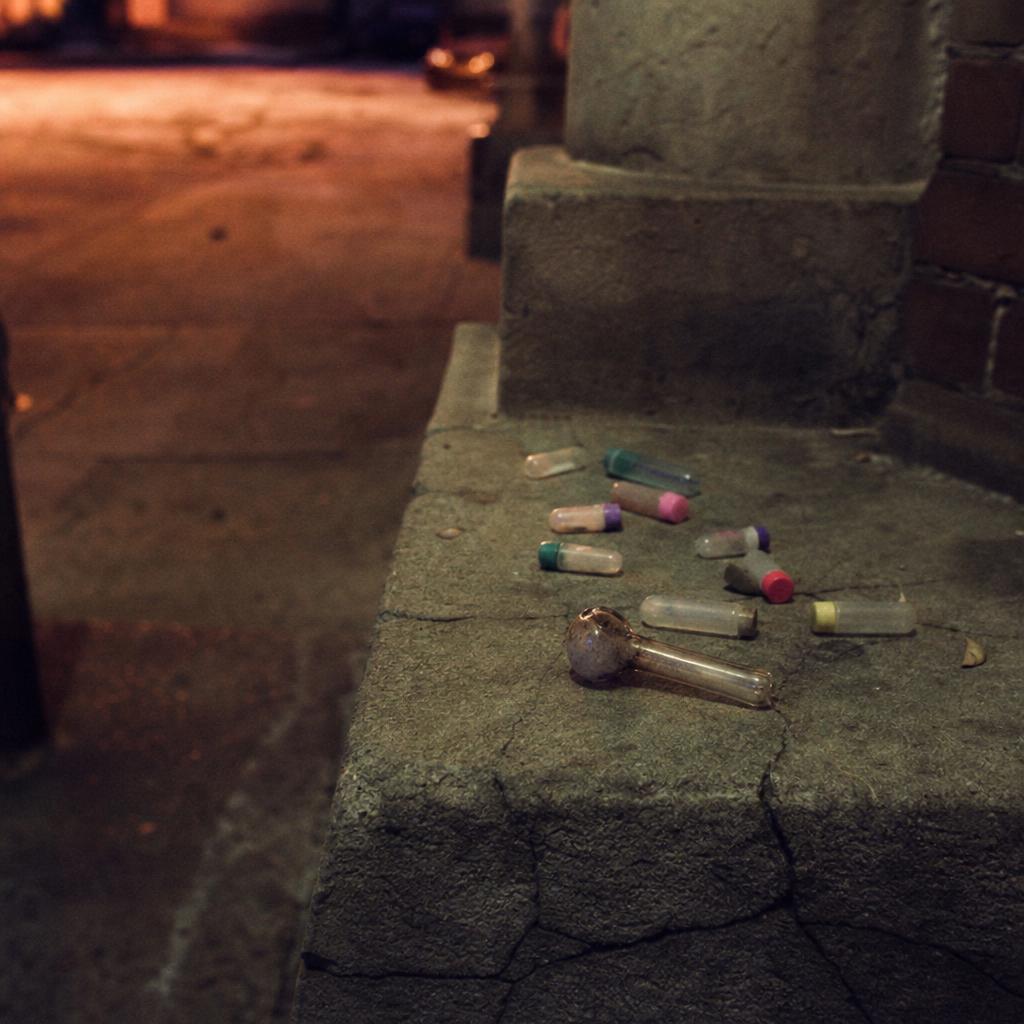
A vial’s plastic cap came in red, blue, or yellow, snapped on by hand at the point of packaging, and told a regular customer which crew’s product he was buying before a word passed between them — the trade’s own informal trademark, no two rival sellers on a given block using the same color at the same time. The Drug Enforcement Administration’s field offices tracked these cap colors as a matter of course: a block’s color changes went into the same case notes that logged prices, purity, and the routine turnover of who was selling where, filed alongside surveillance logs and arrest reports as one more data point about a market the agency was already watching.1 A trademark dispute conducted in vial caps and adjudicated, when it came to that, in gunfire was, by the back half of the 1980s, ordinary enough on the blocks it touched that the government’s own paperwork had stopped finding it remarkable.

The market those caps served had, four years earlier, no name at all. In February 1986, a music magazine put the drug on its cover under a headline that called it a Tiffany drug at Woolworth prices.2 The writer, Barry Michael Cooper, had grown up in Harlem and pitched his editor at Spin a story about a new, cheap form of cocaine moving through the city’s poorer blocks; the piece ran before almost anyone in the national press had used the word. Four months later, Time put its own cover on the story, quoting the director of research for the National Cocaine Hotline: as late as May, he said, he had never heard of crack.3 Between the two magazines lay a single year in which a drug went from unnamed to unavoidable.
The economics behind the speed were traceable. Cocaine had flooded into the United States through Caribbean routes in volumes large enough, by the middle of the decade, to collapse the wholesale price by as much as eighty percent — a kilogram of powder that ran $47,000 to $70,000 at the decade’s start fell to $10,000 to $38,000 by its end.4 A drug that had been priced for a professional’s nose became, converted into small smokable units, priced for pocket change. The conversion itself was simple: cocaine hydrochloride, baking soda, and water, cooked down to a solid the trade called a rock, cut into a vial that a dealer could sell whole rather than weigh out. Time’s reporting priced the earliest vials at ten dollars; competition pushed the unit lower still before the decade turned.3
Crack had reached New York by December 1983 as a marginal curiosity; by early 1986 it held, in the drug trade’s own description of itself, a stranglehold on the city’s poorer neighborhoods, with a mid-level distribution network that ran substantially through Dominican traffickers based in Washington Heights.1 The neighborhoods that network organized were, by that point, already hollowed by a shrinking legitimate job base and thinned social-program budgets, sitting inside a housing pattern that had long kept Black and Latino blocks the shortest physical distance from whatever illegal economy the moment offered.5 None of this required a conspiracy. It required only a glut, a recipe, and a ten-dollar unit small enough for a fourteen-year-old to sell out of a coat pocket.3 Powder cocaine had always demanded a customer with cash on hand and, usually, a middleman with a reputation; a vial demanded neither. It could be bought the way a pack of cigarettes was bought, from a stranger, on credit, and be gone in the time it took to smoke it — a retail unit that matched, almost too neatly, the retail rhythm of the neighborhoods where the wholesale glut had made it cheapest to sell.
The Pipe
The high itself ran on a clock that powder cocaine did not share. A user packed a pea-sized rock into the end of a glass or scavenged-metal stem, sometimes wedged against a scrap of Brillo pad to hold it steady, and ran a butane lighter’s flame under the bowl while pulling breath through it; the rock cracked — the sound gave the drug its name — and the smoke that filled the lungs was dense and faintly plastic. What followed began within seconds: an electric charge starting in the chest and skull, a rush of confidence and bodily lightness lasting five to ten minutes, and then a steep fall into craving severe enough that users interviewed decades later could still describe its shape. The interval between one hit and the wish for the next left almost no room for anything else. A conversation stopped mid-sentence; the eyes went half-closed or fixed on a middle distance; short, repetitive phrases followed — one more, one more — before the person was already reckoning, in the same breath, what could be pawned or sold to buy the next rock.5
Sustained use produced a recognizable gait — light, restless, canted slightly forward, as if the body expected at any moment to dart across a street — and a recognizable paranoia to go with it: phantom knocks at the door, shapes moving at the edge of vision, a conviction that neighbors or the police were listening through the wall. Speech broke into fragments and circled back on itself, sometimes ending, without transition, in never mind, you don’t get it. None of this description matched the tabloid shorthand for the drug as cleanly as the shorthand implied; a great many users held jobs, raised children, and kept the habit invisible for months or years before it showed on the face or in the missing teeth. The instant-collapse version of the story was a later simplification of an event that, on the ground, unfolded at more than one speed.5
What powder cocaine had made a weekend indulgence, the pipe made a full-time occupation. A five-to-ten-minute high, repeated through a night and into a morning, turned the arithmetic of a habit inside out: where a gram of powder might carry a user through an evening, a pipe habit could burn through the same money by mid-afternoon. For a heavy user, the search for the next rock filled most of the waking day, every day, without a break built into the arrangement anywhere.5
The Mission
For the users whose habits did progress, the pattern chroniclers came to call a mission was the visible marker: a disappearance of twenty-four to seventy-two hours, cash burned through, possessions pawned, sex or stolen goods traded for the next rock, sleep reduced to catnaps taken sitting upright.5 The crash that followed a mission ran the other direction — a day or more of heavy sleep, then a wave of hunger, tears, and irritability, the body settling its accounts. Correction officer and photographer Jamel Shabazz, who began working at Rikers Island in 1983, at what he later called the exact moment crack hit, watched the arriving population change in front of him: men who came into the system, in his description, broken, mentally and physically, in ways the jail’s older population had not been. He described the drug’s early spread through the city in a single image — a tornado that had devastated everything in its path — and traced the toll less in any single collapse than in a slow stripping-away of hygiene, weight, and the teeth that chronic dry mouth and neglect left cracked or missing.6
Photographer Eugene Richards, working through the era’s crack houses in Red Hook and East New York, documented a use pattern crack introduced that heroin’s largely male history had not carried at the same scale: women sliding from recreational use into survival sex, trading sex nightly for rocks or the cash to buy them, some operating out of the same apartments where the drug was sold. The era’s own vocabulary for these women — crack ho, pipe queen — flattened a more complicated set of arrangements, among them long-running relationships between a user and a particular dealer that could hold exploitation and a rough form of protection at once.7 Families interviewed years later described the same person disappearing in stages rather than all at once — a missed holiday, a job quietly lost, a visit that ended in a request for money — so that the moment a relative could point to and call the beginning of the end rarely existed; it was recognized, if at all, only by looking backward across a year of small absences.
The House and the Corner
A crack house, in Richards’s photographs and in the period’s ethnographic record, was rarely more than a stripped room in an otherwise abandoned building: a mattress or two, a couch salvaged from the street, windows boarded or hung with a blanket, a single bare bulb or the blue flicker of a television running to no audience. The smell was a compound of burned chemical residue, stale smoke, and unwashed bodies; the sound was the click of lighters, low arguments over a missing rock, and — at intervals — a sudden hush when someone called out that police were near. Inside, a rough hierarchy held: a dealer who controlled product and cash, one or two lieutenants who kept order, and a floating population of customers, some of whom worked off their habit cleaning the room, standing lookout, or turning tricks in a back corner. Violence inside these rooms was both random and transactional — a user behind on a debt could be beaten or put out — but observers also recorded an unexpected camaraderie: running nicknames, in-jokes, older women who nudged the younger ones to eat or sleep between hits.7
The Corner, Staffed
A crack spot ran on a small, informally understood division of labor, repeated with local variation on blocks across the city.
| Role | Typically filled by | Function |
|---|---|---|
| Lookout (“eyes”) | Teenagers, sometimes younger, posted at corners or rooftops | Watch for police; call coded warnings (“Five-O,” “ninety-nine”) |
| Runner | Mobile sellers moving between customer and stash | Take cash, fetch product from a hidden supply, insulate the dealer |
| Holder | Often women or older residents | Keep the bulk supply — in an apartment, a stroller, a hollow object — dispensing small amounts |
| Boss | The crew’s senior member | Control wholesale supply, pay the crew, negotiate territory |
The territory these roles served was frequently worth killing over. In the South Bronx, a crack operation built by Lenin and Nelson Sepulveda — Dominican-American brothers who had been classmates at George Washington High School in Washington Heights — grew from a single Mott Haven sales point into a network branded, like a legitimate product line, by the red-capped vials that gave the operation its street name, Red Top; the gang the brothers led, later chronicled by sociologist Robert Jackall from three years spent alongside the detectives who dismantled it, pistol-whipped its own workers, killed rivals and suspected informants, and eventually turned on itself in a war among its own members.8 A 1988 study of 414 homicides across a set of New York City precincts, using a framework that distinguished violence caused directly by a drug’s pharmacology from violence caused by the economics of buying it and violence caused by the drug trade’s own disputes, found the third category dominant: better than a third of the killings traced to systemic disputes over territory, debts, and robberies of dealers, and cocaine in some form was present in the large majority of the drug-linked deaths.9 The city’s homicide count, climbing through the years the wave crested, closed 1990 at 2,245 — the highest total in its modern record.10 Most of that violence never touched the blocks where Meridian’s readers lived or worked. It concentrated instead in a small number of precincts, struck repeatedly, which was part of why a citywide record went largely unnoticed by the city that had just set it.
The Corner and the Park
The corner economy was not confined to the interiors ethnographers photographed; it had a public face, and City Hall had been naming it since before crack existed. In April 1984, Mayor Edward Koch wrote in the New York Times that the blocks east of First Avenue — Alphabet City, so called for the lettered avenues running toward the river — had “for years been occupied by a stubbornly persistent plague of street dealers in narcotics whose flagrantly open drug dealing has destroyed the community life of the neighborhood.”11 Crack, when it arrived, moved into a market the neighborhood already had; Avenue D was known, in the period’s own description, as the largest retail drug market in the country, and Tompkins Square Park, a few blocks north, carried the trade openly enough that the Parks Department imposed an overnight curfew and the police cleared it twice by force, the second clearance, on August 6 and 7, 1988, escalating into a night of officers with badge numbers taped over and residents fighting back from the surrounding blocks.12 Washington Square Park, a mile and a half west, had carried its own open trade since well before the crack years — hundreds of arrests and thousands of summonses in a single year in the early 1980s, most of them drug-related, by one contemporary count — and did not see the trade meaningfully recede until 1987, when the local precinct, NYU, and Village residents coordinated a sustained push against it.13 Musician Moby, who spent his own early-1980s adolescence around the park’s fountain, later recalled the dealers’ patter as background noise to the ordinary business of being a teenager there: “smoke, smoke, mescaline, smoke, smoke, weed, smoke, dust, smoke.”14 Further out, in the housing projects of Red Hook, East New York, and the Harlem complexes, the market moved indoors into stairwells and courtyards built, ironically, for the kind of casual surveillance that made the crack trade instead easier to police from a rooftop than a street corner.7 A visitor from below 14th Street driving north to buy stood out on any of these blocks within a minute of arriving: the unfamiliar car, the wrong shoes, a face a lookout did not recognize from the block’s own daily traffic. The geography ran, in this one narrow respect, in both directions at once.
Grandmothers and Ghosts
Crack’s reach into family life followed a pattern the city’s earlier heroin era had not produced at the same scale. Heroin’s population of daily users had skewed heavily male; crack’s did not, and the consequence showed up a generation down, in households where an older woman — a grandmother, an aunt — became the one raising children whose parents cycled between using, jail, and residential treatment.5 In Mott Haven, the Reverend Martha Overall, a Radcliffe graduate and former trial attorney who had left law for the priesthood, watched the drug roll through her South Bronx parish, St. Ann’s Episcopal Church, in a single sustained wave; the after-school programs and food pantry she ran there became, for a stretch of years, one of the only fixed points in blocks where the crack vials on the sidewalk changed hands faster than any agency could track. Overall’s account, and others like it, described the toll less as a single dramatic collapse per family than as a slow removal — food stamps sold for rocks, sudden placements with relatives, children who learned to expect a parent’s disappearance for days at a time.15
The era’s press fixed, with comparable intensity, on the figure of the “crack baby” — the era’s own shorthand for a generation of children predicted to carry permanent, visible damage from prenatal exposure. A systematic review of the accumulated research, published well after the wave itself had passed, found no developmental toxicity distinct in severity or kind from the effects of poverty, poor prenatal care, and the other risk factors that traveled with it — a finding the alarm of 1989 had no way to anticipate.16 Neither the alarm nor its correction canceled the other fact on the ground: block associations that took turns watching a corner in shifts, negotiating informally with dealers to keep the open sales away from a school gate or a playground, and neighborhoods where a storefront church ran its Sunday service through a loudspeaker on the same block where a crew still worked a corner in plain view.5 The two economies — the pantry line and the sales line — often ran within a half-block of each other for years without either displacing the other. Neither was hidden from the other; a dealer working a corner and a grandmother walking four children to the same corner’s bus stop each recognized the other’s daily route, and each, by most accounts, left the other alone. The corner’s grandmothers did not so much overcome the wave as outlast it.
Two Blocks Away
For most of the professional floor south of 96th Street, the wave was legible mainly as weather glimpsed from a moving car: a thin man working vials on a subway platform, glass stems in a gutter outside a residential hotel on the West Side, an open pitch heard in passing near a downtown park. A bodega clerk might quietly point a regular customer toward a nearby seller, or slip a vial into a customer’s change without a word exchanged on either side — a transaction a Manhattan office worker buying cigarettes at the same counter would have had no way to notice.5 The distance was not accidental; it was the same distance the city’s housing pattern had already built, and it meant that the law arriving to answer the wave fell almost entirely on one side of it. The Anti-Drug Abuse Act, signed by President Reagan on October 27, 1986, in the months after the cocaine overdose of college basketball star Len Bias, set a five-year mandatory minimum for five grams of crack — the same sentence federal law required for five hundred grams of powder, a hundred-to-one disparity that tracked the color line of who was arrested with each.17 A second act, signed November 18, 1988, went further, making crack the only drug in the federal code carrying a mandatory minimum for simple possession, no sale required.18 A vial bought on a Bronx corner and a line taken in a Midtown office bathroom were, in the era’s own chemistry, close to the same drug. They were not close to the same law: a handful of grams on one side of the line could mean a mandatory federal sentence measured in years; the same weight in the other, more familiar form of the drug, more often meant a client’s discretion, a firm’s silence, or nothing at all.
The wave left two kinds of record. One was the era’s own — a music magazine’s scoop, a news-magazine cover, a law passed in the same year as a famous man’s death — legible from any distance, filed and indexed and easy to find again. The other recorded itself only at the scale of a block: a red-capped vial, a grandmother’s food pantry, a corner watched in shifts by women who had no press credential and no legislative sponsor. Both records were accurate. Neither was complete without the other, and for most of the decade neither much noticed the other existed — the same city, read in two languages that had not yet agreed to be translated into one.
A piece for The City would have carried the number without hedging: 2,245, the highest total the city’s modern record would show, folded into a paragraph a reader’s eye would have passed without pausing on its way to whatever else the issue carried that month. Verifying it would have gone to a checking assistant who had grown up on University Avenue, running the wire copy against the police department’s release the way she would have run any other figure that would have crossed her desk that winter; she would have logged the number and initialed the sheet without remark, one entry among several she would have cleared before the issue closed.
Her mother would not have seen that sheet. She would have worked the medical wards at Lincoln Hospital, a walk from the apartment she would still have kept, and for most of the year the count covered she would have treated cases that fed into that same total.
Footnotes
-
Drug Enforcement Administration, The Drug Enforcement Administration, 1985–1990, 58–67. ↩ ↩2
-
Barry Michael Cooper, “Crack, a Tiffany Drug at Woolworth Prices,” Spin, February 1986. ↩
-
“Crack: A Cheap and Deadly Cocaine Is a Fast-Spreading Menace,” Time, June 2, 1986. ↩ ↩2 ↩3
-
U.S. Department of Justice, Office of the Inspector General, The CIA-Contra-Crack Cocaine Controversy: A Review of the Justice Department’s Investigations and Prosecutions (December 1997), chap. 6. ↩
-
Donovan X. Ramsey, When Crack Was King: A People’s History of a Misunderstood Era (One World, 2023). ↩ ↩2 ↩3 ↩4 ↩5 ↩6 ↩7 ↩8
-
Jamel Shabazz, interviewed in Miss Rosen, “I Was a Black Corrections Officer During the American Crack Epidemic,” Dazed, June 1, 2018. ↩
-
Eugene Richards, Cocaine True, Cocaine Blue (Aperture, 1994). ↩ ↩2 ↩3
-
Robert Jackall, Wild Cowboys: Urban Marauders & the Forces of Order (Harvard University Press, 1997). ↩
-
Paul J. Goldstein, Henry H. Brownstein, Patrick J. Ryan, and Patricia A. Bellucci, “Crack and Homicide in New York City, 1988: A Conceptually Based Event Analysis,” Contemporary Drug Problems 16, no. 4 (1989): 651–687. ↩
-
Andrew Karmen, New York Murder Mystery: The True Story Behind the Crime Crash of the 1990s (New York University Press, 2000). ↩
-
Edward I. Koch, “Needed: Federal Anti-Drug Aid,” New York Times, April 27, 1984. ↩
-
Janet L. Abu-Lughod, ed., From Urban Village to East Village: The Battle for New York’s Lower East Side (Blackwell, 1994). ↩
-
Stephen Petrus, “The Taming of New York’s Washington Square: A Wild Civility,” Gotham Center for New York City History, September 10, 2020. ↩
-
Moby, “In the Early 80’s My Friends and I Spent a Lot of Time in Washington Sq Park,” moby.com journal. ↩
-
Jonathan Kozol, Amazing Grace: The Lives of Children and the Conscience of a Nation (Crown, 1995). ↩
-
Deborah A. Frank, Marilyn Augustyn, Wanda Grant Knight, Tripler Pell, and Barry Zuckerman, “Growth, Development, and Behavior in Early Childhood Following Prenatal Cocaine Exposure: A Systematic Review,” JAMA 285, no. 12 (2001): 1613–1625. ↩
-
Anti-Drug Abuse Act of 1986, Pub. L. No. 99-570, 100 Stat. 3207 (1986). ↩
-
Anti-Drug Abuse Act of 1988, Pub. L. No. 100-690, 102 Stat. 4181 (1988). ↩