Crack: Race, Class, and Who Was Blamed, 1985–1995
Subscribe
https://meridian-archive.com/feed.xmlOpen in your app, or paste the link above into any other:
A Ratio Written Into Law
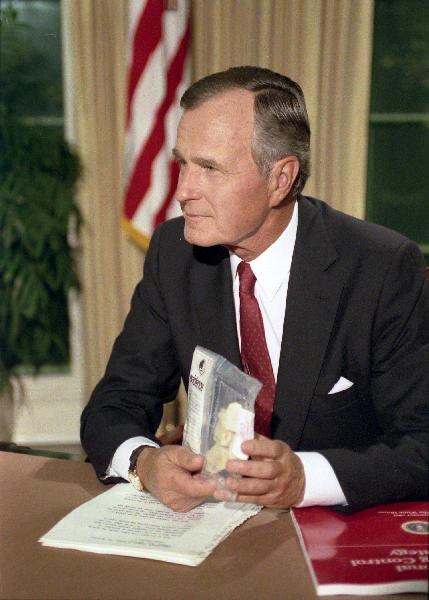
Federal law fixed the weight of crack cocaine that triggered a five-year mandatory minimum prison sentence at five grams, and the weight of powder cocaine that triggered the identical sentence at five hundred grams — a hundred-to-one ratio, in the statute’s own arithmetic, between the two forms of the same drug.1 Two years later Congress went further and made crack the only substance in the federal code carrying a mandatory minimum for a first-offense simple possession charge, with no equivalent floor attached to a first arrest for powder.2 Federal prosecutors and sentencing judges applied the hundred-to-one figure as a line item in the federal sentencing table for more than a decade afterward, the same fixed ratio consulted for a handful of street-corner vials as for a briefcase of powder, whenever the smaller case reached federal court at all.3
The law’s asymmetry mapped onto a demographic reality it did not originate. The Drug Enforcement Administration’s own tally of who was smoking crack first, in the New York City area, put the figure at odds with the popular image of the drug that took hold by the decade’s end. More than three in four of the earliest consumers, the agency’s internal history recorded, were white professionals or middle-class youths from Long Island, suburban New Jersey, and Westchester County.4 The drug had an obvious appeal to that population before it had any appeal to a poorer one: a small, cheap unit of cocaine, smoked rather than snorted, produced a faster and more intense rush than a line, and a purer high per dollar than the powder these same buyers already kept in a desk drawer or a coat pocket. It appealed first to people who already knew cocaine socially, could afford to experiment with a stronger version of a drug they were not new to, and had no reason yet to think the experiment marked them as anything but curious.
The curiosity had a decade of precedent behind it. Wealthy entertainers had been smoking freebase cocaine since the late 1970s, a home-chemistry process that used ether to strip the hydrochloride from powder cocaine and left a purer base that could be vaporized and inhaled. The comedian Richard Pryor’s near-fatal burns in June 1980, reported at the time as a freebasing accident, were the era’s most public warning of what the ether step could do; the warning did not stop the practice so much as give it a name recognizable outside the circles that practiced it.5 By the middle of the 1980s, crack offered the same rush without the ether or the flame, manufactured with baking soda instead, and some of the same entertainment-world and downtown-artistic circles that had freebased in private moved to it — quietly, at a party or in a loft bathroom, and without using the plain street name for what was in the pipe. A person in those rooms might have called it “base” or said nothing about it at all; she was reliably the last person a stranger would have guessed was smoking cocaine off a stem rather than snorting it off a mirror.
The Reversal
The DEA’s own account of the New York area found crack already dominant in the city’s poorest neighborhoods within roughly a year of its arrival, as cheap, low-purity rock displaced the costlier ether-processed alternative and dealers found a unit price low enough to sell on nearly any corner.4 Television crews and newspaper reporters, drawn to open-air markets that were, by design, visible from the street, built the decade’s crack coverage almost entirely around those markets and the neighborhoods that hosted them; a crew could stand across the street from a housing-project courtyard and film the whole transaction, where the same drug changing hands in a Rye kitchen or a Garden City basement offered nothing a camera could use. The public image of the drug reversed within a few years of the DEA’s own tally: a drug the agency’s confidential estimate had first located largely in Long Island split-levels and Westchester dorm rooms became, in the coverage that reached the largest audience, a drug of Harlem tenements and South Bronx corners, its earliest consumers rarely mentioned again.6
The reversal was not a correction of an error so much as a change of subject that kept the drug’s old name. Reporters covering the visible market wrote what they could see and verify — an arrest, a corner, a body count — and what they could see and verify was, by the second half of the decade, concentrated overwhelmingly in Black and Latino neighborhoods, whatever the earlier demographic had looked like. A statistic about who used a drug first was not a statistic a newsroom could generate on deadline; a statistic about who got arrested for it was. The arrest number was the one that survived in the public record.
Below Ninety-Sixth Street
For the media professionals who worked and mostly lived below Ninety-Sixth Street, crack in these years was something happening in Harlem, or the Bronx, or a subway ride away — not something a colleague might have tried. The distance was not always literal. A junior editor riding the number 6 past Lexington and 125th, or crossing Tompkins Square Park on a Saturday afternoon, might have watched a user’s unmistakable gait and paranoid scanning up close and still filed the sight under someone else’s crisis, even while a downtown loft two subway stops from that same platform hosted its own quiet after-hours pipe. Editors and writers who worked this beat later described the particular hypocrisy without much shame attached to it: joking at a midtown party that the real emergency was uptown, while cutting lines of powder on the same coffee table.
The same editor could pass a vial glinting on a subway platform, or a knot of men working a corner near a housing project, and read the scene as confirmation of a story already filed rather than as evidence bearing on anyone she knew personally. The habit of mind cost nothing to maintain, because nothing in her own social circle contradicted it out loud.
A junior person curious enough to try the pipe once or twice at a downtown gathering had an easy way back that a crack user further north did not: a private verdict that it had been too dirty, too much, and a quiet return to powder, the experiment never mentioned again to a colleague. A professional’s choice between the two drugs was less a matter of preference than of which one still let her show up to the office the next morning as herself.
A cab that would not cross into certain blocks after dark, a real-estate broker’s map that thinned out past a specific cross street, a magazine’s own assignment desk that sent a photographer north for crisis and rarely for anything else — none of it was written down as policy, and none of it needed to be.
The Price of Getting Caught
A magazine professional’s drinking, or an occasional line of powder before a party, cost her nothing socially that the era’s gossip columns can show; both were, if anything, part of a recognizable and even admired type, the charmingly overextended writer whose vices read as glamour rather than as a warning sign. Crack broke that pattern entirely. The same professional class that tolerated a colleague’s cocaine habit for years treated a rumor of crack use as terminal, a mark of a collapse in judgment that powder, however heavy, was not read to signify.
The fallout that followed a rumor depended on how much power stood behind the person it named. A junior staffer discovered at an Alphabet City address associated with crack could be dismissed within days, the departure explained internally as exhaustion or a family matter rather than named for what it was; a senior writer or editor whose habit stayed confined to hours the masthead never had to answer for could keep both the habit and the job for years, protected by exactly the discretion a junior colleague had no standing to draw on. No personnel policy distinguished the two drugs on paper; a senior editor’s private judgment, exercised case by case, decided which one ended a career.
Nobody on a masthead needed to write the distinction down, because everybody on the masthead already carried it. A drinking problem was a long-running character trait a newsroom could plan its coverage assignments around; a crack rumor was a verdict, delivered once, that ended the conversation about a person’s future at the magazine before it had properly started.
The Same Rock, Different Sentence
The Anti-Drug Abuse Act of 1986 was signed October 27; the Anti-Drug Abuse Act of 1988 that added the crack-only possession floor was signed November 18.12 Human Rights Watch’s later accounting of the two laws’ practical effect found federal crack prosecutions falling disproportionately on Black defendants and federal powder prosecutions falling disproportionately on white ones, a split that tracked the geography of enforcement rather than any measured difference in how often each race actually used the drug.3
A Bronx corner arrest for a handful of five-dollar vials and a bathroom line at a midtown expense-account dinner were, by weight and by law, versions of the identical transaction. Only one of them was built, by 1988, to end in a federal prison sentence measured in years.
The drug did not sort New York by race or class on its own; the coverage of it did, and the law that followed the coverage made the sorting permanent. A DEA agent counting users in 1985 would have found the city’s earliest and most affluent consumers in the same Westchester towns and Long Island suburbs that supplied Meridian’s own junior staff, and within a few years the same drug was prosecuted, covered, and feared as though it had never touched that ground at all. What the decade actually produced was not one crack epidemic but two publics reading the identical rock through entirely different lenses — one permitted to experiment and forget it, one denied the forgetting altogether, and neither public aware for years that the other one existed at all.
A masthead of Meridian’s tier would have assigned the crack story in the standard shape of the era’s coverage: a City-desk feature on an open-air market a subway ride from the building, sourced from a precinct captain, a clinic director, a grieving mother, written with genuine sympathy and genuine distance in the same sentence. Internal praise would have followed its publication, and the assignment desk’s habits for its next reporter would not have shifted because of it.
A harder pitch — the drug’s real first constituency, Westchester and Long Island rather than Harlem and the Bronx — would have gotten a hearing exactly once and then would have quietly disappeared from the schedule, on grounds nobody would have needed to state aloud: the counties in the pitch would have been the counties on the subscription rolls, and a magazine that lived on the confidence of its readers would not have opened an issue by telling them the epidemic had been theirs first.
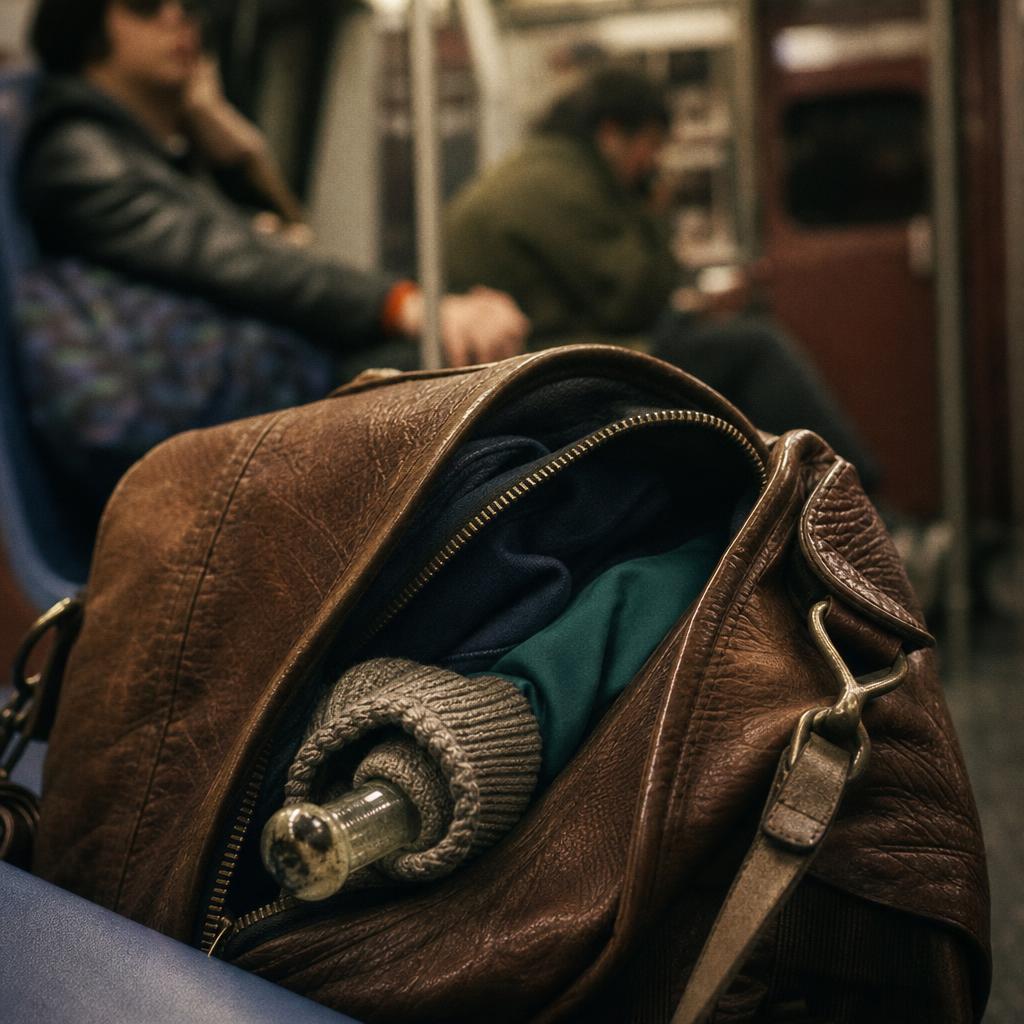
A junior editor boarding a commuter train out of Grand Central on a Friday evening would not have known that the broker two seats over, riding home to Rye for the weekend, would have been carrying a glass stem wrapped in a sock at the bottom of his overnight bag. She would not have guessed that the same commuter line would likely have carried the drug north into the county years before any camera crew would have found it a subway ride south. Neither of them, trading sections of the same folded newspaper across the aisle without a word passing between them, would have recognized the story riding the rails that evening as a story at all — let alone as the one that the masthead, without ever voting on it, would already have assigned to somebody else’s neighborhood.
Footnotes
-
Anti-Drug Abuse Act of 1986, Pub. L. No. 99-570, 100 Stat. 3207. ↩ ↩2
-
Anti-Drug Abuse Act of 1988, Pub. L. No. 100-690, 102 Stat. 4181. ↩ ↩2
-
Human Rights Watch, Punishment and Prejudice: Racial Disparities in the War on Drugs, vol. 12, no. 2 (2000). ↩ ↩2
-
U.S. Drug Enforcement Administration, Drug Enforcement Administration: A Tradition of Excellence, 1973–2003 (Washington, D.C.: U.S. Department of Justice, 2003), pp. 58–67. ↩ ↩2
-
United Press International, “Comedian Richard Pryor Burned While ‘Freebasing,’” June 11, 1980. ↩
-
Donovan X. Ramsey, When Crack Was King: A People’s History of a Misunderstood Era (New York: One World, 2023). ↩