Crack: The Decline and Its Aftermath, 1991–1995
Subscribe
https://meridian-archive.com/feed.xmlOpen in your app, or paste the link above into any other:
The City Licensed the Grandmothers
When New York’s child welfare agency removed a child from a parent lost to the crack trade — dead of AIDS, incarcerated, in residential treatment — it most often placed the child with a grandmother, and processed her not as a relative but as a “kinship” foster parent: a licensed status, supervised by an agency caseworker, carrying a monthly foster-care payment per child, indistinguishable on the city’s books from placement with a stranger.1 By the early 1990s the arrangement was standard practice across the Bronx, routine enough that caseworkers, family courts, and housing authorities administered it as an ordinary category of the system rather than an exception to it. Many grandmothers took the children in anyway, unstipended and unsupervised, when the paperwork lagged or never came.
That the state’s routine answer to a citywide addiction crisis was to formally re-license grandmothers as foster parents to their own grandchildren said something about the crisis’s scale that the homicide count, more visible and far more counted, did not. New York recorded 2,245 homicides in 1990, the highest count in the city’s modern record, and then the number fell — every year, without a reversal, for the rest of the decade.2 Much of what had driven it up was crack-market violence: the shooting was over corners, territory, debts, and supply, the ordinary commercial disputes of an illegal trade conducted in the open. As the trade contracted and stabilized, the disputes grew fewer. By 1993 the gunfire on the worst blocks of the South Bronx and central Brooklyn had thinned from what it had been three years before. The emergency that had frightened the whole city — the part that made the front pages, the part a commuter could read as a threat to himself — was receding.
The punishment ran on a different clock. New York’s drug-sentencing statutes, signed by Governor Nelson Rockefeller on May 8, 1973, set mandatory prison terms of fifteen years to life for the sale or possession of the heaviest quantities of narcotics — sentences keyed to the weight of the drug and removed, by design, from a judge’s discretion.3 For a decade they had been one law among many. Under the pressure of the crack years and the policing built to answer them, they became the central mechanism of a vast expansion. A conviction on the top charge carried its fifteen-year floor regardless of the defendant’s role in the trade, regardless of whether the person was a courier, a lookout, or a principal, regardless of what a judge who had heard the case might have preferred to do about it. The discretion the statutes removed from the bench they handed, in practice, to the prosecutor, whose choice of charge set the sentence before a plea was ever entered.3
The numbers moved accordingly. In the early 1980s, drug offenders had been about one in ten of the people in New York’s prisons; by the mid-1990s they were closer to a third. The state’s prison population, near 13,400 when the laws passed, went on climbing until the end of the decade, roughly five times over; to hold the growth, the state opened dozens of new prisons upstate across the 1980s and 1990s, and more than a hundred thousand New Yorkers entered prison on drug charges across the decade.4
The geography of the expansion was as concentrated at one end as the other. The people who filled the new prisons came disproportionately from a small number of city neighborhoods — the South Bronx, central Brooklyn, Harlem, Washington Heights — and the prisons that held them stood hundreds of miles to the north, in towns whose economies came to depend on them.4 The distance turned a visit into a day’s journey for the families left in the city. The wave that had justified the alarm crested around 1990 and went down; the number of people imprisoned under the law kept rising for another nine years.
Why It Ebbed
The wave receded for reasons that had little to do with the sentences. It had begun, in part, as an economic event: a glut of powder cocaine entering the country in the early 1980s drove wholesale prices down, and dealers converted the surplus into a smokable rock sold in units small and cheap enough to reach customers who could never have afforded a gram.5 By the early 1990s that trade had stopped paying as it once had. The early profits collapsed as the market saturated and the customers’ capacity to pay gave out, and the corner that had once looked like the only available work began to look like a losing one.
The people who had watched the drug closest were the first to refuse it. Younger siblings who had seen an older brother or sister lose teeth, work, and freedom to the pipe wanted no part of it, and the refusal spread as its own kind of knowledge — a generational learning transmitted on the blocks that had paid for it. Aggressive policing and long terms removed a large share of both sellers and users from the street. And the music that had once narrated the trade turned against it, the boast curdling into elegy.5
New users grew scarce; established ones did not. Through the 1990s the older cohort persisted in pockets of the Bronx, Harlem, Brooklyn, and Washington Heights — no longer an epidemic, now a standing feature of certain blocks and shelters: the familiar figures picking through trash cans, nodding on stoops, turning up intermittently in emergency rooms and detox wards. The neighborhoods that absorbed the damage also organized against it. Storefront churches opened after-school programs and food pantries; block associations watched the corners, pressed the sales away from the school doors, and leaned on landlords to seal the buildings the trade worked out of. The devastation and the resistance ran on the same blocks, often within sight of each other.5
A Block in the Bronx, 1993
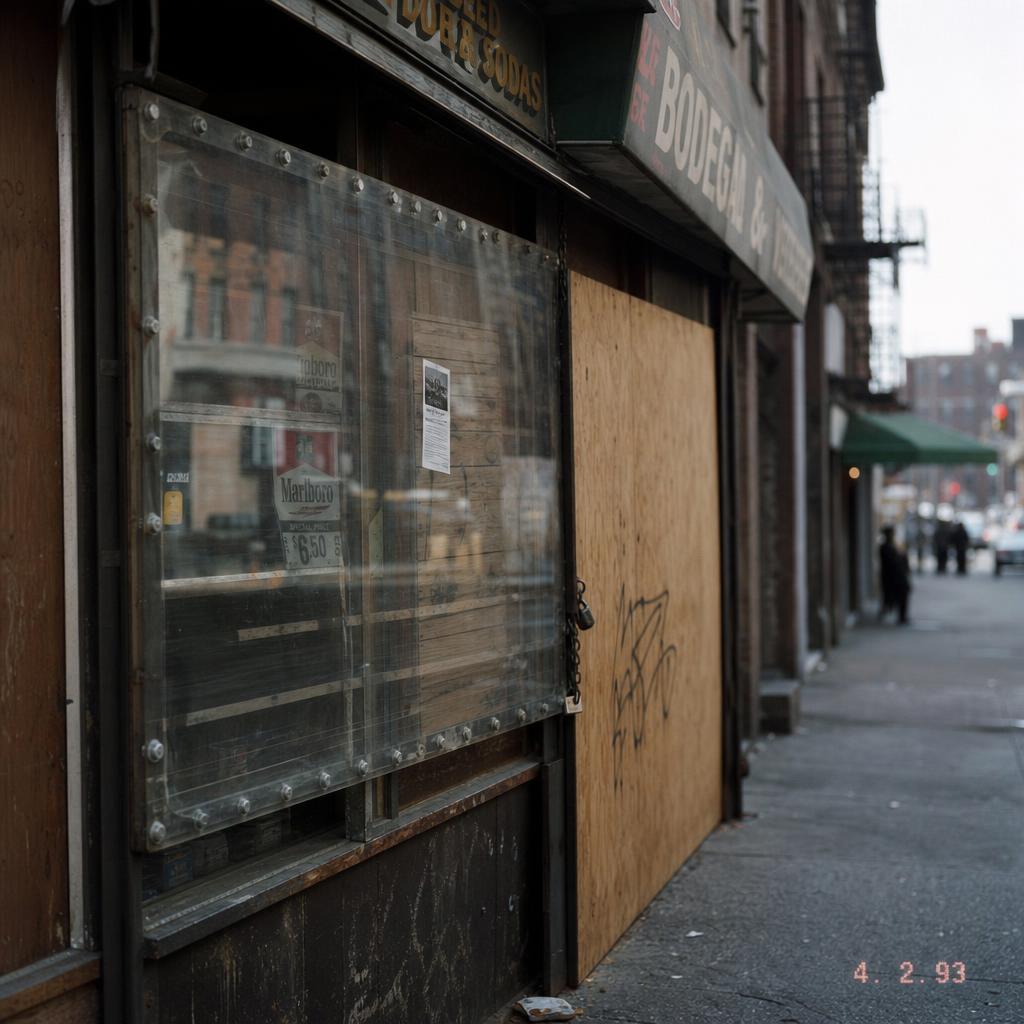
Mott Haven, in the South Bronx, held some of the poorest census tracts in the United States — the surrounding congressional district was, by the mid-1990s, the poorest in the nation.1 On a block there in 1993 — East 138th Street near Cypress Avenue, or up in Morris Heights along Walton — the visible signs of the wave had mostly cleared from the sidewalk. The corner where the vials used to lie underfoot was empty. What stayed was the residue. The building the trade had worked out of stood abandoned still, plywood over its windows. The bodega on the corner still had the Plexiglas shield the owner had installed at the height of the violence, bolted in and never taken down.
What the block had lost was less visible than what it kept. Many of the young men were gone — upstate at Attica, Sing Sing, Greene, or Coxsackie, or out on parole, or carrying a Class A-I felony conviction that made legitimate hiring nearly impossible.4 Their absence was structural: the removal of a cohort of men in their twenties and thirties from a set of blocks that could least afford to lose them, and their replacement, at the school doors in the morning, by the grandmothers. The ones who came back came back to blocks where a felony record foreclosed the legal work, and often the lease, that would have let them rejoin the households they had left.3
The pattern was specific to crack and new to the city’s drug history. Earlier heroin waves had skewed male; crack drew women in near-equal numbers, and when the mothers went — dead of AIDS, in jail, in residential treatment at Daytop or Phoenix House, or working the strolls around Hunts Point — the children went to whoever remained.5 Most often that was a grandmother in her fifties or sixties, raising two or three or four grandchildren in a small apartment in one of the Mott Haven housing projects, on a stipend that came nowhere near the cost.1 The women were the age at which their own mothers had begun to rest, and they were raising a second family instead, walking a set of small children to the elementary school in the morning and back in the afternoon, negotiating the caseworkers, the clinics, and the courts on behalf of parents who were mostly absent and sometimes dead.
The institutions that held the block together were the ones that had always held it. In Mott Haven the priest at St. Ann’s Episcopal Church, Martha Overall, ran her parish around exactly this: families uprooted, children moving in and out of foster care, grandparents keeping together what was left of the households the wave had emptied.1 The church ran an after-school program and a summer program, fed the children who came, and served as a place a grandmother could bring a child when there was nowhere else to bring one. It was not a recovery in any sense the word usually carried. It was maintenance — the daily work of keeping a diminished household from falling further.
The Ninety Percent
The people the laws reached were not a cross-section of the people who used drugs. Surveys through the period found drug use spread fairly evenly across the races; the prison terms did not.3 By the mid-1990s, more than nine in ten of the New Yorkers held in state prison on drug charges were Black or Latino.3 The enforcement that produced that figure fell on the street-level crack economy of specific uptown and outer-borough neighborhoods, and almost never on the powder cocaine moving through midtown offices, restaurants, and bathrooms a few miles south.
That distance was as much a matter of belief as of geography. For much of white professional Manhattan, crack in the early 1990s was something happening up in Harlem or the Bronx, an alien and distant problem, even for people who watched frantic users on subway platforms or stepped over vials in the gutter near a West Side hotel.5 The powder cocaine in the same people’s own social world did not register as the same subject, or as a subject at all. It was the drug of the after-work drink, the closing night, the bathroom stall, and it carried none of the street drug’s stigma because it carried none of the street drug’s policing.
The asymmetry was legible at both ends of it. Federal law of the mid-1980s set the penalties for crack roughly a hundred times more severe by weight than for powder cocaine — the same drug, differently packaged, differently punished. A user in the Bronx could draw a multi-year term for a handful of vials. A professional in a midtown office, taking bumps in a locked stall on a closing night, faced at worst a quiet conversation with a superior and a cover story about exhaustion.
The violence had been the emergency, and the emergency was what the city watched. When the shooting receded, the attention receded with it, and the aftermath — the part that came after the part that frightened people — was left to run in the neighborhoods that had never stopped living inside it. The sentences did not soften when the wave passed; they had been written to be indifferent to circumstance, and they were. The blocks that had absorbed the drug now absorbed the punishment: a generation of men subtracted into the prisons upstate, a generation of grandmothers standing in for the parents in between. None of it was hidden. It sat in the corrections tables, the foster-care files, the census tracts, available to anyone who went looking. What it wanted was someone to go looking, and to count the aftermath as part of the story rather than the quiet after it.
The City would have carried it in the spring of 1993: homicides down for the third straight year from the 1990 peak, the decline steep enough that an editor would have wanted a writer to check it twice before believing a number that good, and the piece would have cleared for the April issue on the strength of its own arithmetic.
What would not have cleared was the harder number six years further on — the state’s prison population climbing toward five times its 1973 level under the same drug law, deep into a decade the crime story had already closed its book on. The stable would have had a writer who could work a courtroom for a week and a writer who could sit a housing project for a month, but not, in that year, anyone who had spent enough time inside a corrections department’s own tables to make a population count read as a story and not a spreadsheet. The gap would not have been a decision against the piece; there would have been no piece to decide against, only a reporter who did not exist in the building.
Footnotes
-
Jonathan Kozol, Amazing Grace: The Lives of Children and the Conscience of a Nation (Crown, 1995). ↩ ↩2 ↩3 ↩4
-
Franklin E. Zimring, The City That Became Safe: New York’s Lessons for Urban Crime and Its Control (Oxford University Press, 2011). ↩
-
Human Rights Watch, Cruel and Usual: Disproportionate Sentences for New York Drug Offenders (Human Rights Watch, 1997). ↩ ↩2 ↩3 ↩4 ↩5
-
Ernest Drucker, “Population Impact of Mass Incarceration Under New York’s Rockefeller Drug Laws: An Analysis of Years of Life Lost,” Journal of Urban Health 79, no. 3 (2002). ↩ ↩2 ↩3
-
Donovan X. Ramsey, When Crack Was King: A People’s History of a Misunderstood Era (One World, 2023). ↩ ↩2 ↩3 ↩4 ↩5