Cocaine: The Magazine World, 1985–1995
Subscribe
https://meridian-archive.com/feed.xmlOpen in your app, or paste the link above into any other:
The Diagnosis of Exhaustion
A magazine staffer whose cocaine use began interfering with production did not appear in a personnel file as fired for cause. Editors’ memoirs of the era converge, independently, on the word that stood in for it: exhaustion.1 A junior copy editor who disappeared into Alphabet City on a spree could be quietly let go or sent to a rehabilitation stay under that diagnosis; a star writer or editor whose habit produced the identical absences was more often kept on staff and protected by the same word, so long as the copy still closed on time.1 The floor had, in effect, manufactured its own medical category — a euphemism administered as though it were an actual clinical finding, entered on the record, acted on by management, and applied by rank rather than by symptom.
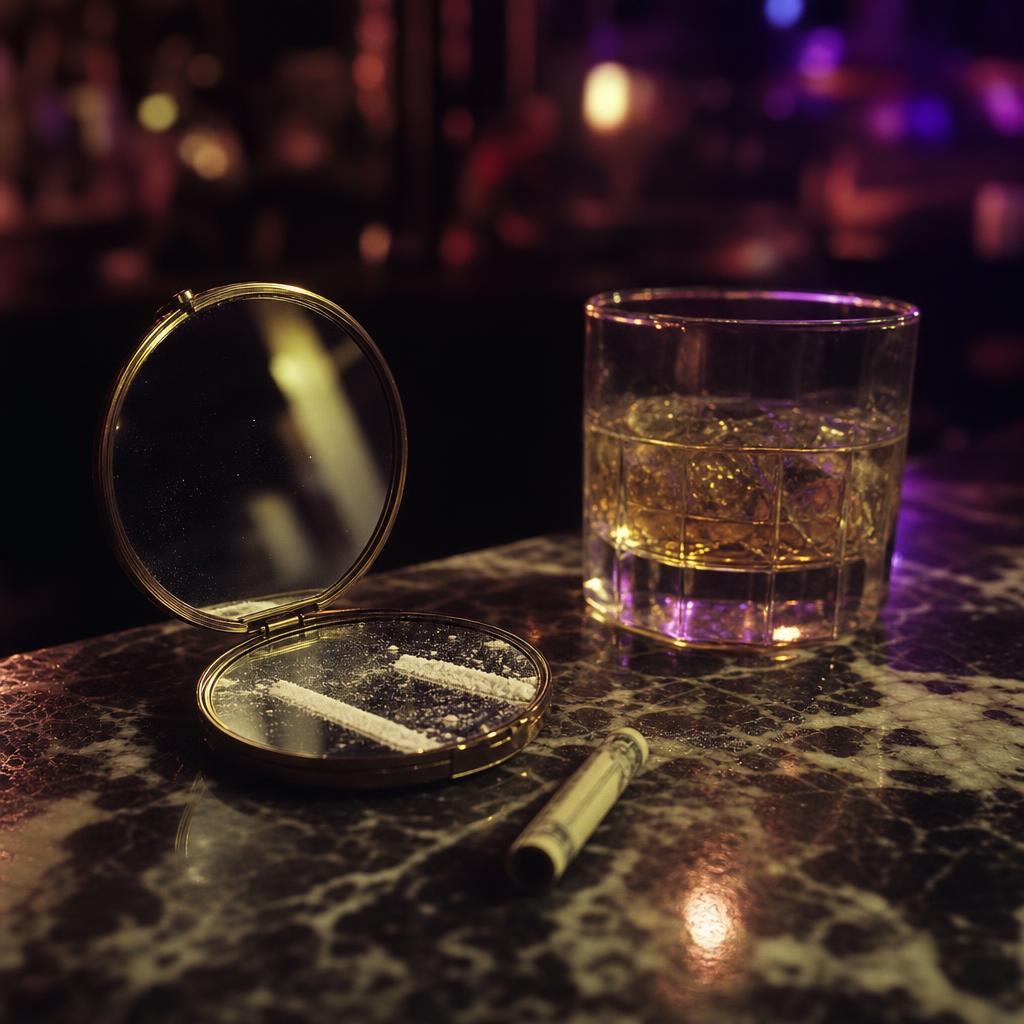
The substance behind that diagnosis was cocaine hydrochloride, and professional Manhattan consumed it almost exclusively in powder form: cut, pressed, and tipped onto a compact mirror or the back of a hand. Cooked down with baking soda and water into a smokable rock, the same drug became crack, sold from a vial in neighborhoods the magazine floor did not otherwise visit. Powder belonged to the professional class of Manhattan below Ninety-sixth Street: finance, advertising, fashion, publishing, and the magazine world seated among them. It moved through college-educated people in their twenties and thirties whose salaries could absorb it, and it circulated through their evenings as an ordinary fixture of the decade’s social machinery, no more remarked on at a certain kind of party than the wine on the same table.
The drug’s reputation as glamorous rested on nothing intrinsic to the chemical. It rested on price and on company. Powder cost enough that regular use signaled disposable income, and it was consumed in rooms — lofts in the Village, apartments on the Upper West Side and in brownstone Brooklyn, back tables at bars near the office — that admitted people already sorted by education and salary. The same molecule sold cheaply enough uptown to be within reach of someone with no income at all was, downtown, expensive enough to certify that its user had money to waste. Cost was not a drawback of the professional-class version; it was the point of it.
The Friend Who Dealt
Almost no one in this world bought from a stranger on a corner. The purchase ran through a friend, or a friend of a friend — a semi-social dealer who delivered to apartments and bars and who was as often as not a musician, an actor, or a club kid supplementing an unreliable income. The transaction carried none of the exposure that street buying carried, and much of its social texture: the dealer stayed for a drink, knew the customers by name, arrived at the party as a guest who happened also to be the supply. Buying became indistinguishable from socializing, which was part of why the people doing it rarely experienced themselves as doing anything a police matter could touch.
The circuit ran through addresses that were themselves credentials. Lofts in the Village, apartments on the Upper West Side, the parlor floors of brownstones in the parts of Brooklyn that college-educated renters were then discovering — these were the private rooms the drug moved through, and admission to them was already sorted by school, salary, and the right introductions before any vial came out. A person invited to the apartment had been vetted long before the powder arrived. The vetting was social; the powder simply followed the same guest list.
Supply was not a constraint. A glut of cocaine had entered the United States through Caribbean routes across the middle 1980s, driving wholesale prices down and purity up, and the professional market absorbed the surplus at the high-purity end where the money was.2 What the glut produced uptown — the cheap rock sold in five-dollar units — and what it produced downtown — a reliable, higher-grade powder delivered to the door — were the two ends of one distribution system that the users at either end did not think of as shared. A person who had a guy did not picture the guy’s supply arriving through the same wholesale channels that stocked a Bronx stairwell. The distance felt total. It was, chemically, nonexistent.
The Geography of the Bump
Where the office had its own arrangements, the wider social world of the magazine floor met cocaine mostly in bathrooms. The bar and club restroom was where it mostly happened: a stall held for a suspiciously long stretch, two or three people crowded into it, one balancing a folded bill or a card and a small vial, another listening at the door; a quick practiced inhale, a sniff, a tilt of the head, and a return to the table with brighter eyes and faster talk. Users tipped lines onto compact mirrors, onto the backs of keys, onto the flat housing of a bathroom hand dryer. In the clubs — China Club uptown, the downtown rooms that opened and closed on their own schedule — the attendant who handed out towels and mints turned a practiced blind eye to the traffic through the stalls.
The behavior the drug produced fit the room it was taken in. Cocaine made people talkative, certain, and fast; it inflated the confidence a networking evening ran on and lubricated the monologue about a pitch, an idea, a grievance with a colleague. After-work drinks led to bathroom lines and back again, a bump taken in the stall and carried out to the bar for another round of louder, quicker talk. Later in the night the same chemistry curdled into suspicion — small slights replayed, a colleague’s remark turned over for hidden intent, a call placed to an ex-partner at three in the morning. The comedown arrived the next day as a headache, a flat dread, a dehydration that the sufferer treated with coffee and more work. None of this was named directly in the company that practiced it. The vocabulary was euphemism: a trip to powder one’s nose, the offer of a little bump, the observation that someone was wired or on fire or in the zone.
The nightlife around the magazines widened the drug’s reach without changing its class. Editors, photographers, stylists, and their assistants moved through the same club rooms as the fashion and music people, and cocaine crossed cleanly among them because it suited the work all of them did — the sharp, competitive, verbal register of a magazine conference room translated directly to a nightclub banquette. It was the one drug that did. The ecstasy that ran the dance floors made its users earnest and confessional, a poor fit for a culture that prized wit and edge; cocaine kept people quick. A features assistant who came in Monday with gossip from the weekend’s clubs had usually gathered it over the same powder the senior editors used at dinner, one social world with two rooms and a single supply moving between them.
Career life happened at tables as much as at desks, and the tables had their fixed addresses — Elaine’s up on Second Avenue, 44 in the Royalton on West Forty-fourth Street, a standing fixture of magazine-world lunches. The magazine culture of the period treated cocaine as nearly institutional, and treated its own participation with a characteristic doubleness — the same writers who mocked the drug-fueled excess of Wall Street in print took their own bumps at the party afterward. The editors who later published memoirs of these years described the surrounding world of dinners, second bars, and discretion in which the habit lived without needing to make it the subject.13 What almost none of them encountered was the drug in its other form. That required leaving the neighborhood.
A professional’s daily exposure to the rock was glancing and one-directional: a thin man muttering over a vial on a subway platform, glass stems in the gutter near the West Side residential hotels, the low patter of dealers working Washington Square as an editor cut across it toward the office — one recollection of the park’s soundtrack ran “smoke, smoke, mescaline, smoke, smoke, weed, smoke, dust, smoke.”4 The bodega that quietly arranged sales from behind its counter registered, if at all, as an unusually busy door. These were sights witnessed from outside, on the way to somewhere else, and filed as evidence of a distant problem rather than a shared one.
A Subway Ride North
The federal law drew the line the culture already felt. Five grams of crack cocaine carried the same five-year federal mandatory minimum as five hundred grams of powder, a hundred-to-one ratio fixed by the Anti-Drug Abuse Act of 1986 and entered, without exception or comment, onto the sentencing worksheets of every federal court in the country for the rest of the decade.5 The distinction had no pharmacological basis, and the Sentencing Commission said so plainly in its 1995 report to Congress, which recommended equalizing the two and documented what everyone in the system already knew — that crack defendants were overwhelmingly Black and that powder moved through a whiter, more affluent population that the enforcement machinery rarely reached.2
The machinery’s geography was the point. New York’s drug policing concentrated on street-level markets, which meant on the neighborhoods where the rock was sold in the open — Harlem, Washington Heights, the South Bronx, central Brooklyn — and produced across the 1990s hundreds of thousands of drug arrests, the great majority for possession and street sale rather than for the private, delivered, indoor transactions of Manhattan below Ninety-sixth. A user in Mott Haven could take a multi-year sentence for a handful of vials. The identical molecule, in its powder form, sat undisturbed on a compact mirror a short ride south.
Consequence tracked address rather than chemistry. For a magazine professional, the worst realistic outcome of a cocaine habit that stayed offstage was not the criminal courts but the personnel arithmetic of the floor: a quiet conversation, an exit dressed as exhaustion, a stint in a private facility that a raised eyebrow among colleagues recast as a rest. The severity ran inversely to the money. The people whose version of the drug was cheapest paid for it in years upstate; the people whose version cost the most paid, at worst, in a reputation managed among people who had every reason to manage it gently, having their own reasons not to look too closely at the stall door.
There was never more than one drug here. Cocaine did not change its nature between the Bronx and the Village; it changed its price, its packaging, and the color and income of the hand that held it, and the city built an entire apparatus of law and attention around pretending these were differences in the thing itself. The professional class that used the powder did not have to lie about this, because it did not have to think about it at all: the distance between the compact mirror and the stairwell felt so complete that no one crossing it in a cab ever registered a crossing. What made the powder glamorous and the rock squalid was never in either substance; it was in the city that had decided, long before anyone unfolded a bill, which of its people it was prepared to forgive. The same decision was being made, all across the decade, about a great deal more than a drug.
Meridian would have carried the U.S. Sentencing Commission’s report into The Essay for the April 1995 issue, the one date the decade’s history of the drug offered a monthly to hang itself on. The Commission’s recommendation to narrow the hundred-to-one ratio between crack and powder, filed to Congress that February, would have arrived already carrying its own peg: a federal body’s own numbers, finding that the enforcement had fallen overwhelmingly on one population and the sentencing on another. The piece would not have had to invent an argument; the report would have supplied one fully formed, disparity by disparity, count by count.
What The Essay would have asked of the writer would have been distance from the numbers rather than proximity to them. No source inside a bar bathroom, no subject who might have recognized himself in the copy, no promise of protection to negotiate with counsel — only the Commission’s own tables and the record of the 1986 statute that had set the ratio in the first place. A piece assembled from a federal report would have cleared legal review in a way a piece assembled from a colleague’s habit would not have, and would have needed no unnamed source to stand behind it. It would have closed on the figure the Commission’s report had asked Congress to narrow: five grams of crack weighed against five hundred of powder, the same five-year sentence attached to each.
Footnotes
-
Graydon Carter, with James Fox, When the Going Was Good: An Editor’s Adventures During the Last Golden Age of Magazines (Penguin Press, 2025). ↩ ↩2 ↩3
-
United States Sentencing Commission, Special Report to the Congress: Cocaine and Federal Sentencing Policy (February 1995). ↩ ↩2 ↩3
-
Tina Brown, The Vanity Fair Diaries: 1983–1992 (Henry Holt, 2017). ↩
-
Moby, “In the early 80’s my friends and I spent a lot of time in Washington Sq Park,” moby.com (journal). ↩
-
Anti-Drug Abuse Act of 1986, Pub. L. No. 99-570, 100 Stat. 3207. ↩