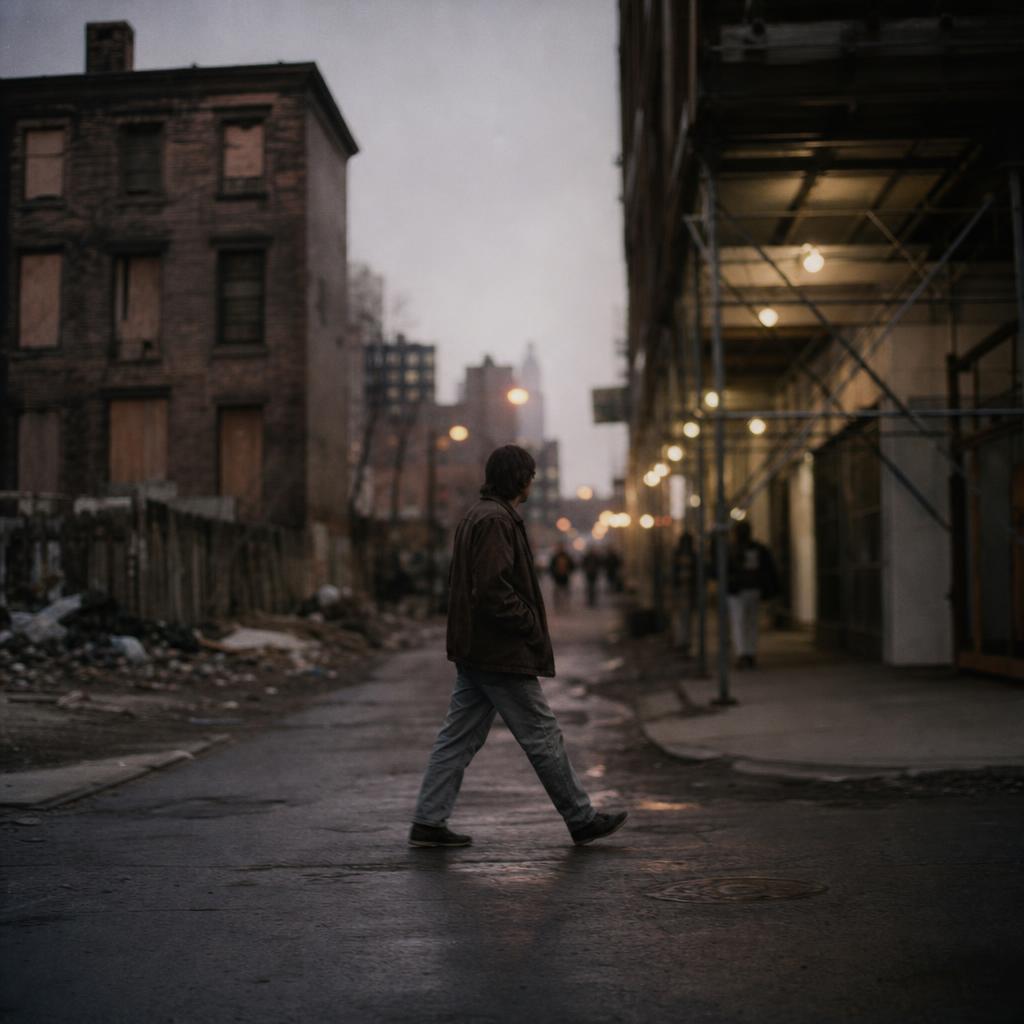
Geography of Gentrification, 1989–1994
Subscribe
https://meridian-archive.com/feed.xmlOpen in your app, or paste the link above into any other:
The Frontier at Street Scale
In June 1991 the Dinkins administration sent roughly three hundred police officers into Tompkins Square Park, cleared several hundred homeless people who had held the park as a tent city since the police riot of August 1988, and locked it behind chain-link for more than a year — work the city’s own paperwork classified as a parks reconstruction project, budgeted and contracted like any other capital job, for an action every side of the dispute understood as an eviction.1 The park reopened in 1992. The tent city did not come back. Nothing about the filing was unusual: clearing an occupied public space and re-opening it, cleaned of the population that had occupied it, was a procedure the city’s agencies had the forms for, and Tompkins Square was only the instance that made the newspapers. The same administration of safety was running, unrecorded, on blocks with no park and no name for it.
In the spring of 1990 a railroad flat in a walk-up east of that park could be had for a few hundred dollars a month, and the courtyard behind it was a place where heroin still changed hands after dark. The rent was low because the block was dangerous; the block was dangerous because two decades of disinvestment had stripped it of everything the market rewarded; and the low rent, to a particular kind of new tenant — a painter, a line cook, an editorial assistant on a salary that made no other borough affordable — was the whole of the attraction. The cheapness was not a defect in the block. It was the block’s only export.
The geographer Neil Smith had named the mechanism a decade before the tenant arrived. Gentrification, Smith argued in a 1979 paper, was not what its defenders called it — a matter of consumer taste, suburbanites choosing at last to come back to the city — but a movement of capital rather than people: money flowed back into a disinvested neighborhood when the gap between what its land earned in its run-down state and what it could earn rebuilt grew wide enough to make the difference worth a developer’s while.2 The gap opened widest exactly where abandonment had gone deepest. A block written off in the fiscal-crisis years — its landlord milking it for the last of its rent, its services cut, in the worst cases its buildings burned for the insurance — was, by the logic of the ledger rather than any pioneer’s courage, the most profitable block to reclaim.
Robert Fitch, writing in 1993, put the same process in the harder language of a deliberate preference: the city’s planning and real-estate apparatus had spent thirty years engineering the substitution of high-rent land uses for low, and the neighborhoods emptied in the 1970s were the raw inventory of that substitution.3 Smith’s own later account gave the pattern its most durable image. He called it an urban frontier, and meant the word in full: the reclamation of the disinvested inner city was narrated, in the real-estate copy and the lifestyle press, in the vocabulary of homesteading and pioneering — a language that made the displacement of the people already there sound like the settling of open land.4
The frontier had a literal edge, and the edge could be read off a street sign. Between 1989 and 1994 it advanced across New York at a granularity finer than the neighborhood, moving by the single avenue and the single block. The people who lived along it kept a running map of risk — which corner not to turn after dark, which side of the street to take, which cash machine not to use past nine at night — updated in real time and accurate to the doorway. Two places measured the same line in the same years, one in Manhattan and one in Brooklyn, and in both it ran down the middle of a named street.
The Line Down Avenue A
By 1990 the Lower East Side below Fourteenth Street was the most closely watched gentrification frontier in the country, and its watchers agreed on where the front line ran. Avenue A was the seam. West of it, toward First Avenue, rents had begun to climb and the storefronts to turn over; east of it, across Avenues B, C, and D toward the river, the neighborhood the real-estate market still called Alphabet City remained what it had been through the 1980s — a landscape of tenements, vacant lots, and squats, with an open-air drug trade running heaviest on Avenues C and D.
The park in the middle of it was the battlefield: the emblem of the whole contest, a public square the neighborhood’s squatters and anarchists defended as liberated ground and the city wanted back — cleared, as recounted above, in June 1991.
The squats supplied the frontier its holdouts. Buildings the city had seized for unpaid taxes and left to rot were occupied floor by floor by tenants who paid no rent and rebuilt the plumbing themselves — C-Squat, Bullet Space, the collective at ABC No Rio — clustered on East Seventh, Ninth, and Thirteenth Streets, dozens of them across the district, beyond the reach of a Ninth Precinct that had neither the manpower nor the mandate to clear them.5 The rubble lots between them had been planted, by the squatters and their neighbors, into community gardens. The anchors of the neighborhood’s public life sat along the same blocks: CBGB on the Bowery, the Pyramid Club on Avenue A, Mars Bar at Second Avenue and First Street, the all-night Ukrainian tables at Veselka, the dairy counter at B&H, the pizza place that had opened on Avenue A at the end of the eighties. They were the institutions of a cheap, dangerous, self-organized district. By 1993 the first restaurants had crossed First Avenue heading east, and Avenue A hardened into the recognized boundary between the part of the neighborhood that had turned and the part that had not. The artists who could no longer make the rent had begun riding the L train one stop under the river, to a Brooklyn neighborhood most of Manhattan could not yet have found on a map.
Two Avenues in Park Slope
The Brooklyn neighborhood the priced-out found first was not Williamsburg but Park Slope, and it had been filling for longer. Across the 1980s a professional and creative class that could not buy in Manhattan, and would not accept the suburban self-definition of the outer boroughs, had assembled a category for itself: Brownstone Brooklyn, a stretch of nineteenth-century row houses within a short subway ride of Manhattan that offered ownership, a stoop, a block association, and a way of living in Brooklyn without conceding that one lived in the outer boroughs at all.6 Park Slope was its capital. Already substantially gentrified by 1989, the neighborhood crossed the next several years from a striving register to a settled one; by 1995 it had the institutions of arrival — a food co-op, a sought-after public elementary school, strollers three abreast on the Seventh Avenue sidewalk — and its type, the Park Slope mother, was solid enough to stand as a stock figure. The turn ran against the worst local economy in a generation: the 1990–91 recession had hollowed out Midtown offices and cut into the same media and professional incomes the brownstone market depended on. It slowed the frontier without reversing it. The buyers who could still buy simply bought lower down the slope.
Lower down the slope was where the line inside the neighborhood ran, between two commercial avenues two blocks apart. Seventh Avenue was the brownstoner spine and had been for years: the health-food store, the bookshop, the coffeehouse, the trade of people who owned their homes. Fifth Avenue, two blocks toward the harbor, was still a working-class Latino commercial strip — bodegas, dollar stores, Spanish-language storefronts and restaurants, the retail of the people the brownstone buyers were displacing. Between roughly 1990 and 1995, Fifth Avenue tipped. The mechanism was rent: Seventh Avenue’s commercial rents had risen past what a second wave of small proprietors could pay, Fifth Avenue still had storefronts standing cheap and empty, the customers were already in place two blocks uphill, and the R train under Fourth Avenue tied the strip to Manhattan. A coffeehouse opened, then a restaurant, then a shop selling things no one on the block had previously been able to buy there. By mid-decade the Fifth Avenue stretch was a recognizable second commercial spine, and the retail that had served the displaced was itself being displaced. In 1992, at the midpoint of the turn, the distance between living on Seventh Avenue and living on Fifth was not two blocks. It was a difference in safety and in class legitimacy, read at a glance by everyone in the neighborhood, and it was priced into the rent.
The Administration of Safety
The safety the frontier priced was, in part, being manufactured by City Hall. David Dinkins had taken office in January 1990 as the city’s first Black mayor, elected by a coalition — Black, Latino, liberal white — that lived disproportionately on the wrong side of every frontier line the real-estate market was drawing. His first full year was the deadliest in the city’s recorded history: 2,245 homicides in 1990, up from 1,905 the year before, roughly six killings a day.7 The murders concentrated by neighborhood. A single precinct in East New York could record more in a year than the whole of the Upper East Side, and the residents of each read the map accordingly — a mugging planned for on one set of blocks, statistically unimaginable on another.
Dinkins’s answer was Safe Streets, Safe City, a 1991 program that paid for a large expansion of the police force. It hired thousands of officers and set the department on the growth his successor inherited and, in office, claimed. The homicide count crested in 1990 and began, unevenly, to fall; the decline the next mayor later credited to himself alone had started on Dinkins’s watch, in the same years the surcharge was putting more officers on the street. The rebuilding of Times Square told the same story: later attributed almost wholly to Rudolph Giuliani, its condemnations and redevelopment agreements had been set in motion under Dinkins, before the administration that finished them took office. The turn from a bargaining-with-decay city to a city of polish was under way before the mayor most associated with it was elected.
The limits of the coalition showed in August 1991, when three days of violence in Crown Heights — after a Black child was struck and killed by a car in a Hasidic motorcade, and a Hasidic student was fatally stabbed in the hours that followed — became the defining rupture of the Dinkins mayoralty and the event his opponents used to unseat him two years on. The frontier climbing Avenue A, the frontier working down toward Fifth Avenue in Brooklyn, the police expansion the surcharge paid for, and the homicide count that made the expansion popular were not four stories. They were one process, dividing the city block by block into the ground that had been made safe enough to sell and the ground that had not.
The frontier of the early 1990s did not move at the scale the word gentrification suggests. It did not take neighborhoods; it took avenues, then blocks, then single storefronts, and the people living a hundred feet on either side of its line occupied different cities with different rents, different risks, and different odds of being asked to leave. What separated the two sides was, more than anything, safety — the thing the cheap side lacked and the thing that, once supplied, was the first amenity the expensive side sold. Reading the line took no theory: the painter east of Avenue A and the family on Fifth Avenue in Brooklyn read it daily, in the rent they paid and the streets they walked home, long before a geographer or a mayor gave the pattern a name. What the theory added was only the reminder that no one standing on either side of the line had drawn it, and that, block by block, it was still coming toward them.
The harder Park Slope story — the one that would have followed a brownstone sale backward to the family whose leaving had made the sale possible, and set what the block gained against what one household lost — would never have reached a meeting where anyone could kill it outright. No editor would have moved to protect the readership from it; counsel would have had no libel flag to raise; the reporting would not have wanted for access. It would have failed for a plainer reason. The two people on the masthead who might have carried it past a pitch list would have left, that same spring, for other mastheads, and the idea would have gone out the door behind them, missed by no one who stayed.
The piece The City would have run instead — the brownstone bought for a song, the block association, the elementary school worth the wait — would have come home before it reached a reader’s mailbox. The senior hand on the copy desk, holding the same rent-stabilized one-bedroom she had held since 1985, would have marked its galleys at a remove of a few blocks rather than none: the arrival the piece described was the street she had never left, the strollers it counted the same strollers passing her own stoop. She would have queried a comma on the second page and let the rest go by without a note in the margin.
The City’s own accounting would have taken the surcharge Albany passed in 1991, funding thousands of new officers toward a force approaching thirty-eight thousand: the tax, the head count, the coalition that had elected the mayor absorbing the increase along with the crime it answered.
Footnotes
-
Janet L. Abu-Lughod, ed., From Urban Village to East Village: The Battle for New York’s Lower East Side (Blackwell, 1994). ↩
-
Neil Smith, “Toward a Theory of Gentrification: A Back to the City Movement by Capital, not People,” Journal of the American Planning Association 45, no. 4 (1979). Smith’s “rent gap” — the distance between a site’s actual and potential ground rent — was the argument’s core: gentrification began when that gap grew wide enough to reward reinvestment, wherever disinvestment had driven actual rents lowest. ↩
-
Robert Fitch, The Assassination of New York (Verso, 1993). ↩
-
Neil Smith, The New Urban Frontier: Gentrification and the Revanchist City (Routledge, 1996). Built around the Tompkins Square Park struggle, the book reads the “frontier” language of urban pioneering as an ideology that recast displacement as settlement. ↩
-
Christopher Mele, Selling the Lower East Side: Culture, Real Estate, and Resistance in New York City (University of Minnesota Press, 2000). ↩
-
Suleiman Osman, The Invention of Brownstone Brooklyn: Gentrification and the Search for Authenticity in Postwar New York (Oxford University Press, 2011). Osman traces the term and the sensibility to a postwar brownstoner movement that cast itself against banks and developers even as it priced out the poorer residents it had first joined against the city’s planners. ↩
-
New York City Police Department, Historical New York City Crime Data (dataset), nyc.gov. ↩
-
David N. Dinkins, A Mayor’s Life: Governing New York’s Gorgeous Mosaic (PublicAffairs, 2013). ↩