Geography of Gentrification: 1994–1998
Subscribe
https://meridian-archive.com/feed.xmlOpen in your app, or paste the link above into any other:
The Vacancy Bonus
After June 1997, a New York City landlord who lost a rent-stabilized tenant collected, by statute, a bonus for it: a rent increase of roughly twenty percent, granted automatically on every vacancy, written into state law under the plain and by-then-routine name of the vacancy bonus.1 The Rent Regulation Reform Act that created it touched, in principle, every one of the roughly one million apartments — about half the city’s rental stock — that sat under rent stabilization, and it did so without naming a single neighborhood or landlord.2 A regulated tenant, protected by law from eviction and from an increase greater than the amount a city board set each year, had in the old arithmetic been a fixed and modest asset. Under the new statute the tenant’s departure was worth money in its own right, apart from anything the tenant had done, and the emptying of an apartment — not its continued occupancy — became the event a landlord had reason to want.
That single incentive, multiplied across a rental stock the size of a small American city’s total housing supply, did the work that a market alone, moving at its own pace, could not have done as fast. By 1998 the cheapest raw space a painter could still take in New York lay on the far side of the East River, in a district where the freight elevators worked and small factories were running yet, and the people taking it were in many cases the same people, or the younger version of the same people, who a few years earlier had been priced out of an East Village where a tenement floor had rented for a few hundred dollars a month at the decade’s start. The frontier of gentrification, which through the 1980s had advanced block by block inside Manhattan and into the brownstone belt of Brooklyn, jumped the river between 1994 and 1998 and came down in Williamsburg.
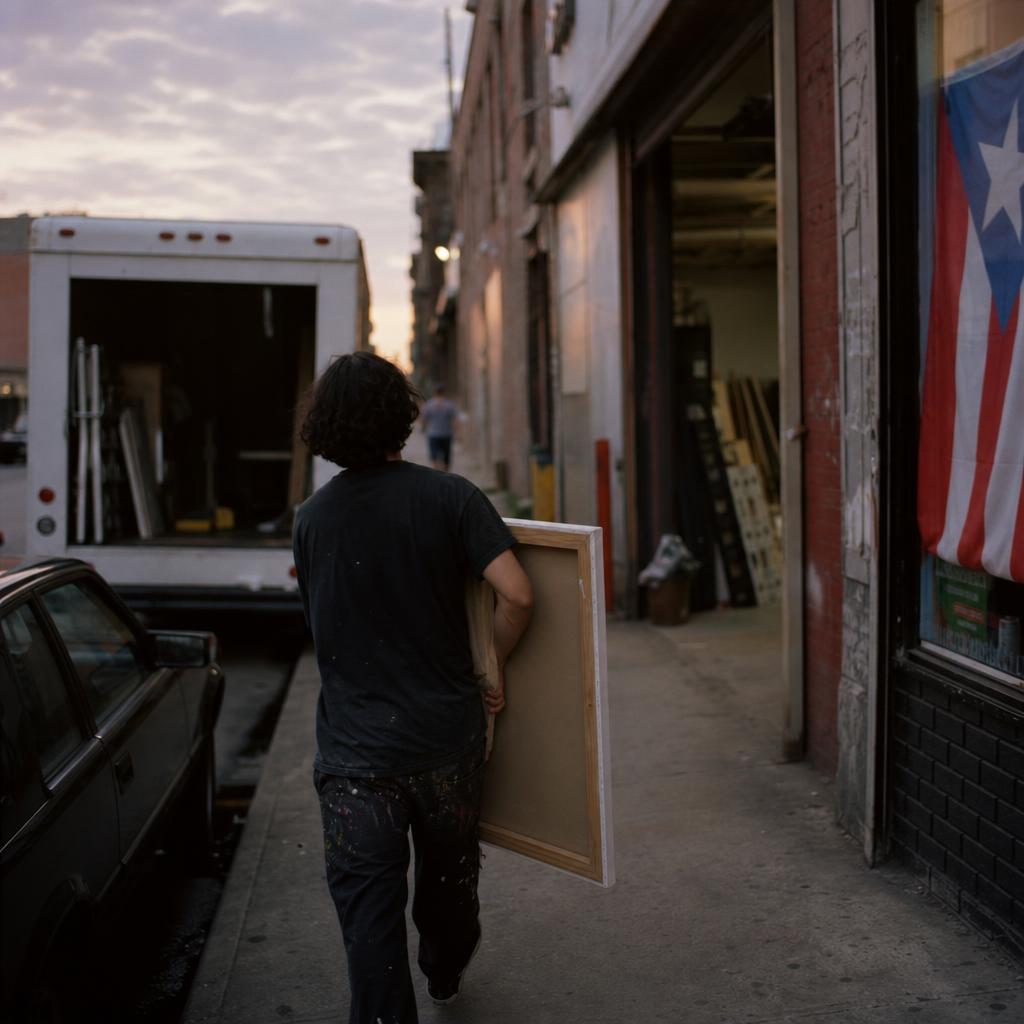
Williamsburg in 1990 was four neighborhoods that did not mix. North of Division Avenue lived the Satmar Hasidim; the Northside above Grand Street was Polish and Italian and industrial; the Southside, “Los Sures,” was Puerto Rican and Dominican; and the blocks around the Bedford Avenue stop on the L train were warehouses and small manufacturers with the machinery still in them.3 The Bedford stop was a single stop from First Avenue in Manhattan, a few minutes under the river — close enough that a person working a downtown job could live where the rent was industrial. What the artists found after 1994 was floor area at a price Manhattan no longer offered: raw lofts, many without a residential certificate of occupancy, rented from owners glad of any tenant at all. Pierogi, an artist-run gallery, opened on North Ninth Street in 1994; the Galapagos art space opened nearby the next year.3 The front edge was Berry Street and the cross-streets running west toward the water, where the rent gradient was steepest and the space cheapest, and where the first bars and galleries opened before the change reached Bedford Avenue at all.
The sequence, once it began, ran the same way it had run in every neighborhood the frontier had already crossed. A painter took a floor no one else wanted. A café opened to serve the painters, then a bar, then a gallery, then a restaurant that reviewed well. A landlord who had been collecting industrial rents discovered he could collect residential ones, and then higher residential ones; the owner of a building two doors down sold to someone who had read about the neighborhood; and the families who had lived on the block through the years no one wanted it began to get the letters, and the buyouts, and the pressure that a 1997 change in the state’s rent law made routine. By 1998 Bedford Avenue itself had a strip of cafés and vintage stores, and the displacement in Los Sures, two long blocks south, had passed from a threat into a process. Downriver at the Manhattan Bridge, a developer named David Walentas had spent the decade buying most of the cobblestoned warehouse district known as DUMBO; the first arts festival under the bridge came in 1997, and the residential conversions began at the decade’s end.3
Downtown, the Same Years
The same movement ran through lower Manhattan, one river-width west, and there it met open resistance. The Lower East Side, which as late as the mid-1980s had been a tenement district where the drug trade held whole blocks and a room could be had for a working wage, turned across the first half of the decade into a nightlife quarter — bars on Ludlow and Orchard, then boutiques, then the restaurants — while the immigrant and Latino population that had held the leases was pressed steadily out.4 The neighborhood’s transformation had been underway since the Tompkins Square Park confrontation of 1988, but its commercial arrival, the point at which a person on the street could read the change without being told, fell in these years.
Where the change met organized bodies, the city brought force. On the morning of May 30, 1995, hundreds of officers in riot gear, backed by a helicopter and a tank-like armored personnel carrier, cleared two squatted buildings on East Thirteenth Street whose occupants had barricaded the doors; thirty-one people were arrested, and the operation was reported to have cost about a million dollars.4 The squatters had held the buildings for years and had won a restraining order the previous autumn; an appeals court lifted it five days before the eviction. The scale of the response — the armor, the helicopter, the million dollars, for two tenement buildings on a single block — was itself the statement, and everyone on the Lower East Side read it.
North and west, SoHo completed a change of a different kind. The cast-iron district that had been invented as an artists’ quarter in the 1970s had become, by the middle of the decade, a retail corridor, its ground floors turned over to fashion and its rents risen past what a gallery could pay. The dealers who had made the neighborhood began leaving for the cheap garages and warehouses of far West Chelsea — Matthew Marks opened there in 1994, and the rest of the trade followed — while the loft space above the stores, which a decade earlier had housed the artists whose presence gave the neighborhood its value, now sold to buyers who had come for the neighborhood the artists had made. The engine underneath all of it was the same: capital following the frontier the artists opened, and closing it behind them. None of these neighborhoods was emptying. Each was filling — with more people, more money, more square feet of renovated floor — while the particular people who had lived in it thinned out. That was the shape of the thing, and it was legible by 1998 from the Bowery to Bedford Avenue.
The Machinery
The frontier moved on culture, but its engine, after June 1997, was written into state law. For most of the postwar period roughly a million of the city’s apartments — about half the rental stock — had sat under rent stabilization, a regime that capped annual increases at levels set each year by a city board and gave a sitting tenant the right to renew.2 The Rent Regulation Reform Act, passed in Albany that month and signed by Governor George Pataki, kept the system standing but bored two holes through its floor.1
The first was vacancy deregulation. Once a stabilized apartment’s legal rent crossed two thousand dollars a month and the apartment then fell vacant, it left regulation permanently and could be rented at whatever the market would bear. The second was high-income deregulation, which lowered the income threshold at which an occupied high-rent apartment could be decontrolled from a household making over two hundred fifty thousand dollars to one making over a hundred seventy-five thousand for two consecutive years. Alongside them ran the levers by which a landlord raised the legal rent toward the two-thousand-dollar threshold in the first place — the vacancy bonus among them — plus permanent increases for renovations to an apartment or major capital improvements to a building, so that every turnover and every claimed improvement pushed the rent nearer the line past which it never came back under regulation at all.
The arithmetic rearranged the incentives of every landlord holding stabilized stock in a neighborhood the frontier was crossing. The deregulated apartment the vacancy bonus and its companion increases produced was worth a multiple of the regulated one. The buyout offer, the withheld repair, the pressure to leave, all of which had existed before as private tactics, now had a statute behind them making each one pay. The law did not name Williamsburg or the Lower East Side. It did not have to. It set the terms on which the emptying happened everywhere the market was already moving.
Harlem on Its Own Terms
Harlem’s transformation across these years ran on a different track, and by a different hand. Where Williamsburg and the Lower East Side changed through the uncoordinated pressure of a moving market, central Harlem changed through a deliberate public and private effort to bring capital back to blocks that four decades of disinvestment had hollowed. In 1994 Upper Manhattan was designated a federal empowerment zone under legislation authored by Representative Charles Rangel and signed by President Clinton; a hundred-million-dollar federal commitment was matched by the state and the city into a development fund of roughly a quarter of a billion dollars for Upper Manhattan, aimed at drawing supermarkets, retail, and jobs to a commercial district that had none of the chains other neighborhoods took for granted.5
The residential side of it had begun a little earlier and came from within. The landmark brownstone districts — Mount Morris Park, Striver’s Row, Sugar Hill on the ridge above the valley, the rowhouses of Hamilton Heights — drew back a Black professional class, some of it returning to the neighborhood its parents had left, buying and restoring houses that had stood carved into rooming units or standing empty.6 The sociologist Monique Taylor, interviewing these buyers, found a gentrification whose actors were, in the main, of the same race as the people already there and yet separated from them by class — a distinction the newcomers managed with a self-consciousness the frontier downtown never required, because downtown the incoming and the displaced rarely shared anything at all.
The commercial change was harder and slower and reached the street later. In October 1994 the new Giuliani administration moved to clear the African street vendors who had worked 125th Street for years; after protests that ran hot for weeks, Imam Izak-El Pasha of the Malcolm Shabazz mosque brokered a relocation to cleared lots on West 116th Street, between Fifth and Lenox Avenues, where the vendors’ market was tented and stood.3 The chains the empowerment zone had been built to attract came at the end of the decade: a fifty-thousand-square-foot Pathmark opened at 125th Street and Lexington Avenue in 1999, the first full-service supermarket central Harlem had seen in some thirty years, and the Harlem USA retail-and-cinema complex opened on 125th Street in 2000.3 By then an inexpensive brownstone in the district was already becoming hard to find.
The Broken Window
The market moved capital and the statute moved tenants, but a third force worked on the same neighborhoods in the same years, and it wore a uniform. The theory had a name and a date: “Broken Windows,” the title of an article the criminologists George Kelling and James Q. Wilson had published in The Atlantic in 1982, which argued that visible small disorder — the unrepaired window, the loiterer, the public drunk — signaled that no one was in charge and invited worse.7 Rudolph Giuliani, elected mayor in 1993 on the perception of a city out of control, made the theory municipal policy. His first police commissioner, William Bratton, paired it with CompStat, a system introduced in 1994 that mapped crime by precinct week to week and held commanders to account for it, and with an order-maintenance campaign against exactly the offenses the theory named.8
What the campaign policed, in practice, were the visible markers of poverty in public space. The squeegee men who washed windshields at the bridge and tunnel mouths for change were cleared first, and early, and became the campaign’s emblem. Turnstile jumpers, graffiti writers, unlicensed vendors, panhandlers, the men drinking from bottles in paper bags — the enforcement fell on the small, cheap, visible signs of disorder that had helped keep a neighborhood’s rents low by keeping its reputation bad, and it fell hardest, arrest for arrest, on the young Black and Latino men who were stopped for the misdemeanor and run through the system for the fingerprints. The city had recorded 1,927 murders in 1993, David Dinkins’s last year; the number fell in every year that followed, and the fall was real and was felt at street level by everyone.9 It was also, in its timing and its geography, the precondition the market had been waiting for. A block became safe to walk, and then it became safe to buy, and the two happened in that order and close together.
The city that resulted looked, by 1998, scrubbed in a way it had not looked in 1992. The squeegee men were gone from the ramps; the sex cinemas and peep shows of Times Square were going dark behind plywood as a new zoning law pushed them out; a coffee chain stood where a corner deli had been; City Hall Park was being restored behind a new iron fence into a lawn no one loitered on. To the editor crossing Fifth Avenue on the way to the office, the change registered as relief, as a city that no longer asked to be braced against. It did not register as a cost, and she did not know whose it had been.
Three forces crossed the same neighborhoods in the same four years, and each on its own would have moved slowly. The market opened frontiers, but the market had always opened frontiers; the law rewired the incentives of every landlord, but a law is only paper until someone acts on it; the police cleared the streets of the signs of poverty, but clearing a corner does not by itself raise a rent. What made 1994 to 1998 the hinge was that the three ran together and reinforced one another — the safe block invited the buyer, the buyer’s arrival raised the value of the empty apartment, the statute made the empty apartment worth emptying, and the newly renovated block was safer still. No one decided, in any single room, to replace the people who lived in these neighborhoods with people who could pay more. It built a machine in which every part rewarded the next, and then it let the machine run, and watched the map change faster than a city’s map was supposed to be able to change.
Williamsburg as discovery would have been the easiest pitch of the four years: cheap lofts, a scene forming where the freight elevators still worked, the sense of arriving first. The City would have carried it in the spring of 1995 at essentially no resistance, the editors assigning it having lived one frontier back themselves and recognizing the story as flattering news about their own migration. The empowerment zone, by contrast, would have needed the December close to make room for a hundred million federal dollars and a matching state and city fund — a public-policy piece, but The City again, because a quarter of a billion dollars moving into Upper Manhattan would have read, on the page, as the same kind of arrival.
Not every piece from that spring would have survived intact. The East Thirteenth Street eviction — the armor, the helicopter, the reported million dollars, for two buildings on one block — would have been irresistible copy and would have gone into The City reframed: order restored to a lawless block, not a report on years of squatter tenancy and a restraining order the city had beaten on appeal five days earlier. The register a monthly could hold would not have stretched to both the raid and the years before it, and what would have made the page would have kept only the raid.
An articles editor would have claimed the Rent Regulation Reform Act for The Essay that September, the mechanism explained at length — the vacancy bonus, the deregulation threshold, the incentives it rearranged for every landlord holding stabilized stock. What would not have survived the room was the piece proposed alongside it, naming the families the same law’s vacancy bonus was pricing out of Los Sures and the blocks like it. The reader weighing whether to take the newly vacant apartment was not, in the room’s judgment, the reader such a piece would have indicted, and the pitch would have died there, without a next issue to carry it to.
Footnotes
-
“Let Them Rent Cake: George Pataki, Market Ideology, and the Attempt to Dismantle Rent Regulation in New York,” Fordham Urban Law Journal 31, no. 2 (2004). The Rent Regulation Reform Act of 1997 set the deregulation rent at two thousand dollars, established a statutory vacancy bonus of roughly twenty percent on a two-year lease, and lowered the high-income decontrol threshold from $250,000 to $175,000 in annual household income over two consecutive years. ↩ ↩2
-
New York City Rent Guidelines Board, Housing NYC: Rents, Markets and Trends 1998 (1998). ↩ ↩2
-
Sharon Zukin, Naked City: The Death and Life of Authentic Urban Places (Oxford University Press, 2010). Zukin’s chapters on Williamsburg and on 125th Street trace the loft frontier and its galleries (Pierogi, founded 1994; Galapagos, 1995), the DUMBO conversions, and the clearance and relocation of the Harlem street vendors, as well as the arrival of chain retail on 125th Street. ↩ ↩2 ↩3 ↩4 ↩5
-
Christopher Mele, Selling the Lower East Side: Culture, Real Estate, and Resistance in New York City (University of Minnesota Press, 2000). The East Thirteenth Street eviction of May 30, 1995 — riot police, a helicopter, and an armored vehicle, at a reported cost near one million dollars — followed an appeals court’s lifting of a restraining order the squatters had won the previous November. ↩ ↩2
-
Upper Manhattan Empowerment Zone Development Corporation, published corporate history, umez.org. Upper Manhattan was designated a federal empowerment zone in 1994; a $100 million federal commitment was matched by the state and the city, with roughly $250 million of the combined fund directed to Upper Manhattan and the balance to the Bronx. ↩
-
Monique M. Taylor, Harlem Between Heaven and Hell (University of Minnesota Press, 2002). ↩
-
George L. Kelling and James Q. Wilson, “Broken Windows,” The Atlantic Monthly, March 1982. ↩
-
William Bratton with Peter Knobler, Turnaround: How America’s Top Cop Reversed the Crime Epidemic (Random House, 1998). CompStat was introduced under Bratton and his deputy Jack Maple in 1994. ↩
-
New York City Police Department, Historical New York City Crime Data (dataset), nyc.gov. ↩