The Geography of Desire, 1989–2001
Subscribe
https://meridian-archive.com/feed.xmlOpen in your app, or paste the link above into any other:
The Forty-Percent Line
Beginning in 1998, the New York City Law Department and the operators of the Times Square sex trade spent the better part of three years litigating, store by store, a single recurring question: what fraction of a given shop’s floor space was pornography. The city’s 1995 adult-use zoning amendments had defined an “adult establishment” as any business dedicating forty percent or more of its stock or floor area to adult material, barred from operating within five hundred feet of a school, a day-care center, a house of worship, a residential zone, or another adult establishment.1 Once enforcement began, the forty-percent line became the industry’s central fact of commercial life. Operator after operator performed the same retrofit: board games nobody bought, paperback fiction, novelty items, and children’s videos stacked at the front of the store to hold the measured adult share under the statutory threshold, with the actual product kept toward the back. Whether a given store’s sixty/forty split satisfied the ordinance’s letter was argued out as ordinary civil litigation into the 2000s, the city tightening its definitional language each time a retrofit closed one loophole and opened another.1
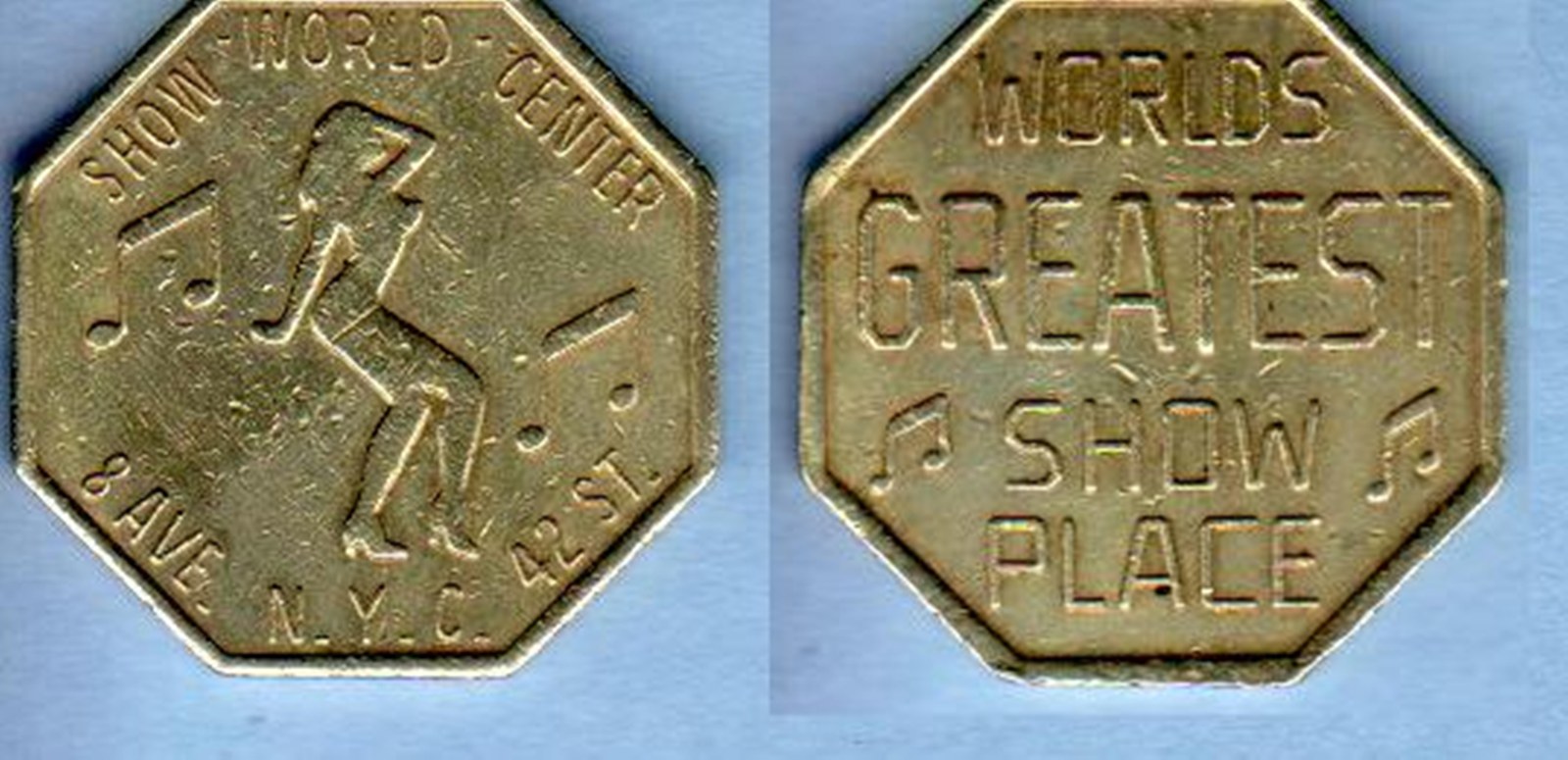
What the forty-percent line was written to reach was a business built on the quarter. A quarter bought between thirty and ninety seconds, the exact span depending on which house set the meter. It went into a coin slot at chest height inside a closet-size, wood-paneled cubicle — vinyl seat, a paper-towel dispenser bolted to the wall — and a small motorized curtain rolled upward on a spring-loaded gear, opening a window onto a shared central stage where a single dancer rotated among six to twelve booths at once.2 The dancer could not see clearly into any one booth and worked instead by the pattern of curtains rising and falling around her. When the meter ran out, the curtain dropped, and the next quarter bought the next window. At Show World Center, the four-story, 22,000-square-foot complex Richard Basciano opened in 1977 at 669 Eighth Avenue and 42nd Street, quarters alone were estimated to bring in ten million dollars a year, a figure that earned the building its nickname in the press: “the McDonald’s of sex.”3 It ran twenty-four hours. Inside were peep booths on the twenty-five-cent and dollar meter, a live-girl room where customers stood at windows ringing a rotating stage, an all-male floor with partner booths and a glass divider that rolled up between two stalls, private dance booths, a large adult bookstore, and screening rooms running 16mm loops that had migrated to videocassette by 1989. The floors were mopped on a one- to two-hour rotation, and the smell in every booth in every house along the strip was reported, across decades of memoirs and oral histories, as the same four notes: amyl nitrite off the patrons, industrial pine disinfectant off the walls, tobacco, and the particular chemical sweetness of wood-paneling cleaner.2
Two blocks east, Peepland ran its own bank of booths and a basement live-window under a neon sign — the word PEEPLAND above a winking eye — that turned up in enough Times Square photographs of the period to function as the strip’s unofficial logo; it opened in 1975 at 136 West 42nd Street and stayed open past the end of the period.4 The Playpen, in the former Ideal and then Adonis Theater at 693 Eighth Avenue, ran video booths upstairs and live-girl windows below, and it outlasted most of its neighbors by retrofitting to the letter of a law that had not yet been written when it opened.5 What none of the strip’s survivors could claim by 1989 was the heterosexual swing club that had defined the previous decade’s idea of sexual glamour: Plato’s Retreat, evicted from the Ansonia’s basement and shut in 1985 by the same state health order that closed the city’s bathhouses, was four years gone by the time the peep-booth economy reached its own peak, and Le Trapeze, Cherry’s, and a handful of lesser successors spent the rest of the period monetizing its memory rather than its scale.6
Aftermath on the Deuce
The City Council passed the amendments on October 25, 1995, on Mayor Rudolph Giuliani’s championing.1 The law did not send police through the doors; it redrew the map around them — zoning, not the cabaret licensing regime that drove the same administration’s separate crackdown on the city’s dance floors, chronicled elsewhere in this part, a different statute enforced against a different target on a different clock. The law took effect on the books at once but sat tied up in litigation for most of the next three years, as described above; sustained enforcement did not begin until 1998, after the United States Supreme Court declined to review the case.7 Most Times Square operators did not bother retrofitting; they sold, closed, or relocated to industrial zones in Hunts Point and Long Island City, where the five-hundred-foot buffers cleared. Of the roughly three dozen adult-use establishments doing business across the Times Square blocks in 1989, only a handful survived in retrofitted form past the end of the period.7
The adult cinema had begun dying before the law arrived, killed by videocassette rather than by statute. The Variety Photoplays, a nickelodeon built in 1897 at 110–112 Third Avenue that had run gay pornography through the 1980s, closed as an adult theater in 1989 under city health-department pressure — the same regulatory authority that had closed the bathhouses four years earlier — and reopened in 1991 as an off-Broadway house before its later demolition.8 Cine 42, a two-screen grindhouse at 216 West 42nd Street running kung fu double bills alongside softcore features, closed in 1992, three years ahead of the zoning law, felled instead by the first wave of Times Square redevelopment.9 The rest of 42nd Street’s grindhouses — the Empire, the Selwyn, the Liberty, the Apollo, the Lyric, the Rialto, the Victory, the Anco, the New Amsterdam, the Harris — went in a single stroke: the city cleared the block under eminent domain in November 1993 for the redevelopment that produced Disney’s restoration of the New Amsterdam.10 By the end of the decade the block between Seventh and Eighth Avenues was under construction for Disney, Madame Tussauds, and an AMC multiplex; by 2001 the New Amsterdam was showing The Lion King and a Hello Kitty store occupied the ground floor where the Rialto’s marquee had hung. The Eighth Avenue houses that were chiefly gay — the Adonis, the Cameo, the Squire — held on longer than the Deuce theaters, falling to the 1995 zoning law rather than the redevelopment. Show World itself survived, unrecognizable — retrofitted to sixty/forty, an upstairs comedy club replacing part of the floor, the live-girl room boarded over.7
The Shop Window and the Twelfth Floor
Three sex shops that operated across the same twelve years sold overlapping merchandise, and each set a different threshold for the customer meant to cross it. The Pink Pussycat Boutique had occupied 167 West 4th Street since 1972, pink neon in the window, lingerie and bachelorette-party gag gifts arranged for the street to see, the actual toys held in glass cases toward the back.11 The embarrassment the shop sold was performative rather than private — brides-to-be came in giggling in small groups, treated the register at the front like a photo opportunity, and were out again by eleven. No cubicles, no booths: the most domesticated version of the sex shop in Manhattan, and the easiest to walk into.
Eve’s Garden was harder to enter, by design. Dell Williams founded it in 1974, first as a mail-order business run out of her own kitchen, then as a showroom at 119 West 57th Street, Suite 1201 — the twelfth floor of an office building between Sixth and Seventh Avenues, reachable only by elevator, invisible from the sidewalk.12 The shop admitted no men, staffed itself with clerks trained as educators rather than salespeople, and lit its rooms like a therapist’s waiting room rather than a novelty store. Consultations and workshops ran by appointment, rooted in Betty Dodson’s masturbation-education classes and the commitments of second-wave feminism; physicians and therapists referred clients there as a matter of course.12 The elevator was the point: a woman who wanted the twelfth floor had to ask for it, floor by floor, and nobody on the street below ever knew she had gone up.
Babeland took the opposite approach when its New York location opened in 1998 at 94 Rivington Street on the Lower East Side, an East Coast branch of a business Claire Cavanah and Rachel Venning had founded in Seattle five years earlier.13 Where Eve’s Garden kept its retail twelve floors up and out of sight, Babeland put its at street level under bright fluorescent light — white walls, staff in T-shirts printed with the store’s name, vibrators out of their boxes on open shelves with hand-lettered cards explaining what each one did. The clientele was gender-mixed for the first time in the category’s Manhattan history; a heterosexual couple in their twenties could browse together without either performing embarrassment for the other’s benefit. Babeland reframed the whole category as wellness retail rather than novelty or education, ran classes on rope and anatomy in a back room on weeknights, and by 2001 doubled as a pre-web hub for zines and sex-positive programming elsewhere in the city.13
The Post Office of Leather
Christopher Street had been the densest concentration of gay-identified retail in the United States since well before the period began, four blocks running from Greenwich Avenue to the river, and by 1989 the block’s anchor stores had operated there long enough to be treated as landmarks. The Leatherman had sold leather at 111 Christopher Street since 1965 — harnesses, chaps, vests, boots, jocks, hoods, paddles, restraints — with staff who measured customers for fit the way a tailor measures for a suit.14 It functioned as more than a shop. Community announcements, club flyers, and news of who was sick, who had died, or who had moved out west circulated there the way mail circulates through an actual post office, and the store outlasted the epidemic years partly because it sold the wardrobe of an identity rather than only the equipment of an act, and the identity persisted after too many of its wearers did not. The Pleasure Chest, founded in 1971 and running through the 1990s at 156 Seventh Avenue South, sold a broader catalogue — everything the Pink Pussycat carried, plus a leather room, harnesses built for any anatomy, and a glass case behind the counter holding small brown bottles labeled, on every one of them, “video head cleaner.”15
By 2001 the corridor was quieter than it had been in 1989. AIDS losses and West Village rent inflation had hollowed out the block’s smaller storefronts, and the demographic center of gay New York had migrated north to Chelsea across the same years — a residential and commercial shift traced in full elsewhere in this part. The Leatherman and the Pleasure Chest were still standing at the end of the period for the reason many of the era’s oldest businesses were still standing: they owned their leases, or had held them long enough to be effectively grandfathered against the rents that had forced out their smaller neighbors.16
Twenty-Two Wholesale Businesses
The Meatpacking District in 1989 sat inside a grid bounded by Gansevoort Street to the south, West 14th Street to the north, Ninth Avenue to the east, and the West Side Highway to the west — cobblestoned blocks holding roughly twenty-two operating wholesale meat businesses, dealing beef, lamb, veal, and poultry.17 The trade ran overnight because daytime traffic on the West Side Highway made truck access impossible: refrigerated trailers, forty feet long with humming compressor units on top, arrived between eleven at night and four in the morning to load and unload, parked along the western blocks of Little West 12th Street and Gansevoort, sometimes detached from their cabs and left running until dawn. By day the streets stood nearly empty. By eleven at night they were loud with hand-trucks, meat hooks, and men in bloody white coats moving carcasses between trucks and coolers.
Three economies occupied the same blocks between midnight and four without merging into one. The meat trade ran as described. Transgender and transvestite sex work operated along Little West 12th, West 13th, and Gansevoort west of Washington Street and up onto the West Side Highway service road, worked by a population later documented from interviews with the women who had held those exact blocks across the period.18 The workers were predominantly Black and Latina trans women, some housed in single-room-occupancy hotels in the West 30s and 40s, some commuting from New Jersey by PATH train and bus; police contact with them ranged, across the period, from grudging coexistence to active harassment, and enforcement under the city’s “quality of life” doctrine intensified after 1994.18 A third traffic overlapped both: patrons entering and leaving the Hellfire Club and its successor, the Vault, along with the after-hours crowd spilling over from Sound Factory and the district’s other big rooms — a dance-club circuit chronicled on its own elsewhere in this part — and, at lower volume than in the pre-AIDS 1970s, opportunistic use of the parked refrigerated trucks themselves, some left unlocked, some still warm from a running compressor.17 The trans sex trade worked one set of blocks, the cruising traffic used another, and the two coexisted on the same square mile after dark without either explaining the other.
At three in the morning on Little West 12th Street in 1993, the soundscape held a constant low note from the refrigeration compressors, hand-truck wheels rattling on Belgian block, a forklift’s backup alarm two blocks over, the West Side Highway’s traffic as a continuous distant hush, a heel on cobblestone, conversation switching between Spanish, English, and AAVE, a burst of bass leaking from the Hellfire door as it opened and closed, a horn from Ninth Avenue. The smell layered animal blood washed into the gutters with bleach water, diesel exhaust, and river silt, with a sex worker’s perfume or a meatpacker’s cigar on break drifting through depending on where a person stood.17
The neighborhood held this character with little change from 1989 through 1996; the meat trade contracted slowly as cold storage relocated to Hunts Point in the Bronx, but it did not collapse. Nineteen ninety-seven is the year most oral histories of the district mark as the hinge. Florent, the twenty-four-hour French bistro that had run at 69 Gansevoort Street since 1985, had by then spent a decade pulling a downtown after-hours crowd into the neighborhood and sat, deliberately or not, at the membrane between the old district and the new one; APC, Jeffrey, and the Hotel Gansevoort were all in planning, and a business-improvement district for the area was in development.17 Keith McNally opened Pastis at 9 Ninth Avenue in 1999, the single event most oral histories of the neighborhood credit with tipping it decisively toward its post-industrial identity; the following summer, Sex and the City shot an episode built around the district’s trans sex workers as a punchline played against a Manhattan newcomer’s discomfort.19 By 2001 CSX had formally abandoned the High Line, the elevated freight spur running the length of the district, and the Friends of the High Line had organized that same year to preserve rather than demolish it; the Stroll was being actively pushed out by both NYPD enforcement and the private security the new restaurants hired, and the wholesale meat businesses were leaving one lease at a time.18 The Hellfire Club’s successor, the Vault, was gone within a few years, killed less by any ordinance than by the real-estate values the neighborhood’s own transformation had produced.20 The block a visitor found at Gansevoort and Ninth Avenue at three in the morning in 1993 was not the block standing there in 2001.
The Open Ground
The free, outdoor circuit of the city’s erotic geography left no business directory and no zoning file, and in 1989 its center was a row of collapsing piers. Pier 45, at the foot of Christopher Street, and the derelict structures around it — Piers 46, 48, 51, 52 — had been built as commercial shipping piers in the late nineteenth and early twentieth centuries and abandoned through the 1960s and 1970s as containerized freight moved to New Jersey.21 By the 1980s the decking was missing in places, fire had gutted sections of the structures, and the piers were still in continuous use by gay men, by queer homeless youth, and by the ball culture the same waterfront hosted and that is documented on its own elsewhere in this part. Jennie Livingston filmed most of Paris Is Burning on and around these piers in the late 1980s, and the film’s images of the waterfront record something close to the state the piers held as the period opened.22 Through the 1990s the city demolished the structures in stages, driven partly by safety and partly to clear ground for Hudson River Park, whose master plan was adopted in 1998, with construction beginning the following year and the first sections opening only after the period closed.23 The men and youth displaced from the piers had no single successor location — some moved into the park’s still-unlandscaped margins for a period, some shifted onto the Christopher Street block itself, and a growing number, by the late 1990s, moved onto AOL and the web instead of any physical ground at all.
Two other outdoor sites held the same function at smaller scale. The Ramble, thirty-six acres of Central Park between 73rd and 78th Streets north of the Lake, had served as a gay cruising site since at least the 1910s and remained active through the 1990s despite vice-squad sweeps that intensified under Commissioner William Bratton and the Giuliani administration; entry ran from the Boathouse on the east or Bow Bridge on the south, the paths concentrated around the rustic stone bridges and the wooded slopes at the park’s southern edge, and weekday lunch-hour traffic ran, by several oral accounts, as heavy as anything after dark.24 A smaller, less central site ran under the elevated Henry Hudson Parkway in Riverside Park, concentrated around the rotunda at 79th Street and the wooded slopes near the Boat Basin. Bryant Park, behind the Public Library, had been a cruising and drug-dealing site of its own before its 1992 redesign; the renovation team of Hanna/Olin and Hardy Holzman Pfeiffer Associates opened sightlines, removed the hedges that had screened the park’s interior from the street, and added restaurant pavilions and daytime concessions that displaced the population that had used the park after dark — the same kind of engineering the 1995 zoning law applied three years later to Times Square, sightlines and program substituting for setback and floor-area rules.25 After 1992 the park held none of its former function.
By Appointment
What regulation could not close, the era’s sexual commerce reorganized into private association. Le Trapeze, a couples-only swing club, opened in 1980 inside the Prince George Hotel building at 17 East 27th Street and ran continuously well past the end of the period, outlasting nearly every other sex-commerce venue of its generation.26 Membership sold at the door made the “members only” designation a license technicality rather than a barrier; no single men were admitted under any circumstance, and single women only with house approval on certain nights. Inside, a dance floor, locker rooms, curtained semi-private rooms, and an open platform room ran alongside something the club advertised as prominently as any of it: a buffet, which supplied the legal frame that let Le Trapeze operate as a private dining and entertainment club rather than as anything a zoning or vice statute could more easily reach.26 Its clientele through the 1990s skewed thirty-five to fifty-five, married or coupled, suburban-commuter and Manhattan upper-middle-class — the nearest surviving descendant of the glamour Plato’s Retreat had sold the previous decade, without ever approaching its scale.
The Hellfire Club, opened in the late 1970s in a basement at the triangular lot where Ninth Avenue, Hudson Street, and West 14th Street met, ran the city’s principal BDSM and fetish venue — polysexual, unmarked from the street, entered through an unsigned door, its rooms holding cages, slings, a “medical room,” and a dungeon fitted with St. Andrew’s crosses.27 Admission ran by donation rather than fixed price. After a mid-1980s health-code crackdown the club stripped out its most obviously illegal fixtures and reopened under a new name, the Vault, first at 675 Hudson Street and later at 28 Tenth Avenue; Madonna shot portions of the Erotica video and the Sex book there in 1992, and the club, with a looser interpretation of the same house rules, ran until real-estate values, rather than any enforcement action, closed it as the period ended.28
A parallel, unaddressed circuit ran through rented hotel suites rather than fixed premises. Couples booked two-bedroom suites at midmarket Manhattan hotels — the Roosevelt, the Wellington, and the Empire were named repeatedly in the period’s own advertising — distributed the address and door code by phone the morning of, and charged roughly eighty to a hundred fifty dollars per couple at the door for parties that ran ten at night to four in the morning. Something on the order of thirty to sixty operators of this kind were thought to be running parties on rotation across the period, advertised in Screw and, later, on AOL personals; because none held a fixed address, this circuit was the sexual geography of the period that moved. A second, unadvertised circuit ran through Tribeca lofts and Chelsea brownstones, invitation-only parties for a self-selected social class of gallerists, designers, and finance and media people, where no money changed hands at the door because admission ran entirely on who already knew the host. It left almost no documentary trace and ran most actively between 1989 and 1995, because nobody ever flyered it.
A Membership Card
Every gay bathhouse in Manhattan closed in the final weeks of 1985, shut under the same state sanitary-code emergency order that also closed Plato’s Retreat and is treated in full elsewhere in this part. What survived the closure was not a bathhouse but a workaround. The East Side Club, on the second and third floors of 227 East 56th Street, reopened as a “private members club” — a twenty-five-dollar annual card, rooms rented by the hour nominally for rest, lockers, towels, a gym, and showers all retained from the old model, resting on the legal fiction that what consenting members did in a rented room was not the establishment’s business.29 By 1989 the East Side Club was the only fully operating gay bathhouse in Manhattan and one of perhaps three in the city; for the next twelve years its identity, to a generation of men who had come out into the epidemic and never set foot in the venues their older friends described, was simply “the one that’s still there.” The West Side Club opened under the identical private-club model in 1995, at 27 West 20th Street in Chelsea, giving the neighborhood its own version of the same workaround a decade after the original.29 No bathhouse closed in 1985 reopened informally at any point in the 1990s; what replaced the category in the city’s gay erotic economy was not a bathhouse but the private sex parties described above, the surviving outdoor cruising sites, and, from around 1996 onward, AOL chat rooms.
The Venue Directory
| Venue | Address | Type | In-period span |
|---|---|---|---|
| Show World Center | 669 Eighth Ave | Peep arcade | Opened 1977; retrofitted 60/40 by the late 1990s3 |
| Peepland | 136 W 42nd St | Peep show | Opened 1975; operating throughout4 |
| The Playpen | 693 Eighth Ave | Peep/live-girl | Opened in the 1980s; a 60/40 survivor5 |
| Pink Pussycat Boutique | 167 W 4th St | Sex shop | Opened 1972; operating throughout11 |
| Eve’s Garden | 119 W 57th St, Suite 1201 | Women’s sex shop | Opened 1974; operating throughout12 |
| Babeland | 94 Rivington St | Sex-positive retail | Opened 199813 |
| The Leatherman | 111 Christopher St | Leather goods | Opened 1965; operating throughout14 |
| The Pleasure Chest | 156 Seventh Ave South | Sex emporium | Opened 1971 at this location15 |
| Le Trapeze | 17 E 27th St | Swing club | Opened 1980; operating throughout26 |
| The Vault (né Hellfire Club) | 675 Hudson St, later 28 Tenth Ave | BDSM club | Late 1970s; closed at the turn of the decade28 |
| East Side Club | 227 E 56th St | Bathhouse, private-club model | Private-club model from after the 1985 closures29 |
| West Side Club | 27 W 20th St | Bathhouse, private-club model | Opened 199529 |
The Physical Economy of the Voice
By the time the zoning law reached full enforcement, a second sexual economy had grown up that needed no address at all. The American phone-sex industry generated an estimated fifty-four million dollars in 1988, climbed to roughly two billion dollars by 1996 — a year in which an estimated 1.5 percent of all international telephone calls placed were 1-900 sex lines — and was still generating something near a billion dollars annually as the period closed, before the broadband decade collapsed it.30 At its peak a single major operator could report more than a million dollars in revenue on one night.
The industry’s physical infrastructure existed, and it was almost entirely not in Manhattan. Rent explains most of the absence: a call center needed floor space for banks of phone lines and, in the larger operations, rows of desks, and midtown or downtown commercial rents priced that floor space out of the business’s margins in a way suburban New Jersey office parks did not. Most call centers ran instead from commercial buildings in New Jersey and the outer boroughs, with a smaller number of Manhattan-based operations concentrated in commercial buildings between 32nd and 50th Streets on the West Side, buildings whose other tenants had no idea what one floor did all day.31 A meaningful share of operators worked from home rather than from any bullpen at all, taking calls routed to a dedicated line the company had installed — a model the operator American Telnet built much of its business on.
The operators themselves were predominantly women, paid ten to forty cents a minute against the two dollars and ninety-nine cents or more a minute the caller was charged; a skilled operator working seven calls an hour could gross seven hundred to a thousand dollars a week.31 The fictional cliché of the dominatrix graduate student paying her way through a doctorate had enough real instances behind it to survive in popular memory, but it described the aggregate poorly; most operators were working-class women, many of them single mothers, fitting the shifts around a second job or a class schedule. A live call ran a loose but recognizable script — ninety seconds drawing out a caller’s preference, three to seven minutes of guided fantasy paced to the caller’s breathing, then hang-up management between the eighth and twelfth minute, since an operator’s income depended on extending a call’s length without losing the caller’s investment in it.31 After 1996 the residential modem and AOL chat rooms began drawing the industry’s male audience away; by 1998 the decline was visible in the traffic; by 2000 most surviving operators had begun converting their businesses into the web platforms that carried the same commerce forward without a phone line at all. What happened to the bill itself, once it reached a house with more than one name on the account, belongs to the private side of the same economy, treated elsewhere in this part.
No single law and no single disease closed the erotic city; both hurried along a change real estate was already making inevitable. A quarter bought ninety seconds in a peep booth in 1989 the way it had for a decade, and by 2001 a modem bought an unlimited number of them without a curtain, a doorman, or an address at all. Between those two purchases, door after door either shut, moved, or learned to survive by pretending to be something else — a private club, a dining society, a wellness boutique with the lights turned up. What did not change was the appetite the doors had always been built to serve, or the city’s persistence in finding it a room. The room simply moved — indoors, then uptown, then onto a screen — and carried its economics and its discretion along with it, the same appetite finding a new door every time an old one closed, all the way into the next century.
The 1995 zoning fight would have run in The City, the ordinance’s free-speech exposure weighed against a decade of neighborhood complaint at a length the argument could sustain. Eighteen months earlier, the clearance of the Deuce’s grindhouse block under eminent domain would have reached the same pages by a different route — not the fight over a law but the fact of a block gone, an articles editor claiming it for The City on the strength of the redevelopment alone, no ordinance required to make it news. Babeland’s arrival on Rivington in 1998 would have earned its own paragraph in a June issue’s The City, the shop’s fluorescent-lit, gender-mixed retail floor read as the decade’s clean rebuttal to the peep booth’s dark one. The Hudson River Park master plan, adopted the same year, would have belonged there too — the last derelict piers scheduled for clearance making an argument any City piece on the waterfront’s future would have wanted, once the ground the cruising traffic had used for two decades was finally spoken for on paper.
The West Side Club’s 1995 opening under the private-membership model would have drawn the room’s standing verdict on its own, smaller terms — a workaround worth a paragraph on a slow week, never a piece, because the reader outside New York had no stake in which street corner in Chelsea had found its own way around a 1985 closure.
Footnotes
-
“Fighting For Survival, X-Rated Businesses In NYC Can Stay Put For Now,” Gothamist, accessed 2026. ↩ ↩2 ↩3 ↩4 ↩5
-
“Times Square in the 1970s: Grindhouses, Peep Shows and XXX Neon Nostalgia,” Bowery Boys, boweryboyshistory.com, accessed 2026. ↩ ↩2 ↩3
-
“Times Square: The History of Show World Center, ‘The McDonald’s of Sex,’” Untapped New York, untappedcities.com, accessed 2026. ↩ ↩2 ↩3
-
“Peep Shows, Sex, And Crack: 27 Photos Of Times Square At Its Lowest,” All That’s Interesting, accessed 2026. ↩ ↩2
-
“A $13.8M Peep Show: Porn Shop, Venue Gets New Owner,” The Real Deal, June 2018. ↩ ↩2 ↩3
-
UPI Archives, “Plato’s Retreat,” November 22, 1985. ↩
-
“Today in NYC History: Rudy Giuliani Battles the Times Square Porn Shops in 1998,” Untapped New York, untappedcities.com, accessed 2026. ↩ ↩2 ↩3 ↩4
-
“Nickelodeon Theater with a Varied History: The Variety,” Village Preservation, villagepreservation.org, accessed 2026. ↩
-
“Cine 42,” Grindhouse Cinema Database, accessed 2026. ↩
-
“Celluloid Corruption: New York’s Infamous 42nd Street and Grindhouse Cinema,” Film Cred, accessed 2026. ↩ ↩2
-
“The Pink Pussycat Boutique,” Time Out New York, timeout.com, accessed 2026. ↩ ↩2
-
“Multi-Faceted Feminist Started Eve’s Garden from Her West 57th Street Kitchen,” Chelsea News, March 2015. ↩ ↩2 ↩3 ↩4
-
“Feminist Sex Toy Shop Babeland Sells to New Owner After 25 Years,” DNAinfo, July 2017. ↩ ↩2 ↩3 ↩4
-
“About Us,” The Leather Man Inc., leathermannyc.com, accessed 2026. ↩ ↩2
-
“Pleasure Chest, 1972,” Jeremiah’s Vanishing New York, vanishingnewyork.blogspot.com, accessed 2026. ↩ ↩2 ↩3
-
“Greenwich Village Waterfront,” NYC LGBTQ Historic Sites Project, nyclgbtsites.org, accessed 2026. ↩
-
“The Urban Lens: Travel Back to the Gritty Meatpacking District of the ’80s and ’90s,” 6sqft, accessed 2026. ↩ ↩2 ↩3 ↩4
-
Kristen Lovell and Zackary Drucker, dir., The Stroll (HBO, 2023), built from interviews with women who worked the district’s blocks across the period; “‘The Stroll’ Puts Trans Sex Workers on the Map of NYC’s Queer History,” NBC News, accessed 2026. ↩ ↩2 ↩3
-
“Weekly Thoughts: Pastis,” Chenmark, chenmark.com, accessed 2026. ↩
-
“The Legendary Vault Closes :: The Proverbial Vault Opens,” Eating Drinking and Overthinking, accessed 2026. ↩
-
“When NYC’s Piers Were a Sanctuary for Gay Gathering,” Hyperallergic, accessed 2026. ↩
-
Jennie Livingston, dir., Paris Is Burning (Miramax, 1990; filmed 1987–1989). ↩
-
“Greenwich Village Waterfront,” NYC LGBTQ Historic Sites Project, nyclgbtsites.org, accessed 2026. ↩
-
“Central Park,” NYC LGBTQ Historic Sites Project, nyclgbtsites.org, accessed 2026. ↩
-
“A Brief History of Bryant Park,” Bryant Park Corporation, bryantpark.org, accessed 2026. ↩
-
“Le Trapeze, One Of The City’s Oldest Swingers Club, Loses Lease,” The Real Deal, June 2016. ↩ ↩2 ↩3
-
“Tour the Infamous Sexual History of NYC’s Meatpacking District,” Xtra Magazine, accessed 2026. ↩ ↩2
-
“The Sexy Secret Underneath ‘Little Flatiron,’” Bowery Boys, boweryboyshistory.com, accessed 2026. ↩ ↩2 ↩3
-
“East Side Club, New York,” Travelgay, travelgay.com, accessed 2026. ↩ ↩2 ↩3 ↩4
-
“Inside the Shady Billion-Dollar Phone Sex Industry,” The Daily Beast, accessed 2026. ↩
-
“Horny Dads, Armed Raids, and a Coup: The Wild Story of Phone Sex in the 90s,” Dazed, accessed 2026. ↩ ↩2 ↩3