The Private Economy of Pornography, 1989–2001
Subscribe
https://meridian-archive.com/feed.xmlOpen in your app, or paste the link above into any other:
The Condition of Employment
By the early 1990s, condom use on a new release was a standing condition of employment at nearly every major gay pornography studio in the country — Falcon, Colt, Catalina, and the rest of the field enforced it the way a production company enforces any other set rule, learned on a first call sheet rather than announced to a customer, with no comparable floor ever adopted by the heterosexual studios across town, which relied instead on a rotating, unpublished regime of performer testing that reached no customer’s eye either.1 The rule had no trade name and generated no press release; it functioned as ordinary production discipline, the kind of requirement a call sheet lists beside wardrobe and call time, driven into the industry by the AIDS crisis and by performer organizing rather than by any regulator, and it separated the gay and heterosexual branches of the same city’s adult-film business more completely than genre, budget, or aesthetic ever did. The magazine trade divided the same business a different way — not by what a set required of a performer, but by what a customer’s hand could tell apart without looking.
Three magazines sat on the same upper rack of a Manhattan newsstand, and a customer’s hand could tell them apart without looking. Playboy came on heavy coated stock with the give of a hardcover; Penthouse was lighter and glossier, faintly tacky at the gutter; Hustler was tabloid newsprint, cheap enough to leave ink on a thumb. The three magazines were not interchangeable, and the difference was not only editorial. Playboy, founded by Hugh Hefner in 1953, was the acceptable one — a UES coffee table could hold it without comment, the famous Playboy Interview ran figures like Jimmy Carter and John Lennon at prestige-magazine rates, and the photography stayed soft-focus, without penetration, through most of the decade; circulation stood at roughly 3.4 million in 1989 and fell steadily afterward.2 Penthouse, which Bob Guccione had brought to the American market in 1969, ran a franker style — pinker light, harder poses — and its numbers told the era’s clearest decline: a 1979 peak of 4.7 million copies a month, down to 3 million by 1987, just over 1 million by 1995, the first year it lost money.3 By the back half of the decade, under mounting financial pressure, Penthouse drifted toward the fetish content — bondage, watersports — that Playboy had never run and Guccione’s readers of the 1970s would not have recognized. Hustler, which Larry Flynt founded in 1974, showed what the other two would not: explicit genital detail, in matter-of-fact close-up, on the cheapest paper in the category. Flynt built the magazine as a deliberate class insult to Playboy’s aspirational gloss, and the fight he picked with the religious right reached the Supreme Court in 1988, when the Court ruled for Hustler against a defamation claim brought by the Reverend Jerry Falwell.4 A customer sorted the three by weight and finish before reading a word of any of them.
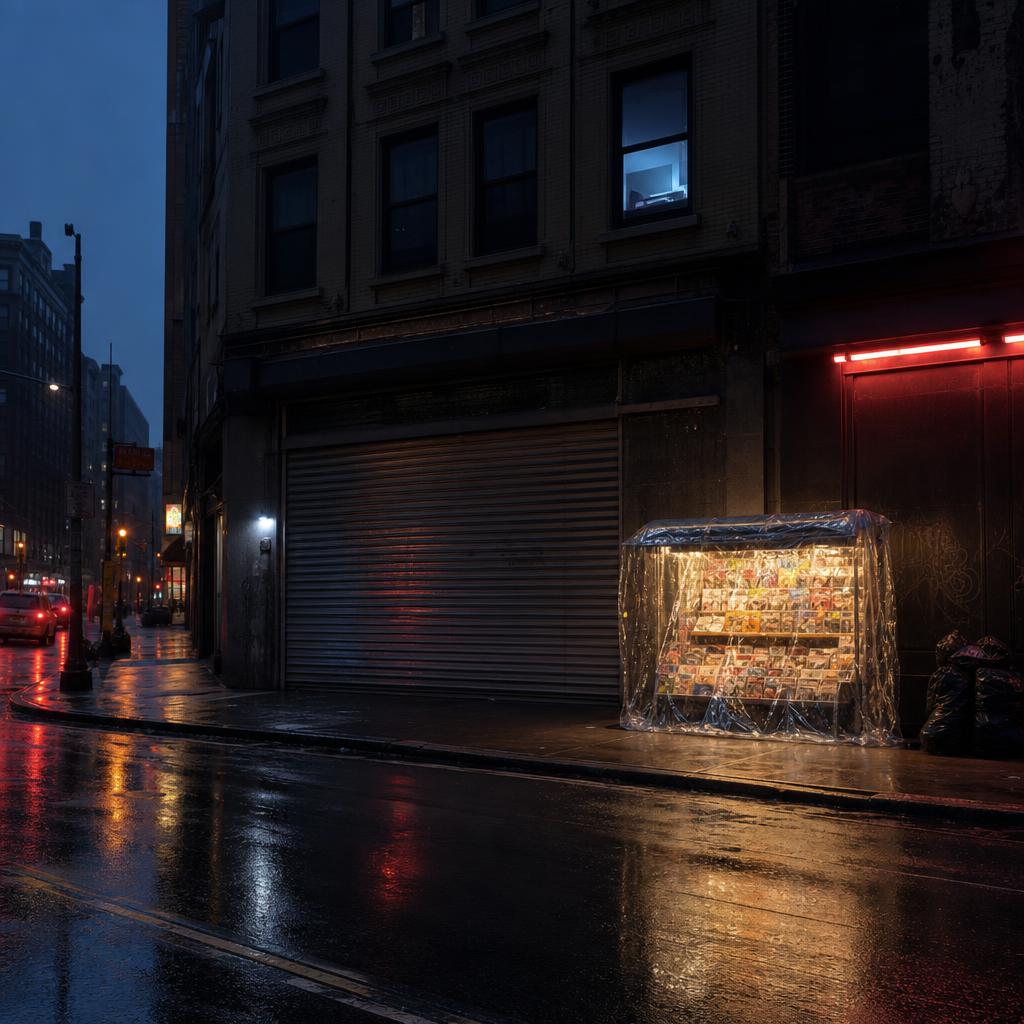
The city’s retail geography sorted the same way. The big midtown newsstands — corner stands at 42nd and Sixth, 53rd and Sixth, the kiosks around Times Square — kept Playboy and Penthouse on the upper rack, increasingly sealed in clear plastic as an informal “shrink-wrap rule” tightened from around 1992 onward; Hustler sat behind the counter at most of them, and a customer asked for it by name. Bodegas stratified by neighborhood — the Upper East Side often did not stock Hustler at all, while stores in Hell’s Kitchen and the Lower East Side carried the full range. Eighth Avenue between 42nd and 50th held the city’s densest concentration of adult bookstores; its largest storefront, Show World Center, was known in the press as the “McDonald’s of sex.”5 The Strand and the smaller used-book shops of the Village sold back-issue Playboys by the box, and the transaction carried none of the newsstand’s charge: a 1968 copy read as a collector’s piece, bought for the interview, where a current issue read as current use. The whole geography began contracting in October 1995, when Mayor Rudolph Giuliani signed a zoning amendment barring adult businesses from residential districts and from within 500 feet of a school, a house of worship, or another adult establishment; the roughly 177 adult establishments the city then counted fell, over the years that followed, toward a couple of dozen.6 The cause had nothing to do with the technology arriving to replace the storefronts, and the two coincided anyway.
The non-straight, non-male press occupied a separate shelf entirely. On Our Backs, founded in 1984 by Debi Sundahl and Myrna Elana with Susie Bright editing from the first issue through 1991, was the first erotica magazine made by lesbians for lesbians, sold at the Village’s specialty bookstores in a black-and-white, art-photography register the mainstream magazines never approximated.7 The Mavety Media Group ran the equivalent hierarchy for gay men: Mandate, launched in 1975 and read as the category’s Playboy, reached a peak circulation above 100,000; Honcho, from 1978, ran leather and bear material; Inches specialized further, with Black Inches and Latin Inches as race-specific spin-offs; Playguy, from 1976, worked the younger end.8 The Advocate’s own sister title, Advocate Men, later renamed Men, sold beside The Advocate itself at the same newsstands and occupied gay publishing’s Playboy position — glossy, lifestyle-adjacent, less explicit than the rest of the shelf. The porn-forward Eighth Avenue stores, Big Apple Oasis and Unicorn Books among them, carried the gay-male material in volume that the literary shops would not stock. Christopher Street Books and, from May 1990, the Chelsea branch of A Different Light carried the magazines and the videotapes alongside literary stock; the Oscar Wilde Memorial Bookshop, opened by Craig Rodwell in 1967 as the country’s first gay bookstore and moved to 15 Christopher Street in 1973, did not — its remit stayed literary, and it sold On Our Backs and The Advocate but nothing further down the shelf.9
Behind the Curtain
Blockbuster Video, founded in 1985, built its national expansion on a policy decision made at the outset: no adult titles, ever, on any shelf.10 The policy cost Blockbuster nothing it wanted and won it a customer base of parents who let their children wander the aisles unsupervised — a competitive advantage against the mom-and-pop stores that had no such rule. Those independent stores filled the gap Blockbuster left, most often with a partitioned back room behind a beaded curtain or a swinging door marked ADULTS ONLY, positioned so that anyone browsing New Releases could see a customer disappear behind it. Dedicated adult video stores, thick along Eighth Avenue, dispensed with the curtain altogether: blacked-out windows, fluorescent light, an elevated counter with the register in view of the door.
The box on the shelf followed its own templates, generic enough that a customer could read the genre without opening the case. Parody titles rode six months behind whatever mainstream film they riffed on — Edward Penishands, Forrest Hump; compilation series ran past volume eighty under a single numbered name; the surviving “couples market” sold plot tapes built around a handful of contract performers, Janine Lindemulder, Christy Canyon, and Jenna Jameson among them, whose names on a spine did for a rental customer roughly what a studio’s own name did on a mainstream release.11 The plastic clamshell itself was slightly tackier to the touch than a mainstream rental case, which meant the box announced itself even shelved without a label.
The tape itself was a rental transaction with its own arithmetic. New-release adult titles ran $3.99 to $4.99 a night, catalog titles $2.99 to $3.99, late fees a dollar or two a day — ordinary rental pricing, extraordinary only in what returning the tape cost the customer in nerve. The out-of-hours drop box solved the problem for anyone willing to wait; a late return meant the clerk, and the calculus of whether to eat another night’s fee or face the counter was a real, if minor, domestic negotiation. The industry that supplied these stores had its own trade press by 1983, when Paul Fishbein, Irv Slifkin, and Barry Rosenblatt founded Adult Video News as an eight-page newsletter out of Philadelphia — a publication The New York Times later called “to pornographic films what Billboard is to records,” tracking rental data and eventually staging an annual Las Vegas awards show that became the industry’s own Oscars.12
The Cost Crash
The major studios split the same way the magazines had. VCA Pictures, founded in 1978 by Russ Hampshire and Walter Gernert, made big-budget features with scripts and sets, in the “golden age” tradition that ran roughly from Deep Throat’s 1972 release through the mid-1980s.13 Vivid Entertainment, which Steven Hirsch and David James started in 1984, pursued the couples market instead, building higher production values and a stable of contract performers marketed toward women as well as men.11 Evil Angel, which John Stagliano founded in 1989, pioneered “gonzo”: handheld, point-of-view, no plot, no set, the camera operator and the performer often the same person. Evil Angel grossed roughly a million dollars a year within its first several seasons of operation and, by the back half of the decade, was moving product in the hundreds of thousands of tapes annually — a volume the golden-age studios had never approached and did not survive competing with.14 The arithmetic was the whole story: production cost fell, output rose, and the feature-length, script-driven work lost ground to the cheap and the prolific.
Gay pornography ran a parallel stratification with a different watershed. Falcon Studios, which Chuck Holmes founded in 1971, built its brand on a California-clean look — bright light, swimming pools, athletic bodies — that gave it the category’s prestige position; Colt, which Jim French started in 1967, worked an older, hyper-muscular, photography-first aesthetic that read as art rather than commerce; Catalina Video, run by the producer Scott Masters, occupied the broader middle ground.1516 AIDS reshaped the product before it reshaped anything else in the business, tightening the condom requirement already standard across the category into something closer to unbreakable. A specialty market in unprotected sex reemerged toward the end of the decade; Treasure Island Media, founded in San Francisco in 1998 by Paul Morris, became its most-discussed producer.17
The Slow Reveal
Usenet predated the web and ran on a different architecture entirely: messages posted to one server propagated to peer servers worldwide over the Network News Transfer Protocol, organized into newsgroups a reader subscribed to by hand.18 The relevant hierarchy, alt.binaries.pictures.erotica and its proliferating subcategories, carried images as uuencoded or yEnc-encoded text, a single JPEG split across five to twenty separate articles that a news reader reassembled on the user’s own machine. A typical 1995 image ran 100 to 300 kilobytes; a 28.8k modem delivered roughly 3.5 kilobytes a second in practice, so the picture built top to bottom on the screen over thirty seconds to a minute and a half, and a broken multipart article meant the reassembly simply failed. Finding anything required a usenet account, a news reader, and a working knowledge of which of thousands of newsgroups to search — knowledge that traveled by word of mouth and by monthly FAQ postings until DejaNews, founded in 1995, became the first tool that let a user search the archive directly.19 Anyone whose own internet provider omitted a news server bought access separately from a subscription service such as Giganews, founded in 1994 for exactly that gap. For roughly three years, 1994 to 1997, actively locating pornography online required real technical literacy, and the people who had it were not exclusively young men: sysadmins, academics, and journalists on the technology beat made up a real share of the audience.
The shame architecture migrated with the medium. A browser stored thumbnails in a cache folder a spouse could open by accident; a news reader kept an unread/read history that persisted until cleared; America Online let one account hold multiple screen names, and the second name became the wall between a household’s public use of the computer and its private use. Most households owned exactly one computer until close to 1998, so the machine itself was a shared object, and giving a folder an innocuous name was a real and common practice rather than a special precaution.
Where It Was Hidden
| Medium | Where it was hidden | The vulnerability |
|---|---|---|
| Magazine (Playboy, Penthouse) | Bottom of a drawer, behind books on a high shelf, a locked briefcase at the office | The cleaning person, a visiting parent, a spouse looking for a tax document |
| Magazine (Hustler) | Under the mattress, a closet shoebox | The same searches, without “the interviews” as cover |
| VHS tape | A shoebox under the bed, behind winter coats, a relabeled spine | A child’s or roommate’s hand reaching the VCR by accident |
| Usenet binaries | A misnamed folder, a cleared news reader | The shared family computer, the office systems administrator |
| 1-900 call | Nothing physical — the bill itself | The spouse who opened the long-distance statement |
| Paysite subscription | A cleared browser history, a second Windows account | The credit-card statement’s line item |
| Cable (Channel 35) | Nothing — broadcast, watched late, volume low | A neighbor’s glance at the television’s glow through a window |
The Wrong Name on the Bill
A 1-900 charge never arrived as a physical object to hide; it arrived as a line on the monthly long-distance bill, which is part of why the architecture worked — a household where one spouse paid the local bill and the other handled long-distance had a built-in blind spot. The line item itself was designed to say nothing: a service-bureau name like AMERIQUEST COMMUNICATIONS or INTEGRETEL, two or three wholesale-sounding words, never DIAL-A-SEX, never the number actually dialed. The industry’s size and its call-center geography are treated elsewhere in this part; the fact that belongs here is the bill itself, and what changed about it. The Telephone Disclosure and Dispute Resolution Act, signed into law on October 28, 1992, required pay-per-call services to disclose their price before the meter started, to carry mandatory warnings on any service that might target children, to give consumers the right to dispute a charge without losing local phone service, and to let a household block 900-numbers entirely at no cost.20 The Federal Trade Commission’s implementing rule followed in 1993, and the 900-charge was pushed into its own clearly labeled section of the bill rather than folded anonymously into the total. None of it made the underlying transaction visible; it only made the invisible transaction harder to be surprised by, after the fact, on the kitchen counter.
Free With the Cable Bill
Robin Byrd ran the one medium in this economy that cost nothing beyond what a household already paid. She had renamed her own program The Robin Byrd Show in 1977, broadcasting first on Channel J, Manhattan Cable Television’s famously uncensored public-access channel, and later on Channel 35, a leased-access outlet that Time Warner Cable Manhattan carried into the late 1990s.21 The format never changed: Byrd, in her trademark black mesh top, interviewed adult performers on a set built around a vinyl couch, the interview a frame for a strip segment set to her closing theme, “Baby, Let Me Bang Your Box,” and a kiss to the camera. It aired Friday and Saturday nights, past midnight, and it existed because federal law required it to: the Cable Communications Policy Act of 1984 obliged cable systems to carry public-access channels and barred the operator from controlling their content, and Manhattan’s public-access system, among the most active in the country, filled its latest weekend hours with exactly this kind of unclassifiable programming.22 Byrd’s audience was deliberately two audiences at once — genuine late-night viewers, and a downtown literary and queer crowd that watched her as camp, an appreciation confirmed when her image appeared in Madonna’s “Erotica” video. A specific anxiety attached to the channel that had no basis in how the technology worked: viewers worried that the cable box itself logged which channel a household watched and reported it back to the operator. A pay-per-view order did appear on the monthly bill; ordinary channel-tuning did not, in a system with no return path for that information until digital cable arrived after the period closed. The fear outran the wiring. Every other medium in this economy required its own separate payment, its own transaction to explain or conceal. Channel 35 arrived bundled into the same monthly cable bill that carried MTV and ESPN, and the only cost of watching was staying up.
The Paysite
Web pornography from 1996 onward organized itself around the paysite: a single domain with a free “tour” page of thumbnails, the rest locked behind a password bought with a credit card. Monthly rates ran $9.95 to $29.95, and the charge appeared on a statement through an intermediary processor — CCBill, Epoch — under a deliberately generic line item, “INTERNET BILLING” or “WEB SERVICES,” sometimes a numbered LLC. The statement on the kitchen counter could not say what it was for, by design.
Danni’s Hard Drive, the site Danni Ashe launched from a spare bedroom in July 1995 with $8,000 of her own money, is generally credited as the first profitable adult paysite.23 Its revenue grew quickly across its first years, reaching around $3 million in 1997 and, by 2000, roughly $6.5 to $7 million annually from about 27,000 subscribers to its “HotBox” membership tier.24 The Wall Street Journal profiled her; she testified before the federal COPA Commission in 2000, and that August the Guinness Book of World Records named her the most downloaded woman on the internet.23 What made Danni’s Hard Drive significant beyond its own numbers was the proof it offered before anyone else had offered it: that a household would pay a flat monthly fee, sight unseen, for content delivered over the internet, on the strength of a brand rather than a single transaction. Subscription internet was incubated in pornography before it was incubated anywhere else.
Streaming video arrived at the end of the period, and it arrived crude. RealPlayer, which held more than 95 million users and something above 85 percent of the streaming-media market by 2000, delivered “full-screen” video at 320 by 240 pixels and two to eight frames a second over a dial-up line, launched from a browser pop-up after a buffering bar crawled for ten or thirty seconds.25 Adult Friend Finder, the personals site Andrew Conru founded in 1996 after users of his general dating site began posting nude photographs on their own, became a major traffic node between paysite culture and the emerging world of online dating.26 No tube site existed yet to give any of it away for free; the user-uploaded video model lay beyond the period entirely, and so every paysite in these years remained a walled garden a household paid to enter, one credit card at a time. The same arithmetic that had emptied the golden-age studio in the video era — production cost falling, volume rising, the durable and expensive work losing ground to the cheap and the prolific — was reshaping the magazine business by the very same years, for a symmetrical reason.27
A senior writer who bought Playboy at a kiosk in 1989 was, by 2001, paying a monthly credit-card charge to a company whose name meant nothing on the statement, for video delivered over a connection that had not existed five years earlier. Every technology in between — the shrink-wrapped rack, the beaded curtain, the news reader, the paysite — invented its own object to hide and its own place to hide it, and each invention was received, in its moment, as more private than the one before it. None of them were. What moved between 1989 and 2001 was not the presence of shame but its address, migrating from a shoebox to a browser cache to a line on a statement, changing shape fast enough that no single decade’s household ever quite caught up with where it had gone.
Three items touching the decade’s paysite economy would have crossed The Front, and no two would have arrived by the same door. The phone-bill disclosure law of 1992 would have reached The Front in early 1993, but only after the room would have decided the reporting toward the phone-sex trade the statute had chiefly been written for would have outrun anyone then on staff; what would have run instead would have covered psychic hotlines and telemarketing, the underlying industry left off the page. DejaNews’s 1995 launch would have found The Front already committed: the technology column, two issues earlier, would have carried a different search-engine roundup, and a second archive-search item inside the same volume would have read, to the desk, as repeating itself rather than reporting news, so what would have closed instead would have named searchable internet archives generally, without alt.binaries.pictures.erotica or the traffic that had made the tool necessary. The Front would have closed the decade with a business-page item built from Danni Ashe’s Guinness record, her subscriber numbers would have been cited to illustrate the coming internet economy in general terms, and the account of what her own site actually sold would have been withheld because a rival masthead would already have been presumed to own that story.
Her earlier moment would have found no purchase at all. The spare-bedroom launch that became Danni’s Hard Drive, in July 1995, would have arrived with no date to hang it on — late by design, with nothing in the decade’s calendar to anchor the lateness — and would have gone no further than a business editor’s memory. Andrew Conru’s 1996 pivot from a general dating site into a market for user-posted nude photographs would have reached the room and would have stalled there, would have been ceded to whichever masthead its editors presumed already owned the personals beat. Paul Morris’s 1998 studio, founded in San Francisco to produce the era’s bareback material, would never have crossed a Meridian desk: no beat on the floor would have touched it, and the masthead would never have known Treasure Island Media existed.
Footnotes
-
Wikipedia, “Sexually transmitted infections in the pornography industry,” https://en.wikipedia.org/wiki/Sexually_transmitted_infections_in_the_pornography_industry; Wikipedia, “Gay pornography,” https://en.wikipedia.org/wiki/Gay_pornography. ↩
-
Wikipedia, “Playboy,” https://en.wikipedia.org/wiki/Playboy. ↩
-
Encyclopedia.com, “Penthouse,” https://www.encyclopedia.com/penthouse. ↩
-
Wikipedia, “Hustler Magazine v. Falwell,” https://en.wikipedia.org/wiki/Hustler_Magazine_v._Falwell. ↩
-
Untapped New York, “Times Square: The History of Show World Center, ‘The McDonald’s of Sex,’” untappedcities.com. ↩
-
CBS News, “Did Giuliani Really Clean Up Times Square?”; The Christian Science Monitor, “New York’s Zoning Laws Create X-Rated Hybrids,” September 29, 1998. ↩
-
Wikipedia, “On Our Backs,” https://en.wikipedia.org/wiki/On_Our_Backs. ↩
-
Wikipedia, “Mavety Media Group,” https://en.wikipedia.org/wiki/Mavety_Media_Group. ↩
-
Wikipedia, “Oscar Wilde Bookshop,” https://en.wikipedia.org/wiki/Oscar_Wilde_Bookshop; Wikipedia, “A Different Light (bookstore),” https://en.wikipedia.org/wiki/A_Different_Light_(bookstore). ↩
-
Wikipedia, “Blockbuster (retailer),” https://en.wikipedia.org/wiki/Blockbuster_(retailer). ↩
-
Wikipedia, “Vivid Entertainment,” https://en.wikipedia.org/wiki/Vivid_Entertainment. ↩ ↩2
-
Wikipedia, “AVN (magazine),” https://en.wikipedia.org/wiki/AVN_(magazine). ↩
-
Wikipedia, “VCA Pictures,” https://en.wikipedia.org/wiki/VCA_Pictures. ↩
-
Wikipedia, “Evil Angel (studio),” https://en.wikipedia.org/wiki/Evil_Angel_(studio); David Segal, “The Maharajah of Poontang,” Salon, November 8, 1999. ↩
-
Wikipedia, “Falcon Entertainment,” https://en.wikipedia.org/wiki/Falcon_Entertainment. ↩
-
Wikipedia, “Colt Studio Group,” https://en.wikipedia.org/wiki/Colt_Studio_Group; Wikipedia, “Jim French (photographer),” https://en.wikipedia.org/wiki/Jim_French_(photographer). ↩
-
Wikipedia, “Treasure Island Media,” https://en.wikipedia.org/wiki/Treasure_Island_Media. ↩
-
Wikipedia, “Usenet,” https://en.wikipedia.org/wiki/Usenet. ↩
-
Ernie Smith, “Usenet History: How Binaries Took Over Newsgroups,” Tedium, October 3, 2017. ↩
-
Congress.gov, “H.R.6191 — Telephone Disclosure and Dispute Resolution Act,” 102nd Congress, enacted October 28, 1992; Federal Trade Commission, “Telephone Disclosure and Dispute Resolution Act of 1992,” ftc.gov. ↩
-
Wikipedia, “Robin Byrd,” https://en.wikipedia.org/wiki/Robin_Byrd. ↩
-
Wikipedia, “Cable Communications Policy Act of 1984,” https://en.wikipedia.org/wiki/Cable_Communications_Policy_Act_of_1984. ↩
-
Wikipedia, “Danni Ashe,” https://en.wikipedia.org/wiki/Danni_Ashe. ↩ ↩2
-
The Hustle, “The stripper who ushered in the modern subscription-based internet,” thehustle.co. ↩
-
Wikipedia, “RealPlayer,” https://en.wikipedia.org/wiki/RealPlayer. ↩
-
Wikipedia, “Adult FriendFinder,” https://en.wikipedia.org/wiki/Adult_FriendFinder; Wikipedia, “Andrew Conru,” https://en.wikipedia.org/wiki/Andrew_Conru. ↩
-
Treated at length in chapter 3.13, “Print Journalism’s Existential Crisis.” ↩