The House: Ballroom as Mutual Aid, 1989–1998
Subscribe
https://meridian-archive.com/feed.xmlOpen in your app, or paste the link above into any other:
The Floor and the Trophy
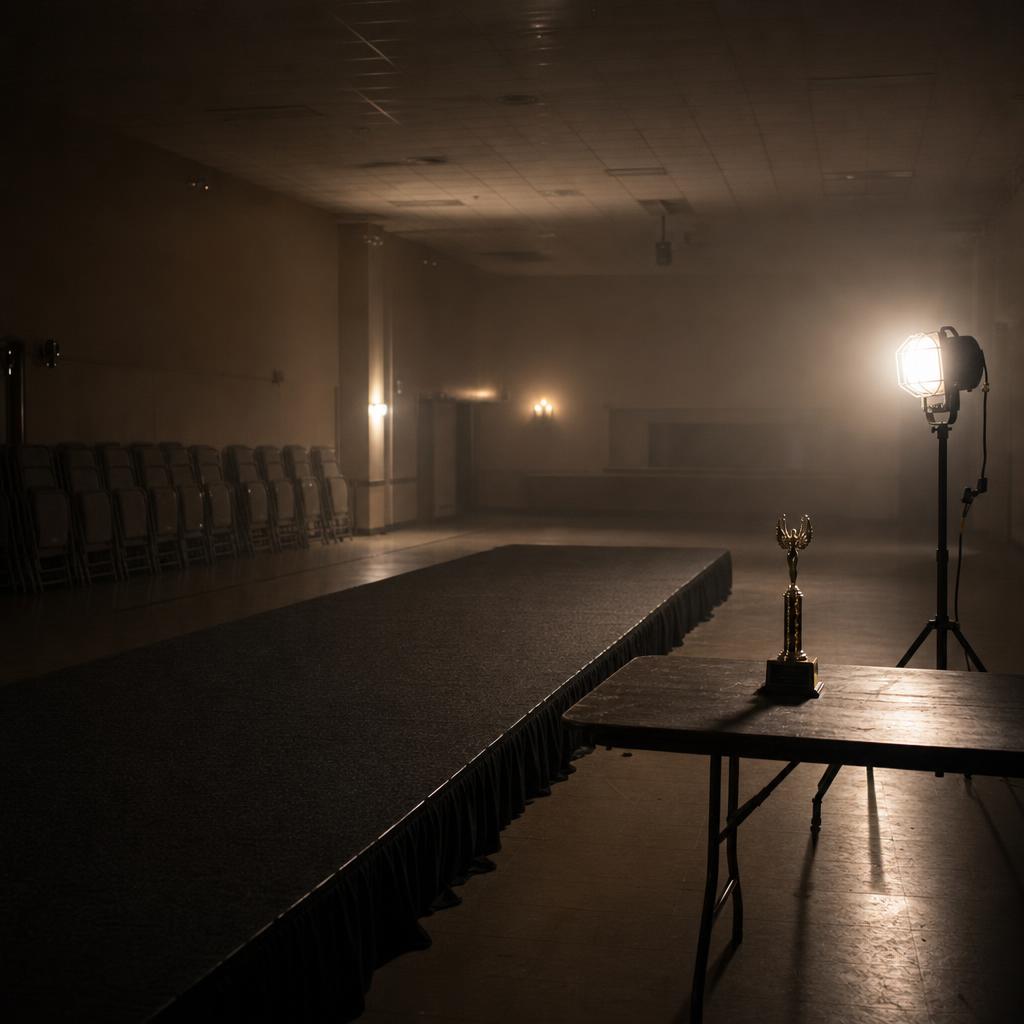
The Gay Men’s Health Crisis, the city’s largest AIDS service organization, ran an annual drag-ball competition on its own HIV-prevention calendar. Its House of Latex Project, founded in 1989, staged the first Latex Ball the following year — houses walking against houses for trophies, judges scoring realness and vogue at a card table, exactly as at any ball a House itself produced — and condoms went out at the door alongside the trophies, an outreach line item budgeted and run by a nonprofit through the same calendar cycle as its clinics and hotlines.1 A ball, on any other night of the year, ran on a rented floor — a hotel function room, a hall taken by the hour, folding chairs stacked against the wall to clear space for the runway down the middle. A commentator worked a microphone and called categories one after another through the night: butch queen realness, executive realness, femme queen realness, vogue. Contestants walked, one house against another, for a trophy that cost the promoter a few dollars at a Manhattan trophy shop and meant, on the floor, considerably more than that. The room ran hot by midnight, the air thick with hairspray and cigarette smoke, the crowd packed in around a runway too narrow for the number of people trying to see it. The same rooms that staged this competition — categorical, judged, occasionally vicious in its judging — doubled, across the same years, as the site of a chosen family structure that had taken in members whose biological families had not. The trophy and the outreach table were not opposed purposes occupying the same building by coincidence. They were the same institution doing what it had always done: producing belonging through structure, at a moment when belonging and survival had become close to the same problem.
The House
A House was named for its founder or its line of succession — the House of LaBeija, the House of Xtravaganza, the House of Ninja, the House of Pendavis, the House of Dupree — and organized around a fictive kinship structure that mapped family roles onto the House’s leadership: a mother, sometimes a father, and children, the members she had taken in.2 The Houses that carried a name into the 1990s had, by then, already run for years; the structure was not improvised anew each year but inherited, House to House, mother to daughter-mother, across a line of succession that predated most of its own members. Membership was frequently the direct consequence of expulsion. A member arrived at a House having been thrown out of a biological household for being gay or transgender, sometimes as a teenager, with nowhere else structured to receive him. The House supplied what the biological family had withdrawn — a roof on hard nights, food, coaching in how to walk a category and how to survive on the street between balls, and a chain of adult authority that took responsibility for members considerably younger than the mother herself. A House mother’s authority was real and specific: she assigned categories to walk, she disciplined a child who competed for a rival House, she represented the House’s standing in negotiations with other House mothers, and she was, in the literal sense the term claimed, accountable for the people under her name.
The ball itself ran on categories, each a costume-and-performance brief a competitor built an entire look around: an executive suit read as convincingly corporate as any man who worked on the eleventh floor of a Midtown office tower; military dress; a débutante gown; a body sculpted and presented as if born, rather than performed, into a given gender presentation. Voguing — the dance, angular, frozen-frame, borrowing its geometry from fashion-magazine poses held and released in sequence — was itself a category and also the ambient texture of the floor between categories, danced in circles that formed and dissolved around whoever was voguing hardest at a given moment.
A House’s authority did not stop at the door of the hall. It extended into the rest of the week the way a family’s did: a mother fielding a phone call at two in the morning from a child in trouble, a mother deciding which of her children would walk which category at the next ball and coaching the walk in a living room beforehand, a mother settling a dispute between two children the way a parent settled a dispute between siblings, because that was, in the vocabulary the House itself used, exactly what she was. Rivalry between Houses could be sharp — a category lost badly enough could start a feud that outlasted the ball that produced it — but the rivalry sat inside a larger structure of mutual recognition: every House mother in the room understood every other House mother’s job, because it was, in its particulars, her own.
After the Film
Ballroom’s mainstream surface arrived twice inside a single year, and both times without the House system’s consent. Madonna’s single “Vogue,” released March 20, 1990, took the dance’s name and a version of its geometry to a national pop audience that had never seen a House ball and would not recognize the word House as this world used it.3 Jennie Livingston’s documentary Paris Is Burning, shot across the House scene between 1986 and 1989, won the Grand Jury Prize for documentary at Sundance in January 1991 and opened theatrically that March, grossing several times its budget and putting Willi Ninja, Pepper LaBeija, Junior LaBeija, Octavia St. Laurent, Dorian Corey, and the Houses of Xtravaganza, Ninja, LaBeija, Pendavis, and Dupree in front of an audience outside the rooms that had produced them.4 Christian LaBeija, Grandfather of the House of LaBeija, later dated the scene’s visible growth to that release: by his account the number of active Houses in New York ran to about twenty-seven before the film and to about seventy within a year of it.2 The scene had grown, visibly, in the balls’ own attendance — but the growth did not translate cleanly into income for the people the film had made visible.
Willi Ninja, founder of the House of Ninja and the era’s most consequential vogue choreographer, converted his visibility into a run of commercial work — runway appearances for Jean-Paul Gaultier and choreography credits on music videos for Malcolm McLaren’s “Deep in Vogue” and for Janet Jackson.5 It was a narrow crossover, available to one dancer of exceptional and already-established skill, and it sat inside a wider resentment that ran through the Houses at the same time: a commercial dance-music single and a festival documentary had both drawn on a form built inside a community that received, in the main, none of the money the form generated once it left the room. The scene had been made visible to a national audience without being compensated by it, and the imbalance was widely felt inside the Houses as exactly that: an imbalance, not a favor.
What the Coverage Missed
The city’s alternative press did cover the scene across these years, mainly through Michael Musto’s nightlife column in the Village Voice, which treated the balls as a downtown curiosity adjacent to the celebrities who occasionally turned up to watch — a register that read the Houses’ extravagance and wit as spectacle rather than as the institution’s daily working purpose. What the column’s celebrity-adjacent frame passed over was the part of the House’s function that produced no photograph: the mother on the phone with a hospital, the House quietly absorbing a member’s funeral costs, the informal welfare network running underneath the runway. The gap between what got covered and what was actually happening was not a failure of access — reporters could and did get into balls — but a failure of category. The coverage was built to notice the costume; what the Houses were actually living was the family. A column built to file weekly nightlife items had a structural preference for the legible unit — a look, a quote, a celebrity sighting — over the slower, undocumented labor a House performed between balls, labor that produced no photograph and answered to no deadline. The coverage was not dishonest. It reported the part of the institution a weekly column was equipped to notice, and it left the rest unreported.
The Latex Ball
The epidemic ran through the Houses with the same intimacy it ran through every part of gay New York, and the House structure — a mother accountable for a defined roster of children, a chain of people who already checked in on one another — did work in the epidemic’s middle years that no outside agency was positioned to do. A House mother coordinated hospital visits for a sick member with no other visitor. She organized benefits to cover a funeral a family declined to pay for, or declined to attend. She passed along what she knew about hormone access, about which clinics asked fewer questions, about which corners were dangerous that week for members doing sex work to survive between balls. None of this ran through a nonprofit’s letterhead or a foundation’s grant cycle. It ran through the House, because the House was already there, already organized, and already understood as an institution that took responsibility for its own.
The welfare work and the competitive work were not separable functions performed by the same organization; they were a single function performed on different nights. A mother who spent a Tuesday afternoon at a hospital bed spent a Saturday coaching a category walk with the same attention, because both were the House doing what a House did — looking after its own, whether the need on a given week was a trophy or a diagnosis. Biological families that had severed a member for being gay or transgender rarely reversed the decision when illness arrived; the House, not the family of origin, was frequently the body that made funeral arrangements, notified the next of kin the deceased had actually chosen, and stood in the room a biological family had declined to enter.
None of this welfare function was written into a charter or recognized by any city agency as a service. A House held no tax-exempt status, filed no annual report, and received no line item in anyone’s budget. It ran on what a mother could raise from her children and from the Houses she was on good terms with — a benefit night’s door money, a collection passed hand to hand at a ball, a debt called in from a House that owed hers a favor from a year no one wrote down. The informality was, in its way, the point: an institution built and run entirely by people the formal welfare system had already failed once could not afford to wait for that system to notice it. It built its own instead, out of whatever it already had — a name, a hierarchy, and a floor full of members who had learned, from the inside, exactly what it cost to have nowhere else to go.
The scene’s own demographic engine worked against it in these years in a specific way: the elders who held the form’s institutional memory — the mothers who had built and run Houses since before the film, who could teach a category’s history along with its technique — were the generation the epidemic struck hardest. Angie Xtravaganza, mother of the House of Xtravaganza, died of AIDS-related illness on March 31, 1993, at the age of twenty-eight.6 A House that lost its mother lost, at the same moment, its custodial structure and its archive. The transmission line between the founding generation and whoever would have carried the form forward ran thinner with each such death, at precisely the period when the film and the single had made the form more visible than it had ever been to an audience that had no part in sustaining it. What organized itself among younger members in the years just past the period, working alongside GMHC and other youth-service groups toward the Houses’ original purpose, belonged to a later stage of the same institution, past this account’s period.
The Houses solved a problem the rest of the city had not agreed existed: what to do with a young person a family had put out the door for being who he was. They solved it with a structure borrowed from the family itself — a mother, a set of children, a name to answer to — built and rebuilt across a generation of members who had nowhere else that would take the role seriously. That the same structure produced, on the same nights, a competition judged on the precision of an executive suit and, on one night a year, a citywide push to get a condom into every hand that walked through the door, was not a contradiction the Houses had to resolve. Care and competition ran through the same rooms because the rooms had never been asked to be only one thing.
A pitch for a City piece on the House scene itself would have surfaced more than once in the years after Paris Is Burning opened, and would have lost the argument in the room each time, not for want of interest but because it could not have cleared the checking desk. A ball was built to admit only its own members; a reporter’s presence would have changed what he was there to record, and no fact he brought back would have stood up to verification at the standard the desk required. The story would have gone down as unsourceable, discussed and declined more than once.
Meanwhile the borrowed surface of the same scene would have found its way into the book by routes the Houses never controlled. Madonna’s single would have carried nothing of the dance’s origin, only its name, and The Front would have run a note on it that June regardless. Sundance’s prize for the documentary that had actually shot inside the Houses would have reached readers differently: a critic would have claimed the review for The Back that May, weighing the film on its own terms rather than the scene’s.
A brief on the Gay Men’s Health Crisis’s new Latex Ball would have been claimed for The Front that October as well, the House mothers and the House names it was actually organized around stripped out before it would have run — a contributing editor’s worry that naming a House risked a foundation’s standing on the magazine’s own donor list would have reduced a competition to a condom count.
Angie Xtravaganza’s death would have reached the floor only through an obituary already printed elsewhere, and the one editor positioned to push it would have let it go: he would have clashed with the freelancer who would have floated it, over an unrelated piece the year before, and the idea would never have gotten a fair reading with that name attached.
Footnotes
-
“How GMHC’s Latex Ball Has Been Promoting LGBTQ+ Health for 30 Years,” The Advocate, March 22, 2022. ↩ ↩2
-
Tim Lawrence, “‘Listen, and You Will Hear all the Houses that Walked There Before’: A History of Drag Balls, Houses and the Culture of Voguing,” timlawrence.info, 2011; house-count estimate (about twenty-seven Houses before Paris Is Burning, about seventy within a year of its release) attributed there to Christian Marcel LaBeija. ↩ ↩2 ↩3
-
Madonna, “Vogue,” Sire Records, released March 20, 1990. ↩
-
Paris Is Burning, directed by Jennie Livingston (Off White Productions, 1990), Sundance Grand Jury Prize for documentary, January 1991; U.S. theatrical release, March 1991. ↩ ↩2
-
“Willi Ninja,” Wikipedia (accessed 2026) — biographical entry, including birth and death years and his choreography and modeling credits. ↩ ↩2
-
Jesse Green, “Paris Has Burned,” The New York Times, April 18, 1993. ↩ ↩2