The Newspaper Wars: New York's Print Battlefield, 1989–2001
Subscribe
https://meridian-archive.com/feed.xmlOpen in your app, or paste the link above into any other:
The Coded Page
By 1989 the classified pages that ran in the back of the Village Voice carried personal advertisements in a fixed abbreviation system printed without a key anywhere on the page: GWM, SBF, ISO, and the rest of an alphabet standing for gay white male, single Black female, in search of, set between that week’s apartment listings and job postings in the same type, the same rate structure, the same layout grid the paper used to sell a sublet or a secretarial opening. No legend ran in the corner of the page. No annual explainer column walked a new reader through the code. The Voice’s own classified department had administered the vocabulary long enough that it required no translation — a stranger’s want, in a hundred characters or fewer, filed and typeset as routinely as a hiring notice.
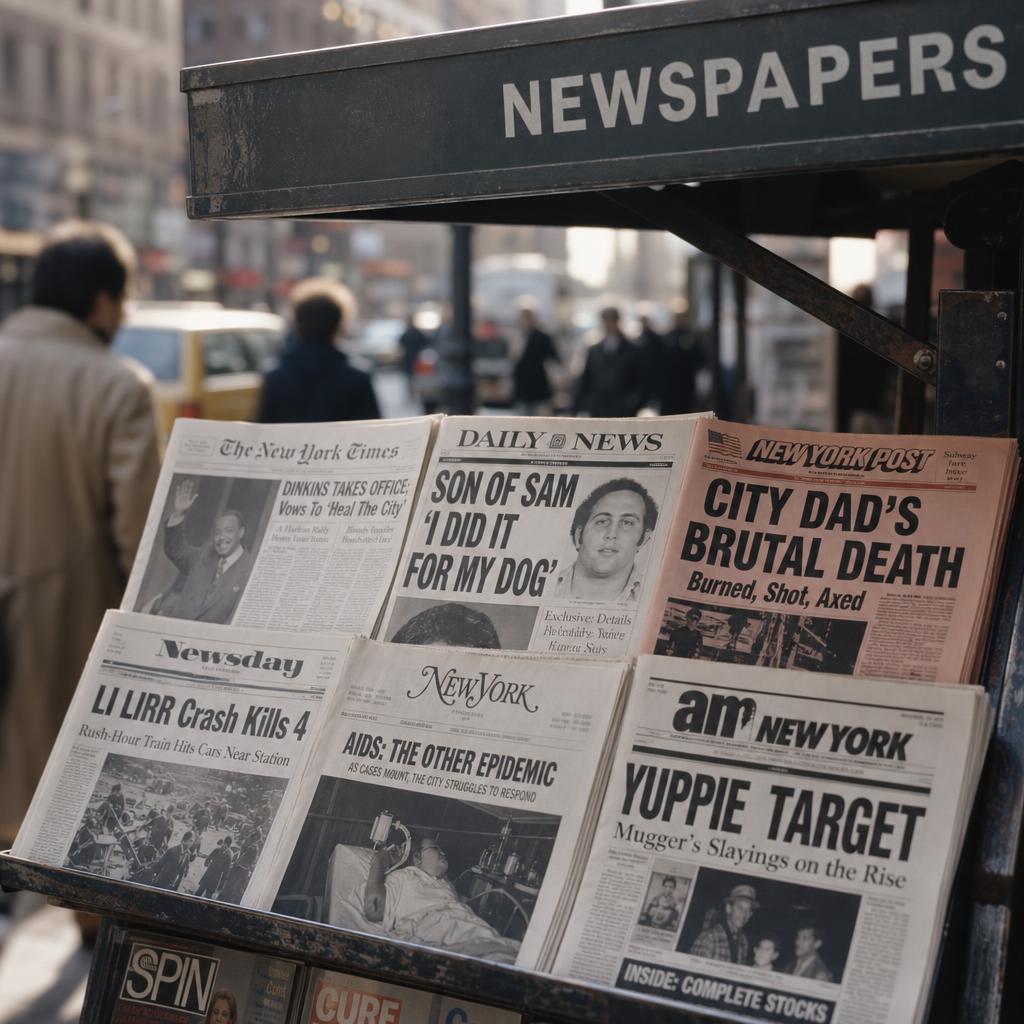
The dailies fought over the front page the way the classifieds absorbed the personals: as settled procedure, not spectacle. In April 1983 the New York Post gave its entire front page to five words about a killing in a Queens bar: HEADLESS BODY IN TOPLESS BAR. The same morning the New York Times ran the same crime on the second page of its metropolitan section under a headline of its own: OWNER OF A BAR SHOT TO DEATH; SUSPECT IS HELD.1 One headline dramatized the killing; the other recorded it. The two described an identical event and proposed two incompatible theories of what a newspaper was for.
Vincent Musetto, a Post editor, wrote the first, and the form he crystallized became the house grammar of the tabloid front page for the decade that followed: maximum information in minimum space, with a standing preference for the lurid, the punning, and the alliterative. The front page was a compression engine. Its repertoire was small and exact — the single-word shout in capitals over a photograph (BUST, CAUGHT, SHAME); the pun that carried a body count and a joke in the same six words; the imperative addressed to an official by his first name. After a young tourist, Brian Watkins, was stabbed to death defending his mother against a gang on a subway platform in September 1990, the Post ran DAVE, DO SOMETHING! across a full page at Mayor David Dinkins, the first-name address functioning at once as a claim of familiarity and as a form of contempt.2
The Daily News answered from the back. Its back page was the most valuable sports real estate in the city, and it carried the same exclamatory grammar turned toward the Mets and the Knicks and the fight game. Two staffs of headline writers competed every morning to be more memorable, more devastating, or more entertaining than the other, and both papers ran their front-page photographs full-bleed and as dramatic as the day allowed — a body under a sheet, a suspect in handcuffs, a fire, a pennant. The News had the older and stronger tradition of news photography and more of the prizes to show for it; the Post shot for maximum impact and rarely apologized for the choice. When O. J. Simpson was arrested in the summer of 1994, the two papers produced competing front pages for weeks, because for the readership that bought them it was the biggest story there was. The competition was not a figure of speech. It was waged daily, on adjacent newsstands, for the same quarter.
Magazine people consumed the form as professionals, students of a craft they would not always admit to studying. The compression of a tabloid front page and the construction of a magazine cover were different skills pointed at the same problem: making a stranger decide, in under two seconds, whether the thing in front of them deserved attention. The tabloid solved it through shock and the cover through aspiration. The people who could do either job well understood the other’s difficulty exactly.
Murdoch’s Weapon, Twice
Rupert Murdoch had owned the Post since 1976, when he bought it for about $30.5 million, and in February 1988 he was forced to sell it — for about $37.6 million, to the real-estate developer Peter Kalikow — not because the paper had failed but because Murdoch had also acquired a television station, WNYW, and a federal rule barred a single owner from holding a newspaper and a broadcaster in the same market once Congress closed the waiver that had let him keep both.3 Kalikow had no newspaper experience and kept losing money without understanding why. By the end of 1989 his cumulative losses had run into the tens of millions, and the paper was reportedly bleeding more than a quarter of a million dollars a week. He filed for personal bankruptcy in 1991.
What followed was the most improbable stretch in the paper’s modern history. In early 1993 control passed briefly to the financier Steven Hoffenberg and then, for barely two weeks, to Abe Hirschfeld, a parking-garage developer who fired the editor, Pete Hamill, and ordered his replacement to draw up a list of more than 270 staff to be cut.4 The newsroom revolted. It produced an edition whose front page ran the paper’s own masthead portrait of Alexander Hamilton with a single tear painted down his cheek, above a text denouncing the man attempting to take the paper over.5 Within weeks Murdoch bought the Post back, after Governor Mario Cuomo and other New York officials helped persuade the Federal Communications Commission to make his cross-ownership waiver permanent.6 From 1993 the paper was his again: a title that lost money by design and returned the loss as political influence it could not have purchased at a profit.
Circulation was never the argument. Through the period the Post sold on the order of 435,000 copies on a weekday, well behind the Daily News, which sold some 729,000, and it did not expect to win on that number. It won on other ground — most of it occupied by Page Six, which the media world read before it read anything else. By the early 1990s the paper’s editorial voice was committed without reservation to Rudolph Giuliani and to the proposition, advanced daily, that Dinkins was failing the city.
The Paper of the D Train
The Daily News had once been the highest-circulation newspaper in the country, a tabloid founded in 1919 that at its peak sold more than two million copies a day. By 1989 it was in serious trouble and still selling close to 1.3 million. Its identity was settled: outer-borough, working-class, Democratic without being liberal-intellectual, with the strongest sports section in the city and a readership that took the back page as seriously as any front.
The strike defined the period for it. On October 25, 1990, a dispute over whether a driver claiming a medical disability could sit down while working set off a walkout; the drivers struck, and nine other unions joined them under the Allied Printing Trades Council.7 The Tribune Company kept the paper publishing with replacement workers, a decision that turned the picket lines violent, and the strike ran roughly five months. For those months the paper’s own front pages were laid out by the replacement workers, the News reporting its near-collapse from the inside. The paper lost more than a hundred million dollars before taxes that year, and its daily circulation fell below 800,000. Robert Maxwell — a British publishing magnate, heavily indebted, in possession of a yacht called the Lady Ghislaine — bought it in March 1991 for about $60 million, extracting some $72 million in union concessions and cutting the workforce from roughly 2,600 to 1,800, and ended the strike. He drowned off that yacht in November 1991, his empire collapsed within weeks, and the paper filed for bankruptcy in December. Mortimer Zuckerman, who already owned U.S. News & World Report and The Atlantic Monthly, outbid the Canadian press baron Conrad Black and took the Daily News out of bankruptcy in early 1993.
The back page carried its own stars. Mike Lupica anchored the sports column for much of the period, and Bill Gallo’s sports cartoons had run for decades, a signature as recognizable to the paper’s readers as any photograph; the identity was tied specifically to the teams of the outer boroughs and the working-class neighborhoods — the Mets as much as the Yankees, the Knicks, the boxing card. This was the paper’s other front page, and its readers turned to it first.
Its political voice was more genuinely Democratic than the Post’s, aligned with the unions that made up much of its readership. Pete Hamill and Jimmy Breslin — the two defining voices of humanist tabloid journalism, both products of the city’s white-ethnic Catholic tradition — wrote from the bars and courtrooms of the outer boroughs in a column-as-city-document tradition wholly unlike the Post’s gossip-first approach; they understood the working class without condescending to it. The Daily News was the paper you read on the D train coming in from the Bronx. The Post was what you bought at a Midtown newsstand when you wanted to know what had happened at a party you had not been invited to.
The Broadsheet
Arthur Ochs Sulzberger Jr. became publisher of the New York Times in 1992, succeeding his father, and the handover began a reorientation more than a change of name at the top. The elder Sulzberger had run the paper through the Pentagon Papers and Watergate, the years in which it most fully inhabited the paper-of-record idea. The son arrived with different priorities — diversification, aggressive national and international expansion, and eventually digital investment — and a willingness to add lifestyle and cultural coverage that the paper of record had long kept at arm’s length. The Sunday Times Magazine was the prestige venue for long-form journalism in American publishing, paying rates most magazines could not match; the Book Review, another Sunday supplement, was the central arbiter of literary standing, where a strong notice could move a novel from a few hundred copies to tens of thousands.
The paper’s other identity was physical. It was a broadsheet, the full-size format that could not be opened flat on a crowded subway car without endangering a neighbor’s eye. On January 22, 1996, nytimes.com began publishing on the World Wide Web, carrying most of the day’s contents, the crossword, and the masthead motto — “All the News That’s Fit to Print” — set above the words ON THE WEB in small capitals.8 The site was free to readers in the United States and charged those who reached it from abroad, an early instinct about where the paper thought value lived. The newsroom treated it as a supplement: something a reader browsed in addition to the paper, not instead of it. The paper-of-record identity had itself been the product of a media monoculture that was already dissolving, and by the late 1990s, with the Observer and the Voice and other titles covering the city each in its own register, the claim to definitive coverage no longer felt automatic.
The Peach Paper and the Alternative
The New York Observer began in September 1987, founded by Arthur Carter, a former investment banker who had cashed out of the firm that became Shearson and judged the city’s existing papers dull. It printed on salmon-pink newsprint, the color borrowed from the Financial Times, and it could be picked out across a room. It told advertisers its readers were the most affluent and educated in Manhattan — average net worth in the millions, nearly all of them college graduates. Peter Kaplan took over as editor in 1994 and gave the paper its voice: sardonic, literary, fixed on media and real estate, written for and about the precise Manhattan stratum that held power and liked to read about itself.9 Under him the Observer treated the social life of upper Manhattan as the primary story of civic importance, running publishing feuds, real-estate maneuvers, and editorial hirings as front-page news. On November 28, 1994, Candace Bushnell’s column “Sex and the City,” under a title Kaplan supplied, began appearing in it.10 The paper was a pleasure to hold: the salmon stock did not smear the way ordinary newsprint did, and the broadsheet was lighter than the Times and thicker than a magazine, carried folded under one arm. Its readers were media professionals, entertainment and real-estate lawyers, literary agents, book editors, gallery owners — near enough the magazine world’s own readership. It was where an editor learned who was leaving which title for which job, and whose book was being discussed before it was published. It was also a training ground: its literary approach and media focus made it a natural feeder into magazine work, and writers crossed from its pages into the glossies as a matter of course.
The Village Voice held the opposite ground. Founded in Greenwich Village in 1955, it had been built on four pillars — cultural criticism, investigative reporting, political advocacy, and the classified advertising that was its financial foundation: the apartment listings, the job listings, and the coded personals. By 1989 it had been shedding readers since the early part of the decade before. It went free in the spring of 1996, and its circulation rose sharply, but the underlying fact held: the classifieds paid for everything else.11 What “alternative” had meant in 1989 — covering what the mainstream press ignored, from ACT UP to hip-hop to experimental theater — blurred as the mainstream absorbed the aesthetics, grunge going platinum and hip-hop becoming an industry, gay characters arriving on network television. The paper’s investment in hip-hop as a serious form had been early and real, years ahead of the outlets that later treated it as obvious. Its content was not wrong; its relationship to power had simply changed, and by the late 1990s its politics carried a campus intensity that felt foreign to the pragmatic liberalism of the magazine class. In the summer of 2000 Craigslist reached New York, its free listings pointed squarely at the revenue that had kept the paper solvent.
The Morning Ritual
A Manhattan magazine office in 1992 ran on newspapers. A working newsstand carried a hundred or two hundred titles, the major dailies stacked in front with the tabloids at eye level and the broadsheet folded beneath; some Midtown stands were known for their foreign papers. The arrivals were staggered through the week. The Times came by delivery or was picked up on the way in; the Post and the Daily News were on the corners before dawn; the Observer appeared on Wednesday; the Voice dropped on Tuesday night. Newsprint left a gray-black smear on the hands, worse from the tabloids’ cheaper stock, and regular readers learned to wash before touching a manuscript.
Who read what was observable, and it was observed. The editor who read the Times front to back was broadcasting seriousness. The one who went first to the Daily News sports pages was broadcasting other priorities. The Observer was read openly, the correct paper to be seen holding in a media office. And the Post lived inside the Times: carried for Page Six, folded behind the broadsheet by people who could not resist the column and did not want to be seen buying the paper that printed it — the most economical class signal the period produced in print. The map was not absolute, but it was reliable. Times readers read the tabloids; tabloid readers might take the Times on Sunday. The assumptions the map generated were part of what made the whole ecosystem socially legible.
The papers were not read only for the news, and everyone who read them knew it. Which paper a person carried, how they held it, and what they thought of the one they did not read added up to a position — on class, on the city, on the kind of attention a serious adult was supposed to pay. A city that supported six competing dailies was a city in which what a person carried at nine in the morning announced who they were, at every newsstand, before the workday began. The tabloid war looked, from the editorial floors above it, like someone else’s noisy business, a lower form practiced by people with cruder instruments. But the instruments were the same ones the floors used, aimed at the same scarce thing, which was a stranger’s willingness to look. What the papers were really competing to describe was the city itself — and the city, that morning as on every morning, bought all six versions at once.
The Post’s collapse into three owners inside two months, and the newsroom’s one-day revolt against the last of them, would have supplied what The Front would have run in May 1993: Kalikow’s decade of loss, the fortnight under Hirschfeld, and the masthead’s own Hamilton portrait printed with a single tear, denouncing the man trying to take the paper before Murdoch took it back. A magazine that covered media as a beat would not have needed the episode softened; the industry’s own story would have needed no hedge.
The Times’s move onto the Web in January 1996 would have reached the same section in retreat from its own particulars. The competitor’s communications office offered nothing past a canned line, and no senior editor at the table would have wanted to be the one making news of a rival’s success, so what The Front would have carried instead was a generic item on the future of print itself — the launch folded into a meditation on electronic publishing that never named the move it was actually about.
Craigslist reaching New York in the summer of 2000 would have gone no further than a lunch table, where a senior editor would have called it a problem for the Voice, whose classifieds paid for the alternative weekly’s whole operation, and nobody else at the table would have followed it up. It would have been less a grudge than indifference, and the idea would have ended there, unrecorded.
Footnotes
-
“‘Headless Body in Topless Bar’: 40 Years Later, the Story Behind the Famous Headline,” The Philadelphia Inquirer, April 14, 2023. ↩
-
Bill Hughes, “The Murder That Changed New York City,” City Limits, October 26, 2010. ↩
-
“New York Post Owner Rupert Murdoch Sold the 187-Year-Old Post,” United Press International, February 7, 1988. ↩
-
“The Rape of the New York Post,” The Baltimore Sun, March 18, 1993. ↩
-
“N.Y. Post Back on Stands With Blast at Would-Be Owner,” United Press International, March 16, 1993. ↩
-
“Publisher Murdoch’s U.S. Track Record,” Pew Research Center, August 1, 2007. ↩
-
New York Daily News Strike of 1990/1991 Records, McCormick Library of Special Collections, Northwestern University Libraries. ↩
-
“20 Years Ago Today, NYTimes.com Debuted ‘On-Line’ on the Web,” Nieman Journalism Lab, January 22, 2016. ↩
-
“Peter Kaplan, Longtime New York Observer Editor, Dies at 59,” The Hollywood Reporter, December 1, 2013. ↩
-
“It’s an It Girl! The Birth of ‘Sex and the City,’” WRAL, 2018. ↩
-
“Talking About the Village Voice, the Paper That Couldn’t Be Bought,” L.A. Weekly, October 22, 2015. ↩
-
Pazz & Jop critics’ poll, The Village Voice, 1989. ↩