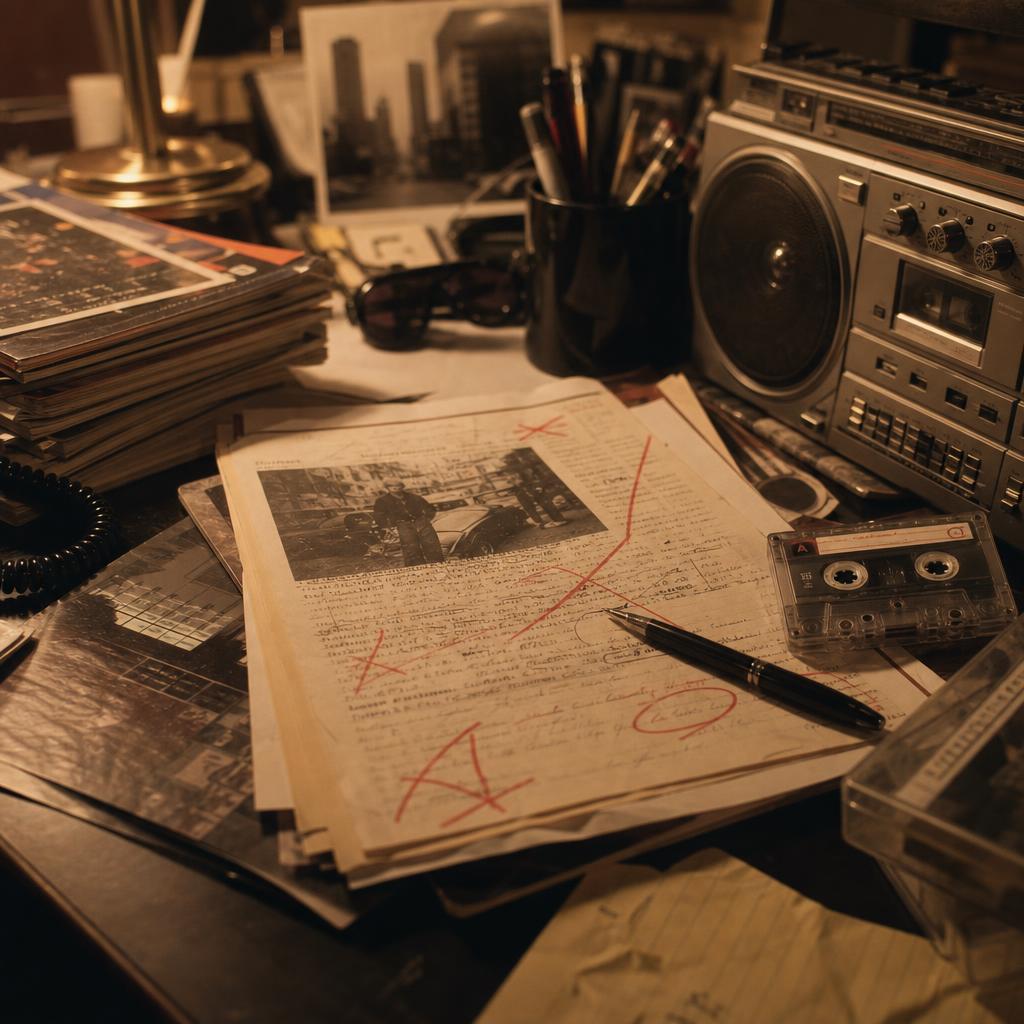
Hip-Hop: The Decade the Floor Did Not Cover, 1989–2001
Subscribe
https://meridian-archive.com/feed.xmlOpen in your app, or paste the link above into any other:
The Five Objections
By the early 1990s, a magazine’s rejection of a rap pitch had a fixed shape, five objections deployed in something close to a standing order regardless of the piece proposed. A young Black staffer or freelancer brought a story; a senior editor met it, first, with a claim about the readership — that the names in the piece would mean nothing to a subscriber, a line applied indiscriminately whether the artist was Wu-Tang, genuinely unfamiliar outside the genre in 1994, or Public Enemy, who had sold platinum records and appeared on network news. Second came the ghettoization move: the magazine had “done rap” the previous year, a single feature treated as having discharged the beat permanently, a bookkeeping logic no other genre’s coverage was held to. Third, the photo desk raised its own objection to cover treatment of Black artists wearing gold teeth and jewelry, an aesthetic judgment dressed as a production concern. Fourth came the dismissal that the music was a fad, an argument that grew harder to sustain with each passing year the genre failed to pass. Fifth, and most reliably, an editor invoked Tipper Gore or C. Delores Tucker’s public warnings about profanity and glorified violence — cited not as an assessment of the specific piece on the table but as a checklist item that ended the meeting on its own. None of the five objections required the editor raising it to have listened to the record.1
In November 1989, hip-hop was not new. Kool Herc had thrown the party at 1520 Sedgwick Avenue in the West Bronx sixteen years earlier; Run-DMC had gone platinum; LL Cool J had a Top 20 pop hit; Public Enemy’s Fear of a Black Planet was months from release and its predecessor, It Takes a Nation of Millions to Hold Us Back, was already a text taught, in some classrooms, as literature. Yo! MTV Raps had been on the air since August 1988, delivering the music into houses that would never have bought the record.2 De La Soul’s 3 Feet High and Rising, six months old that November, was still in heavy rotation on the boomboxes and Walkmans of outer-borough New York, alongside new releases from Big Daddy Kane, Queen Latifah, and the Jungle Brothers.3 None of this was underground in the sense of hidden. It was a commercially proven, demographically enormous American art form, made largely by Black teenagers and twenty-somethings from the Bronx, Brooklyn, and Queens, and it was, to the prestige monthly press of Manhattan, functionally invisible — not suppressed, not boycotted, simply not treated as a subject serious criticism addressed. A magazine willing to run forty pages on the Bosnian question was not yet willing to run four hundred words on Big Daddy Kane. The strangeness was not that hip-hop existed without prestige-press attention. Plenty of American culture did. The strangeness was the scale of the mismatch: a genre selling hundreds of thousands of units a week, broadcast nightly on cable to a national teenage audience, treated by the country’s most serious magazines as noise a City piece might someday get around to, once someone explained what it was.
Native Tongues and the Daisy Age, 1989–1993
The dominant register of the moment, at least among the crowd the trade called Native Tongues — De La Soul, A Tribe Called Quest, the Jungle Brothers, Queen Latifah, and Monie Love — ran against the decade’s later reputation for menace. Peace medallions, jazz samples, loose cardigans, a strain of Afrocentric positivity the press eventually and reductively labeled the Daisy Age: De La Soul’s own coinage, meant half as a joke about the flowers on their debut’s cover and taken up in earnest by writers who liked the alliteration. Latifah’s “Ladies First,” released with Monie Love that November, argued its politics as directly as its title. Tribe’s early catalog ran the same seam of jazz-literate, socially minded, unhostile rap that made the loosest possible case, to anyone paying attention, that the genre’s menace-first coverage frame had never been the whole picture.
The music was built, in this period, on machines a general-interest editor would not have recognized by name. The E-mu SP-1200, launched in 1987, gave producers roughly ten seconds of sample memory at twelve-bit resolution — a severe constraint that shaped the sound rather than merely limiting it. Producers pitched a vinyl sample up to 45 RPM to make it fit inside the SP-1200’s short memory window, sampled it, then pitched the sampler’s playback back down; the resulting crunch, thicker and dirtier than a clean transfer, became the signature texture later critics called boom-bap. The Akai MPC60, co-designed with Roger Linn and released in 1988, added a swing algorithm and roughly twenty-six seconds of memory, extending what a producer could build a track from without abandoning the sampler’s grain.4 A producer’s craft, in this period, was inseparable from crate knowledge — knowing which four bars of which out-of-print soul or jazz record would loop into something new, a form of inherited musical literacy that ran through Black record collections built over a generation.
The genre’s geographic center of gravity moved over these years from the Bronx, where it had been invented, toward Brooklyn and Queens, where a new generation of artists — Big Daddy Kane and MC Lyte from Brooklyn, Marley Marl and the Queensbridge Juice Crew from Queens — dominated the charts the Bronx pioneers had opened. The shift had a cause the music press rarely named directly: the crack epidemic had hollowed out Bronx neighborhoods through the late 1980s, and New York police attributed roughly two-thirds of the city’s 1990 homicides to the drug trade, a peak year of 2,245 murders citywide.5 Mott Haven, Hunts Point, and Morris Heights, the neighborhoods that had produced Herc, Bambaataa, and Grandmaster Flash, were living through a different decade than the one the music from Brooklyn and Queens now soundtracked. The studios where records got made — Chung King in Chinatown, D&D on West 37th Street, Calliope near Eighth Avenue — clustered in Midtown and downtown Manhattan, not the Bronx, a further quiet correction to the geography a casual reader assumed.
The retail geography ran on its own separate map, one a subway rider crossed daily without noticing it as a map at all. Stanley Platzer’s Music Factory, working out of the Times Square IRT mezzanine near West 42nd Street, was where a break record surfaced first; Beat Street Records, in the basement at 494 Fulton Street on Brooklyn’s Fulton Mall, held the same standing across the river. A twelve-inch single ran five to seven dollars; a cassette album, the format a Walkman or a boombox took, cost seven to nine dollars off the shelf against a list price nearer eleven. Vinyl remained the format the DJs and the producers themselves respected — the Technics SL-1200 turntable was the trade’s standard instrument — even as cassettes carried the music through the neighborhoods the record stores did not reach, sold, dubbed, and re-dubbed by hand at a fraction of the retail price, one boombox and one blank tape at a time.6
The Number That Could Not Be Argued With
On May 25, 1991, Billboard began compiling its 200 albums chart from SoundScan’s point-of-sale barcode figures. Within months the chart’s assumptions collapsed: N.W.A’s Efil4zaggin entered at number two, and then number one, without a Hot 100 single to explain it; hip-hop and country both revealed sales volumes the trade press had not credited. For a magazine editor deciding what a national audience wanted, this mattered in a way no critic’s essay could match: for the first time, the claim that white suburban households were buying rap albums in large numbers was not a hunch a junior staffer brought back from a record store. It was a number, audited, printed weekly, impossible to wave off as anecdote.
The trade and alternative press had, in fact, been ahead of this reckoning for years without carrying the prestige monthlies with it. The Village Voice had run Greg Tate’s criticism since 1982 and devoted a full January 1988 issue, “Hip Hop Nation,” to the genre as a serious subject; Nelson George had covered Black music for Billboard before writing a Voice column, “Native Son,” from 1989 onward, and a cohort of younger critics — dream hampton, Touré, Joan Morgan, Kevin Powell — carried the same beat into The Source and Vibe.7 The Source began in August 1988 as a photocopied one-page newsletter run out of a Harvard dormitory by Dave Mays and Jon Shecter, and moved its operation to New York in June 1990.8 Time Inc. launched Vibe in September 1993, under the patronage of Quincy Jones, with Time’s own institutional resources behind it — and even inside that launch, staff later recalled a company proofreader asking, in apparent sincerity, “do hip-hop fans actually read?”9 The prestige monthlies read none of this as their own beat. A genre with its own trade press, its own critical vocabulary, and an audited sales chart proving national reach still needed, in the view of a Manhattan editorial floor, an outside explainer before it could be assigned.
The Golden Age, 1993–1997
Two records released the same day, November 9, 1993 — Wu-Tang Clan’s Enter the Wu-Tang (36 Chambers), out of the Stapleton and Park Hill projects on Staten Island, and A Tribe Called Quest’s Midnight Marauders — marked the opening of the period later criticism would call hip-hop’s golden age, a label largely retrospective, popularized by a 1998 Source feature and cemented by Jeff Chang’s history Can’t Stop Won’t Stop a decade later.10 Wu-Tang’s debut peaked at only number 41 on the Billboard 200 and moved roughly 30,000 copies in its first week — to a non-specialist editor at the time, nine masked men from an island most Manhattan readers associated with the ferry and little else, rapping over kung-fu-movie samples that read, on first encounter, as a novelty act rather than a movement.11 Nas released Illmatic on Columbia on April 19, 1994, recorded across four Manhattan studios — Chung King, D&D, Battery, Unique — with production from DJ Premier, Pete Rock, Q-Tip, and Large Professor; it sold 59,000 copies its first week, a number modest enough that its eventual canonization as the genre’s most acclaimed album was not evident on release.12 Five months later, on September 13, 1994, Bad Boy Records released the Brooklyn rapper Christopher Wallace’s debut as the Notorious B.I.G., Ready to Die, which moved 57,000 copies its first week and went gold by mid-November.13 Bad Boy itself, founded by Sean “Puffy” Combs in 1993 on an initial Arista deal worth roughly $1.5 million, was eighteen months from being a name any general-interest editor would recognize.14
The Three Eras
| Years | Register | Landmark records | Center of gravity |
|---|---|---|---|
| 1989–1993 | Daisy Age / Native Tongues | 3 Feet High and Rising (1989); Ladies First (1989); Midnight Marauders (1993) | Bronx origin, Brooklyn/Queens ascendance |
| 1993–1997 | Golden Age | Enter the Wu-Tang (1993); Illmatic (1994); Ready to Die (1994); Reasonable Doubt (1996) | Manhattan studios, Staten Island, Queensbridge |
| 1997–2001 | After the deaths | Life After Death (1997); No Way Out (1997); Vol. 2… Hard Knock Life (1998) | Bad Boy commercial dominance, then Virginia Beach production |
The rivalry the press eventually flattened into “East Coast versus West Coast” surfaced publicly at the Second Annual Source Awards, held August 3, 1995, at the Paramount Theater inside Madison Square Garden, on Seventh Avenue at West 32nd Street. Accepting the award for Soundtrack of the Year, Death Row’s Suge Knight told the room that any artist who wanted to stay a star, without an executive producer “all in the videos, all on the records, dancin’,” should come to Death Row — an unmistakable jab at Combs, delivered in front of the New York room Bad Boy called home.15 The two men spoke briefly and without incident at the after-party, held at the Tunnel on West 27th Street, the club whose Sunday hip-hop night under Funkmaster Flex had by then become one of the genre’s central New York rooms. The public animosity did not stay contained: in September 1995 a member of Death Row’s circle was murdered at a party in Atlanta that the label’s leadership blamed on people close to Combs, and the accumulated grievance ran forward, unresolved, into 1996.
The labels underneath the rivalry ran on strikingly different arrangements. Def Jam, founded in 1984 by Russell Simmons and Rick Rubin, sold to PolyGram for roughly $33 million in 1994, an early sign that a genre once considered a specialty niche could command a major label’s real money. Loud Records, founded in 1991 by Steve Rifkind, carried Wu-Tang and Mobb Deep through an RCA distribution deal and sold half the company to RCA in 1996. Death Row, built by Suge Knight and Dr. Dre in 1991 on an Interscope distribution arrangement, ran on a management style the trade press described, carefully, as intimidation-adjacent. Bad Boy’s own initial Arista deal, worth roughly $1.5 million in 1993, was renegotiated by 1996 into an arrangement reported near $10 million and a fifty-percent equity stake — the clearest single data point, for anyone reading the trade paper rather than the culture pages, that the genre’s commercial center had shifted decisively east from Los Angeles back to New York.16
The Deaths, 1996–1997
Tupac Shakur, shot in Las Vegas on September 7, 1996, riding in Suge Knight’s car after a Mike Tyson fight, died six days later, on September 13, at a Los Angeles hospital.17 The coverage inside New York ran complicated: Tupac had been raised partly in Harlem and Brooklyn before his family moved to Baltimore and then California, and he had accused people close to Bad Boy of involvement in a November 1994 shooting at Quad Studios in Times Square. The city’s hip-hop station, Hot 97, went to wall-to-wall Tupac programming, but the local mourning carried an asterisk the national coverage did not — grief for one of the genre’s own, complicated by an unresolved coastal feud that had not, with his death, resolved.
Six months later, in the early hours of March 9, 1997, the Notorious B.I.G. was shot and killed in Los Angeles after a party at the Petersen Automotive Museum. He was twenty-four. His funeral was held March 18, 1997, at the Frank E. Campbell Funeral Chapel on Madison Avenue at East 81st Street, the same Upper East Side chapel that had handled the funerals of Rudolph Valentino and John Lennon. The procession then crossed the East River into Brooklyn, moving down Fulton Street and past St. James Place, where Wallace had grown up. Thousands of mourners lined the route; people climbed lampposts and hung from windows above the street; a car sound system played his music as the hearse passed. Police and mourners clashed at points along the route — officers used pepper spray, and roughly ten people were arrested, among them a New York Times stringer, Julia Campbell, handcuffed after asking an officer why he had used it on her; the disorderly-conduct charge against her was later dropped.18 Life After Death, the double album he had completed before his death, was released sixteen days later, on March 25, 1997.
The Shiny Suit Years, 1997–2001
The commercial machinery that followed the deaths bore little resemblance to the crate-dug austerity of the golden age. “I’ll Be Missing You,” Combs’s Police-sampling tribute to Wallace released in May 1997 with Faith Evans and 112, spent eleven weeks at number one — the first hip-hop single to debut atop the Hot 100. No Way Out, the Puff Daddy album that followed on July 22, 1997, debuted at number one with first-week sales of 561,000 copies.19 The visual grammar shifted with the sales figures: director Hype Williams’s fish-eye lens, metallic Versace suits, and Cristal-and-Bentley set dressing replaced the hoodies and Timberlands of the earlier decade, a change contemporaries called, without much affection, the shiny-suit era. Jay-Z, whose 1996 debut Reasonable Doubt had sold modestly, built a run of annual, increasingly commercial albums through the turn of the millennium — Vol. 2… Hard Knock Life, built around a sample of the Depression-era Broadway musical Annie, went five-times platinum in 1998 — while his Roc-A-Fella label, co-founded with Damon Dash and Kareem “Biggs” Burke, moved from an independent hustle into a Def Jam-backed operation. By decade’s end, the sonic signature had turned again: Virginia Beach’s Neptunes and Timbaland built tracks from synthesizers and programmed drum patterns rather than crate-dug loops, a shift that also changed who could plausibly become a producer — sample-based craft required a father’s record collection and the patience to dig through it; synthesizer-based craft required none of that inheritance, only a machine and an ear. Jay-Z’s The Blueprint, produced by a mix of soul-sampling holdouts and the new synthetic sound, was released September 11, 2001, and still sold 427,000 copies in a week the country spent watching something else entirely.20
The Press Arrives
By 1998, general-interest editors who would not have known a Wu-Tang record from a novelty single four years earlier were commissioning Sean Combs profiles that treated him, without irony, as a business mogul. GQ and the trade magazines had gotten there faster than the older prestige monthlies; the New Yorker engaged seriously only toward the decade’s close. The lag was not concealment — the Source, Vibe, and the Voice had been documenting the genre in real time for a decade, in print any interested editor could have subscribed to — it was a magazine class that waited for permission the circulation figures had already given it, years earlier.
No part of this required anyone at a magazine to dislike the music. Most of the editors who eventually ran the Combs profile or the Jay-Z piece would have said, honestly, that they liked what they were hearing on the radio, once they started listening. What the decade’s record shows instead is a longer, quieter failure of proximity: an art form built four subway stops from the office, documented by its own trade press since 1988, proven by an audited sales chart since 1991, treated by the country’s most serious magazines as a subject that required an outside guide before it could be assigned to anyone. The guide arrived, eventually, carrying a story that had been available the entire time — not a discovery, only a permission slip, granted years after the evidence that should have made it unnecessary.
Meridian would have run into the Native Tongues catalog everywhere on the sidewalk and nowhere on the assignment sheet: De La Soul, Latifah, the Jungle Brothers would have reached the floor only as background on somebody’s Walkman, never as a pitch, because no desk on the masthead would have owned the beat and a daily’s music brief would not have been a shape Meridian’s own pages would have taken. A later failure would have come closer to an actual meeting. A stringer capable of arguing Illmatic and Ready to Die with a novel’s interpretive weight would have turned up on staff, brought in on a favor to a contributing editor’s college friend; the pitch would have circulated at two or three commissioning meetings across as many years and never once have been assigned, and once it stalled, nobody would have wanted to be seen defending a favor case rather than a story.
A number, rather than an argument, would have moved the calendar first. SoundScan’s point-of-sale count, adopted by Billboard that May, would have made The Front’s July close by proof rather than hunch. Time Inc.’s launch of Vibe two years later, under Quincy Jones’s patronage, would have drawn an editor’s attention as fact before threat, and would have opened that November’s Front. Tupac Shakur’s death that September, six days after the shooting rather than by wire the same night, would have given the desk time enough to place an obituary in The Front’s November pages.
An editor would have carried the Notorious B.I.G.’s funeral procession through Brooklyn into The City that May, the crowds and the pepper spray and the stringer’s arrest all reported past the point where a monthly’s version could have been anything but confirmation. An articles editor would have claimed the Combs profile for The Feature Well the following February, once No Way Out’s debut would have made the mogul a subject nobody senior could still have filed as a novelty. The Blueprint, released the week the country was watching something else entirely, would have found room anyway in The Back’s November pages.
Footnotes
-
Billboard, oral history of the SoundScan-era hip-hop coverage shift; The Ringer, SoundScan retrospective; Nelson George, Hip Hop America (Viking, 1998). ↩
-
Wikipedia, “Yo! MTV Raps,” https://en.wikipedia.org/wiki/Yo!_MTV_Raps. ↩
-
Wikipedia, “3 Feet High and Rising,” https://en.wikipedia.org/wiki/3_Feet_High_and_Rising. ↩
-
Wikipedia, “E-mu SP-1200,” https://en.wikipedia.org/wiki/E-mu_SP-1200; Wikipedia, “Akai MPC,” https://en.wikipedia.org/wiki/Akai_MPC. ↩
-
New York City Police Department historical crime statistics, cited in Wikipedia, “Crime in New York City,” https://en.wikipedia.org/wiki/Crime_in_New_York_City. ↩
-
BKReader, “Celebrating Beat Street Records, a Hip-Hop Mecca in Brooklyn,” https://www.bkreader.com/arts-entertainment/celebrating-beat-street-records-a-hip-hop-mecca-in-brooklyn-12485022; Nelson George, Hip Hop America (Viking, 1998). ↩
-
Village Voice, “Hip Hop Nation” special issue, January 19, 1988. ↩
-
Wikipedia, “The Source (magazine),” https://en.wikipedia.org/wiki/The_Source_(magazine). ↩
-
Wikipedia, “Vibe (magazine),” https://en.wikipedia.org/wiki/Vibe_(magazine); Billboard, “Vibe at 25: An Oral History,” 2018. ↩
-
Jeff Chang, Can’t Stop Won’t Stop: A History of the Hip-Hop Generation (St. Martin’s Press, 2005). ↩
-
Wikipedia, “Enter the Wu-Tang (36 Chambers),” https://en.wikipedia.org/wiki/Enter_the_Wu-Tang_(36_Chambers). ↩
-
Wikipedia, “Illmatic,” https://en.wikipedia.org/wiki/Illmatic. ↩
-
Wikipedia, “Ready to Die,” https://en.wikipedia.org/wiki/Ready_to_Die. ↩
-
Dan Charnas, The Big Payback: The History of the Business of Hip-Hop (New American Library, 2010). ↩
-
Wikipedia, “1995 Source Awards,” https://en.wikipedia.org/wiki/1995_Source_Awards. ↩
-
Dan Charnas, The Big Payback: The History of the Business of Hip-Hop (New American Library, 2010); Wikipedia, “Def Jam Recordings,” https://en.wikipedia.org/wiki/Def_Jam_Recordings. ↩
-
Wikipedia, “Murder of Tupac Shakur,” https://en.wikipedia.org/wiki/Murder_of_Tupac_Shakur. ↩
-
Democracy Now, “Burial of Notorious B.I.G. in Brooklyn,” March 19, 1997, https://www.democracynow.org/1997/3/19/burial_of_notorious_b_i_g; Wikipedia, “Julia Campbell (journalist),” https://en.wikipedia.org/wiki/Julia_Campbell_(journalist). ↩
-
Wikipedia, “No Way Out (Puff Daddy album),” https://en.wikipedia.org/wiki/No_Way_Out_(Puff_Daddy_album). ↩
-
Wikipedia, “The Blueprint,” https://en.wikipedia.org/wiki/The_Blueprint. ↩