Nevermind: How the Music Press Told the Floor What to Think, 1989–2001
Subscribe
https://meridian-archive.com/feed.xmlOpen in your app, or paste the link above into any other:
The Number Nobody Had Counted
For most of the history of the Billboard 200, the number that told the American record industry which album had sold the most copies in a given week was not a count of purchases. It was an estimate, self-reported by record retailers to the trade magazine that then published it as a precise, ranked chart position — no error margin attached, no distinction drawn for the reader between a store’s guess and a register total — and the industry that lived and died by that number did not trust it: in 1991 the labels replaced the retailer-estimate system with SoundScan, a barcode-based point-of-sale service that tracked what actually crossed the register, adopted specifically because label executives no longer believed what retailers told them.1 SoundScan’s first full year of operation delivered a result the old estimate-chart had never once produced. On January 11, 1992, a record made for a college-radio audience of a few hundred thousand people displaced Michael Jackson’s Listen onSpotifyApple MusicYouTube Music at number one, and the trade press spent the following weeks explaining an event none of it had predicted.1 Listen onSpotifyApple MusicYouTube Music had entered the chart at number 144 the week of its release, September 24, 1991, behind Garth Brooks and a dozen records nobody expected it to outlast; MTV had put the video for Listen onSpotifyApple MusicYouTube Music into its Buzz Bin rotation that November, and the album had climbed the chart on television exposure rather than radio add sheets, doubling its sales roughly every two weeks through December.2 What collapsed in the four months between the release and the displacement was not Michael Jackson’s career. It was the working assumption, held by nearly everyone whose job was to know, that a record built by and for an audience the trade called “alternative” stayed on one side of a line that divided it from the audience the trade called mainstream. The line had organized the record business, the concert-booking business, and the criticism business since punk. After January 1992 it no longer organized anything, and the magazines paid to notice such things spent most of the decade’s remaining years catching up to a shift that had already happened before any of them wrote a word about it.
Kurt Cobain told an interviewer the following year that he had been “trying to rip off the Pixies” when he wrote the song that did the displacing — a debt the Boston band’s Doolittle and Bossanova had made legible to anyone paying close attention to the loud-quiet-loud structure underneath the hook.3 Almost no one outside a specific college-radio listenership had been paying that attention. The record’s audience had built itself for a decade out of small venues, university stations, and a handful of independent labels operating well beneath the notice of the institutions that decided, for a much larger public, what music mattered — and the audience’s private literature, its ranked opinions and its arguments about who had gotten there first, existed nowhere near the pages of the magazines, which spent 1992 explaining it to everyone else.
The Floor Beneath the Sound
Television did the work first, and it did it structurally rather than by editorial judgment. MTV in 1989 was already a decade into a slow drift away from the all-video format that had defined it, but its music programming still functioned, for a large national audience, as the primary discovery mechanism — the channel that decided, block by block and hour by hour, which sounds got a hearing before a critic weighed in on them.4 120 Minutes, the Sunday-night alternative-rock program, did for viewers outside college-radio range roughly what a campus station did for students inside it: a curated, out-of-hours signal reaching an audience the daytime schedule was not built to serve. The Buzz Bin — the rotation tier MTV used for records it had decided to push before the sales data caught up — put “Smells Like Teen Spirit” in front of a viewership an order of magnitude larger than any single radio format could deliver, and did so on the strength of a programming director’s judgment rather than a chart position that did not yet exist.
MTV Unplugged, which had launched in November 1989 as a lower-stakes acoustic format, became by mid-decade the channel’s most serious claim to cultural gravity: Eric Clapton’s January 1992 taping, Nirvana’s own session at Sony Music Studios on November 18, 1993 — aired that December, released as an album the following November, some seven months after Cobain’s death had turned it into something closer to an epitaph than a performance.4 The format’s later turns tracked the channel’s own drift away from music altogether — The Real World premiered in May 1992, Total Request Live arrived from a Times Square storefront in September 1998 — and by the time nu-metal and boy-band pop had displaced alternative rock as the dominant chart category, around 1999 and 2000, MTV’s role had changed from tastemaker to appointment-viewing engine for an audience the magazine class no longer recognized as its own. The decisive venue, in other words, was never a magazine page. It was MTV’s own programming schedule, set in a control room months ahead of any review.
The Court of Appeal
Once a record had already succeeded on television and at retail, the print press arrived to rule on what the success meant, and the ruling arrived in a specific order that the magazines themselves could not fully control. Rolling Stone did not put Nirvana on its cover until issue 628, dated April 16, 1992 — three months after Nevermind had already reached number one — with a cover line promising the reader access to “the heart and mind of Kurt Cobain” and a photograph the band’s own singer tried, unsuccessfully, to sabotage by wearing a hand-lettered shirt reading “Corporate Magazines Still Suck” under his cardigan.3 Spin, the magazine with the stronger claim to having been paying attention, had put Metallica on its cover the previous October — the issue already at the printer the week Nevermind shipped — and recovered fast enough to run its own Nirvana cover story, “Heaven Can’t Wait,” in January 1992, within weeks of the chart position that made the assignment obvious.5 Neither magazine had covered the band seriously before the numbers forced the question; both then competed, for the length of a news cycle, over which of them had recovered faster.
The verdict that mattered more than either newsstand cover ran in a weekly with no glossy pretensions at all. The Village Voice’s Pazz & Jop poll, tabulated every winter from the year-end ballots of several hundred working critics and published under Robert Christgau’s editorship since the poll’s founding in 1971, gave Nevermind an unprecedented sweep for 1991 — first place in albums, singles, and videos at once, on the strength of roughly three hundred separate ballots naming it the year’s best record.6 Pazz & Jop measured something the newsstand covers could not: not which record a magazine’s editors had decided, after the fact, to put a face on, but what several hundred people paid to think seriously about music, independently and anonymously, actually believed had mattered that year. The poll’s verdict and the sales chart’s verdict agreed in January 1992. They did not always agree again, and the gap between them — a record the critics preferred losing, at the newsstand or on the chart, to a record the public preferred — became one of the decade’s standing arguments about who owned the authority to say what a year in music had been.
By 1997 the poll and the newsstand had drifted apart in a way that told its own story. Bob Dylan’s Listen onSpotifyApple MusicYouTube Music took first place in that winter’s Pazz & Jop with 1,655 points to Radiohead’s OK Computer’s 1,475 — a critics’ preference for a veteran’s comeback over the record that a large part of the magazine class spent the following years calling the decade’s most serious rock statement.8 A year later the poll’s winner was Lucinda Williams’s Listen onSpotifyApple MusicYouTube Music, an alt-country record on an independent label, ahead of Lauryn Hill’s Listen onSpotifyApple MusicYouTube Music — a record that had entered the Billboard 200 at number one, sold into the millions domestically, and gone on to take five Grammy awards including Album of the Year at the February 1999 ceremony.9 The critics’ poll and the commercial and industry-award verdicts were measuring three different things by the late 1990s — a serious record the guild of critics preferred, a serious record the mass public bought, and a serious record the recording industry’s own membership chose to honor — and a reader trying to reconcile all three no longer had a single ranked list to consult.
The Store
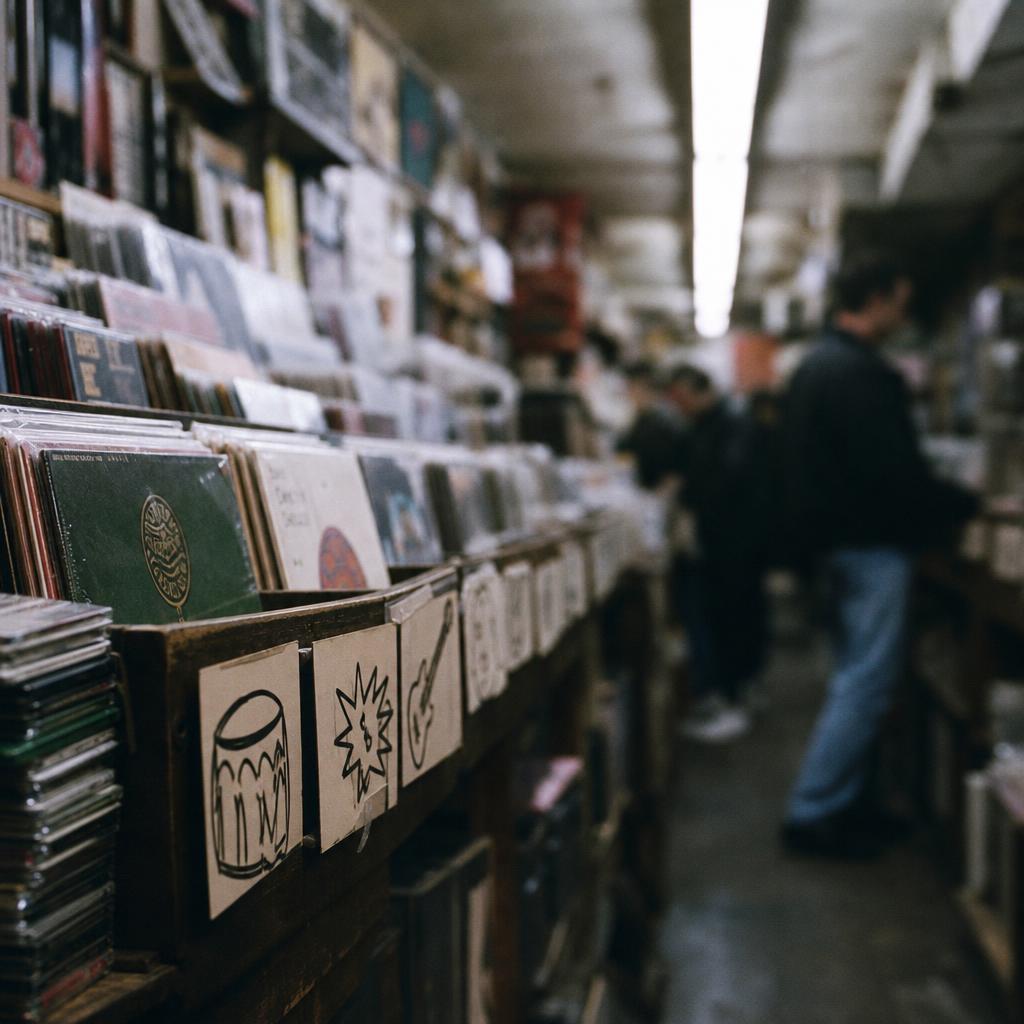
Before any of those verdicts reached a reader, the record itself usually passed through a clerk’s hands, and by the middle of the decade New York supported a small, competing set of institutions built entirely around that transaction. Tower Records had opened its downtown flagship at 692 Broadway, at the corner of East Fourth Street where the block runs into Lafayette, in 1983, and a second store at Broadway and Sixty-Sixth Street two years later — open past midnight, fluorescent-lit, with listening stations tethered to the wall and a floor staff whose recommendations carried more weight with a browsing customer than any single review.10 Directly across Fourth Street from the downtown Tower, a much smaller store called Other Music opened in 1995, founded by Josh Madell and Chris Vanderloo, two veterans of Kim’s Video’s used-record counter, and built its identity on precisely the inventory Tower did not stock: hand-written shelf cards sorted into genre categories invented on the spot, a staff whose taste ran ahead of the trade press by a year or more, and a name that was itself a rebuke — literally, the other music, the music the store across the street was not selling.11 A few blocks north, Kim’s Video and Music at St. Mark’s Place ran video rental upstairs over a used-and-rare record floor below, an inventory built on trade-ins and back-catalog obsession that made a Kim’s staffer’s private knowledge, on any given genre, deeper than what most contributing critics carried into a magazine assignment.
The clerk behind any of these counters occupied a position no critic writing for a national magazine could match: a running, weekly record of what an actual customer bought, returned, argued about, and came back for. A magazine writer filed a verdict once, months after a record’s release, informed by a promotional copy and a deadline. A clerk restocked the same bin every day, watched what moved without a single word of press behind it, and adjusted a private ranking in real time that no editorial calendar could keep pace with. The hand-lettered card taped under a bin at Other Music — a two-sentence, unsigned judgment on a record a magazine had not yet reviewed — carried, for a specific and self-selecting customer, more predictive authority than the newsstand cover that followed it by half a year.
The Binary That Would Not Hold
The distinction the record business had leaned on since punk — a mainstream that sold and an underground that mattered — did not survive the decade the January 1992 chart shift opened. What replaced it, across the years that followed, was a pipeline: a record proved itself first on an independent label and a college-radio playlist, then migrated, with or without its makers’ consent, onto a major label and a national chart, at which point the same critical apparatus that had certified it as underground began arguing about whether the migration had cost it anything. Nirvana’s own label history made the pattern explicit — a small Seattle independent’s roster absorbed whole into the majors’ attention within about two years of the underground signal reaching them — and every alternative-rock band that followed through the decade negotiated some version of the same crossing, publicly and under press scrutiny that had not existed for the previous generation’s equivalent moves.12 The runway’s own translation of that crossing — a flannel shirt priced as thrift-store necessity in one city and reproduced as couture six weeks later in another — belongs to its own reckoning with price and audience, and does not need retelling here.
The pipeline had a New York end the national coverage mostly skipped. Matador Records, founded in a Lower East Side apartment in 1989 by Chris Lombardi and joined the next year by Gerard Cosloy, built a roster — Pavement, Yo La Tengo, Liz Phair, Guided by Voices — that the majors spent the decade trying to buy into or copy; Sonic Youth, the downtown band whose decade inside the underground had made it the scene’s nearest thing to elder statesmen, signed to Geffen’s DGC imprint in 1990 and used the leverage to steer the label toward Nirvana, a bridge from the small rooms to the majors that ran directly through Manhattan. The small rooms were a circuit a reader could walk: CBGB on the Bowery, the Knitting Factory, Brownies on Avenue A, the Mercury Lounge on East Houston from 1993 — venues where a record proved itself to a few hundred people before any certifying institution arrived. Lollapalooza, the touring festival Perry Farrell launched in 1991, did the same work at national scale, carrying an alternative bill to amphitheaters the college stations never reached.13
By the back half of the decade the binary had stopped organizing the argument entirely, because the record proving itself was no longer reliably American or reliably guitar music. Radiohead released Listen onSpotifyApple MusicYouTube Music in June 1997, and the record’s reception — a British band moving, within a single album, from radio-friendly guitar rock toward something closer to orchestrated dread — was treated by a wide swath of the English-language music press as the moment “alternative” stopped describing a marketing category and started describing serious composition.14 The same band’s Listen onSpotifyApple MusicYouTube Music, in October 2000, abandoned the guitar-rock premise almost entirely, and a press corps that had spent nine years learning to certify alternative rock as art found itself needing to certify something that hardly qualified as rock at all. Elsewhere the same collapse ran through hip-hop’s own crossover into the glossy press — a separate argument, fought inside its own institutions, over who had standing to write about a music that had built its authority the same way alternative rock had, from outside the buildings now competing to cover it. The jazz rooms along the Village Vanguard axis, by contrast, kept a critical economy of their own throughout the period, largely undisturbed by any of this and largely indifferent to the alternative-rock press’s verdicts.
The Free File
The pipeline that had organized two full magazine generations — an independent label breaks a record, the majors absorb it, MTV and the trade press certify it, the record store sells the physical object — depended on a scarcity the industry had never had to defend, because until the very end of the period nothing threatened it. Napster launched on June 1, 1999, built by an eighteen-year-old computer-science student at Northeastern University, and within its first year had drawn something on the order of twenty million users trading compressed audio files with no purchase required at any step.15 The service converted the album — the unit every institution described in this record had spent the decade organizing itself around, reviewing, ranking, and selling — into something closer to a rumor: a collection of songs a listener could now acquire individually, for nothing, outside every one of the gates a critic, a programming director, or a store clerk had spent a decade guarding. By July 2001 a federal court had ordered the service shut down, and by September it had entered bankruptcy, but the twenty-seven months in between had already done the structural work no single review or chart position ever could. The record store, the trade magazine, and the video channel had each, in their own way, told a customer what to buy. After June 1999, for the first time in the period this record covers, an increasing number of listeners were no longer buying anything at all.
No single institution decided what the alternative-rock decade would sound like, and that is the part the era’s own coverage kept getting backward. A record climbed a chart on the strength of a programming director’s rotation slot before any critic weighed in; a critics’ poll crowned a record the public had already declined to buy in equal numbers; a clerk behind a counter on Fourth Street knew, months ahead of any newsstand cover, which record was about to matter and could not have told a reporter why in words a magazine would print. The authority to say what music meant in a given year turned out to be distributed across a television control room, a printing schedule, a felt-tip card taped under a record bin, and several hundred anonymous ballots — never concentrated in the hands of any one of the institutions built, at considerable expense, to claim it. What arrived at the end of the period, a free file traded computer to computer with no institution’s blessing required at all, did not so much destroy that authority as finish a job the decade had already been doing to it, one chart surprise and one late cover story at a time.
A pitch to chase Nevermind’s chart displacement as breaking news would have died in the room before any anniversary date, and it would have died for the plainest reason on the sheet: the story would already have belonged to Rolling Stone and to Spin, and a rival masthead’s ownership of the assignment would have been reason enough to let it go begging. Meridian would have waited instead for the record to turn a year old, and would have run the appraisal in The Back of the January 1993 issue — judicious, credited to the college audience that would have heard the record first, and would have arrived as history rather than argument.
Radiohead’s OK Computer would have gotten a comparable review the following year, the assignment would have fallen to an articles editor who would have claimed it for The Back the month the record’s reputation would have settled rather than the month it shipped. The Miseducation of Lauryn Hill’s Grammy sweep the following February would have drawn the identical treatment, and The Back’s April 1999 issue would have closed on the award rather than the album, since a masthead paced monthly would only ever have been able to certify a verdict some faster institution had already rendered.
Napster’s June 1999 arrival would have belonged in The Essay rather than the news pages, the space would have been used to argue that the album itself — the unit every piece above it would have spent the decade organizing around — would have been dissolving. Radiohead’s Kid A, that October a year later, would have fallen once more to The Back, and the review would have needed to explain a record that would have abandoned the guitar-rock premise the magazine would have spent nine years learning to certify. The Front would have led with the July 2001 court order shutting the service down, a news item rather than a verdict.
Footnotes
-
Charles R. Cross, Heavier Than Heaven: A Biography of Kurt Cobain (Hyperion, 2001) — Nevermind’s September 24, 1991 release and its January 11, 1992 displacement of Michael Jackson’s Dangerous at number one; the SoundScan-driven surprise of the chart climb. ↩ ↩2
-
Paul Grein, “Rewinding the Charts: In 1991, Nirvana’s ‘Nevermind’ Dethroned the King of Pop,” Billboard, January 11, 2018 — the album’s number-144 chart debut and its climb via MTV’s Buzz Bin rotation. ↩
-
David Fricke, “Nirvana: Inside the Heart and Mind of Kurt Cobain,” Rolling Stone, issue 628, April 16, 1992; David Fricke, “Kurt Cobain: The Rolling Stone Interview,” Rolling Stone, January 27, 1994 — the “trying to rip off the Pixies” quote. ↩ ↩2
-
Rob Tannenbaum and Craig Marks, I Want My MTV: The Uncensored Story of the Music Video Revolution (Dutton, 2011) — the Buzz Bin, the November 1989 launch of MTV Unplugged, and the November 18, 1993 taping of Nirvana’s session. ↩ ↩2
-
“Nirvana: The 1992 ‘Nevermind’ Cover Story, ‘Heaven Can’t Wait,’” Spin, January 1992. ↩
-
Robert Christgau, “Pazz & Jop 1991: Critics Poll” and “Reality Used to Be a Friend of Ours,” The Village Voice, March 3, 1992 — Nevermind’s sweep of album, single, and video, 1,699 points from roughly 300 ballots. ↩
-
Robert Christgau, “Pazz & Jop” poll archive and methodology notes, robertchristgau.com — the poll’s 1971 founding and its name as a spoonerism of the defunct Jazz & Pop magazine’s critics survey. ↩
-
Robert Christgau, “Pazz & Jop 1997: Critics Poll,” The Village Voice, 1998 — Bob Dylan’s Time Out of Mind (1,655 points) ahead of Radiohead’s OK Computer (1,475 points). ↩
-
Robert Christgau, “Pazz & Jop 1998: Critics Poll,” The Village Voice, 1999 — Lucinda Williams’s Car Wheels on a Gravel Road ahead of Lauryn Hill’s The Miseducation of Lauryn Hill; “The Miseducation Of Lauryn Hill: For The Record,” GRAMMY.com — the album’s number-one debut, five Grammy wins at the February 1999 ceremony including Album of the Year. ↩
-
“From Rags to Records and Beyond at Broadway and East 4th Street,” Village Preservation, September 29, 2021 — Tower Records’ 692 Broadway flagship, opened 1983 at the Lafayette Street corner. ↩
-
“Other Music,” Wikipedia — the store’s 1995 opening at 15 East Fourth Street, directly across from Tower, founded by Josh Madell and Chris Vanderloo, both formerly of Kim’s Video. ↩
-
Paul Grein, “Rewinding the Charts: In 1991, Nirvana’s ‘Nevermind’ Dethroned the King of Pop,” Billboard, January 11, 2018 — the independent-to-major-label pattern the chart shift accelerated. ↩
-
Michael Azerrad, Our Band Could Be Your Life: Scenes from the American Indie Underground, 1981–1991 (Little, Brown, 2001); “Matador Records,” “Sonic Youth,” and “Lollapalooza,” Wikipedia — Matador’s 1989 founding by Chris Lombardi (Gerard Cosloy joining in 1990), Sonic Youth’s 1990 move to DGC, and Perry Farrell’s 1991 festival. ↩
-
Mac Randall, Exit Music: The Radiohead Story (Delta, 2000) — OK Computer’s June 1997 release and its reception as a turn from guitar rock toward composition. ↩
-
Joseph Menn, All the Rave: The Rise and Fall of Shawn Fanning’s Napster (Crown Business, 2003) — the June 1, 1999 launch, Fanning’s Northeastern University origins, and the July 2001 court-ordered shutdown; “Ashes to Ashes, Peer to Peer: An Oral History of Napster,” Fortune, September 5, 2013 — the roughly twenty-million-user figure within the service’s first year. ↩