The Big Rooms: Limelight, Tunnel, Sound Factory, 1989–2001
Subscribe
https://meridian-archive.com/feed.xmlOpen in your app, or paste the link above into any other:
The License Nobody Had
Since 1926, any New York City establishment where patrons danced was required by law to hold a cabaret license, and by January 1989 fewer than two hundred such licenses were active against a field of roughly twenty-five thousand eating-and-drinking establishments citywide.1 Almost no club held one; almost every club let its floor fill anyway, under a policy of selective non-enforcement that ran through the Koch and Dinkins administrations. The gap between the statute and the floor was not an oversight the city had failed to notice — it was administered. A joint task force drawing on the police, fire, buildings, and liquor authorities carried a standard step, written into raid procedure years before any particular raid occurred, for verifying the violation: patrons held at the door while inspectors worked the room were asked under oath whether dancing had taken place, and an affirmative answer, license absent, produced a summons — the “cabaret check,” a sworn interrogation about a dance floor, filed by inspectors as routinely as an exit-sign citation.2 The four rooms that anchored the era’s nightlife operated for most of their lives inside that gap.
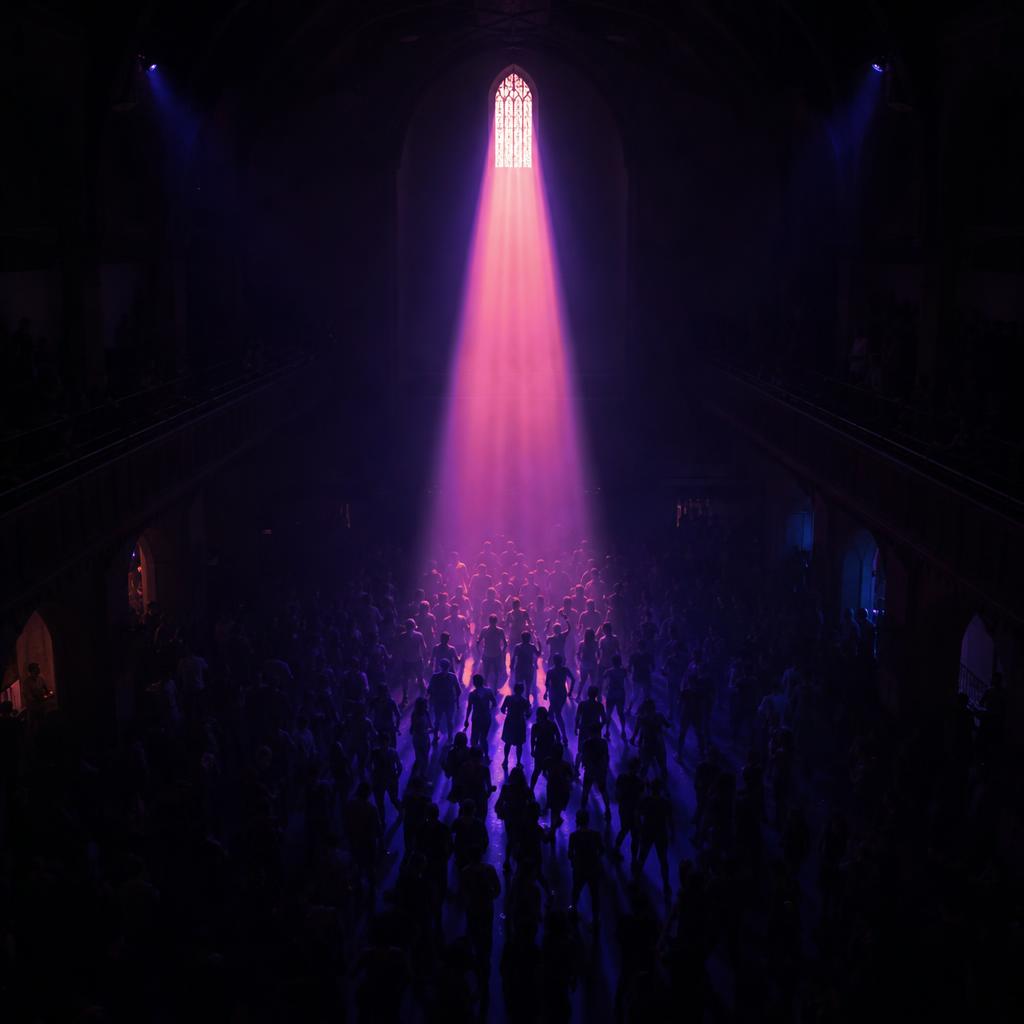
The building at Sixth Avenue and West Twentieth Street had been consecrated in 1846 as the Church of the Holy Communion, a Gothic Revival sanctuary designed by Richard Upjohn, the architect of Trinity Church downtown, and it was the first asymmetrical Gothic Revival church built in America.3 By the late 1980s several thousand people a week moved across its nave on a Wednesday night, under stained glass the club’s designers had backlit so the windows glowed after dark much as they did by daylight.4 The confessional booths survived; they had been rebuilt as private banquettes, sold by the night. Peter Gatien, a one-eyed Canadian club operator who had run a chain of discothèques in Ontario before crossing into Manhattan, bought the deconsecrated building in 1983 and named the club after his first Florida venue, the Limelight.4 What made the building a nightclub was not disguised as anything else. The altar end of the room held the DJ booth; the side chapels held bars; the vestry held a back room. A dance floor needs a large open volume with good sightlines and no interior columns, and a nineteenth-century sanctuary, built to hold a congregation’s collective attention on a single point at the front, satisfies both requirements without adaptation.
The interior renovation, credited to the designer Ari Bahat, kept the shell essentially intact and added five separate staircases running down from the sanctuary floor to a warren of smaller rooms — a gothic chapel bar, VIP lounges, and by 1998 an upstairs chamber Gatien commissioned from the Swiss artist H.R. Giger, who filled it with backlit biomechanical sculpture and furnished seating cast from the same aesthetic as his film work for Alien.5 The room functioned as a private space reserved above the general floor, reachable by its own staircase, a chapel within the chapel. Four stories of open ceiling ran over the main dance floor below it, and from the sanctuary floor a dancer could look straight up into the original roof trusses. The crowd underneath them by the early 1990s ran wider than any other room in the city: goths in vinyl and black lace beside Wall Street men who had come from a late dinner, drag queens beside NYU freshmen, a scene that in 1988 a Manhattan magazine’s cover story had already found a name for — the Club Kids — months before Michael Alig’s Wednesday party, Disco 2000, existed to give the name a fixed address.6
Twelfth Avenue and the Freight Line
A mile north and over toward the river, on Twelfth Avenue at Twenty-Seventh Street, stood a different kind of building entirely: the Terminal Warehouse Company’s Central Stores Building, an 1891 freight depot that had once let railroad sidings run directly into its ground floor, so that boxcars ferried across the Hudson on car floats from Hoboken could be unloaded under cover.7 Gatien opened the Tunnel there in 1986, and the name was literal — a length of narrow track, sunk into the floor, ran the length of the main room, a relic of the loading days left visible rather than paved over. At roughly a hundred thousand square feet the building held a long straightaway bar worked by as many as ten bartenders on the busiest nights, and a unisex bathroom converted from the terminal workers’ old locker room, with a small circular bar built into its center — a room where the line for the toilet and the line for a drink were the same room, and neither line moved quickly.7
What made the Tunnel a hip-hop room rather than the multi-genre space it had opened as was a single Sunday-night party. The promoter Jessica Rosenblum, who ran a hip-hop party called Mecca, brought the young DJ Funkmaster Flex to the Tunnel’s Sunday night around 1993 — a slot Gatien had regarded as commercially dead space, a night no other promoter wanted, and had no objection to filling.7 Flex’s prime slot ran roughly from one to two-thirty in the morning, and by the middle of the decade the Sunday-night crowd, several thousand strong, had made the room the most consequential stage in New York for a record about to break — Wu-Tang Clan, the Notorious B.I.G., Jay-Z before his first album, DMX, Mary J. Blige — acts that played the Tunnel’s floor before radio caught up to them.7 The room’s other nights ran rock, industrial, and mixed programming to smaller, quieter crowds; none carried the density or the consequence of the Sunday hip-hop room, and by the back half of the decade Sunday was simply what the Tunnel meant.
Five Thirty West Twenty-Seventh
A third kind of room, smaller and stranger than either, occupied a converted warehouse at 530 West Twenty-Seventh Street: the Sound Factory, opened in 1989 by the owner Richard Grant with the DJ Junior Vasquez as resident, and built around a decision that set it apart from every other big room in the city — it served no alcohol at all.8 Without a liquor license there was no last call, no state-mandated four o’clock closing, and no bar staff to manage; the room opened Saturday at midnight and did not close until Vasquez stopped playing, which was often noon on Sunday, a twelve-hour set on a wooden floor built specifically to move under dancing feet.8 The sound system, engineered by Richard Long, was the same audio house that had built the Paradise Garage’s system a decade earlier on King Street, and the lineage ran further than the equipment. Vasquez had been a regular on the Paradise Garage floor through the early 1980s, a devotee of its resident DJ Larry Levan, and when the Garage’s lease ran out in 1987 much of its crowd — gay, Black and Latino, unmixed with any of the neighboring straight clubs — followed Vasquez to the Sound Factory in the years after.9 Levan himself, largely sidelined in New York by the early 1990s, made occasional guest appearances on Vasquez’s floor before his death in November 1992; the marathon set Vasquez built his reputation on, running past dawn into the following afternoon, was explicitly modeled on the all-night sets Levan and Frankie Knuckles had pioneered at the Garage and Chicago’s Warehouse.10
Because the room ran without a bar, its only point of commerce sat inside the bathroom rather than beside the dance floor, and by four in the morning the line for it moved as slowly as the line for anything else in the building.
The Academy of Music
Uptown of both, at 126 East Fourteenth Street, stood the Palladium, converted in 1985 from a nineteenth-century theater, the old Academy of Music, by Steve Rubell and Ian Schrager — the pair behind Studio 54, rebuilding a second empire on a different block after the first had closed and its owners had served time for tax evasion. For the interior they hired Arata Isozaki, the Japanese architect, who gutted the theater’s shell and built into it nearly ten thousand square feet of nightclub arranged across seven stories, each floor keyed to a distinct room rather than a single undifferentiated volume.11 The main dance floor sat at the building’s center, lit from behind by a mural Keith Haring painted directly onto the wall; the Mike Todd Room held a mural by Jean-Michel Basquiat and functioned as the club’s more exclusive inner chamber; the Kenny Scharf Room, smaller again, carried Scharf’s day-glo cartoon canvases across every surface a body could brush against on the way through. A grand illuminated staircase ran up the front of the building, its risers frescoed by Francesco Clemente, so that the climb from the street to the dance floor was itself routed through the era’s downtown art world before a dancer reached the music. Andy Warhol designed the drink tickets. The room seated, by the club’s own licensed capacity, something over three thousand.11
The Palladium’s crowd never sorted itself as cleanly as the Tunnel’s Sunday room or the Sound Factory’s Saturday one; a mainstream dance-club audience filled most nights, drawn by the address and the art rather than by any single DJ’s residency, and hip-hop nights ran there too, in a room built for spectacle rather than for the specific, hours-long trance the smaller music-first rooms cultivated. A visitor entering off Fourteenth Street passed through Clemente’s frescoed stairwell before reaching any music at all, a sequence no other room in the city required of its crowd, and one that made the Palladium read, in a way the others did not, as an art project that happened to sell tickets. What it offered its crowd was the fact of having been inside a room four separate downtown painters had marked, in the same year those painters were, for the first time, becoming publicly famous in their own right.
The Four Rooms
| Room | Address | Building’s prior use | Opened | Interior credit |
|---|---|---|---|---|
| Limelight | Sixth Ave at W 20th St | Episcopal Church of the Holy Communion (1846) | 1983 | Ari Bahat; H.R. Giger VIP room, 1998 |
| Tunnel | 220 Twelfth Ave | Terminal Warehouse Co. freight depot (1891) | 1986 | Unrenovated warehouse shell |
| Sound Factory | 530 W 27th St | Converted warehouse | 1989 | Richard Long sound system |
| Palladium | 126 E 14th St | Academy of Music theater | 1985 | Arata Isozaki; Haring, Basquiat, Scharf, Clemente |
Every room but the Tunnel had been built for a different purpose entirely before it became a dance floor.37811
The Latin Rooms
The Palladium’s name was itself a borrowing from an earlier New York dance economy. The original Palladium Ballroom, at Broadway and West Fifty-Third Street, opened in March 1946 and closed in 1966, and from 1948 on it was the room where the mambo became a New York music — Machito’s orchestra, Tito Puente’s, Tito Rodríguez’s, playing to a floor that mixed Puerto Rican, Black, Jewish, and Italian dancers on the same nights, a mixture almost no other midtown room of the 1950s permitted.12 The ballroom was long gone by 1989, but the circuit it had anchored was not. Latin New York in the 1990s ran its own set of big rooms, on its own calendar, largely invisible to the downtown press that covered the Limelight’s Wednesdays, and at its center stood the oldest continuously famous nightclub name in the city.
The Copacabana had opened in November 1940 at 10 East Sixtieth Street, and by the late 1980s the room that had once booked Sinatra and Martin and Lewis was running Latin dance nights for a crowd the midtown supper-club era had never served.13 In 1992 the club left the East Side altogether for 617 West Fifty-Seventh Street, a far larger space near the Hudson — owner Peter Dorn’s stated reason for the move was a landlord dispute — where it ran through the rest of the decade as the flagship of the Latin dance circuit, two rooms under one roof on the big nights, salsa and merengue live in the main room and a DJ floor beside it, with Tito Puente among the orchestras still working the bandstand and younger singers coming up through the same scene, Marc Anthony among them.14 In 2001 the club moved again, forced out when its landlord terminated the lease early to build office towers on the site, to West Thirty-Fourth Street at Eleventh Avenue — its third address in a decade of Manhattan real estate that kept pricing a dance floor off whatever block it occupied.15
The Bronx built its own flagship in 1993, when Jimmy Rodríguez, a restaurateur who had started in his father’s seafood business, opened Jimmy’s Bronx Café on Fordham Road near the Major Deegan — a restaurant, banquet hall, and nightclub running as one continuous establishment, seating on a scale no Manhattan Latin room matched.16 The room’s specific achievement was its crowd: Yankees and Mets ballplayers at the tables, salsa and merengue headliners on the stage, and elected officials working the banquet floor, in a borough whose nightlife the Manhattan papers otherwise covered as a police blotter. Politicians campaigning for Latino votes learned the room’s address quickly, and its guest register through the middle 1990s carried names that made the club a Bronx institution rather than a Bronx bar.17
Below the flagships ran the circuit proper: rooms like the Latin Quarter on Broadway at Ninety-Sixth Street and the salsa and merengue nights that rotated through midtown and upper-Broadway ballrooms, where the economics were governed by the bandstand.18 A working salsa orquesta carried twelve to fourteen musicians — a full brass and rhythm section, two or three singers — and a merengue band little fewer, so a club that booked live music on a Friday was meeting a payroll several times the cost of any DJ in the city. The standard solution was the split night: one or two orchestras alternating with a DJ, the bands playing shortened sets, the cover charge and the bottle service on the tables carrying the difference. The dress codes at the door were the strictest in New York nightlife — no sneakers, no jeans, no work boots, collared shirts on men — a formality the downtown rooms had abandoned and the Latin rooms enforced as policy, because the night was understood as an occasion and the clothes were part of the occasion.19
Two currents fed the rooms from outside. The first was freestyle, the drum-machine dance music built by Puerto Rican and Italian-American producers in the Bronx and Brooklyn during the late 1980s — TKA, the Cover Girls, Judy Torres, George Lamond — which by 1989 filled club nights and radio playlists in equal measure and gave the circuit’s younger, English-dominant crowd a music that was theirs rather than their parents’; its chart presence faded in the early 1990s, but its records held the floor at Latin nights for years past their release dates.20 The second was the radio. WSKQ-FM at 97.9 had broadcast a Spanish-language format since February 1989, and in 1993 it relaunched under new management as “La Mega,” a tropical format built on salsa and merengue at full commercial scale; the station functioned as the circuit’s assignment desk, with the artists in heaviest rotation the same artists on the weekend’s bandstands.21
The Hours
Across all four rooms the clock ran on the same statute: last call was four in the morning statewide, unchanged through the period, and a licensed room’s night ended there whether or not its crowd wanted it to.22 Doors opened at midnight and nobody came before it; the line did not form in earnest until one, the floor did not fill until half past two, and the room’s most crowded hour — the true peak, the one the resident DJ built the set toward — arrived in the last ninety minutes before closing. Rooms without a bar to regulate escaped that clock entirely. The Sound Factory ran past it by design, and the after-hours economy that filled the gap between four and ten in the morning — Save the Robots on Avenue B, the last of a lineage of unlicensed rooms that had operated since the early 1980s — opened precisely when the licensed rooms went dark, so that a determined dancer could move from the Tunnel’s four o’clock closing directly into a room that had been waiting for exactly that crowd.23 By ten the after-hours rooms closed too, and whoever remained walked out into a city already at work.
The four rooms did not compete for the same hour so much as divide the night into shifts: the Palladium’s early-evening spectacle, the Tunnel’s one-to-two-thirty peak on Sunday, the Limelight’s midnight-to-four Wednesday run, the Sound Factory’s refusal to close at all. A single week’s calendar, read room by room, described less a set of separate businesses than one continuous room the city kept lit somewhere between midnight and ten in the morning, seven nights running, its address changing by the hour.
The route changed with the hour as much as the crowd did. A body that started the night on Fourteenth Street, under Isozaki’s staircase and Clemente’s frescoed risers, could be on Sixth Avenue by one, inside the nave under the backlit glass; by three it could be on Twelfth Avenue, past the old freight tracks sunk into the Tunnel’s floor; and if the night had not ended by four, the only room left open ran without a liquor license at all, ten blocks south on West Twenty-Seventh Street, its floor still full at an hour when every other room in the four had already gone dark. Each building held its crowd at a different density — the Palladium wide and lit, built for being seen; the Limelight compressed under four stories of open church air; the Tunnel narrow and straight, a single corridor run the length of a converted freight bay; the Sound Factory windowless and close, with no bar and no spectacle to sell. A dancer moving between them in a single night crossed four different buildings’ worth of purpose-built spectacle without ever leaving a six-block radius of the West Side rail yards that had, a century earlier, unloaded produce and dry goods rather than people.
None of these four buildings had been designed to hold a crowd moving to a beat. A church, a freight depot, a warehouse, and a vaudeville theater became the decade’s four largest dance floors because each one already supplied, for reasons that had nothing to do with music, the thing a big room actually needs: an open volume, good sightlines, a roof high enough to lose in the dark, and a floor built to bear weight it was never designed for. The industrial and devotional city of an earlier New York had built these rooms for freight and worship and vaudeville, and by 1989 that earlier city’s leftover architecture was the only stock large enough and cheap enough to hold what the current one wanted to do at two in the morning. The rooms did not last, and the four buildings outlived every party held inside them, standing on blocks whose real-estate value was already climbing past what a nightclub could pay to occupy.
The Giger chamber built into the Limelight’s upper floor would have found its notice in June of 1998, in The City — a short item on the biomechanical room Gatien had commissioned, filed beside that month’s other reports on what a builder had lately done to an old address, no larger in scale than a note on a gallery’s new annex. An editor assigning it would have needed nothing past the invitation and a photographer willing to climb the extra staircase.
What would have gone unwritten was the Tunnel’s Sunday slot becoming, sometime in 1993, the room where a record broke before radio caught it. A pitch describing an ongoing residency rather than a single dated night would have arrived with no hook to hang a close on, and by the time an editor located one, the slot would already have become simply what Sunday meant at the Tunnel — its moment gone before anyone on the floor could have named it as a story.
Larry Levan’s death, on November 8, 1992, would have reached the floor the next morning as the kind of loss discussed at the coffee machine and nowhere in the well. A City editor would have pitched a short remembrance before lunch and would have pulled it himself before the day closed, unable to defend to the room why a club DJ belonged among that month’s other obituaries.
Footnotes
-
NYC Admin. Code §20-359; “New York City’s Bizarre Law Against Dancing,” NYU Journal of Intellectual Property & Entertainment Law. ↩
-
“Mayor Adams Launches Effort to Enhance Nightlife Safety… Phasing Out ‘MARCH’ Enforcement,” New York City Mayor’s Office, December 28, 2023. ↩
-
Church of the Holy Communion and Buildings, Designation Report (New York City Landmarks Preservation Commission, 1966). ↩ ↩2
-
“Limelight: The Rise And Fall Of The Church Of Rave,” NPR, September 26, 2011. ↩ ↩2 ↩3
-
“Revisiting the Late H.R. Giger’s VIP Room at Limelight,” Gothamist, May 13, 2014. ↩
-
James St. James, Disco Bloodbath: A Fabulous but True Tale of Murder in Clubland (Simon & Schuster, 1999). ↩
-
Ross Scarano, “The Oral History of the Tunnel,” Complex, August 21, 2012. ↩ ↩2 ↩3 ↩4 ↩5
-
“The Life and Death of the Sound Factory,” DJ History, Frank Broughton. ↩ ↩2 ↩3 ↩4
-
“Saturday Mass: Larry Levan and the Paradise Garage,” Red Bull Music Academy Daily, April 2014. ↩
-
“Junior Vasquez Ruled the Factory Floor,” DJ History. ↩
-
“Movie Palace, Music Hall, Dance Club: The Many Lives of the Palladium,” Village Preservation, September 18, 2023. ↩ ↩2 ↩3
-
“Palladium Ballroom,” Wikipedia, accessed 2026; Museum of Music & Entertainment in NYC, “Keepers of the Flame: Inside Mambo at the Palladium Ballroom.” The ballroom opened March 15, 1946, at Broadway and West 53rd Street and closed in 1966 after a 1961 liquor-license revocation; Machito, Tito Puente, and Tito Rodríguez — “the Big Three” — anchored it from 1948, and its mixed dance floor is documented as unusual for midtown in the period. ↩
-
“Copacabana (nightclub),” Wikipedia, accessed 2026; Worthpoint, Copacabana menu, original location, 10 East 60th Street, c. 1940. The club opened November 10, 1940, at 10 East 60th Street. Its later Latin-dance-night programming is attested generally but without a precise start date; the specific claim of a crowd drawn from named neighborhoods is presentational, not sourced to a period account. ↩
-
“Copacabana (nightclub),” Wikipedia, accessed 2026. The club moved in 1992 to 617 West 57th Street under owner Peter Dorn, who cited a landlord dispute as the reason. Tito Puente’s decades-long association with the Copacabana and Latin big-room bookings generally is well documented; a specific Marc Anthony or La India engagement at the 57th Street room is not independently confirmed and the body text has been softened accordingly. ↩
-
“Copacabana (nightclub),” Wikipedia, accessed 2026. The club’s move to West 34th Street at Eleventh Avenue took place in 2001, when the West 57th Street landlord terminated the lease early to build office towers on the site — within the 1989–2001 period. ↩
-
Worth Magazine, “From the Archives: American Dream” (Jimmy Rodríguez profile); JRank, “Jimmy Rodriguez Biography.” Jimmy’s Bronx Café opened in 1993 on Fordham Road near the Major Deegan Expressway; Rodríguez started selling seafood with his father from a car near a Deegan entrance before opening a stand on Fordham Road. ↩
-
“Players Cautioned About Cafe,” The Washington Post, August 23, 1995 (Ruben Sierra’s investment and the club’s status as a Yankees hangout); Deseret News, “Jimmy’s Bronx Cafe closes after 10 years,” January 4, 2004 (Fidel Castro’s 1995 visit, Derek Jeter’s birthday parties, Bill Clinton, Celia Cruz, Tito Puente among documented guests). Specific documented visits support the general claim; the sweep of “politicians campaigning for Latino votes” is presentational rather than itemized. ↩
-
“Latin Quarter (nightclub),” Wikipedia, accessed 2026, confirms the club’s location at 2551 Broadway at 96th Street. The 12–14-piece orquesta standard and split-night live-band/DJ economics reflect general accounts of the New York salsa circuit (see Christopher Washburne, Sounding Salsa: Performing Latin Music in New York City, Temple University Press, 2008) rather than a single documented source for the exact figures. ↩ ↩2
-
General door-policy accounts of 1990s New York Latin dance clubs (see Washburne, Sounding Salsa, Temple University Press, 2008); no single period source documents the specific list of prohibited items, so the claim is presented as characteristic circuit practice rather than a cited house rule. ↩
-
Freestyle’s Bronx origins are documented at the Devil’s Nest, the club owned by Sal Abbatiello (Italian-American) where Little Louie Vega, TKA, the Cover Girls, and other acts were discovered; TKA, the Cover Girls (Judy Torres began separately), and George Lamond were New York/Bronx-based freestyle acts of the late 1980s whose chart run faded in the early 1990s while their records remained club staples. The claim of a specifically Puerto Rican-and-Italian-American production base is consistent with this history but not independently itemized by named producer. ↩
-
“WSKQ-FM,” Wikipedia, accessed 2026. WSKQ-FM 97.9 launched a Spanish-language format on February 1, 1989, and relaunched as the tropical/salsa-merengue “Mega 97.9” format in 1993 under GM Alfredo Alonso — not, as originally stated, “at full commercial scale” from the late 1980s. No period (1990s) Arbitron data confirming a No. 1 overall market ranking was found; the station’s documented No. 1 rankings date to 2013 and 2017. The body text has been corrected to remove the unverified 1990s ratings claim. ↩
-
New York State Alcoholic Beverage Control Law §106, statewide on-premises closing hour. ↩
-
Frank Owen, Clubland: The Fabulous Rise and Murderous Fall of Club Culture (Broadway Books, 2003). ↩