Third Street: The Nuyorican and the Slam, 1989
Subscribe
https://meridian-archive.com/feed.xmlOpen in your app, or paste the link above into any other:
The Sacrificial Poet
Every poetry slam run on the rules the format settled into by 1989 opened with a reader who could not win and was not trying to: the sacrificial poet, a fixed position on the night’s own lineup, assigned in advance to a poet who would read to the same five judges as everyone after them and be scored on command like everyone after them — and then have that score thrown out, uncounted, before the competition proper began. The role carried its name flatly in the format’s own rules, repeated at door after door on the circuit the National Poetry Slam organized out of contests like the one at 236 East 3rd Street: a scale with no reference point was worthless, and the difference between a 6 and an 8 meant nothing until five strangers had heard one poem they could agree, informally, to call a 7. Building that shared sense of the scale took one poem read for no score at all, by a poet who took the stage knowing the exercise cost nothing and settled nothing, and sat back down once it was over.
The Nuyorican Poets Cafe reopened on those terms on Halloween 1989, between Avenues B and C in Loisaida, after most of the 1980s spent shuttered — closed, in the words of the man who reopened it, “due to the fallout from crack, AIDS and gentrification.”1 What went back into the room was a form that had not existed at all four years earlier: the poetry slam, invented in Chicago in 1986 by a construction worker and part-time poet named Marc Smith at a bar called the Get Me High Lounge, built on a wager that poetry read aloud to a bored barroom needed the same stakes as anything else people paid to watch — a winner, a loser, and a crowd with the power to say so out loud.2 Bob Holman, who had spent years coordinating readings at the St. Mark’s Poetry Project a mile uptown, brought the form south and put it on a bare stage at a converted tenement storefront that had served, since the cafe took the building in 1981, as a coffeehouse, a theater, and a rehearsal space for playwrights and poets under the direction of Miguel Algarín, the Rutgers professor who had founded it in the first place.3 After the sacrificial reading, five judges chosen from the audience minutes earlier and instructed to have no credentials beyond an opinion wrote a number from 0.0 to 10.0 on an index card after each poem and held it up on command. The rules governing that number were public, contested, and enforced half by paper and half by the room’s own noise: the high and low scores were sometimes dropped before the total, sometimes not, depending on the night and who was keeping time at the door; three minutes was the poem’s outer limit, with time penalties assessed against a poet who ran long; no props, no costumes, no musical instruments. Marc Smith’s own account of the form’s origin held that he had built the scoring in as a joke on literary seriousness and then watched rooms across the country take it seriously anyway.2 A poet could be undone in the time it took five strangers to write a single digit.
The Room’s Verdict
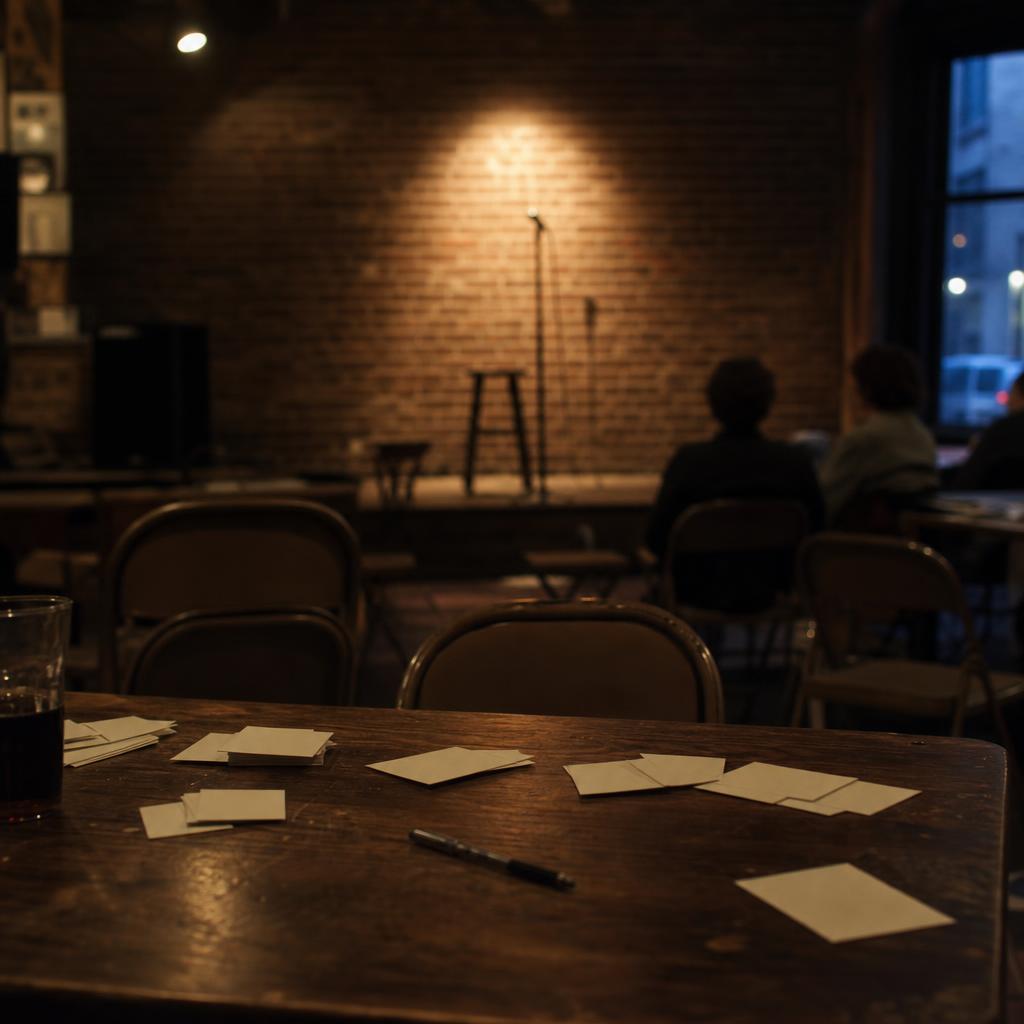
The stage itself was unadorned by design as much as by budget — a small platform against a brick wall, a single working light, a microphone on a stand, folding chairs pulled close enough that the front row could see a poet’s hands shake. Heat in the room came from bodies rather than any radiator that kept up with a full house on a winter night, and the noise between poems was not polite: applause, but also groans at a low score, arguments carried on in half-whispers about whether a judge had been generous or stingy, a running commentary from the crowd that made the audience as much a performer as anyone on the platform. A poet did not read into silence and wait for a verdict rendered elsewhere, in a review or a rejection letter arriving by mail weeks later. The verdict arrived in the room, in seconds, on cards held over strangers’ heads, and the poet stood there and watched it happen to their own poem in real time.
The Room Itself
The cafe’s storefront had passed through several uses since the building came under Algarín’s control in 1981 — coffeehouse, black-box theater, rehearsal space for playwrights working the same downtown circuit as PS122 and La MaMa a few blocks west — before the Halloween 1989 reopening settled it, more or less permanently, on the reading and the slam as its main business. The room mixed forms in a way no single genre category quite covered: poetry on the mic, jazz players sitting in on a given night, hip-hop’s rhythms audible in how the younger readers phrased a line, all inside a storefront that held, by most accounts, somewhat over a hundred people on a full night, folding chairs pulled in close enough that latecomers stood along the back wall. Allen Ginsberg, who read there himself on occasion, was remembered around the cafe as having called it something close to the most integrated room in the country — a line repeated often enough at Third Street to have become part of the room’s own account of itself, though no fixed date or transcript travels with it. A slam night on Third Street, for anyone who wandered down from a party elsewhere in the neighborhood, read as a version of a certain kind of Lower East Side evening: cheap admission, a packed room, and an audience with the standing right to boo.
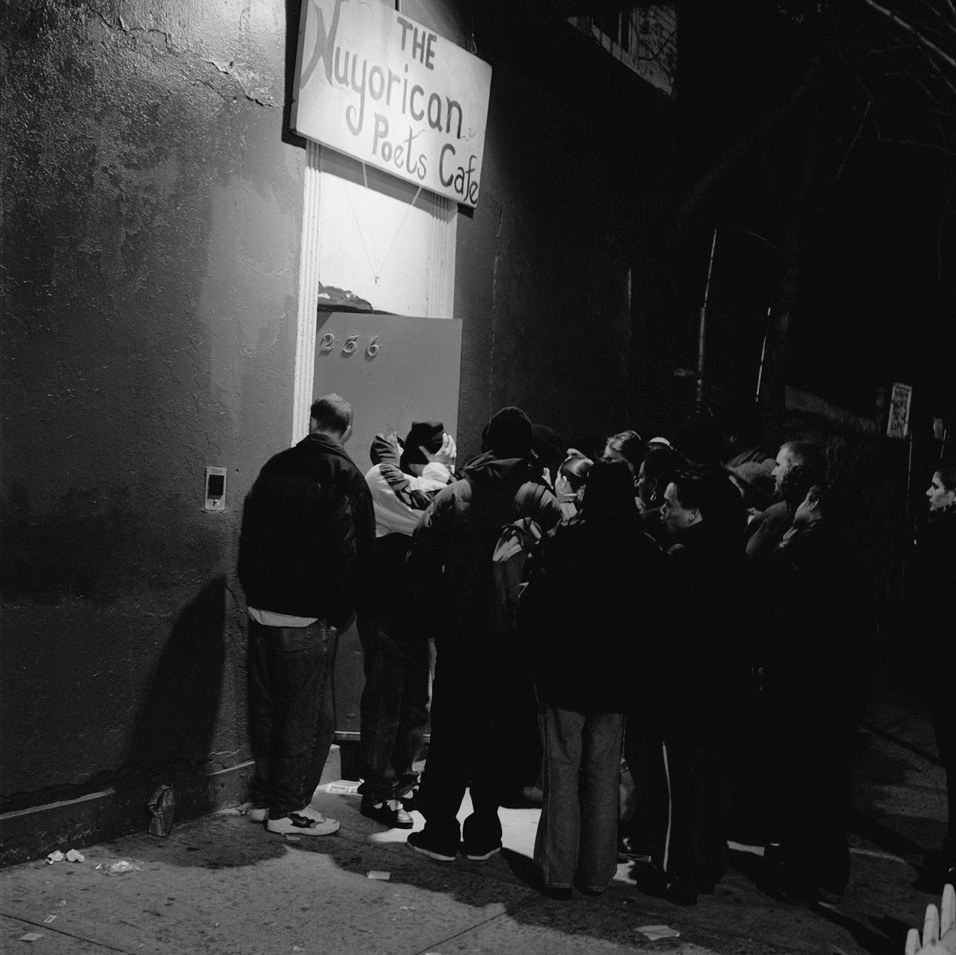
The crowd’s authority was not incidental to the form; it was the form. A reader who lost the room lost the scores that followed, whatever the poem’s merit on the page — five judges did not read in isolation from the noise around them, and a stanza that drew groans before the cards went up rarely drew a nine after. This made the slam, by design, a different contract than a magazine’s between writer and reader: no editor stood between the poem and its audience, no month’s delay separated the writing from the verdict, and no rejection arrived quietly by mail to be absorbed alone. The verdict happened in public, among people the poet could see, before the poet had left the stage.
Who the Room Made
Through the first half of the 1990s the Nuyorican’s Wednesday and Friday nights built a bench that the cafe’s small stage could not by itself explain. Paul Beatty won the first Grand Slam championship the cafe staged, in 1990, and turned the win directly into a book deal — Big Bank Take Little Bank came out from Nuyorican Poets Cafe Press in 1991, a small-press debut published by the room that had made him; a commercial publisher, Penguin, picked him up only later, for Joker, Joker, Deuce in 1994.4 Reg E. Gaines came up through the same rooms and carried the form into the theater, writing the book for Bring in ‘da Noise, Bring in ‘da Funk; the show earned him a Tony nomination in 1996 for Best Book of a Musical, an award that went that year to Jonathan Larson for Rent — Gaines did not win it.5 Tracie Morris, muMs da Schemer, and a rotating cast of others read the same nights, in the same room, off the same scoring cards.
The relationship between the Nuyorican’s stage and the hip-hop scene developing a few subway stops away ran through specific rooms rather than through any general kinship of sound: the Brooklyn Moon Café, which did not open until January 1995, became an open-mic where poets working in the Nuyorican’s tradition crossed paths with Mos Def, Talib Kweli, and Erykah Badu, all of whom passed through the cafe’s readings as well.6 The traffic ran the other direction too, briefly and loudly, when the touring Lollapalooza festival added a spoken-word stage in 1994 — “Rev. Samuel Mudd’s Little Armageddon and Spoken Word Revival” tent, organized by the poet and promoter Juliette Torrez, carrying Maggie Estep and Wammo across a summer of outdoor rock crowds who had not necessarily come for poetry.7 Estep also appeared, the year before, on MTV Unplugged: Spoken Word, taped at Sony Music Studios on April 20, 1993, and broadcast that July 28, alongside Reg E. Gaines, Bob Holman, and Henry Rollins.8
The Slam Poet’s Perfect Ten
A number of poets across the cafe’s first five years drew a perfect ten from all five judges on a given night — the room’s rarest outcome, five strangers independently agreeing that nothing about the reading had left room for a lower score. The scorecards did not survive as archive; the cafe kept no official register of every ten thrown in those years, and a ten that landed on a Wednesday in 1990 or 1991 lived afterward only in the memory of whoever had been in the room to see the cards go up.
The Other Mic Room
The city ran a second circuit of small rooms built around a microphone, a clock, and a stranger’s verdict, and it predated the slam by a generation: the comedy club, where the scoring cards were replaced by the blunter instrument of whether anyone laughed. The room that anchored the Village end of that circuit sat in a basement at 117 MacDougal Street, below the Olive Tree Cafe: the Comedy Cellar, opened downstairs from the cafe in 1981–82 and owned throughout the period by Manny Dworman, an Israeli-born musician who had run the Olive Tree since 1969 and ran the club below it as a nightly proving room rather than a showcase for names.9 The Cellar’s distinctive institution was not on the stage at all — it was the comedians’ table in the Olive Tree upstairs, where comics who had just come off the basement mic, or were waiting to go on, sat over Middle Eastern food and argued until closing, a standing seminar with no syllabus that regulars treated as the club’s actual product. Jerry Seinfeld worked out material on the Cellar’s stage across the 1990s while carrying a network sitcom bearing his own name; the room’s regulars across the decade included Colin Quinn, Dave Attell, and Ray Romano, comics who came down the stairs to test five new minutes in front of ninety people the same week they taped television for millions — Louis C.K. and Sarah Silverman were part of the same downtown circuit in the 1990s, though their own Cellar-headliner fame is chiefly a post-2001 development.10
The rest of the circuit sorted itself by neighborhood and by rung. A block from the Cellar on West 3rd Street, the Boston Comedy Club — named for its owner’s hometown, not its location — ran later and rougher, a room where a comic still assembling an act could get stage time the fancier clubs would not give.11 Uptown, Stand Up NY opened in 1986 at 78th and Broadway and worked the Upper West Side.12 At the top of the ladder stood Caroline’s, which Caroline Hirsch had opened in Chelsea in 1982 and moved twice upmarket — to the South Street Seaport in 1987, then in 1992 to Broadway around 49th Street, planting a purpose-built comedy theater in Times Square in the same years the state and the Disney Company were remaking 42nd Street two blocks south.13 And one institution went the other way: Catch a Rising Star, the East 77th Street room that had been the city’s defining showcase club since 1972 — the stage that had made Pat Benatar’s and Billy Crystal’s early careers — closed its original Manhattan location in the early 1990s, a casualty of the same contraction then working through the whole business.14
The contraction had a mechanism. Stand-up comedy had boomed through the 1980s on cable television’s appetite for cheap programming; the half-hour stand-up special and the late-night showcase multiplied clubs across the country until the market held several hundred full-time rooms by the end of the decade. When the recession arrived and the television bookings thinned, the boom reversed: clubs closed across the country in the early 1990s, and the New York rooms that survived were the ones, like the Cellar, that had never depended on the boom’s touring economics in the first place.15 What survival looked like from the bottom was unglamorous arithmetic. A comic starting out played open mics for nothing, then “bringer” shows — a booking conditional on the comic delivering a set number of paying friends at the door, an arrangement that made the newest performers the club’s unpaid sales force. Above that came the passed hat, the guest spot, and eventually the paid weekend spot, worth on the order of tens of dollars per set; a working New York comic pieced together a night’s income by running between clubs, doing three or four sets in different rooms between nine and one.16
What the circuit produced, the decade’s television then hired. The sitcoms that organized 1990s network programming were built to an unusual degree around stand-up comics whose acts had been assembled in exactly these rooms — Seinfeld’s, Romano’s, and the casts and writing staffs beneath them drew steadily on the New York clubs, and Saturday Night Live took Colin Quinn from the same pool. The comedy club and the slam room ran on the same contract, a performer alone at a microphone before strangers licensed to judge instantly and out loud; the difference was that by mid-decade one of those rooms had become the primary feeder for the most profitable half hour on American television, and the other was still passing a hat.
A room on Third Street had built, out of index cards and a three-minute clock, a way of judging a poem that a monthly magazine’s editorial process could not replicate and did not try to: instant, public, decided by whoever happened to be sitting in the folding chairs that night rather than by anyone credentialed to decide. The scoring looked like a joke on literary seriousness and worked, within a few years, exactly as well as the seriousness it mocked — a Tony nomination, a Sundance prize, a shelf of published books traced straight back to a stage against a brick wall in Loisaida. Nothing about the form required an editor, an agent, or a masthead. It required a poem, a clock, and five strangers willing to hold up a number.
A pitch built around Paul Beatty’s 1990 Grand Slam win would have circled the floor and stalled on the same ground each time: the piece would have set the masthead’s own literary judgment against five strangers with scorecards, and no one in the stable would have wanted to publish that comparison. A pitch built around the July 1993 broadcast of MTV Unplugged: Spoken Word would have died on a narrower question — whether a cable special belonged to youth-music coverage or to the literary page — and the room would never have agreed whose reader it flattered.
The 1994 Lollapalooza spoken-word tent, reframed from a poetry story into a touring-festival business item, would have run in The Front that September — the one photo stringer credentialed for that summer’s festival circuit would have been pulled onto a Bosnia assignment two weeks before the tent opened, and no replacement would have reached the fairgrounds in time. An editor assembling that November’s back pages would have logged Paul Beatty’s move to a commercial publisher, Penguin, for The Back. The Back’s August 1996 issue would have carried a shorter item on Reg E. Gaines’s Tony nomination for the book of Bring in ‘da Noise, Bring in ‘da Funk, the award that year going to Jonathan Larson for Rent.
The January 1995 opening of the Brooklyn Moon Cafe would have missed every closing calendar it might have joined, becoming an established stop on the same circuit before any desk would have logged it as news at all. Saul Williams’s 1996 Grand Slam win and the Nuyorican team’s run to the National Poetry Slam finals in Portland would have wanted a full profile, twelve thousand words tracing the arc back to the cafe’s back room, and no writer on the stable would have had that length open that cycle.
Footnotes
-
“The Nuyorican Poets Cafe, a DIY Hip-Hop Incubator,” Red Bull Music Academy Daily, November 2018. ↩
-
“Nuyorican Poets Café,” NYC LGBTQ Historic Sites Project. ↩
-
“Paul Beatty: from slam poet to Man Booker Prize,” The Irish Times, October 29, 2016. ↩
-
Internet Broadway Database, “Bring in ‘da Noise, Bring in ‘da Funk” (1996), production credits and Tony Award nomination record. ↩
-
“Brooklyn Moon Cafe Poets,” BOMB Magazine, April 1997. ↩
-
“Fans shout and shimmy at raucous Lollapalooza,” Baltimore Sun, August 9, 1994. ↩
-
Caryn James, “Poetry Goes Pop on ‘MTV Unplugged’,” The New York Times, 1993. ↩
-
Amy Plitt (amNewYork), “Manny Dworman’s Impact on NYC’s Nightlife Scene”; “Comedy Cellar,” Wikipedia, accessed 2026. The club at 117 MacDougal Street was founded by comedian Bill Grundfest in 1981 and opened downstairs from the Olive Tree Cafe in 1982; Manny Dworman, an Israeli-born oud and guitar player who had run the Olive Tree since 1969, owned the building and the club throughout the period (his son Noam inherited it in 2003). The body text has been corrected to reflect Dworman’s role as longtime owner rather than sole founder. ↩
-
“Comedy Cellar,” Wikipedia, accessed 2026; Mint Comedy, “Dive Deep into the Cellar.” Seinfeld’s and Ray Romano’s use of the Cellar to work out material while running their network sitcoms (1989–1998 and 1996–2005 respectively) is well documented, as is Colin Quinn’s and Dave Attell’s regular presence through the 1990s. Louis C.K.’s and Sarah Silverman’s Cellar-headliner reputations date chiefly to after 2001; the body text now flags this distinction rather than presenting them as period-equal “regulars.” ↩
-
“Boston Comedy Club,” Wikipedia, accessed 2026. The club, at 82 West 3rd Street in Greenwich Village, was founded by Barry Katz in 1988 and operated until 2005; Katz, a Boston-born comedian and manager, named it for his hometown, not its address. ↩
-
“Stand Up NY,” Wikipedia, accessed 2026. The club opened in spring 1986 at 236 West 78th Street on the Upper West Side, a block from Broadway. ↩
-
“Carolines on Broadway,” Wikipedia, accessed 2026. Caroline Hirsch opened the club in Chelsea (Eighth Avenue at 26th Street) in 1982, moved it to the South Street Seaport in 1987, and moved it to Broadway (750 Seventh Avenue, in the Times Square theater district) in 1992, where it remained until closing in 2022. ↩
-
“Catch a Rising Star (comedy clubs),” Wikipedia, accessed 2026. Rick Newman founded the club in December 1972 at 1487 First Avenue, between East 77th and 78th Streets; Pat Benatar and Billy Crystal were among the performers whose early careers it launched. Newman sold the business in 1986, and the original Manhattan location closed in 1993. ↩
-
“A Brief on the Comedy Boom,” Stand Up NY (Medium), accessed 2026. The 1980s cable-driven comedy boom (HBO specials, MTV’s Half-Hour Comedy Hour from 1988, Comedy Central’s 1991 launch) gave way to an early-1990s contraction as clubs oversaturated the market and cable made stand-up freely available at home; the Improv chain alone closed roughly a third of its locations in the downturn. ↩
-
The bringer-show arrangement and the open-mic/bringer/paid-spot hierarchy are well documented as an enduring structure of the New York club circuit, but the sources located describe the practice in general and contemporary terms rather than dating it precisely to 1989–2001 or itemizing period pay rates. The body text’s “tens of dollars per set” figure is presented as an order-of-magnitude characterization, not a cited period wage. ↩