Sitcoms: The Last Mass Genre, 1989–2001
Subscribe
https://meridian-archive.com/feed.xmlOpen in your app, or paste the link above into any other:
The Ouster
A man could be removed, within the first weeks of a situation comedy’s life, from every authority a network recognized an executive producer as holding — barred from the writers’ room, stripped of the final word over a single line his own actors spoke — and his name would run under the show’s title anyway, “created by,” for as long as the show itself ran — eight more seasons of episodes he had no further hand in.1 The screen credit was not a courtesy the network could revoke to punish him or restore to make amends; once fixed, it simply outlived the fact it had been created to describe. Roseanne was the show, and the mechanics of the credit’s survival ran through a fight that began within the first weeks of 1989. Roseanne Barr had brought the show to ABC on October 18, 1988, built from the stand-up persona she had spent a decade sharpening in comedy clubs: a Colorado factory-line mother, unglamorous and unapologetic, married to a construction worker, raising three children on a paycheck that did not stretch. Matt Williams, who had written for The Cosby Show before creating the series, held the writers’-room authority a network expected its executive producer to hold. Barr held a different authority — the claim of a woman playing, on television, close to the actual conditions of her own life — and she meant to keep the final word over what came out of that mouth. She refused lines through the first thirteen episodes and threatened to quit unless Williams went; ABC removed him instead of her, and the show’s highest-rated season of new comedy that year continued production without the man it had listed, from its first broadcast, as having made it.1
Nothing about the show’s premise — a household strained by money, a mother who raised her voice, a marriage that looked like actual work — was new to American comedy. What was new was a lead performer who had fought, at real professional cost to somebody else, to keep the account of that household as close to her own life as a network permitted, and had won before the show’s first season even ended. The show outlived Williams by eight seasons and closed, in May 1997, on a twist built from the same authorial claim Barr had fought for in 1989: the finale revealed the family’s lottery win as fiction, invented inside a novel the Conner matriarch had been writing to cope with her husband’s actual death the year before — the trade press’s standing citation, ever after, for how not to end a situation comedy.2
A Woman Who Did Not Exist
On May 19, 1992, the vice president of the United States gave a speech blaming part of the year’s civic unrest on a woman who did not exist. Dan Quayle, addressing the Commonwealth Club of California in the weeks after riots had spread through Los Angeles, argued that the deeper crisis was “a poverty of values” rather than a poverty of money, and reached for a single illustration: “It doesn’t help matters when prime-time TV has Murphy Brown — a character who supposedly epitomizes today’s intelligent, highly paid, professional woman — mocking the importance of fathers, by bearing a child alone, and calling it just another lifestyle choice.”3 Murphy Brown was a CBS comedy, created by Diane English, that had premiered on November 14, 1988, built around a hard-driving television news anchor played by Candice Bergen; the character had given birth to a son as a single mother in the season finale that aired the night before Quayle spoke, a storyline written and filmed months before any vice president had occasion to remark on it.4
The speech’s own argument — a policy case about welfare and family structure, delivered in the wake of an actual riot — survived barely a news cycle in that shape. What survived was a fight over a fictional character, conducted in earnest by two institutions that had never previously addressed each other directly. English’s writers wrote the reply into the season premiere that September: “You Say Potatoe, I Say Potato,” broadcast September 21, 1992, opened on Murphy watching Quayle’s speech on her own television and turning to answer him, an hour of network comedy built around a specific paragraph a sitting vice president had delivered four months earlier.5 No prior American situation comedy had been named, by title and character, in a vice-presidential address; none had needed its own writers’ room to draft a reply to one, either.
The Hangout Machine
NBC’s research department screened a rough cut of a half-hour pilot called The Seinfeld Chronicles in early 1989 and rated it weak — not a middling score inside a healthy range but the bottom tier a large majority of NBC pilots that year also received, except that, as one network veteran later put it, “this was a weak weak.”6 NBC’s president, Brandon Tartikoff, himself a Jewish New Yorker running the network out of Burbank, dismissed his own network’s find in four words: “Too New York, too Jewish.”7 Rick Ludwin, the NBC executive who ran late night and specials, believed in the pilot enough to fund four additional episodes out of his own budget line by canceling a Bob Hope special already scheduled that year — the entire second life of what became Seinfeld traced back to money redirected from a comedian fifty years Jerry Seinfeld’s senior.6 The pilot burned off as a summer special on July 5, 1989, and finished second in its own time slot against a CBS procedural;6 on its own the show went no further, and only Ludwin’s four additional episodes gave it anywhere left to build from.
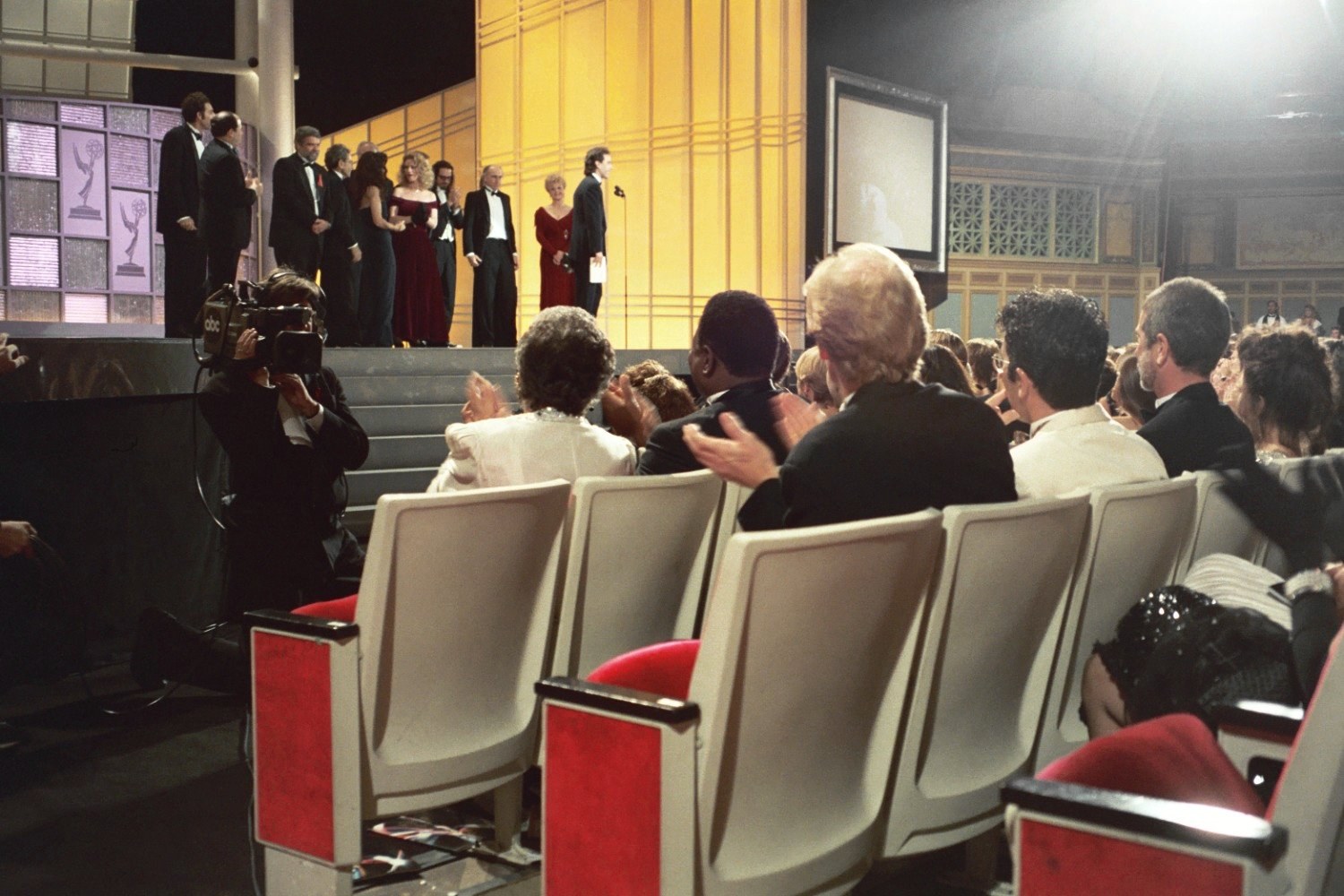
By the time NBC’s promotional department, under Dan Holm, branded the network’s Thursday comedy block “Must See TV” in August 1993 — the slogan’s premiere night, September 16, 1993, carried the season openings of Seinfeld and Mad About You alongside the series debut of Frasier — the shows sharing that hour had almost nothing in common except the night and the name.8 Seinfeld, developed by Larry David and Jerry Seinfeld around what David called a show about nothing, treated its own refusal of sentiment as a structural principle: no hugs, no lessons, four New Yorkers whose friendships survived on mutual irritation rather than affection. The show’s Emmy for outstanding writing arrived for “The Contest,” broadcast November 18, 1992, built entirely around a wager over who could last longest without masturbating — a premise NBC’s own censors refused to let the show name outright, so David wrote around the prohibition rather than against it, and the euphemism the script substituted for the forbidden word outlived the episode’s own broadcast restrictions by decades.9 Paul Reiser and the writer Danny Jacobson built Mad About You around a newly married couple in Greenwich Village, played by Reiser and Helen Hunt, the most specifically located of the block’s shows and the one whose premise demanded the least plot of all: two people, married, in one apartment, talking.10 David Angell, Peter Casey, and David Lee built Frasier almost entirely out of verbal precision — a psychiatrist, his brother, their father, a call-in radio audience — inheriting NBC’s Thursday anchor position from Cheers, whose own eleventh-season finale had closed out May 20, 1993, watched by an audience Nielsen put at roughly eighty million and NBC’s own survey closer to a hundred, celebrated that night not in New York but on Boston’s Beacon Street, outside the Bull & Finch Pub the show’s own set had been modeled on.11 Frasier’s writing then won the Outstanding Comedy Series Emmy five years running, 1994 through 1998, a record no comedy had set before and only one comedy matched, sixteen years later.12 David Crane and Marta Kauffman’s Friends, premiering September 22, 1994, took the hangout premise nearest to its logical end: six people with barely differentiated incomes, an apartment no single one of their stated salaries could plausibly have carried, built to sustain relationship plots across a decade without needing an outside engine to drive any of them. NBC staged its own proof of how little the block’s shows actually had in common on November 3, 1994, when Mad About You and Friends wrote the same fictional New York blackout into the same evening’s scripts and handed it off to a third, lesser-remembered comedy, Madman of the People, to close out; Seinfeld, offered a chance to join what the trade press was already calling Blackout Thursday, declined to bend its own no-plot premise for a single night’s ratings stunt.13
The six Friends leads started that decade earning the same fee, twenty-two thousand five hundred dollars an episode apiece in the first season; by the second, a subplot between two of the six had pulled ahead of the ensemble on-screen, and the network began paying two of the six more than the other four off it.14 Rather than let the gap widen, all six began negotiating jointly starting with the third season, refusing separate deals so that no single actor’s leverage could be turned against the rest — a strategy no ensemble comedy had organized at that scale before, and one other casts later copied outright.
The Six Become One: Friends Cast Pay Per Episode
| Season | Rate | Arrangement |
|---|---|---|
| 1 (1994–95) | $22,500 | Equal, individually negotiated |
| 2 (1995–96) | $20,000–$40,000 | Split; two leads paid above the other four |
| 3 (1996–97) | $75,000 | Equal, negotiated jointly |
| 4 (1997–98) | $85,000 | Equal, negotiated jointly |
| 5 (1998–99) | $100,000 | Equal, negotiated jointly |
None of the block’s four shows read the same on the page. What they shared was a slot, a syndication package, and a name invented by a marketing department, not by any writer in any of the four rooms, to describe a scheduling strategy rather than a genre.
The Room With No Studio Audience
Garry Shandling turned down a reported five-million-dollar NBC offer to keep making a show that used the sitcom’s own machinery against itself. The network approached him in 1993 to succeed David Letterman as host of Late Night once Letterman’s move to CBS became public; Shandling declined it to continue The Larry Sanders Show, an HBO comedy that had premiered August 15, 1992, shot single-camera with no studio audience and no laugh track — conventions the genre had used since its earliest television-taped stage shows, rejected here entirely.15 Rip Torn played the fictional host’s producer and Jeffrey Tambor his sycophantic sidekick; the writers’ room built around them over its run included Judd Apatow, Bob Odenkirk, and Paul Simms, then journeyman names on a small cable comedy rather than the credits later attached to them. The show’s own finale, “Flip,” broadcast May 31, 1998, won Shandling and his co-writer Peter Tolan the Emmy for Outstanding Writing in a Comedy Series — the same category “The Contest” had won five years earlier, awarded this time to a show whose explicit premise was that its host’s on-camera warmth was a performance, and its real subject the flattery and terror behind the desk.16
Paul Simms, who had written for Sanders before creating his own show, built NewsRadio around a fictional AM news station in Manhattan, the sitcom era’s closest approach to a New York newsroom. It premiered March 21, 1995.17 Phil Hartman, cast as the station’s preening anchor Bill McNeal, was murdered by his wife at their home in Encino, California, on May 28, 1998, days before the show’s fourth season was set to resume production.17 The writers did not recast the role and did not write around the absence: the episode “Bill Moves On” opened on the station’s staff returning from McNeal’s funeral, gave his death a heart attack rather than reproducing the circumstances of Hartman’s own, and was filmed, by the account of people who worked on it, through repeated stoppages because the cast could not get through some of the scenes without breaking down.17 A show that had spent four seasons treating a fictional newsroom’s daily indignities as comic material now had to write an actual death into the same half-hour form, in the same rooms, with the same actors, within days of the man who had played the part being buried.
The Last Network Event
Will & Grace premiered on NBC on September 21, 1998 — six years to the day after Murphy Brown’s own reply to a vice president — built around a gay lawyer and his straight best friend sharing a Manhattan apartment, the first American network comedy whose leads included an openly gay man; creators David Kohan and Max Mutchnick drew the premise from Mutchnick’s own real friendship with a woman much like the character of Grace.18 Nothing about the show’s form was new: hangout premise, multi-camera stage, a laugh track recorded in front of a studio audience — the genre had absorbed nearly every shape it was going to absorb across the preceding decade. What was new sat entirely in who the leads were permitted to be, on a broadcast network, at an hour advertisers were still willing to buy. Vice President Joe Biden later credited the show directly, telling a Sunday news program: “I think Will & Grace probably did more to educate the American public than almost anything anybody’s ever done so far” — a verdict delivered by the same office that had spent a vice-presidential speech, six years earlier, attacking a fictional woman for raising a child alone.19
The trade press filed all of these shows under a single word, and the word explained less than it seemed to. A star’s fight to control the words her own mouth spoke, a vice president’s attack on a woman scripted months before he spoke, four half-hour machines sharing a night and a marketing slogan none of their own writers had coined, a cable show that spent six seasons refusing every convention the word was supposed to guarantee, and a broadcast comedy whose casting decision did more political work than any single magazine editorial managed that decade — “sitcom” named the timeslot these things shared, not the thing any of them actually were. What closed in 2001 was not a genre. It was the fiction that the genre had ever been only one thing, sustained for exactly as long as all of it still fit on the same handful of channels at the same hour on the same night.
A senior editor’s objection would not have been enough to keep Meridian off the Roseanne producer’s ouster in the first weeks of 1989: the standoff between the man credited with creating the show and the star who had forced him out would have offered undeniable copy, but the network’s own advertisers would have belonged to a category the publisher’s ad pages courted that season, and a piece airing a star’s power fight with her own network would have read, on the floor, as a needless risk to run.
The vice president’s attack on a fictional single mother, that May, would have been the rarer case: a speech delivered in Washington on family values would have belonged to Meridian’s front matter as a policy question first, and an articles editor would have claimed the argument the speech left behind — a magazine’s own fictional cast entering a national argument about itself — for The Essay, months after the microphone itself would have gone cold. Two years later, when three of the same network’s comedies would have written an identical fictional blackout into the same November night to cross-promote a single hour, the desk would have found no hook worth the trouble: a marketing department’s stunt, built for one broadcast, would have left nothing behind it that could still anchor a monthly item by the time any issue closed.
The Back, before the decade closed, would have run the finale’s own twist — a family’s lottery win revealed as a novel its widowed matriarch had been writing, the trade press’s standing citation ever after for how not to end a situation comedy. In between, in the late spring of 1998, an actor’s real death rewritten into his character’s off-screen heart attack would have reached the room only to stall there: the pitch would have arrived as a grief piece about a cast’s own mourning, and the floor would not have settled whether that grief belonged to the reader it edited for or to the tabloids that had already told the story first. The November 1998 close’s own Back would have taken the last of the six for granted: a gay lawyer and his best friend sharing a Manhattan lease, the first such leads a network comedy would have offered.
Footnotes
-
Nikki Finke, “One Big Happy Family? : Why ‘Roseanne’s’ Creator Left Hit Show After Dispute With Its Star,” Los Angeles Times, January 26, 1989; Wikipedia, “Matt Williams (producer),” https://en.wikipedia.org/wiki/Matt_Williams_(producer). ↩ ↩2
-
“Into That Good Night, Part 2,” Roseanne, season 9, episode 24, ABC, May 20, 1997; Wikipedia, “Roseanne (season 9),” https://en.wikipedia.org/wiki/Roseanne_(season_9). ↩
-
James Danforth Quayle III, “Murphy Brown Speech,” Commonwealth Club of California, May 19, 1992, reprinted at Voices of Democracy, voicesofdemocracy.umd.edu. ↩
-
“Birth 101,” Murphy Brown, season 4, episode 26, CBS, May 18, 1992; Wikipedia, “Murphy Brown,” https://en.wikipedia.org/wiki/Murphy_Brown. ↩
-
“You Say Potatoe, I Say Potato (Part 1),” Murphy Brown, CBS, September 21, 1992; Wikipedia, “Murphy Brown,” https://en.wikipedia.org/wiki/Murphy_Brown. ↩
-
TV Guide, “The Biz: The Research Memo That Almost Killed Seinfeld,” tvguide.com, June 27, 2014; Gothamist, “‘Too New York, Too Jewish:’ The 30th Anniversary Of ‘The Seinfeld Chronicles’ Pilot,” gothamist.com, July 5, 2019. ↩ ↩2 ↩3
-
Gothamist, “‘Too New York, Too Jewish:’ The 30th Anniversary Of ‘The Seinfeld Chronicles’ Pilot,” gothamist.com, July 5, 2019. ↩
-
Wikipedia, “Must See TV,” https://en.wikipedia.org/wiki/Must_See_TV. ↩
-
Wikipedia, “The Contest,” https://en.wikipedia.org/wiki/The_Contest. ↩
-
Wikipedia, “Mad About You,” https://en.wikipedia.org/wiki/Mad_About_You. ↩
-
UPI, “Cheers’ finale watched by nearly 100 million,” May 21, 1993; Wikipedia, “One for the Road (Cheers),” https://en.wikipedia.org/wiki/One_for_the_Road_(Cheers). ↩
-
Wikipedia, “List of awards and nominations received by Frasier,” https://en.wikipedia.org/wiki/List_of_awards_and_nominations_received_by_Frasier; Guinness World Records, “Most Emmy awards for best comedy series,” guinnessworldrecords.com, April 27, 2009. ↩
-
Digital Trends, “30 years ago, New York City went dark and NBC’s Must See TV shined brightly,” digitaltrends.com, November 3, 2024; IndieWire, “NBC’s Blackout Programming Stunt Celebrates 30th Anniversary,” indiewire.com, November 4, 2024. ↩
-
Next TV, “‘Friends’ - A Timeline of Obscene Profitability,” nexttv.com, May 28, 2021; Looper, “How Much Did The Cast Of Friends Get Paid?,” looper.com, December 7, 2022. ↩
-
The Hollywood Reporter, “Bill Carter on Garry Shandling’s Legacy: The Late-Night Star Who Never Was,” hollywoodreporter.com, October 12, 2016; Wikipedia, “The Larry Sanders Show,” https://en.wikipedia.org/wiki/The_Larry_Sanders_Show. ↩
-
Wikipedia, “List of awards and nominations received by The Larry Sanders Show,” https://en.wikipedia.org/wiki/List_of_awards_and_nominations_received_by_The_Larry_Sanders_Show; The Washington Post, “Tears of Laughter for ‘Larry Sanders,’” May 30, 1998. ↩
-
The Baltimore Sun, “Show captures farewell just right,” September 23, 1998; Wikipedia, “NewsRadio,” https://en.wikipedia.org/wiki/NewsRadio. ↩ ↩2 ↩3
-
Wikipedia, “Will & Grace,” https://en.wikipedia.org/wiki/Will_%26_Grace; The Hollywood Reporter, “‘Will & Grace’ First Episode: THR’s 1998 Review,” hollywoodreporter.com, September 21, 2021. ↩
-
TheWrap, “How ‘Will & Grace’ Had a Real-Life Political Impact on Marriage Equality,” thewrap.com, September 29, 2017. ↩