Late Night
Subscribe
https://meridian-archive.com/feed.xmlOpen in your app, or paste the link above into any other:
The Booking
A network could employ the host of its own flagship late-night program in thirteen-week increments, renewing or dropping him each quarter with no obligation to say which it would be — an ordinary contractual instrument, not a special humiliation reserved for a show in trouble. NBC ran Conan O’Brien’s Late Night this way through 1994, extending him thirteen weeks at a time while it decided whether to keep going, a practice the trade press reported as routine business rather than as news.1 The uncertainty a young host lived under for the better part of a year was the standard condition of the job, not an aberration in it; the same networks that spent the era selling continuity to viewers — the returning face, the familiar desk — administered their own performers’ livelihoods a fiscal quarter at a time.
Which couch a writer sat on told the magazine floor where he stood before he opened his mouth. A literary novelist with a modest first printing did the interview hour on the city’s public station and was reviewed at length in the New York Review of Books. A novelist with a large commercial printing did Letterman. A writer who agreed to do Leno had, by the reckoning of the floor, given something up. The gradation was never written down and never had to be; everyone who cared to read it could read it, and the people who mattered most to a magazine — the writers it published and the writers it wanted — sorted themselves along it without instruction.
Tom Wolfe, whose Bonfire of the Vanities had been the New York novel of the late 1980s, sat with David Letterman on NBC’s Late Night in December 1987 to talk about it, and returned to Letterman’s couch, by then at CBS, in November 1998 for A Man in Full.2 A best-selling novelist belonged there. The interview hour that Charlie Rose began on the city’s public television station in the fall of 1991 — a single guest, a plain black table, an hour of talk with no band and no monologue — belonged to a different writer: the one whose sales were smaller and whose standing was made of other things.3 Between the two sat most of the distinctions the magazine world spent its days maintaining, and a booking made those distinctions legible to anyone holding the remote.
The floor watched late night the way it read the trades: for intelligence. A late-night appearance was a signal that a writer had entered the cultural bloodstream at that particular moment, and the magazine’s editors, whose business was deciding whose moment it was, tracked the signal closely while affecting not to care about the medium carrying it. Rose’s hour, which reached the rest of the country over the public network in January 1993 after fifteen months as a local New York program, sharpened the gradation rather than softening it: it gave the smaller writer a room of his own, a place to be serious at length in front of an audience that had chosen seriousness, and the choice of that room over the Broadway theater was itself a statement about what kind of writer one meant to be.3
The Wars
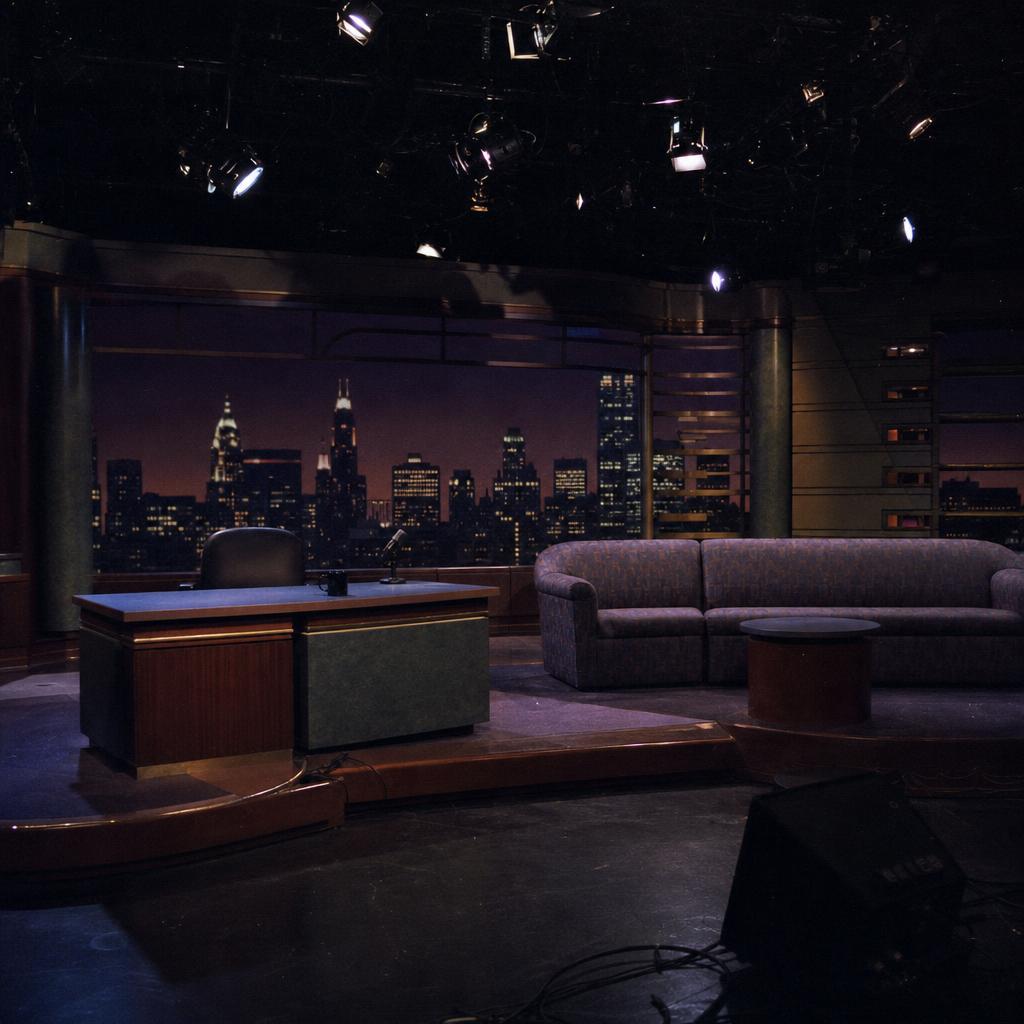
The whole arrangement had been thrown into motion by a retirement. Johnny Carson, who had held The Tonight Show for three decades, told NBC’s affiliates in May 1991 that he intended to leave; his last broadcast came a year later, in May 1992.4 NBC chose Jay Leno, Carson’s frequent guest host, over Letterman to inherit the chair — a decision made by the network’s own executives rather than by Carson, and one Letterman took as a wound. On Carson’s advice, he left NBC entirely. CBS built him a show around the old Ed Sullivan Theater on Broadway, and Late Show with David Letterman went on the air there on August 30, 1993, with Bill Murray as its first guest and an audience of twenty-three million.5 For nearly two years Letterman beat Leno every week.
The magazine floor read the contest as a story about temperament and institutions, which was the register in which it read most things. Bill Carter, the New York Times reporter who covered the television business, turned the whole affair into a book, The Late Shift, in 1994, and the book sat on senior editors’ desks as the authoritative account of a corporate decision that had somehow become a cultural one.6 What the floor was slower to admit was that it had a stake in the outcome. Letterman’s irony — the ostentatious refusal to pretend the show mattered, the running joke that the whole apparatus of television was absurd — was the floor’s own house style broadcast at half past eleven, and the editors who watched him recognized the manner as their own.
The Writers’ Host
Into the slot Letterman vacated at NBC, the network put a thirty-year-old with no on-camera experience. Conan O’Brien had written for Saturday Night Live and The Simpsons and had come up through the Harvard Lampoon, the same pipeline that had fed a generation of comedy writing rooms; Lorne Michaels produced the new Late Night, Robert Smigel ran its writers, and a comic actor named Andy Richter sat beside the host as a foil. It premiered on September 13, 1993, from Studio 6A at Rockefeller Plaza, with John Goodman as its first guest,1 to reviews that ranged from cool to unkind. Variety, two days later, called the show “far from an unqualified success” but granted the host promise: he had, the paper allowed, “his own distinctive style, and is more viewer-friendly than Jay Leno, less acerbic than David Letterman.”8 The turn came in February 1994, when Letterman himself — the man whose old chair O’Brien had inherited — came on as a guest and, in effect, vouched for his successor; the network’s confidence steadied from there.1
The magazine floor’s first verdict on O’Brien was that he was too inside — the jokes were built for people who had themselves sat in a writers’ room, the Lampoon-bred absurdism legible mainly to other writers — and the floor was, on this point, describing itself. It rooted for him accordingly. By 1996, after the near-cancellation and a slow consolidation of its audience, his show had become the one an editorial assistant watched: a writer with genuinely strange material went on Conan because Conan’s room would actually engage the writing. A real line ran through the office by then, and it ran by rank. The assistants watched O’Brien. The executives watched Letterman. Nobody on any floor admitted to watching Leno.
The Hugh Grant Line
That line acquired a date. On June 27, 1995, the British actor Hugh Grant was arrested in Los Angeles on a solicitation charge; thirteen days later, on July 10, he sat down with Leno for his first interview since, and Leno opened with the only question anyone had. The broadcast drew the numbers, and for the first time since taking the chair Leno beat Letterman — the start of a lead The Tonight Show held for fourteen years.9 The magazine floor understood exactly what it had lost and exactly why. Leno’s audience was the national one, the households the floor had spent a career defining itself against: the monologue was a stand-up’s joke book, the guests were sitcom actors selling that week’s installment, and the whole enterprise was pitched at the middle of the country rather than at the corner of Madison and Fifty-first.
Leno had not gotten worse. He had simply been confirmed as the host of everyone the floor did not consider its reader, and his victory was a small notice that the mass audience the editors had learned to condescend to was larger than the audience that shared their taste, and was not going away. The contempt was reciprocal and mostly unspoken. It was also, on the floor’s side, a form of self-protection: to admit that Leno was funny, or merely that Leno was popular in a way that meant something, was to admit that the coded hierarchy of couches was a vanity rather than a judgment.
What the Slot Became
The irony that had defined the slot did not hold to the end of the decade. On January 14, 2000, Letterman underwent quintuple bypass surgery; when he came back to the Ed Sullivan Theater five weeks later, he brought the surgeons and nurses who had operated on him onto the stage, told the audience they had saved his life, and wept in front of it.10 The man whose entire manner had been the refusal to be sincere on camera had been unable to sustain the refusal, and the moment was noted on the floor as a small breach in a style the floor also practiced. When the medium’s oldest posture of detachment cracked, it cracked first in the place that had made detachment a brand.
The final crack was collective. Letterman was the first of the network hosts to return to the air after September 11, 2001, on the seventeenth, and he returned without a monologue, talking plainly and without jokes about a city he could see out the theater doors.11 The slot that had been built to insist nothing was serious had become, for a night, the place the culture went to be told that something was. The class code of the couches did not survive the decade intact, but it had governed the floor’s evenings for most of it, sorting hosts and the writers who sat with them into ranks the magazine never set in type.
The magazine floor kept a ledger it never printed. It recorded which host a writer sat with, and read the entry as a verdict on the writer’s standing — the public station’s hour for the smaller talent, Letterman’s couch for the commercial one, Leno’s for the writer who had stopped minding. The editors watched the medium closely while telling themselves and one another that it was beneath close watching, and the gap between the watching and the telling was the whole of their relation to it. What they were guarding, in the end, was a distinction they could not have defended out loud: that the audience which shared their taste was the audience that counted, and that a host who drew a larger one drew the wrong one. The half-hour past eleven was where a magazine that processed the culture for a living went to find out, night after night, where it stood in a contest it pretended not to be entering.
The Carson succession — the chair passing to Leno over Letterman — would have gone into The Back for the July close, wire mechanics and network politics assigned to whoever would have drawn the media beat that year. Letterman’s own move to CBS, and the debut from the Ed Sullivan Theater, would have belonged to The Back’s October pages by the same route, an editor already primed by the Carson piece to claim the sequel.
O’Brien’s arrival at NBC would have been raised as an essay rather than a note and would have died before assignment: the pitch would have called the new host’s humor too inside, built for people who would themselves have sat in a writers’ room, and the writer proposing it would have recognized the description as applying first to the room he sat in. The Late Late Show, arriving under Letterman’s own production company, would have been read on the floor as a footnote already spent — a twelve-thirty story to a contest the magazine would have considered told at eleven-thirty, with no close left to carry it.
The Hugh Grant appearance would have reached the room only once removed: not the arrest, tabloid material the house voice could not have carried without sounding like the tabloids describing it, but a paragraph on the ratings war’s economics, folded into a wider piece for The Back’s September close. Letterman’s return from bypass surgery would have taken a place in The Back on its own account in April — the irony broken, the surgical team brought onstage, thanks given where a joke would have gone. The return after September’s attacks would have earned The Back again that November, the piece built around a broadcast with no monologue.
Footnotes
-
“Late Night with Conan O’Brien,” Wikipedia. Premiered September 13, 1993, from Studio 6A at 30 Rockefeller Plaza; Lorne Michaels executive producer, Robert Smigel head writer, Andy Richter sidekick, John Goodman first guest. David Letterman’s guest appearance in February 1994 is generally credited as the turning point that steadied the show against cancellation. ↩ ↩2 ↩3
-
Tom Wolfe appeared on NBC’s Late Night with David Letterman on December 9, 1987, and on CBS’s Late Show with David Letterman on November 10, 1998 (episode airdate records, IMDb). ↩
-
“Charlie Rose (talk show),” Wikipedia. The interview program began on the New York public television station Thirteen/WNET on September 30, 1991, and was distributed nationally on PBS from January 1993. ↩ ↩2
-
“Carson Takes a Swing at Retirement,” Deseret News, May 30, 1991. Carson’s final Tonight Show aired May 22, 1992. ↩
-
“August 30, 1993 — ‘Late Show With David Letterman’ Debuts on CBS,” Eyes of a Generation (television history archive). The debut, from the Ed Sullivan Theater, featured Bill Murray as first guest and drew roughly twenty-three million viewers. ↩
-
Bill Carter, The Late Shift: Letterman, Leno, and the Network Battle for the Night (New York: Hyperion, 1994). ↩
-
“The Late Late Show with Tom Snyder,” Wikipedia. The program, produced by Letterman’s Worldwide Pants and following Late Show on CBS, premiered January 9, 1995, and ran without a house band, monologue, or studio audience. ↩
-
Variety, “Late Night with Conan O’Brien” (review), September 15, 1993 (variety.com). ↩
-
“Hugh Grant Appears on Tonight Show After Hollywood Arrest,” Sky History (This Day in History, July 10). Grant was arrested June 27, 1995; the July 10 appearance gave Leno his first ratings win over Letterman, the start of a fourteen-year lead for The Tonight Show. ↩
-
“20 Years Ago: David Letterman Returns After Heart Surgery,” Ultimate Classic Rock. The quintuple bypass was performed January 14, 2000, by Dr. O. Wayne Isom; Letterman returned to air February 21, 2000, and brought his surgical team onstage. ↩
-
“911 Remembered: David Letterman Delivered a Powerful Monologue After the Attacks,” WFTV. Letterman was the first major late-night host to return to air after September 11, 2001, on September 17. ↩