After the Kitchen Closes: The Restaurant at Night, 1989–2001
Subscribe
https://meridian-archive.com/feed.xmlOpen in your app, or paste the link above into any other:
The Room After Midnight
New York State’s 1996 restructuring of welfare eligibility converted continued public assistance into a standing work requirement, and the city’s welfare offices met that requirement by routing recipients into the lowest tier of the service economy in volume — dish stations and prep lines absorbing part of a caseload the new law no longer let sit outside employment altogether, alongside the janitorial contracts servicing the same finance boom that was filling the dining rooms upstairs. The restaurant trade took the placements as it took a produce delivery: as supply, unremarked in the industry’s own accounting of who worked a kitchen and why. A prep cook peeling vegetables at four in the afternoon and a bond trader closing a position forty blocks north were both, in their own registers, provisioning the same evening, and neither the menu nor the review ever mentioned the first one by name — nor did the welfare office’s own paperwork mark the placement as anything but a case closed.
By one in the morning the restaurant belonged to a different city than the one that had eaten in it at eight. At the Odeon, the TriBeCa brasserie that had opened in a converted cafeteria on West Broadway in 1980, the crowd that mattered arrived after the theaters let out and did not thin until the sky was turning: cooks off their own shifts drinking at the far end of the bar, a table of magazine people who had left a party two blocks over, someone reading a paperback alone in a booth because the light was good and no one would ask her to leave.1 Its own bar produced, in the late 1980s, one of the decade’s small durable artifacts: the bartender Toby Cecchini, working the Odeon’s late shift, was credited with popularizing the Cosmopolitan there, a drink built for exactly the hours the room specialized in — after the review had been filed, after the show had closed, when the only order left to fill was one more round.2
Recognizable faces did as much to fill it as the late hour did. The Odeon’s regulars through the 1980s and into the period this account covers included cast members of Saturday Night Live and the artist Andy Warhol among the crowd the neighborhood was newly attracting, and the crowd’s own visibility was, in a small way, the room’s advertising; a restaurant that filled itself with recognizable faces after midnight sold every other customer on the fact of being in the right place at the wrong hour.3 A few blocks southwest, in a district the city still zoned for meatpacking, a room called Florent stayed open around the clock, every day, drawing the graveyard economy of the neighborhood — the butchers coming off the killing floor at dawn, the drag queens and sex workers finishing their own shift, the club kids not yet ready to go home — onto stools set along a Formica counter salvaged from the diner the room had been before it was Florent. Florent Morellet, the Frenchman who took the lease over in 1985, ran the room’s Bastille Day block party from 1989 on and, after his own HIV diagnosis in 1987, posted his T-cell count on the specials board beside the soup of the day, a piece of information as freely offered to a stranger on a stool as the price of the onion soup.4 Both rooms served the same meal, more or less, at eight and at three. What changed between those hours was who was allowed to be in the room, and the restaurant at night let in a version of the city the restaurant at noon did not.
The daytime version of the New York restaurant — the power lunch that priced a table at Michael’s or the Four Seasons by who could be seen at it, and the Greek diner counter that priced nothing at all and asked nothing of the customer who sat there for two hours over one cup of coffee — has its own accounting elsewhere in this book.5 Both belonged to the meal that ran on a clock everyone could read: a start time, a party, an expense report. The restaurant at night ran on a different clock, one set by the kitchen’s own hours rather than the diner’s, and it opened onto a room the daytime version never showed — the line behind the pass, staffed by people who cooked the city’s dinners and then, still in kitchen whites, went out to drink in the same kind of late rooms they had just worked.
The Kitchen Underground
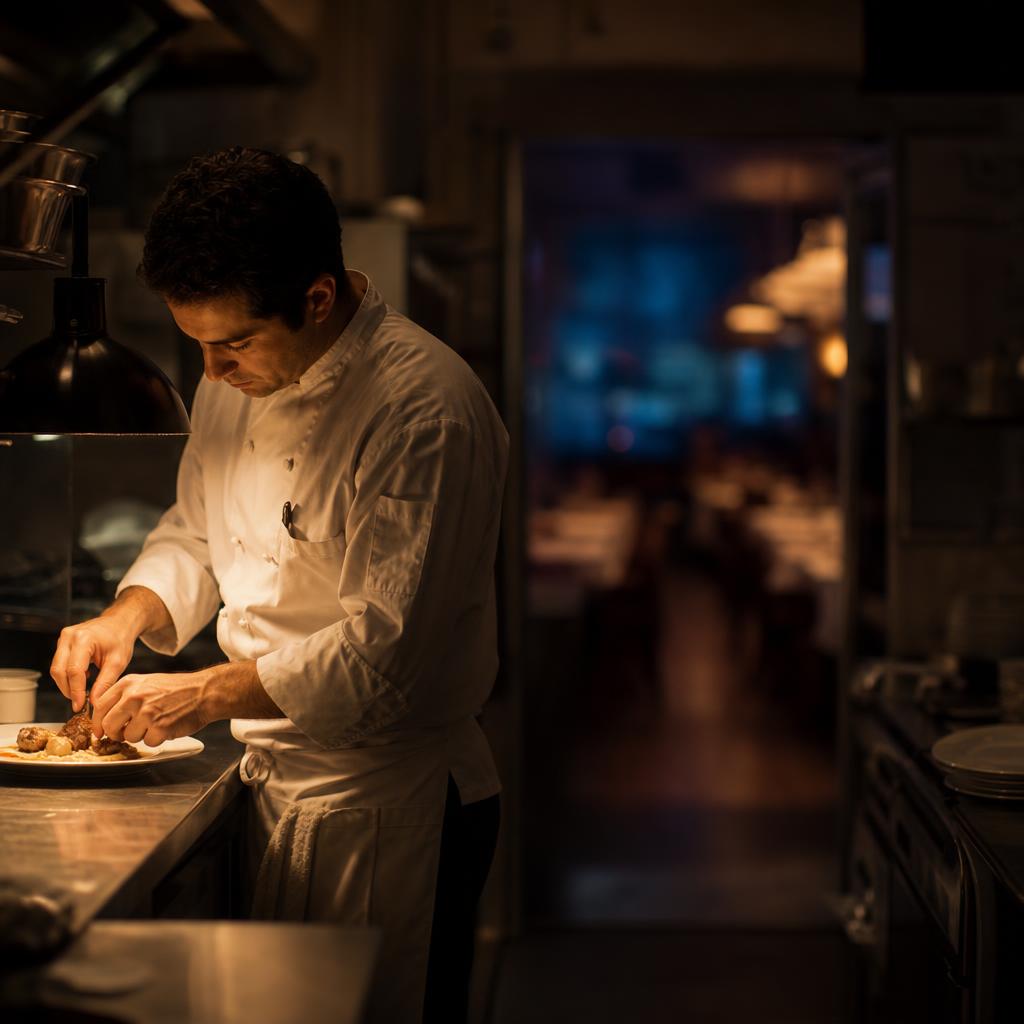
Beneath every dining room the decade celebrated ran a second institution the dining room never saw, organized on a hierarchy inherited from a nineteenth-century French system of ranks — the executive chef, the sous chef, the line cooks arranged by station, garde manger and saucier and grill, each answering to the one above and shouting orders down to the one below — and staffed, disproportionately, by people for whom the kitchen was the only door in the American labor market that opened without a diploma, a green card that worked cleanly, or fluent English.6 The hours were the trade’s defining fact: an eighty-hour week was ordinary at a serious restaurant, the shift beginning at midday prep and not ending until the last ticket cleared and the line was broken down and scrubbed past midnight, six days repeated most weeks of the year.6 The pay for a line cook in New York across the period ran low against the hours worked — a wage that made the work, by any conventional accounting, a bad deal, and made the reasons people stayed in it a subject the trade discussed mostly among itself.
The kitchen’s labor pool widened as the decade went on for reasons that had nothing to do with cooking, the welfare caseload of the middle 1990s feeding the same dish stations and prep lines from below. The kitchen did not advertise this the way the dining room advertised its chef.
The account that finally said this to a general audience arrived from inside the kitchen rather than from a food critic looking in. Anthony Bourdain, then the executive chef at Les Halles on Park Avenue South, published “Don’t Eat Before Reading This” in The New Yorker in April 1999 — an essay on what actually happened to food and to the people who cooked it before either reached the dining room — and expanded it the following year into Kitchen Confidential: Adventures in the Culinary Underbelly, a memoir of two decades on New York lines that named the kitchen’s own economy for readers who had only ever sat on the other side of the pass: the drugs that kept an exhausted line moving through a Saturday dinner service, the crews built out of ex-convicts and immigrants and dropouts because no one else would show up for the wage and the hours, the code of loyalty and casual brutality that held a kitchen together under a dinner rush no outsider could see from the dining room.6 The book became a bestseller and, for the first time at that scale, made the line cook’s night legible to the customer who had only ever met him as a name on a menu credit or not at all.
The clearest evidence of the kitchen’s own internal culture was a ritual with no equivalent on the customer’s side of the pass: the family meal, cooked by the crew for the crew and eaten together, standing or on overturned crates, in the last calm window before service began. Thomas Keller devoted a chapter of The French Laundry Cookbook, published in 1999, to the practice under the title “The Importance of Staff Meal,” treating it as a matter of professional discipline rather than charity — a kitchen that fed its own people well, he argued, cooked better for the people paying to eat there.7 David Waltuck, the chef at the East Village restaurant Chanterelle, went further the following year and published Staff Meals from Chanterelle, two hundred recipes built from the odd cuts and the day’s excess that a paying menu would never carry — the food a kitchen made for itself, out of what a kitchen alone would have thrown away.8
The shift did not end when the last plate went out. A kitchen crew coming off a Friday service at midnight went, as a body, to whichever bar in the neighborhood served people still in checked pants and clogs without commentary — a habit as consistent across the trade as the family meal itself, the after-work drink standing in for the family that a schedule running six nights a week made impossible to keep any other way. The room they drank in was frequently the same room, or one down the block from the same room, where other people’s night had just ended over dessert. The dining room’s customer and the kitchen’s line cook occupied the same blocks after midnight and almost never occupied them as the same class of person; the customer went home to sleep before the next day’s schedule, and the cook went to the bar because the bar was the only social life the schedule left standing.
The Chef Decade
The kitchen’s near-invisibility ran alongside a countervailing trend the decade also produced: the individual chef, for the first time at this scale, became a public figure with a name a customer would recognize before ever eating at the restaurant. Bobby Flay’s Mesa Grill, which opened on Lower Fifth Avenue in 1991, made a public name of a chef cooking Southwestern food downtown, an early instance of the pattern; Danny Meyer opened Union Square Cafe on East Sixteenth Street in 1985 at the age of twenty-seven, proposing a room that served food as serious as the French houses without their formality, and confirmed the model in 1994 when he opened Gramercy Tavern on East Twentieth Street with the chef Tom Colicchio — a partnership in which the chef’s name sat beside the owner’s on the marquee rather than hidden behind it.9 The same year, on Hudson Street, Nobu Matsuhisa opened the restaurant that carried his own name in partnership with the restaurateur Drew Nieporent, the actor Robert De Niro, and the investor Meir Teper, and the difficulty of the reservation became inseparable, in the years that followed, from the fame of the chef who had made the room hard to get into.10 Keith McNally closed the loop in April 1997 when he opened Balthazar on Spring Street, a French brasserie built with such deliberate patina — the aged mirrors, the tin ceiling, the zinc bar — that it read as though it had stood for a century; the press credited McNally with having invented downtown all over again, seventeen years after he had done the same thing once already at the Odeon.11
What the chef decade sold the public was the fantasy that the kitchen was glamorous, staffed by artists rather than a shift crew working a bad wage past midnight — a fantasy that the same decade’s other current, Bourdain’s account of the line, was quietly correcting from the inside. The two stories ran through the same rooms at once: the dining room learning to treat the chef as a celebrity, and the kitchen behind it staying exactly what it had always been, a crew of people who worked longer hours for less money than almost anyone eating what they cooked, and who ate their own dinner standing up an hour before anyone else’s arrived.
The restaurant did not stop being a stage when the sun went down; it changed which parts of itself the stage lit. By day it sorted its customers by status — who sat where, who paid, who was seen paying. By night it sorted them by access — who could still get a table at midnight, whose name got a chef to come out of the kitchen, who belonged to the after-hours city rather than merely visiting it — and running underneath both performances, unlit and unpaid attention by either audience, was a second institution keeping the whole apparatus fed: a kitchen crew working the hours no customer saw, cooking a meal for itself before it cooked one for anyone else, and going out afterward into the same rooms it had just closed. The chef became famous in these years for the first time at this scale. The people who worked the line beneath him did not, and the gap between those two facts was not an oversight anyone corrected so much as a shape the trade simply kept.
Bourdain’s kitchen-labor piece, when The New Yorker ran it in April 1999, would have landed on Meridian’s own floor already read rather than pitched — a book that assigned restaurant coverage as reliably as any monthly in the city would have known the subject before anyone brought it upstairs. It would not, on that account, have become Meridian’s own assignment. The restaurant trade would have sat among the book’s steadier advertising categories that year, and a kitchen exposé that would have run two months behind a rival’s version would have cost the book more against those accounts than a late imitation could have been worth to a reader who would already have read the original. An editor weighing the pitch would have been weighing the ledger rather than the story, and the piece would have gone no further, unassigned rather than argued down.
Kitchen Confidential, arriving as a book the following spring, would have posed no such problem for the floor. The same trade whose exposure Meridian would have declined to fund a year earlier would have been safe to review once the exposure would have belonged to someone else’s imprint. The March 2000 issue would have carried it in The Back, a book notice among that month’s others, running the length such notices would have run and no further — the eighty-hour week and the family meal reduced to a critic’s paragraph rather than an assignment of their own.
Footnotes
-
Jay McInerney, Bright Lights, Big City (Vintage Contemporaries, 1984) — the novel’s cover photograph and several of its late-night scenes were shot at the Odeon, then serving the downtown media-and-arts clientele the room was built for. ↩
-
Toby Cecchini, Cosmopolitan: A Bartender’s Life (Broadway Books, 2004), on tending bar at the Odeon and the drink’s origin there. ↩
-
“This Legendary NYC Restaurant Helped Define the Cosmopolitan — and Became a Celebrity Institution,” Tasting Table, March 3, 2026, on the Odeon’s regular clientele of Saturday Night Live cast members and downtown artists including Andy Warhol. ↩
-
“Farewell, Florent: New York Loses a Mecca of Cool,” NPR, June 5, 2008, on Florent Morellet’s 1985 takeover of the former R&L Restaurant on Gansevoort Street and its round-the-clock hours in the meatpacking district. ↩
-
The power lunch (Michael’s, the Four Seasons) and the Greek diner counter (Eisenberg’s, the Anthora cup) are treated at length elsewhere in this archive’s account of class at the table. ↩
-
Anthony Bourdain, Kitchen Confidential: Adventures in the Culinary Underbelly (Bloomsbury, 2000); the material first appeared as “Don’t Eat Before Reading This,” The New Yorker, April 19, 1999. ↩ ↩2 ↩3
-
Thomas Keller, Susie Heller, and Michael Ruhlman, The French Laundry Cookbook (Artisan, 1999), chapter “The Importance of Staff Meal.” ↩
-
David Waltuck and Melicia Phillips, Staff Meals from Chanterelle (Workman, 2000). ↩
-
Danny Meyer, Setting the Table: The Transforming Power of Hospitality in Business (HarperCollins, 2006), on the 1985 opening of Union Square Cafe and the 1994 opening of Gramercy Tavern with Tom Colicchio. ↩
-
Nobu Matsuhisa, Nobu: A Memoir (Atria Books, 2017), on the 1994 opening on Hudson Street with Robert De Niro, Drew Nieporent, and Meir Teper. ↩
-
Riad Nasr, Lee Hanson, and Keith McNally, The Balthazar Cookbook (Clarkson Potter, 2003), on the April 1997 opening on Spring Street. ↩