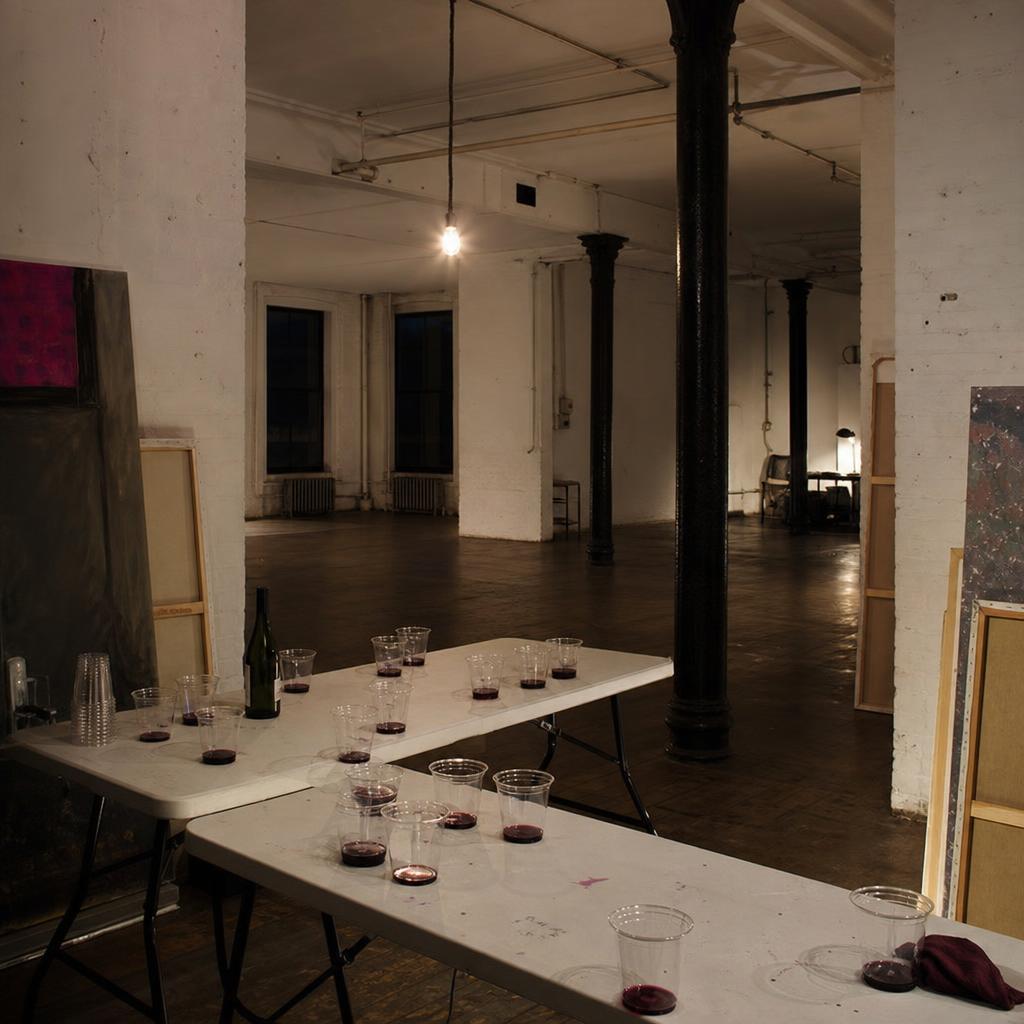
The Guest List: Who Came to the Opening, 1991
Subscribe
https://meridian-archive.com/feed.xmlOpen in your app, or paste the link above into any other:
The Freight Elevator
Under Article 7-C of the New York State Multiple Dwelling Law, enacted in 1982, a tenant of a former manufacturing loft in Tribeca qualified to live there legally only by certifying as a working artist before a city committee and posting an “Artist-in-Residence” placard by the door, a requirement written for firemen more than for landlords — proof, to anyone climbing the stairs in the dark, that a body was inside.1 The certificate said nothing about who else got to be there. A Tribeca loft party in 1991 kept no guest list of its own, posted no one at the door, and sorted its room with complete reliability anyway. The mechanism worked before a single word was exchanged. A visitor climbed the same stairwell or rode the same freight elevator as everyone else, arrived on the same fifth floor of the same converted textile warehouse, and within a minute of arriving had either been absorbed into the room or had not — and the difference had nothing to do with an invitation, which in the neighborhood’s studios that year traveled almost entirely by word of mouth, phone tree, or a mailed postcard bearing one image and a date.
Inside, the room told on itself without meaning to: cast-iron columns at intervals down the length of the floor, a slot kitchen scavenged from a diner that had closed, a bathroom with one bulb and paint on everything, radiator heat that ran to eighty degrees in February and could not be turned down. The freight elevator’s gate clanged through the floor roughly every ninety seconds all night, a sound nobody in the room consciously registered after a while.1 Turpentine or photographic solvent hung under the cigarette smoke, whatever the host’s medium happened to be, and underneath both sat the smell of somebody’s dinner still cooking, garlic and tomato most nights, on a range pulled from a restaurant that had gone out of business. A stereo, not yet by 1991 anything a person would have called a sound system, ran through whatever tape or record the host owned enough of to fill four hours — the Velvet Underground, Sonic Youth, a side of late Coltrane, Talking Heads if the host had not yet tired of them. Nobody adjusted it; it ran on unattended all night, part of the room’s fixed equipment.
What separated the evening’s two populations was a piece of etiquette so minor it was barely instruction: a guest brought a bottle, was not greeted at the door because there was no door to be greeted at, found the host somewhere in the room’s middle distance, and raised the bottle in the host’s direction. The host nodded. That was the entire transaction, and a person who did not know to perform it — who expected to be met, who set the bottle down unraised, who asked, within earshot, what a painting on the wall cost — had, without anyone saying so, identified himself as someone the room had not been built for. Nothing kept him out physically. Everything about the room’s grammar kept him at its edge.
Who Came
The room filled in recognizable stages. The first, around half past ten, was mostly painters and sculptors coming straight from their own studios, still in the clothes they had worked in. A second group arrived close to midnight, having come from another opening a few blocks over, carrying the particular energy of people who had already stood through one crowded room that evening and were treating the second as an extension of the first. Critics tended to arrive close to the stated time and stay past everyone’s patience, taking a last beer for the walk to the subway. Dealers and the handful of collectors who bothered with a loft party at all came latest and left soonest — they had come to be seen arriving, which required arriving after the room had already noticed itself, and to be seen leaving early, which required leaving before the room’s later, looser hours made the leaving illegible. No one in the room offered a job title on being introduced. A first name did the work of an introduction; what a person did for a living, and how well, showed up later and elsewhere — in the shoes, in who a person stood near, in whether anyone crossed the room to reach them or waited to be reached.
The paintings on the walls belonged to the host, or to a friend of the host’s, or had arrived as a trade for a favor, and asking their price was a small breach of manners unless the asker had already, by some other signal, established that he was there to buy. This was the room’s inner ring, and it had its own quiet hierarchy independent of anything a magazine would have printed: an artist two years past a well-reviewed show stood differently than an artist who had never had one, and everyone in the room could read the difference at a glance, the way a fluent reader takes in a paragraph without sounding out the words.
A third population worked the room’s edges without belonging fully to either the first wave or the second: art students down from Cooper Union or the School of Visual Arts, there because a teacher or an older studio-mate had brought them and gone quiet since; a handful of downtown fashion people who arrived even later than the dealers and stayed only long enough to be seen having arrived; a boyfriend or a girlfriend of somebody who mattered, standing near the kitchen with a beer, correctly aware that his own presence in the room was borrowed rather than earned. None of them raised a bottle at anyone. None of them were asked to. Their invitation, such as it was, ran through a person rather than to them directly, and everyone in the room understood the distinction without anyone stating it.
Who Did Not
The absences registered more than the presences, to anyone positioned to notice them. Some were structural and recent: the East Village scene that had produced the decade before it — the storefront galleries on the far side of Houston, one of them Patti Astor’s Fun Gallery, which had given early shows to painters who went on to be famous and had itself closed in 1985, priced and crowded out by the very success it had helped manufacture — was gone by 1989 and stayed gone; anyone who spoke of it that year was old enough to have been there or was repeating a story secondhand.2 Others were economic and current: the market that had paid six figures for a fashionable painter’s canvas two years earlier had gone soft through 1990 and 1991, and a number of painters who would have filled a loft like this one in 1988 were, in 1991, painting in a studio nobody was visiting and showing nowhere at all, their galleries having quietly stopped answering the phone. And some absences were older and did not resolve into a sentence anyone said aloud: a painter or a photographer who would have been standing in that room two winters earlier, arguing about somebody else’s canvas, was instead dead of the same cause that had taken a widely-known circle of the downtown art world’s own in 1989 and 1990, and the room, by 1991, had gotten used to not remarking on the empty space where he would have stood.
None of these three absences required an explanation inside the room. Everyone present already knew which kind applied to which name, and the knowing was itself a form of belonging the newcomer with the unraised bottle did not share. It was the same knowledge, differently distributed, that had closed galleries all over lower Manhattan every December first since 1989, when hundreds of institutions had gone dark or draped a single work for a single day to mark a toll that was, by 1991, no longer new;3 a loft party that fall did not observe the date, but the room that filled it had, without exception, already lost someone, and the fact sat under the evening the way the freight elevator’s gate sat under the music, noticed by no one and absent from nothing.
The Dinner After
The party was not, strictly, where the evening’s real business happened. Sometime after midnight the loft began to thin, and a smaller group — never announced, never formally assembled — walked out together toward one of a short list of restaurants that stayed open for exactly this purpose: a table at a place on Grand Street or Prince Street, a booth held without a reservation because the owner knew who was likely to arrive. Being in the loft had been the first sort. Being asked, wordlessly, to keep walking after it emptied was the second and the harder one, and it ran on the same illegible rules — who had said something sharp and correct about the show, who had brought the right bottle and raised it to the right person, who a dealer wanted at the same table as a critic for reasons that had nothing to do with friendship. The talk at the loft, by one and two in the morning, moved through its own recognizable arc: who was sleeping with whom, and then, later and lower, who was sick, and then, later still, who was talking about leaving the city altogether. No one steered the conversation there. It arrived on its own, the way the freight elevator’s gate arrived every ninety seconds, a fact of the building rather than a subject anyone had chosen.
By two or three in the morning, walking out past the loading docks toward the subway at Franklin Street or Chambers Street, the same handful of people who had been sorted in at the door were sorted out again by nothing more than fatigue and the hour. The streets that late were empty in a way no later decade’s Tribeca would be again — the loading docks dark, the trucks that restocked the neighborhood’s produce and paper wholesalers still hours from rolling in, footfalls audible from two blocks off, a single lit window belonging to a restaurant just closing for the night and a single bodega open past everything else on the block. A different mechanism, working on the same population that had walked in twelve hours earlier from studios and day jobs across the city, arrived at roughly the same list it had started with.
No one had designed the loft party to work this way, and no one running one could have explained its rules if asked; they had simply been absorbed, over enough Thursday and Saturday nights, by everyone who belonged there, without anyone ever having taught them. The party cost the host a case of wine and an evening’s mess. It returned, to those who could read it, a precise and current account of who stood where that season — whose gallery had held through the downturn, whose had not, who was still working and who had quietly stopped being asked. A stranger could walk the same stairs, ride the same elevator, stand in the same room, and never once be told he had failed the evening’s only real test. He simply left not knowing there had been one, carrying home nothing but the smell of turpentine and the sense, not quite nameable, that everyone else in the room had been speaking a language he had almost, but not quite, followed.
The Back would have carried, in its February 1990 issue, a small accounting of Day Without Art — the coordinated closure or draping of downtown galleries the first of the preceding December, a listing item rather than a piece, filed the way the section filed openings and closings any month. Whichever desk assembled the item would have needed no primer on why a gallery on lower Broadway or in SoHo had gone dark for the day; the loft circuit and the gallery circuit ran through the same buildings and the same names, and an editor who covered one would already have known the other’s calendar without having been told. The item would have carried the participating houses’ names and nothing else — no interview, no toll counted out in a sentence, no writer’s byline attached to a listing of that length and kind. It would have run under a two-line head, the sort of notice a reader’s eye crossed on the way to the well’s longer pieces without necessarily stopping.
Nothing about the shutter would have required more than that from a monthly. The galleries had organized the closure themselves, coordinated through their own trade channels rather than through any editor’s assignment; Meridian’s part would have been to note that it had happened, at the length a note allows, and to move the well on to whatever the February issue’s longer pieces concerned themselves with instead. The Back would have been built for exactly this kind of accounting.