Groceries, Bodegas, and the Food Economy, 1989–2001
Subscribe
https://meridian-archive.com/feed.xmlOpen in your app, or paste the link above into any other:
The Loosie
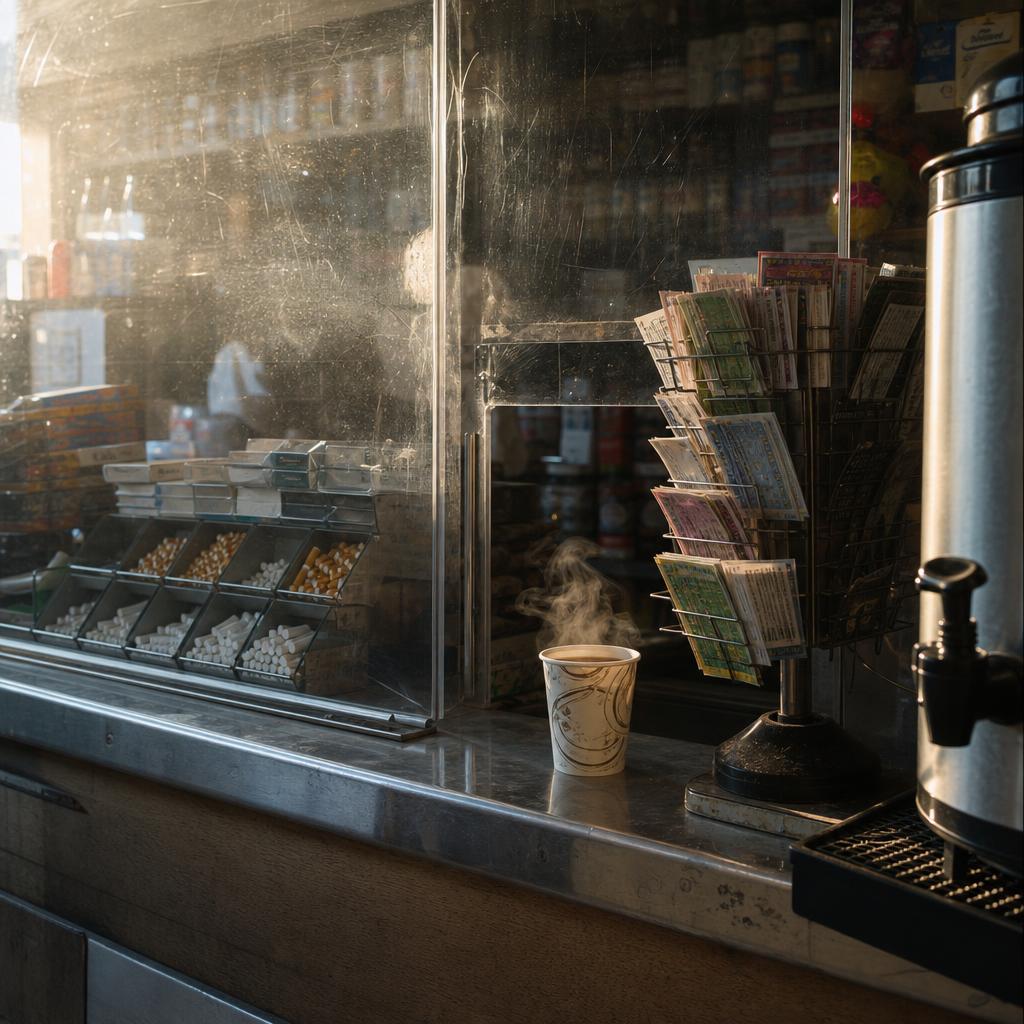
In November 1989, a bodega on any corner of the city sold cigarettes three ways: by the carton, by the pack, and singly — a “loosie,” worked out of an opened pack and priced by the smoke rather than the carton, sold to a customer buying only what the day’s cash allowed. Every one of those single-cigarette sales violated New York’s cigarette-tax law, which taxed and regulated sale by the pack; every one of them was also so routine a feature of the bodega’s business that it went unenforced against as a matter of course, a violation the city’s own inspectors had, in practice, absorbed into the corner store’s unwritten terms of operation rather than one they moved to correct. Sold beside the loosie, from the same register, behind the same Plexiglass: a lottery ticket, another product New York State itself printed, licensed, and profited from at that same counter.
The loosie was not the strangest thing about the corner store’s coffee counter, only the plainest illustration of how thoroughly the city’s institutions had made peace with what the corner store actually did. The same tolerance ran through coffee. In November 1989, a cup of coffee in New York City cost between fifty cents and two dollars depending only on which counter served it, and at none of those counters was a customer asked to choose a size, a roast, or a name for the drink. A bodega poured it from a pump thermos for fifty to seventy-five cents. Chock full o’Nuts, the vacuum-pack coffee brand whose namesake lunch counters were down to a handful of Manhattan locations, charged sixty-five to seventy-five cents at the counter that still bore its name.1 A Greek diner filled the same paper cup for seventy-five cents to a dollar. An espresso at one of the two surviving Village coffeehouses that had served the neighborhood’s Italian immigrants since before the First World War ran a dollar-fifty to two dollars. Every one of these was a transaction that took four or five seconds and ended in a single, unmodified noun: a coffee. In April 1994 a store opened on Broadway at Eighty-Seventh Street that charged two to two-fifty for the same base beverage and required the customer to specify its size and its preparation before the transaction could be completed at all.2 The store did not invent expensive coffee — New York had sold coffee at $1.50 for eighty years by then, a few blocks south. What it invented, for a customer who had never had to do it before, was choosing.
The five-year gap between those two coffee facts runs through the whole food economy that fed the editorial floor and the neighborhoods below it — priced from the corner bodega up through the gourmet grocery, before and after the moment a national chain arrived to sell New York back its own coffee at three times the price and call the markup a category.
Behind the Plexiglass
The daily food shopping for most of the city’s working population happened at the bodega — a small, family-run corner store, overwhelmingly Puerto Rican- or Dominican-owned by the late 1980s, a business a family could run without English beyond the register and a supplier’s invoice, selling bread, milk, eggs, beer, lottery tickets, and a loose cigarette from behind a barrier the store existed to require. Above the bodega tier, and serving the same working-class neighborhoods at slightly greater distance and lower unit cost, sat a second layer of chain groceries: C-Town, a Bronx-headquartered voluntary banner that Krasdale Foods had launched in the middle 1970s — the company’s own account puts it at 1975, after a first attempt to call the chain K-Town drew a legal threat from Kmart — specifically to give independent grocers in underserved neighborhoods a shared identity and buying power against the large supermarket chains that were leaving the city.3 Associated Supermarket, Key Food, and the warehouse-format Western Beef filled the same tier, each a cooperative or franchise banner rather than a single corporate chain, each anchored to a stretch of avenue rather than a single flagship address — a C-Town on Sedgwick, an Associated on Tremont, a Key Food on Jerome, Western Beef pushing its warehouse format into Bronx blocks the older chains had already abandoned.
The ratio between the two tiers was not a fixed number anywhere the city kept it, but New York’s health officials tracked it for decades as a rough index of food access, and in an underserved neighborhood it ran, by later counts, to several dozen bodegas for every one supermarket — an order-of-magnitude relationship rather than a precise one, and the 1989 figure for any specific neighborhood is not a number anyone recorded at the time.4 What the ratio meant in practice was that the bodega, not the supermarket, was the food economy’s actual daily interface for a large share of the city — the place a person bought a container of milk on the way home rather than saving the trip for a weekly circuit to a chain store blocks farther off.
The Grocery Row
Above the bodega and the chain supermarket sat a third tier that did not serve daily necessity at all, and its objects sorted into a three-way class read: the old-money household bought at Zabar’s, the new-money household at Dean & DeLuca, the creative-class household at Fairway. The row rewards a closer look at what each store actually was.
Zabar’s, on Broadway at Eightieth Street, had been trading since 1934, when Louis and Lillian Zabar rented an appetizing counter inside a Daitch grocery and built outward from it. Zabar’s founding proposition — sell the best smoked fish available, at a price a regular customer could keep paying — never changed in substance even as the store grew to two floors and a housewares department upstairs; the smoked-salmon counter alone moved roughly a ton of fish a week by the late 1980s.5 The register read as old money not because the prices were low but because the store had stood in the same spot doing the same thing for two generations.
Dean & DeLuca opened in September 1977 at Prince and Greene Streets in SoHo, the creation of a former cheese merchant, Giorgio DeLuca, and a publishing-industry business manager, Joel Dean, and it read from the start as the opposite proposition: imported, curated, cold in its lighting and its idiom, built for a shopper buying a gift rather than a week’s groceries.6 Fairway had begun even earlier and humbler — a fruit-and-vegetable stand Nathan Glickberg opened at Broadway and Seventy-Fourth Street in 1933 to survive the Depression, renamed Fairway at the suggestion of his son Leo’s wife in the 1950s.7 Leo’s son Howie took the business over in 1974 and, with two partners, built it out from a produce stand into a full-line grocery that never lost the produce stand’s habits — fruit stacked chest-high toward the ceiling, aisles narrow enough that two carts could not pass, the operating logic of a market stall carried into a shop that by 1989 sold cheese and coffee beans as well as apples. Where Zabar’s sold continuity and Dean & DeLuca sold curation, Fairway sold to people who did their own cooking.
One tier above even the grocery row sat an institution that did not charge gourmet prices at all: the Union Square Greenmarket, which the planners Barry Benepe and Bob Lewis had opened in 1976, bringing farmers directly to a folding-table market.8 Buying from the greenmarket in 1989 was not yet a stated political position — that came after the period — but it was already a legible one: the produce was better, and the willingness to stand in a park for it, rather than send someone, was its own form of household income.
What a Cup Cost Before the Choosing
The coffee ladder that stood in place before 1994 had five rungs, and each was legible to a different customer without any of them being aware they were reading a system. At the bottom, bodega coffee — strong, sweet, made in a high grounds-to-water ratio that produced something closer to espresso in strength than in character — cost fifty to seventy-five cents and asked nothing of the buyer beyond exact change. One rung up sat the Greek diner urn, whose coffee at seventy-five cents to a dollar was the office worker’s default and was, by design, unremarkable. Beside the diner sat Chock full o’Nuts, a chain William Black had founded in 1926 as a string of roasted-nut shops and converted to lunch counters during the Depression, growing it to roughly eighty New York restaurants by the 1960s at its peak. By 1989 the restaurant side had been sold off piecemeal to the Riese Organization through the 1980s and was down to its last Manhattan counter, on Madison Avenue at Forty-First Street — coffee still poured at sixty-five to seventy-five cents from a chain whose name remained, on the vacuum-packed supermarket can sold in every one of the bodegas and chain groceries described above, far more durable than its restaurants had proven to be.1
Above the diner sat a fourth rung that most of the city never visited: an Italian espresso, made and served in the idiom of Greenwich Village’s Italian immigrant enclave rather than as a citywide category. Caffe Reggio, on MacDougal Street since 1927, still ran its espresso through a vintage machine its founder had bought secondhand decades earlier. An espresso there, or at its near-neighbor Caffe Dante, ran a dollar-fifty to two dollars — expensive, by 1989 New York coffee standards, but understood as an ethnic specialty rather than a general aspiration.9
A fifth category existed alongside the first four and was not, strictly, a cup at all: whole-bean coffee sold for home brewing. Porto Rico Importing Company, on Bleecker Street since 1907, roasted and sold more than a hundred varieties to a customer base of home-brewing enthusiasts who owned a burr grinder and a proper drip machine — equipment that was itself a class marker in 1989.10 Zabar’s sold its own roasted beans in the same register. “Interesting coffee” — coffee understood to have a flavor worth discussing — already existed in November 1989. It existed in two small, self-selecting enclaves: an immigrant neighborhood’s espresso houses and a hobbyist’s kitchen counter. It did not yet exist as something a stranger on Broadway might be expected to want.
The Cup, Six Ways, Circa 1989–94
The same beverage, priced by the room that served it — a spread of four dollars between the cheapest cup and the most self-conscious one, before Starbucks added a sixth rung above them all.
| Where | What | Price |
|---|---|---|
| Bodega | Drip coffee, pump thermos | $0.50–0.75 |
| Chock full o’Nuts counter | Drip coffee | $0.65–0.75 |
| Greek diner | Urn coffee, refillable | $0.75–1.00 |
| Caffe Reggio / Caffe Dante | Espresso | $1.50–2.00 |
| Zabar’s / Porto Rico Importing | Whole-bean, by the pound, for home brewing | not a per-cup price |
| Starbucks (from April 1994) | Specialty drink | $2.00–2.50 |
The Store on Broadway
The first Starbucks in New York City opened on April 23, 1994, at Broadway and Eighty-Seventh Street — a three-thousand-square-foot location, among the largest of the company’s then roughly three hundred stores nationwide, chosen for the Upper West Side specifically because the company’s Seattle mail-order records showed that neighborhood already held the city’s highest concentration of customers ordering Starbucks beans by post before a single store existed there.2 The opening drew heavy press coverage and a measure of open civic contempt — a city that considered its own bad diner coffee a birthright was being told, by a chain from the Pacific Northwest, how coffee ought to be made and sold. A second Manhattan store, four thousand square feet and briefly the chain’s largest in the city, opened at Astor Place eleven months later, in March 1995, and the pace did not slow from there.11 By 2001 the address list had grown toward a hundred and forty Manhattan locations, an expansion concentrated first in the neighborhoods that already had money — the Upper West Side, the Upper East Side, Midtown — and reaching SoHo, Chelsea, and the Village only afterward, while the Bronx, most of Brooklyn, and Washington Heights waited considerably longer for a store at all.12
The bodega did not lose its coffee customer to Starbucks — price and speed still mattered more than atmosphere to a person choosing between the two — but the bodega noticed the new competitor anyway. By the middle of the decade a number of bodegas had installed their own espresso machines, an acknowledgment, priced in equipment rather than argument, that the vocabulary around coffee had shifted under them. The Greek diner lost its younger and its morning-commute customer first and its older, longer-sitting customer last. Starbucks did not cause either shift outright — both establishments were also losing ground to Manhattan rents that a two-dollar cup with a longer dwell time could pay and a seventy-five-cent cup with a five-minute one could not — but it trained the customer who mattered to that arithmetic, the one who had not yet formed a coffee habit, to expect a menu rather than a noun.
Reading the Order
By the back half of the decade, the coffee order itself functioned as a legibility test independent of the coffee. A customer who ordered “a large” was speaking the diner’s vocabulary inside a room built to correct it; a customer who ordered by size-name and modifier had learned a different grammar, and the learning was visible in real time to anyone behind the counter or in line. An editorial assistant on an entry salary could not order the specialty drink daily without noticing the cost against a food budget that ran ten or fifteen dollars a day in total — bodega coffee was still the arithmetic answer — while a senior editor could order the diner’s seventy-five-cent cup on purpose, deliberately, the way a person spends a dollar to make a point rather than because a dollar is what the coffee requires. Both orders were legible, and neither speaker necessarily knew what the other’s meant.
The same test ran, more quietly, through the television set: the Television Food Network went on the air November 22, 1993 — incorporated the previous April, reaching roughly 6.8 million cable homes at launch — and by the middle of the decade its existence functioned less as a source of recipes than as a date-stamp, a background fact whose mere presence in a room told a viewer which years a scene belonged to.13 Food had become a subject a person could be fluent or illiterate in, on air as much as at the counter, and the fluency test ran from the bodega’s loosie window to the store on Broadway without ever once being named as a test by the people taking it.
The five-cent gaps between a bodega coffee and a diner coffee and a diner coffee and an espresso were never really about the coffee. They were a map of a city that had, for decades, sorted its eating by neighborhood and habit without needing to announce the sorting — a Bronx corner store, a Village espresso house, an Upper West Side appetizing counter, each serving a public that already knew, without being told, which counter was its own. What arrived on Broadway in April 1994 did not lower anyone’s coffee or raise anyone’s bodega bill; it added a rung above the top of the old ladder and asked every customer in the city, for the first time in the same transaction, to say out loud which rung they meant to stand on. The corner store kept selling the fifty-cent cup to the same regulars it always had, and the choosing, once it started, did not stop at coffee.
The Broadway arrival would have found its home in the City section — a chain from Seattle pricing a cup of coffee at two dollars and asking a customer, for the first time, to name a size before the register could ring it. An editor assigned to consumer culture would have argued for the piece by June, would have wanted it in front of the trend rather than behind it, and the July issue would have run it, alongside whatever else the month’s well would have carried.
A different piece, on the cable network’s November launch, would never have reached a reader at all. A staff writer would have been assigned it as a wry take on business dressed as broadcasting, and the piece would have been filed and set into galley before an editor working the marked pages would have pulled it. It would have read, on the page, like promotional copy for whichever cable tier a subscriber would have needed to buy in order to watch the thing being described, and no defense of it would have survived that reading. The writer’s week would have gone to it anyway, spent before anyone upstairs would have decided the piece could not run, and the pages would have closed without it.
Footnotes
-
“How New York Did Coffee in the 1950s and 1960s,” Ephemeral New York, December 3, 2018 — on Chock full o’Nuts’ lunch-counter decline, the Riese Organization’s acquisition and closure of its remaining restaurants through the 1980s and early 1990s, and period coffee pricing. ↩ ↩2
-
“David Firestein Brought Starbucks to New York City 30 Years Ago. What’s Next?,” Commercial Observer, March 2023 — on the April 23, 1994 opening at Broadway and 87th Street, its 3,000-square-foot size relative to the chain’s roughly 300 stores at the time, and the Upper West Side’s mail-order customer concentration as the siting rationale. ↩ ↩2
-
“The Supplier That Makes Supermarket Owners Rich,” Crain’s New York Business, November 16, 2018 — on Krasdale Foods’ launch of the C-Town voluntary banner in the mid-1970s to support independent grocers against the large chains leaving the city. ↩
-
Hansi Lo Wang, “New York City Bodegas And The Generations Who Love Them,” NPR Code Switch, March 10, 2017 — on the bodega-to-supermarket ratio as a food-access measure tracked by city health officials. ↩
-
Lori Zabar, Zabar’s: A Family Story, with Recipes (Schocken, 2022) — on the 1934 founding at Broadway and 80th Street and Louis Zabar’s quality standard for smoked fish. ↩
-
Andrew Russeth, “SoHo’s Art Community Mourns the Closing of Dean & DeLuca, the Little Market That Changed the World,” ARTnews, December 3, 2019 — on the September 1977 founding at Prince and Greene Streets by Giorgio DeLuca and Joel Dean. ↩
-
“Fairway Market,” Produce Business, December 1, 2019 — on Nathan Glickberg’s 1933 fruit-and-vegetable stand at Broadway and 74th Street and the family’s later adoption of the Fairway name. ↩
-
“Union Square Greenmarket,” Wikipedia (the market opened in 1976, organized by Barry Benepe and Bob Lewis under the Council on the Environment of New York City). ↩
-
“Caffe Reggio,” Wikipedia (opened 1927 on MacDougal Street by Domenico Parisi; longtime home to a vintage Italian espresso machine). ↩
-
Gary Stern, “Porto Rico Importing: Hybrid Coffee Bean Business Thriving In Greenwich Village For Over A Century,” Forbes, May 8, 2024 — on the Bleecker Street roaster’s 1907 founding and its more than one hundred whole-bean varieties. ↩
-
“Iconic NYC Starbucks Closing After 30 Years,” amNY — on the Astor Place store’s March 30, 1995 opening at 4,000 square feet. ↩
-
Bryant Simon, Everything but the Coffee: Learning About America from Starbucks (University of California Press, 2009) — on the press reception of Starbucks’ 1994 New York entry and the geography of its subsequent Manhattan expansion. ↩
-
Allen Salkin, From Scratch: Inside the Food Network (G. P. Putnam’s Sons, 2013) — on the network’s April 1993 incorporation and November 22, 1993 launch to roughly 6.8 million cable homes. ↩