Beauty, Hair, and Grooming, 1989–2001
Subscribe
https://meridian-archive.com/feed.xmlOpen in your app, or paste the link above into any other:
The Unlisted Condition of Employment
No personnel file at a Manhattan magazine in 1989 listed hair texture as a job requirement, and none needed to. A Black woman on the editorial floor kept her hair chemically relaxed — sodium hydroxide or the gentler guanidine hydroxide formula, reapplied every six to eight weeks as new growth came in, pressed or blown out between appointments to hold the smoothness — not because any handbook said so but because a supervisor could comment on braided or unstraightened hair as unprofessional, did so routinely, and faced no law that said otherwise: no statute yet treated hair texture as a protected trait, so the judgment carried the same institutional weight as a comment on a typo. A full appointment — relaxer, neutralizer, deep conditioning, blow-dry, press — ran sixty to a hundred and twenty dollars at a Harlem or Bronx salon, a standing cost of appearing employable that no line on any expense report or offer letter ever named. Braids were not banned; they were simply understood, correctly, to be a risk a woman took with her own advancement, absorbed into the ordinary judgment of who looked ready for the floor and who did not.
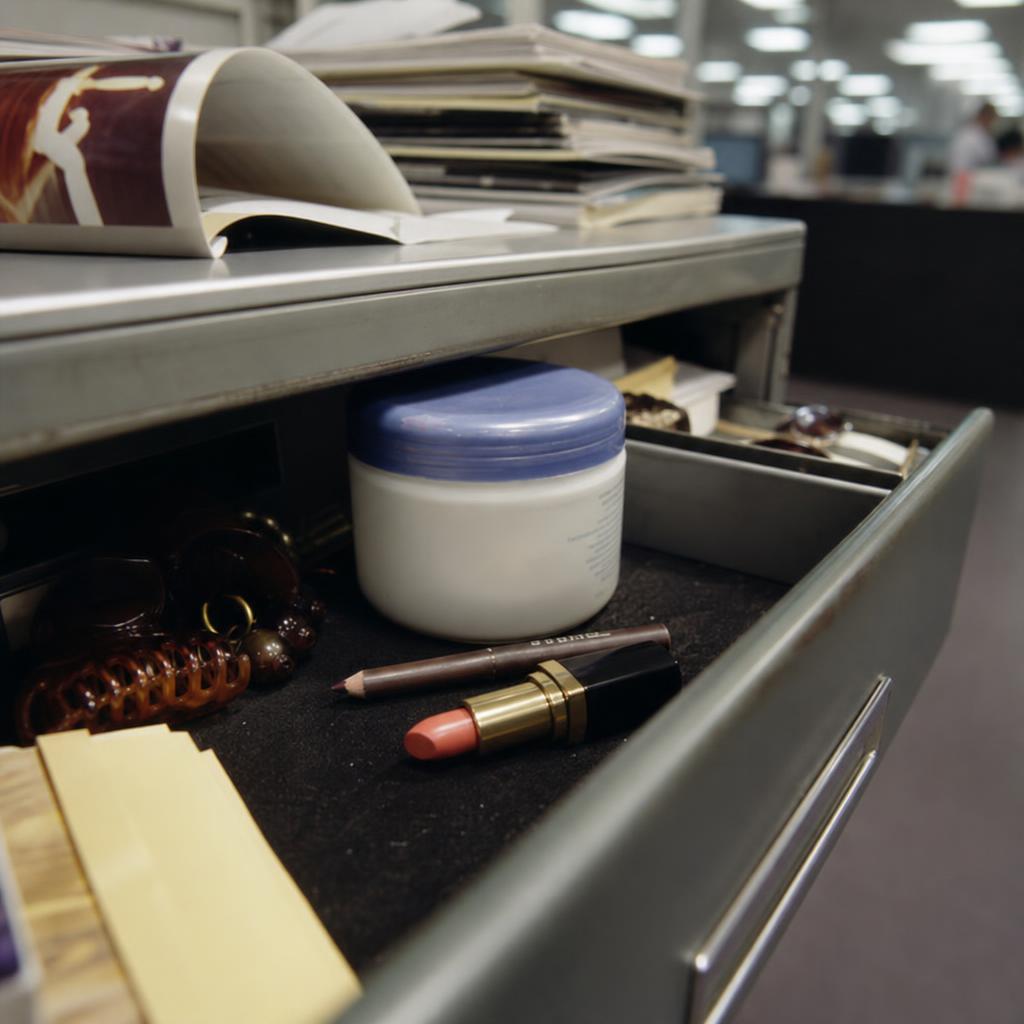
The correct face for a woman on a Manhattan editorial floor in 1989 took roughly twenty minutes and looked, when finished, like no effort had been spared: full-coverage foundation matched to the throat, a brow filled to an unbroken line, a coral-to-brick lip applied with a brush inside a darker liner, blush swept up toward the temple. The look was matte everywhere — no shine on the forehead, no gloss on the mouth — and it was built to survive a ten-hour day under fluorescent light without sliding. By 1994 the correct face had reversed itself: pale, nearly colorless, no blush at all, a single thin coat of mascara or none, a lip that read as bare skin rather than paint. The second face was not less work than the first. It took more — a paler foundation had to be matched with more precision to escape looking ashen, and a face with nothing to hide behind required the skin underneath to be genuinely even, which meant more attention to the part no one would credit as makeup. The correction did not lighten the load. The work simply moved to the part of the face no one would credit as makeup.
The 1989 face belonged to a specific department-store grammar. Estée Lauder Double Wear and Lancôme Maquicontrol anchored the counter tier that a senior editor’s assistant could plausibly afford on an assistant’s salary if she skipped other things; Clinique Superfit, marketed with a dermatologist’s endorsement, let the same woman describe her purchase as skincare rather than vanity. Beneath the department store sat the drugstore aisle — Cover Girl Continuous Wear, introduced in 1989, and L’Oréal Mattique — bought by the same women on different days, in different stores, for different reasons, and rarely mentioned in the same conversation. The lip color of record ran from Revlon’s Cherries in the Snow, a red-pink that had been in the company’s line since the 1950s, through the browner Toast of New York and Cover Girl’s Burgundy Frost — a coral-to-brick spectrum, always matte, always applied with a brush rather than straight from the tube. No product in this arc claimed to be invisible. The face announced that it had been made, the way a well-cut blazer announced that it had been tailored, and in 1989 that announcement was the compliment.
Grunge pressure on the power face arrived gradually rather than all at once, and the editorial floor absorbed it as loosening rather than abandonment. Prescriptives, a counter line built on precise color-matching for an urban clientele, rose through the early 1990s as the alternative to the Lancôme establishment; Clinique’s three-step system — cleanser, toner, moisturizer — became the professional-class skincare ritual that let a woman describe daily maintenance as medicine. The 1993 “natural” face carried more coverage than its name implied: a full-coverage foundation or a medium-coverage powder over a tinted moisturizer, brows still filled to a visible line, a lip in a pinky-beige or sheer rose — never bare, never absent, simply matched well enough to read as effortless to an eye trained to expect effort. Nails softened on the same schedule: shorter, rounder, a pale pink like Essie’s Ballet Slippers, in the line since 1981, or the returning classic red, with a dark burgundy — Essie’s Bordeaux — arriving mid-decade to read as sophisticated rather than dramatic. The 1980s long nail was retired from editorial spaces years before it left anywhere else.
Heroin Chic and the Return of Color
The pale face reached its most legible form between 1994 and 1998, associated first with Kate Moss’s Calvin Klein campaigns, photographed by Corinne Day and Steven Meisel, and denounced by name in 1997 by President Clinton as a look that glamorized addiction.1 The technical description ran opposite the 1989 face point for point: skin matched to look washed-out rather than warm, under-eye circles left visible or lightly enhanced rather than concealed, brows thinned to follow the bone rather than arch above it, eyes reduced to a single smudge of dark pencil at the upper lash line or nothing at all. Where 1989 wore two coats of mascara, 1994 wore one, or none. The lip carried the whole statement. MAC’s Spice — a neutral, brownish-rose pencil — became the era’s signature product; drawn slightly outside the natural lip line and filled with a matching or lighter lipstick, it produced a defined, cool, overdrawn mouth that read as deliberate without reading as painted. A 1999 magazine article cataloguing celebrity signature shades mentioned Spice ten times, more than any competing color, naming Kate Winslet, Mary J. Blige, Neve Campbell, and Courteney Cox among its wearers; Cindy Crawford separately identified it as a backstage secret she shared with Naomi Campbell and Linda Evangelista to achieve the overdrawn lip in a neutral tone.2 On darker skin the pale-foundation half of the look did not translate — an attempt to follow it exactly produced an ashen cast rather than pallor — so Black and brown women who adopted the brown lip kept Spice, which was noted at the time for working across a wide range of skin tones, and paired it with foundation matched to their own coloring rather than lightened to imitate the trend.2 Shine, of any kind, was the era’s other forbidden quantity: powder went on over foundation, blotting paper lived in a desk drawer, and no product on the market yet promised to make skin look wet on purpose. The dewy finish that closed out the decade was still years off.
The decade’s final turn, from 1998 through 2001, ran back toward shine and color in a register the fashion trade experienced as a relief after four years of studied pallor. MAC’s Lipglass, launched in 1997, and a wave of competing high-shine glosses replaced the matte lip; eye shadow returned in shimmer and jewel tones, built around a darker crease and a lighter, shimmering lid; the first luminizing primers appeared, and a tan began to read as health rather than leisure alone. The fashion-editorial extreme of this shift — the full metallic face, the iridescent lid — did not migrate directly onto the editorial floor. What migrated was a translation: a glossier lip than 1996, slightly more definition at the eye, skin allowed a little shine it would not have been allowed five years earlier. The departure from heroin chic was genuine. It was not theatrical.
Women’s Hair: Volume to the Flat Decade
Hair moved on roughly the same four-beat schedule as the face. The 1989 silhouette carried volume at the root and curl through the length, sustained by a perm — spiral or body-wave — that was still common and not yet embarrassing; mousse, worked through damp hair and blow-dried into a structured wave, was the dominant styling product, and the combined smell of mousse and aerosol hairspray was the olfactory signature of a woman’s hair care that year. Highlighting moved across the same years from the striped, cap-pulled result of frosting toward the more precise, higher-cost technique of foil highlighting, in tones running brassy blonde to copper — the shade already visible on the actress Julianne Moore — to burgundy-red.
By 1992 the correction had a shape: the blunt bob, chin-length, unlayered, weighted at the jaw — a severe, controlled silhouette correcting against the volume years in the same register the power face’s later pallor corrected against its own excess. The historical reference was the 1976 Dorothy Hamill bob, though the 1992–1996 version cut shorter and more precisely than the original; dark, glossy, single-process color read as sophisticated in a way lighter color did not, and the actress Winona Ryder’s near-black bob became the specific cultural shorthand for the look.
The magazine-world version of the Rachel, when it arrived on the editorial floor, ran tamer than the television original — the highlights present but less chunky, the layering blended rather than sharply turned outward — but it was unmistakably the same cut to anyone who looked, and it outlasted the show on faces like Drew Barrymore’s, who kept a version for years. It coexisted uneasily with a harder-edged rival then gaining ground: heroin chic hair, flat and center-parted, styled to look unstyled, associated with Kate Moss and, later in the decade, with the actresses Winona Ryder and Chloë Sevigny. Achieving that flatness before 1999 required either careful blow-drying with a paddle brush or the no-heat method of letting hair air-dry untouched, since a consumer-grade flat iron capable of producing the look did not reach the market until 1999–2000; a professional stylist’s flat iron had existed since the 1970s, but the home version was new. Once it arrived — the Babyliss Pro and the Chi, launched in 1999 — hair could go sleek at home rather than only at a salon, and the late-decade silhouette (a glossy, center-parted blowout in the register Gwyneth Paltrow wore through 1995–1998) became the default rather than an occasion. Highlighting finished the decade closer to blended than chunky — subtler than the mid-decade foil, sold on the idea that the sun, not the colorist, had done it.
The Hair the Fashion Press Didn’t Cover
None of the four beats above described most Black women on the editorial floor, whose professional hair standard ran on a different arc entirely and did not appear in the fashion trade coverage the rest of this chapter draws on. By 1989 the Jheri curl, which had peaked between 1983 and 1987, read as behind the moment in a professional setting — too much visible product, too specific a sheen. The chemical relaxer was the dominant standard instead, maintained on the schedule and at the cost described above. Braids — cornrows, box braids, Senegalese twists — existed and were worn, but through the mid-1990s a Black woman wearing them into a corporate office was making the visible choice that carried the professional risk already described. The mainstream natural-hair movement, powered by video-sharing platforms, belonged to the following decade and had no equivalent in this one — going natural in 1989–2001 was a decision concentrated in Black intellectual and political spaces, made at a real social and professional cost, not a widely available style choice.
The foundation shortage this professional standard sat inside was real and, before 1994, largely unaddressed: a Black woman matching her skin at a drugstore or department-store counter in 1989 was choosing between too few shades, custom-mixing a darker tone into a lighter one, or accepting an imperfect match. Iman Cosmetics eased the constraint after its 1994 launch without eliminating it — the counter’s shelf remained shallower for dark skin than for light through the rest of the period. Weaves — synthetic or human hair sewn to a cornrow base — grew more sophisticated and more broadly worn across income levels through the 1990s, offering length and a range of textures without the cumulative heat damage of constant pressing; locks remained stigmatized in most professional settings through 2001. The salon itself, whatever the technique performed inside it, stayed a social institution as much as a service — a place where the appointment was also the gathering.
A separate texture economy ran in Washington Heights, built around the Dominican blowout — a round-brush, high-heat service that produced straight, high-shine results on textured hair, priced modestly in the salons along 181st Street and St. Nicholas Avenue, well below Manhattan rates. The appointment could run a couple of hours and functioned as a community space as much as a hair service — conversation, not just the finished style, was part of what a woman paid for. Neither the Dominican blowout nor the relaxer-and-press standard appeared in the trade press this chapter otherwise draws on; both were, for the women who used them, simply how a head of hair got to work looking finished.
A third texture sat outside both economies. A British-Iranian photographer on the floor carried hair that was thick, dark, and naturally wavy — a texture the American flat iron and the American Rachel both assumed away. The management strategy available to her ran through a round brush and a blow-dryer, aimed at a controlled wave rather than a fully straight finish, since no consumer tool existed yet that could reliably force the texture flat; a salon flat iron could produce a sleek result by the late 1990s, but only at a salon. Her training in London, where stylists were more willing to leave the hair’s natural weight present than their New York counterparts, showed on days when she wore it in a loose knot or a simple wave rather than fighting it into a shape it did not hold. On an assignment, function overrode fashion regardless of the year: pulled back and out of her own way.
Men’s Grooming
The male editorial professional of 1989 wore his hair short at the sides, controlled on top, side-parted, set with mousse combed through damp hair and blow-dried into shape — a look read as either European or straightforwardly corporate depending on the room. Facial hair was absent from Midtown professional life through 1992; a beard signaled academic, artistic, or simply indifferent-to-advancement, depending on who was looking, and a goatee in 1991 read as an admission that its wearer paid attention to the world below Fourteenth Street. The loosening that followed, 1993–1997, was subtle rather than long-haired — hair that was merely less aggressively controlled — with the goatee becoming an accepted middle ground and the buzz cut arriving from military and Black barbershop tradition into wider use, reading on a white Midtown man as either pointedly contemporary or simply unbothered. A man who kept the 1989 power cut unchanged through 1997 was making the inverse statement: that grunge had not touched him. The oldest men on the masthead required no such statement — a senior editor going gray at the temples in 1989 read the silver as authority rather than as something to correct, went to a barber rather than a stylist, and was not expected to color a strand of it. A foreign correspondent rotating back from an assignment carried a different grooming altogether: hair cut short enough to survive weeks without a barber, skin differentially weathered by a sun the office never saw, no cologne and no product at all — a man who did not look wrong in the building so much as recently arrived from somewhere else.
CK One, launched by Calvin Klein in 1994 and developed by perfumers Alberto Morillas and Harry Fremont, became the first unisex fragrance to achieve wide popularity in the United States — sold in minimalist packaging, marketed through black-and-white Steven Meisel photography featuring Kate Moss, and pitched as gender-fluid and anti-establishment rather than corporate. It earned more than five million dollars in its first ten days on sale and, at its commercial peak, sold at a rate of twenty bottles a minute.5 It followed a fragrance arc that ran from Polo Ralph Lauren’s 1980s dominance through Calvin Klein’s own darker, headier Obsession in 1985 and Davidoff’s clean, oceanic Cool Water in 1988 — a progression from heavy and gendered to light and unisex that CK One completed rather than started. Deliberate stubble as a style choice did not read as such in a Midtown office through 1997; a senior editor with visible stubble that year was assumed to have had an early morning or to not be paying attention, and the “designer stubble” concept, understood as British, had not yet naturalized into American professional grooming. Men’s skincare barely existed as a retail category through the period — soap and water were the routine, and the resulting visible pores and uneven texture were simply what a man’s face looked like; a man with a facial-care regimen in 1993 was legible as gay, European, or an early and unusual outlier. Men’s eyebrows went untouched throughout; a shaped brow on a man read, without much regional variation, as gay or European, with no third reading available in most professional rooms.
Eyewear and the Eye
Women’s eyewear ran a three-beat arc closely tracking the hair and face corrections around it. From 1989 to roughly 1993 the frame of authority was large: thick acetate in black, tortoiseshell, or burgundy, rounded-rectangular or gently oval, with genuine presence on the face; wire aviators existed but read as the lesser, less fashionable choice next to plastic. From 1993 to 1997 the round wire-rim took over as the intellectual signal — a thin gold or silver circle, deliberately citing John Lennon, small enough to read as an argument for seriousness over fashion. From 1997 onward the rimless oval and the ultra-thin metal rectangle arrived, alongside the first moment eyewear itself became a fashion category rather than a purely functional object, as Prada and a Tom Ford-era Gucci began treating frames as seasonal accessories.6 Men’s frames tracked the same three beats at a slightly larger scale — conservative tortoiseshell or metal semi-rimless through 1993, the round wire-rim through the middle of the decade, the rimless oval and thin rectangle after.
Sunglasses ran on their own separate clock. The Ray-Ban Wayfarer, revived by Risky Business in 1983, stayed culturally active and safely literary throughout the period; a small, near-circular oval, an intensified downsizing of the round wire-rim, marked the downtown and fashion-forward reader by the mid-1990s; Oakley’s wraparound sport frame arrived mid-decade from a different geography entirely, reading on a magazine editor as either a deliberate athletic statement or simple inattention. Contact lenses had, by the middle of the period, mostly stopped being a medical necessity and become a character choice: Vistakon’s Acuvue disposable lens, introduced in the late 1980s, had helped make soft contacts mainstream in the American market by the early 1990s, and who wore glasses and who wore contacts was, from that point on, a question of preference rather than prescription.7 Reading glasses were their own separate prop, arriving on a senior face around the mid-decade mark whether the face welcomed them or not, kept on a chain, left on a desk, or lost with some regularity among the galley proofs — put on without ceremony to read, and taken off the same way.
Jewelry, Accessories, and Footwear
Jewelry on a woman ran restrained and singular rather than layered: a pearl stud or small drop earring, never a chandelier, in a professional context; a small gold hoop, never large enough to move; an initial pendant on a delicate chain. One necklace at a time was the rule the whole period through — layering several was not yet a technique anyone reached for. On a man, the watch carried nearly the entire burden of visible jewelry, along with the wedding band; a visible necklace on a man in a Midtown office in 1992 made a specific statement — artistic, downtown-affiliated, or gay, never accidental. A single earring on a man tracked its own arc: unambiguously legible as gay or artist or both in 1989, sufficiently normalized by 1997 that a stranger needed more context to read it at all.
The status-bag progression — Coach to Kate Spade to Prada to Fendi — ran on price and logo more than on the face-and-head grammar this reading traces, so what follows is only the shorthand that grammar needs.
The Accessory Calendar
| Year | Object | Note |
|---|---|---|
| 1989–1993 | Coach leather bag | Tan or black turnlock satchel, roughly $150–$300; the establishment signal. |
| 1993 | Kate Spade Sam bag | Structured nylon tote with leather trim, roughly $150–$250, launched with five other styles.8 |
| 1993–1998 | The choker | Velvet ribbon, thin metal, or bead, worn at the throat. |
| Through ~1996 | Pantyhose | Mandatory at a Midtown pitch meeting; the norm eroded first in fashion and media offices, ahead of law or finance.9 |
| 1997 | The pashmina | Reached the U.S. from Nepalese and Indian importers; ordinary by 1999–2000. |
Footwear carried the same status grammar the handbags did, legible before a word was spoken: a Ferragamo Vara pump made a distinct, solid sound on terrazzo that a Nine West pump, the accessible standard, did not reproduce. Doc Martens marked editorial assistants on weekends and Fridays, never at a pitch meeting; a chunky lug sole and, later in the decade, a backless mule or horsebit loafer signaled ease rather than formality. On men, the hierarchy ran from the cap-toe Oxford, the most conservative choice, through the Bass Weejun loafer and the Gucci horsebit version, to the monk strap as the most fashion-literate option. A sneaker at the office read as unthinkable in 1989, permissible on a casual Friday by the mid-1990s, and ordinary for junior staff by the end of the period — still, at that date, a mild statement on anyone senior.
The face and the head carried the decade’s arguments before anyone opened their mouth, and they carried at least two arguments running in different directions at once. The mainstream one ran power to pallor to shine, four corrections in twelve years, each one legible only to a reader trained on the one before it. The other ran underneath it and rarely crossed into the same room: a professional hair standard set for one texture that a large part of the floor did not have, worked around with a relaxer appointment, a custom-mixed foundation, a Saturday at a Washington Heights salon that never appeared in the trade coverage this record otherwise leans on. Both arguments were made in product, in minutes at a mirror, in money that did not show up on an expense report — and both were read, correctly, by everyone who needed to read them, long before either made it into print.
Iman Cosmetics’s launch, and the fourteen shades it opened with, would have reached the Front as a business item — the kind of piece that would have let the magazine describe a market a rival’s counter had missed without saying which counter, or which magazine, had missed it first. The Front, the same year, would have taken up the new Calvin Klein fragrance on its own terms: not a gap to account for but a campaign that had already done the explaining, black-and-white and gender-fluid, needing only a paragraph of business context to sit beside it.
Not everything that season would have cleared a desk. The Kate Spade bag, and the five other styles it had launched alongside, would have stalled without a byline — nobody then writing for the book would have covered a retail debut at that level of granularity, and the gap would have outlived the bag’s own season on the arm of the woman who carried it. The haircut a television actress wore that same year, and the salons it was said to have overwhelmed, would have stalled earlier still, at the room rather than the desk: a piece built around sitcom hair would have had no house voice built to hold it, and the culture desk’s register would not have stretched down that far.
Footnotes
-
“Clinton Blasts ‘Glorification of Heroin’ in Magazine Fashion Photo Spreads,” Washington Post, May 22, 1997. ↩
-
“MAC Finally Brings Back the OG Shade of Iconic Lipliner, Spice,” Dazed, January 7, 2025. ↩ ↩2 ↩3
-
“The One Where Jennifer Aniston’s ‘Rachel’ Haircut on Friends Became a Phenomenon,” Mental Floss, April 24, 2023. ↩
-
“How Somali-American Supermodel Iman Defied Beauty Retailers to Build a $25M Beauty Line,” Face2Face Africa, June 22, 2023. ↩
-
“The History of CK One Fragrance,” Air Mail, May 5, 2023. ↩
-
Teri Agins, The End of Fashion: How Marketing Changed the Clothing Business Forever (William Morrow, 1999). ↩
-
“ACUVUE Disposable Contact Lenses, 1987,” Johnson & Johnson corporate history archive (ourstory.jnj.com), accessed 2026. ↩
-
“The 1993 It Bag Every Celeb Owned Is Back,” Who What Wear, March 25, 2025. ↩
-
Joseph Caputo, “50 Years of Pantyhose,” Smithsonian Magazine, July 7, 2009. ↩