Grunge and Its Co-optation, 1992–1995
Subscribe
https://meridian-archive.com/feed.xmlOpen in your app, or paste the link above into any other:
The Flannel on the Runway
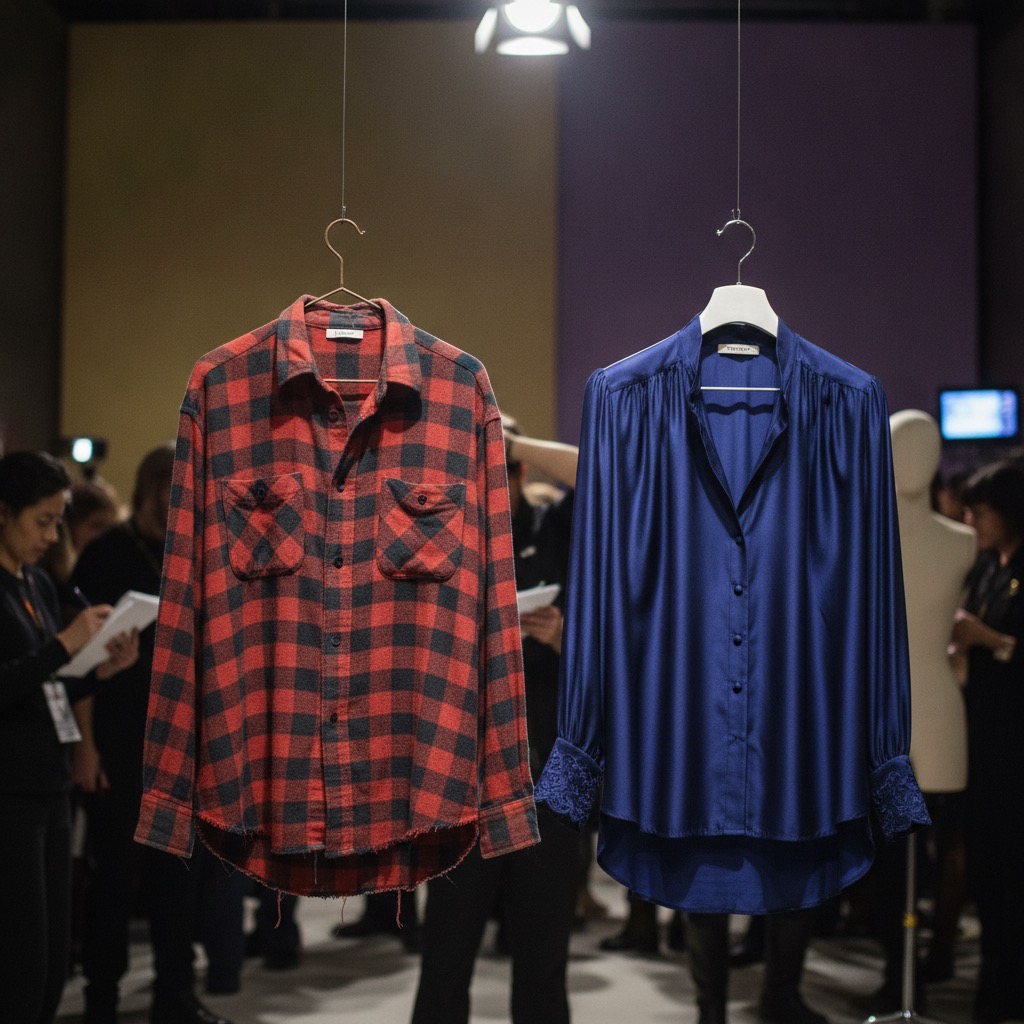
By January 1993, the Council of Fashion Designers of America named Marc Jacobs its Women’s Designer of the Year for a body of work carrying, on every garment tag, showroom door, and the award citation itself, the name of a man seven years dead. Perry Ellis, the designer, had died on May 30, 1986; the company that kept his name afterward passed to Manhattan Industries and, in a corporate takeover the same year, to the Salant Corporation, a licensing operation whose board had no design authority and no member who had ever met the man whose name generated its revenue.1 Jacobs had joined in 1988 as the women’s-wear creative director, hired to keep a dead man’s label credible to buyers under management that answered to sales figures rather than to any founder’s taste — an arrangement that drew no separate comment from the CFDA, from Women’s Wear Daily, or from the Perry Ellis showroom itself, because running a house on a dead designer’s name under owners who had bought it as a licensing asset was, on Seventh Avenue by 1992, an ordinary condition of employment rather than a fact requiring remark. Jacobs built the house’s spring 1993 women’s collection, shown on a Manhattan runway on November 3, 1992, around the wardrobe of the Seattle bands then filling college radio — Nirvana, Mudhoney, Soundgarden — and translated it, garment for garment, into fabrics its actual owners could never have afforded. A two-dollar Goodwill flannel shirt came back reproduced in silk, lumberjack thermal shirts in cashmere, a slouched knit cap in cashmere, canvas sneakers in duchesse satin, and the Doc Martens stayed, deliberately unlaced. A floral housedress recalling the one Kurt Cobain sometimes wore on stage came back in floating chiffon. The rest of the collection carried the same translation through: velvet chokers, thick industrial-buckle belts, macramé shrugs knotted like something made by hand, slip dresses worn under rather than over an oversized flannel shirt — the entire thrift-store grammar of the preceding half-decade, reproduced garment for garment rather than merely gestured at. Women’s Wear Daily called Jacobs the guru of grunge.2 Within days of the CFDA honor, the Salant board — the same owners with no personal stake beyond the balance sheet — fired him and halted the grunge collection’s production entirely; not one piece from the runway show reached a store.2
Jacobs sent finished samples from the collection to Cobain and his wife, Courtney Love, as tribute rather than merchandising — a designer’s acknowledgment of where the clothes had come from. Love, asked about the gesture almost two decades later, was unambiguous about what had happened to them. “Do you know what we did with it?” she said. “We burned it. We were punkers — we didn’t like that kind of thing.”2 The people whose closets had furnished the collection’s premise wanted no part of its execution.
The reviews split along a line that ran, roughly, between critics who could see what Jacobs had done and critics who were offended that he had done it well. Cathy Horyn, writing in The Washington Post, produced the verdict that outlived the show: “Grunge is anathema to fashion,” she wrote. “Rarely has slovenliness looked so self-conscious, or commanded so high a price.”3 The line was more accurate than its author entirely intended. The price gap it named — a thrift shirt reproduced at a designer markup — was the whole subject: a garment traceable from the Seattle thrift rack it started on to the runway it ended on and the closet it passed through, briefly, in between.
What Aberdeen Actually Wore
The clothes Jacobs reproduced were not a costume department’s idea of poverty; they were the working wardrobe of a specific person from a specific place. Kurt Cobain grew up in Aberdeen, Washington, a logging town whose economy had been contracting since the timber industry’s decline in the 1970s. His parents divorced when he was nine, and he moved between relatives’ houses through his teens. The flannel shirts cost two dollars at Goodwill because that was what a flannel shirt cost in Aberdeen — not because a stylist had decided a two-dollar flannel shirt made a statement. The boots were work boots, cheap and durable, worn for the reason work boots are usually worn.
The label that carried this sound out of Aberdeen built its own reputation on a kind of deliberate refusal. Bruce Pavitt and Jonathan Poneman founded Sub Pop in Seattle in 1988, and the label’s early catalog copy for a Green River EP called the record “ultra-loose GRUNGE that destroyed the morals of a generation” — marketing language, aimed at a few hundred record buyers, years before the word named a genre for anyone else.4 Rather than court the American music press, Sub Pop flew the British critic Everett True, of Melody Maker, to Seattle in March 1989 to write about the scene, betting correctly that London’s weeklies would take a new American sound more seriously than New York’s would. Nirvana’s first album, Bleach, recorded for a few hundred dollars, appeared on Sub Pop that June and drew its first substantial press notice in October — a review in Sounds, a British weekly, not an American one.5
Two Seattle bands had already reached major labels before Nirvana forced the wider industry’s attention: Alice in Chains, whose major-label debut arrived on Columbia in August 1990, and Pearl Jam, whose Ten arrived on Epic on August 27, 1991, a month ahead of Nevermind, selling slowly until Nirvana’s own breakthrough pulled it upward too. The majors had been scouting Seattle for roughly two years before the mainstream press noticed the city was there; the discovery that arrived in January 1992 was a media event layered on top of an industry one already well underway.
The route from Aberdeen to an American mainstream magazine ran through college radio and the specialist music press — Spin, the LA Weekly — well before it reached anyone assigning features on Madison Avenue. In 1990, what a New York features director knew about the Seattle scene was, for practical purposes, nothing at all. Whatever she learned by 1992 depended almost entirely on whether she happened to have a friend or a staff writer already inside it. The Rocket, Seattle’s own alternative weekly, had covered the bands from the middle of the decade under editor Charles R. Cross and reached a combined Seattle-Portland circulation approaching ninety thousand — a substantial readership, and one invisible above Fourteenth Street. Nothing about the scene had been built for that other audience’s attention. Its unreadability to it was close to the point.
The Chart Nobody on Madison Avenue Saw Coming
Nevermind, Nirvana’s second album, entered the Billboard 200 at number 144 the week of its release, September 24, 1991, behind records by Michael Jackson, Garth Brooks, and a dozen other acts no one expected it to outlast.6 MTV added the video for “Smells Like Teen Spirit” to its Buzz Bin rotation that November, and the album climbed through the Top 40 on the strength of television rather than radio. On January 11, 1992, Nevermind reached number one, displacing Michael Jackson’s Dangerous, which had held the position for four weeks. Spin, the American magazine with the closest thing to a claim on the story, had put Metallica on its October 1991 cover. Its own editors later acknowledged they had not seen Nirvana coming.
Rolling Stone did not put Nirvana on its cover until issue 628, dated April 16, 1992 — five months after the album reached number one. The cover line read “Nirvana: Inside the Heart and Mind of Kurt Cobain”; the subdeck called Seattle “the New Liverpool.”7 Photographer Mark Seliger asked Cobain not to wear a shirt with writing on it for the shoot. Cobain wore one anyway, hand-lettered, partly visible under his cardigan: “Corporate Magazines Still Suck.” Rolling Stone ran the cover regardless. The magazine that had been slow to notice the record — its own reviewer, Ira Robbins, had given it three stars in a notice printed before the chart climb8 — needed Nirvana more than Nirvana needed it, and the image on the newsstand said so before a reader opened the issue. The New York Times had been faster: critic Simon Reynolds reviewed Nevermind in November 1991, months ahead of Rolling Stone, praising the “raw, raging fashion” of a record most of the mainstream press had not yet heard.
Grunge and Glory
Vogue’s December 1992 issue carried “Grunge & Glory,” photographed by Steven Meisel and styled by Grace Coddington: Naomi Campbell, Nadja Auermann, and Kristen McMenamy shot against a bare, savanna-toned set in Perry Ellis plaid and Nirvana T-shirts, the editorial run alongside an essay contributed by Sub Pop co-founder Jonathan Poneman.9 The pairing — the label that had built its identity refusing the mainstream, writing copy for the magazine that most completely represented it — was not an accident of scheduling. It was the same transaction Perry Ellis had made in November, worked by a different department at a different price point, timed to land in readers’ mailboxes for Christmas.
Not every fashion editor made peace with the reversal. In March 1993, at Milan Fashion Week, Suzy Menkes of the International Herald Tribune handed out pins reading “Grunge is Ghastly” to her fellow editors, a small, deliberate campaign against a look she and a portion of the trade considered a betrayal of what fashion was for.2 The split inside the fashion press mirrored a split outside it, in the general-interest magazines whose editors had to decide who, exactly, had standing to write about the record at all. Rock criticism in 1992 occupied an uncertain rung in a literary magazine’s hierarchy — beneath fiction criticism, beneath the film criticism a generation of writers following Pauline Kael had made respectable, closer in status to advocacy journalism than to the detached long-form the well was built to hold. A senior cultural critic whose ear ran to jazz could write intelligently about Nevermind without ever feeling it; a twenty-four-year-old editorial assistant who had actually worn the record out on her apartment turntable could feel it and still lack the standing, on a masthead ordered by tenure, to be handed the assignment. Neither choice was free, and a magazine that waited to resolve the question waited months past the moment when the record’s chart position had already settled it.
Inside music journalism itself, a stricter test than a masthead’s tenure was already in use: whether a critic had covered the band before Nevermind or only discovered it after. Cobain and Love contacted the American critic Michael Azerrad in late 1992 and gave him the access that produced Come As You Are: The Story of Nirvana, published by Doubleday the following year — the choice of an authorized biographer doubling as a verdict on which writers, among all those now covering the band, had earned the standing to.5 Everett True, who had flown to Seattle for Melody Maker in 1989, and Charles Cross, editing The Rocket out of Seattle since 1986, held a version of the same authority that nobody who discovered the record in 1992 could retroactively claim. A magazine deciding, that spring, who should write its Nirvana piece was making a smaller version of the decision the band itself had already made about who got to write its biography.
Beneath the fashion story was an economic one the coverage mostly declined to tell. The recession that opened the decade had pushed national unemployment to 7.8 percent by June 1992, its cyclical peak, with the Pacific Northwest carrying its own local weight of Boeing layoffs and a contracting timber industry.10 The press wrote grunge’s flatness and rage as generational mood — slacker culture, Generation X alienation — far more often than it wrote them as a specific regional class condition. A flannel shirt worn out of necessity and a flannel shirt worn as a four-figure runway statement occupied the same silhouette and opposite economies, and the magazines covering both rarely paused to say so.
The Lexicon and the Blackout
On November 15, 1992, twelve days after the Perry Ellis show, The New York Times ran a full-page Sunday Styles feature by Rick Marin, “Grunge: A Success Story,” with a sidebar titled “Lexicon of Grunge: Breaking the Code,” crediting a twenty-five-year-old Caroline Records employee named Megan Jasper with a glossary of Seattle slang — “lamestain,” “wack slacks,” “harsh realm,” “cob nobbler.”11 Jasper had invented every term on the spot, testing how far a reporter’s credulity would stretch. It stretched all the way to print. The writer Thomas Frank exposed the fabrication four months later in The Baffler, under the headline “Harsh Realm, Mr. Sulzberger!” — by which point the invented slang had already circulated as fact in smaller papers that had picked it up from the Times.12 The paper of record had asked a record-store crowd to explain itself and printed whatever it was told, format intact, skepticism absent.
A different subculture, coalescing in the same years and answering to some of the same journalists, chose not to be legible at all. Bikini Kill formed in Olympia, Washington, in 1990; the riot grrrl movement that grew up around it, centered in Olympia and Washington, D.C., organized through zines and cassette tapes passed hand to hand rather than through any label or press office.13 By late 1992, its most visible figure, Kathleen Hanna, had led a formal refusal of mainstream press requests, after early coverage had, in the movement’s own account, taken quotes out of context and reduced a political project to a fashion note. The blackout worked in the narrowest sense: no magazine profile could misquote a musician who would not sit for the interview.
The two refusals were not equivalent, and the press’s failure with each was not the same failure. Grunge was covered constantly and misread as fashion and mood rather than as the specific economic condition of a specific place. Riot grrrl was barely covered at all, by design, and the design worked: a movement that would not grant access stayed outside a press ecosystem built to run on it. A magazine capable of producing a fabricated glossary and printing it uncorrected was not, on the evidence, a magazine equipped to have covered the movement that wanted nothing to do with it.
After April 5, 1994
Cobain collapsed in a hotel room in Rome on March 4, 1994, in what was reported at the time as an accidental overdose. Two weeks later, in Seattle, he locked himself in a room and threatened suicide; Courtney Love called the police, and officers seized medication and firearms from the house. He died there by suicide on April 5. An electrician arriving to install a security system found the body on April 8, three days later.14 MTV News broke the discovery on the air that afternoon. Two days after that, more than five thousand people gathered for a public vigil at Seattle Center, some of them burning their own flannel shirts in the crowd, while a tape of Love reading from Cobain’s note played over the public-address system.15
Rolling Stone ran its response as issue 683, dated June 2, 1994: a cover photograph taken the previous October in Kalamazoo, Michigan, and a lead investigative piece, “Kurt Cobain’s Downward Spiral: The Last Days of Nirvana’s Leader,” that traced the final months from the Rome overdose to the discovery of the body — reporting, not elegy, from the magazine whose cover Cobain had worn a protest t-shirt to shoot two years earlier. Newsweek’s April 18 cover story, “The Poet of Alienation,” framed the death as a case study in a generation’s despair.16 The New Yorker had not engaged with grunge as a subject before Cobain’s death; its first substantial notice, Alex Ross’s “Generation Exit,” ran as a Postscript item on April 25, reading the death as cultural criticism rather than news.17 Each magazine arrived at the story from a different distance, and each treated the distance as an argument in itself.
The death did retroactively to grunge what the magazine world’s own coverage of it had been unable to do while it was alive: it closed the subject. A living scene — Pearl Jam recording, Soundgarden recording, new bands still arriving in Seattle — continued afterward exactly as before, but the word that had described it stopped describing something current and started describing something that had already happened, settled cultural history rather than an ongoing story a magazine might still be covering wrong.
The object at the center of the story never changed shape — a flannel shirt was a flannel shirt in Aberdeen in 1986 and on a runway in Manhattan in 1992 — and everything that changed was the price and the audience reading it. A form built from necessity by people the magazine world did not cover became, within a single fashion cycle, a luxury good sold to people who had never needed it, then a subject of prestige photography, then an occasion for an invented glossary a newspaper printed without checking, and finally, after a death nobody in the coverage had priced in, a piece of finished cultural history. The editors who wrote each stage rarely met the people who had lived the stage before it, and few of them doubted their own admiration for the music. What the sequence shows is not hypocrisy exactly — no one at any single magazine set out to misread the record — but how rarely a media apparatus built to recognize and price what was new made any contact with the condition the new thing had actually come from. A two-dollar flannel shirt worn thin in Aberdeen and a flannel shirt sold new on Seventh Avenue for several hundred dollars were, materially, the same garment, priced by people who had only ever seen one of the two places it had been.
The record’s climb to the top of the chart in January 1992 would have posed the harder problem first: not whether Meridian noticed but whether it could have said anything worth saying at monthly length. The real piece — who among the floor would have listened to the record before the chart would have forced everyone to, and who therefore would have had the standing to write about it — would have needed something closer to twelve thousand words than four, and no close that spring would have cleared that much space for a single story. A shorter note might have gone in instead, but the argument that mattered would have gone unmade for want of room.
The fabricated glossary would have run in The Front of the January 1993 issue, chosen precisely because a newspaper’s own credulity would have been the real subject, not a subculture’s slang — a twenty-five-year-old record clerk inventing terms on the spot and watching them print as fact. The March close’s Back would have carried the harder story two months later: a designer’s rise to the industry’s own award and his firing within days of it, a reversal that would have needed no glossary of unfamiliar words to explain itself.
An editor assembling the June 1994 close would have claimed the death for The Back rather than the Front, tracing the arc from a collapse in Rome that March to a vigil at Seattle Center that April as reporting rather than eulogy. Two years and one fired designer removed from the runway that had reproduced his flannel shirts in silk, the record’s own end would have reached the floor as a story already three months old by the time the dailies had finished with it.
Footnotes
-
Bernadine Morris, “Perry Ellis, Fashion Designer, Dead,” The New York Times, May 31, 1986. Manhattan Industries, Ellis’s corporate parent, was acquired by the Salant Corporation later in 1986. ↩
-
Susanne Madsen, “The Story of Marc Jacobs’ Controversial 90s Grunge Collection,” Dazed & Confused, July 25, 2013. ↩ ↩2 ↩3 ↩4
-
Cathy Horyn, fashion review of Marc Jacobs’s grunge collection for Perry Ellis, The Washington Post, 1992 (Horyn was the paper’s fashion writer through the decade before joining The New York Times in 1998). ↩
-
“Green River and Seattle’s First ‘Grunge’ Album: The Oral History,” Rolling Stone, February 1, 2019. ↩
-
Michael Azerrad, Come As You Are: The Story of Nirvana (Doubleday, 1993). ↩ ↩2
-
Paul Grein, “Rewinding the Charts: In 1991, Nirvana’s ‘Nevermind’ Dethroned the King of Pop,” Billboard, January 11, 2018. ↩
-
David Fricke, “Nirvana: Inside the Heart and Mind of Kurt Cobain,” Rolling Stone, issue 628, April 16, 1992. ↩
-
Ira Robbins, “Nevermind,” Rolling Stone, November 1991. ↩
-
“Grunge & Glory,” Vogue, December 1992 (photographs by Steven Meisel, styled by Grace Coddington; essay by Jonathan Poneman). ↩
-
U.S. Bureau of Labor Statistics, Current Population Survey, national civilian unemployment rate, June 1992 (7.8 percent, cyclical peak of the 1990–92 recession). ↩
-
Rick Marin, “Grunge: A Success Story,” The New York Times, November 15, 1992. ↩
-
Thomas Frank, “Harsh Realm, Mr. Sulzberger!,” The Baffler, no. 4, Winter/Spring 1993. ↩
-
Sara Marcus, Girls to the Front: The True Story of the Riot Grrrl Revolution (Harper Perennial, 2010). ↩ ↩2
-
“Kurt Cobain’s Downward Spiral: The Last Days of Nirvana’s Leader,” Rolling Stone, issue 683, June 2, 1994. ↩
-
“Emotion Pours Out for a Fallen Idol — Weeping, Cursing, Raging: Widow, Fans Mourn Cobain in Vigil at Seattle Center,” The Seattle Times, April 11, 1994. ↩
-
Jeff Giles, “The Poet of Alienation,” Newsweek, April 18, 1994. ↩
-
Alex Ross, “Generation Exit,” The New Yorker, April 25, 1994. ↩