Girls to the Front: Riot Grrrl and the Zine, 1991–2001
Subscribe
https://meridian-archive.com/feed.xmlOpen in your app, or paste the link above into any other:
The Blackout
In the last months of 1992, a feminist punk movement built almost entirely out of teenagers, photocopiers, and staple guns announced a boycott not of a product or a politician but of the American press. Riot grrrl — the name attached by then to a loose network of bands, zines, and chapter meetings running from Olympia, Washington to Washington, DC to New York — told its members to decline interviews with mainstream outlets on principle, to leave inquiries unanswered, to grant no access at all.1 Music magazines that had covered the movement with genuine curiosity, general-interest weeklies chasing a trend before a competitor found it, television producers scouting a segment: all were refused, uniformly, without negotiation. A movement organized around distributing its own words as widely as possible had concluded that the machinery built to spread ideas nationally could not be trusted to carry its ideas without flattening them, and chose invisibility over misrepresentation.
The immediate cause was a run of coverage through 1992 that the movement experienced as a pattern rather than a series of accidents. USA Today had announced, in a headline, that “from hundreds of once pink, frilly bedrooms comes the young feminist revolution.” Spin reported, inaccurately, that the singer of the band Bikini Kill bared her breasts at every show, and wrote the band as trauma victims rather than musicians.2 The culmination arrived on November 23, 1992, when Newsweek ran a piece titled “Revolution, Girl Style,” describing the movement as “feminism with a loud happy face dotting the ‘i.’”3 The magazine singled out a sixteen-year-old named Jessica Hopper and her zine, Hit It or Quit It, for its “gushy” feminist essays — printing her age and her handle on the movement as though both were the point. The blackout, organized chiefly by the Washington, DC chapter and its zine-distribution arm, was a direct response: the press had reduced a body of political argument to an aesthetic, patronized its authors as a cute phenomenon, and mistaken the movement’s parody of femininity for the genuine article. Refusing to talk was the only lever the movement had over how it was described. The exception, and the one publication the blackout was not aimed at, was Sassy, the teen magazine that covered the scene from inside its own sensibility — its editor Christina Kelly ran a monthly “Zine of the Month” feature — and gave the movement’s self-published work a national readership the boycott otherwise denied it.2
The blackout did not stop the coverage. It only stopped the coverage from having anyone to quote. Reporters who had lost access wrote around it, describing shows they had not been let backstage at and paraphrasing zines they had bought for a dollar rather than been handed by their authors. The movement’s own attempt to correct the record — a zine titled What Is Riot Grrrl, Anyway?, assembled by members in Olympia specifically to answer the Newsweek piece — circulated at a fraction of Newsweek’s readership and reached almost none of the readers who had already formed an opinion from the trend piece.4 The blackout, in other words, worked exactly as intended and failed at the one thing it could not control: it kept the movement’s own words out of the mainstream press without keeping the mainstream press out of the story.
Girls to the Front
The movement’s public account of itself began two years earlier and several hundred miles to the west. Olympia, Washington was home to the Evergreen State College, a public institution that awarded no grades and treated non-professional artistic production as something closer to a mandate than a hobby.5 K Records, founded there in 1982 by Calvin Johnson to distribute cassette tapes of a band he had recorded for the college radio station, had by the end of the decade become the center of a deliberately amateur aesthetic: toy instruments, primitive recording, hand-drawn cover art, the conviction that the stage required no particular competence to occupy. Kill Rock Stars, founded in February 1991 by Slim Moon and Tinuviel Sampson out of the same scene, was the label’s harder-edged sibling — more confrontational, more explicit in its politics — and became the recording home for Bikini Kill, Bratmobile, and the other bands carrying the movement’s name.5 The label sat downstream of the same college-radio and independent-distribution network that carried the era’s guitar underground more broadly into record-store bins nationwide, but riot grrrl’s bands rode that network toward a politics the rest of alternative rock rarely organized around. Tobi Vail, an Evergreen student, had begun a zine called Jigsaw in 1989; by its third issue, in 1991, its subtitle read “angry grrrl zine,” the deliberate misspelling already the growl the rest of the movement adopted as its own.
The organizational core formed that summer in Washington, DC. Vail’s band, Bikini Kill — she on drums, Kathleen Hanna on vocals, Kathi Wilcox on bass, Billy Karren on guitar — relocated to the capital for the summer of 1991, entering the orbit of Dischord Records, the label Ian MacKaye had built out of DC’s hardcore scene and its unusually strict, self-policed ethic of all-ages shows and non-violent audiences.6 There, Hanna met Allison Wolfe and Molly Neuman, who performed as Bratmobile, and a woman named Jen Smith. Smith, writing to Wolfe that spring after race riots in the city’s Mount Pleasant neighborhood, predicted “this summer’s going to be a girl riot” — a phrase that, combined with Vail’s “grrrl,” produced the movement’s name.6 In early July 1991, Hanna, Wolfe, Neuman, and Smith began a weekly zine they titled Riot Grrrl, intended to run through the rest of the summer; the DC chapter that produced it became the movement’s organizing center.5
The movement’s most visible practice was a command Hanna delivered at the start of every Bikini Kill show: “Girls to the front.” Women in the audience were moved bodily to the front of the room, men pushed to the back or the sides.7 Hanna’s account of the policy hardened over time. She described the early shows as dominated by “straight, cisgender white guys” who took up all the room’s space; later, more bluntly, she said the point was no longer visibility — “we needed them to protect us from guys who wanted to beat us up.” The threat was not rhetorical. The band received physical threats at shows, and Hanna staple-gunned lyric sheets to the venue walls so the audience could follow along without a program; a Bikini Kill show functioned simultaneously as a concert, a consciousness-raising meeting, and a demonstration of who a room belonged to. The movement’s public debut came at the International Pop Underground Convention, a six-day gathering Calvin Johnson organized in Olympia’s Capitol Theater from August 20 to 25, 1991. It opened with a night titled “Love Rock Revolution Girl-Style Now,” its name lifted from Bikini Kill’s own demo cassette, at which nearly twenty all-female bands performed — for Heavens to Betsy, the Olympia band formed that spring around Corin Tucker, it was the group’s first concert.8
The Zine as Machine
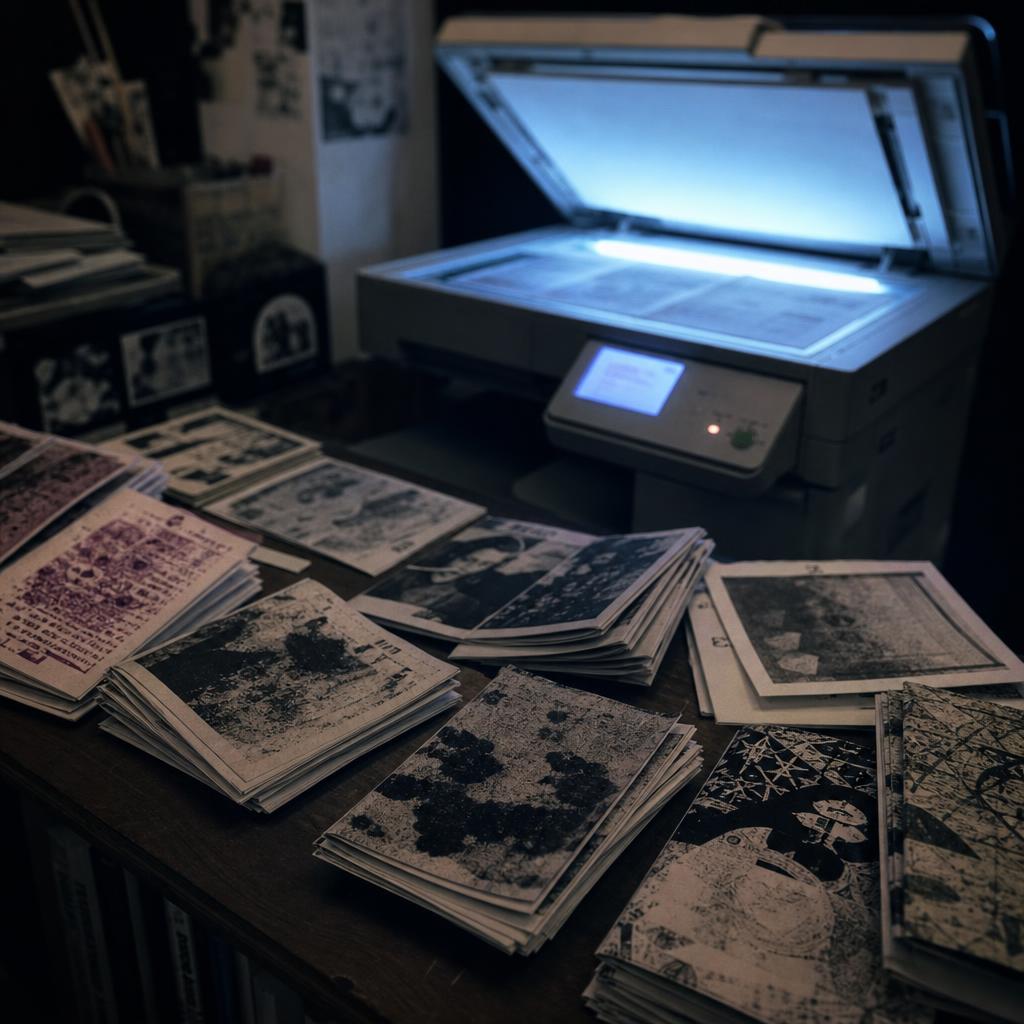
The zine was not incidental to the movement; it was the movement’s primary mechanism, the form through which everything else — the bands, the chapters, the manifesto, the blackout — circulated. Production followed a fixed, low-cost process: text was written by hand or typewriter, cut and pasted into layout with rubber cement, photocopied at a twenty-four-hour copy shop — Kinko’s, most often, and in the East Village specifically the location on St. Marks Place — then folded and stapled by hand, usually into a quarter- or half-fold booklet.9 A finished zine sold at a show table for a dollar, was traded for another zine, or was mailed for the price of a stamp. The roughness was not a limitation the makers worked around; it was the argument. A movement whose central claim was that anyone could make meaning without institutional permission needed an object that visibly cost nothing to produce and demanded no professional skill to make — the photocopier, not the printing press, as the means of production.
The founding text of the movement’s politics, the Riot Grrrl Manifesto, appeared in the second issue of the Bikini Kill zine in 1991, written by Hanna as a cumulative series of “BECAUSE” declarations, structured like a legal brief and addressed entirely to other girls: “BECAUSE us girls crave records and books and fanzines that speak to US that WE feel included in and can understand in our own ways,” and, further down the same page, “BECAUSE we must take over the means of production in order to create our own meanings.”10 A single zine issue might hold, without any sorting logic, a first-person account of assault, unreleased song lyrics, collaged images clipped and defaced from fashion magazines, a how-to guide for starting a band, and a letter from a girl in another city — the zine functioning, in an era before electronic mail was common, as the correspondence network itself.
By 1993 the movement had built its own national distribution infrastructure. Riot Grrrl Press, founded that spring in Washington, DC by Erika Reinstein and May Summer, operated a mail-order catalog — itself a typewritten zine listing available titles — took fifteen to twenty copies of each zine on consignment, and marked prices up roughly a fifth to cover postage and packaging.11 It became, within its first year, the movement’s primary channel for moving zines between cities that had no other way to find each other’s work.
The Third Wave
The zines carried a politics that had, by 1992, acquired a name in the mainstream feminist press as well. Rebecca Walker, twenty-two years old and the daughter of the novelist Alice Walker, published an essay titled “Becoming the Third Wave” in the January/February 1992 issue of Ms. Magazine.15 She had written it in direct response to the Senate Judiciary Committee’s confirmation hearings for Clarence Thomas the previous October, at which Anita Hill’s testimony of sexual harassment had been received by an entirely white, entirely male panel with open skepticism. Walker’s essay closed on a declaration — “I am not a post-feminism feminist. I am the Third Wave” — that gave a generation of younger feminists, inside and outside the punk scenes, a name for the distance they felt from the movement’s institutional prior generation.
The distance had a philosophical companion. Judith Butler’s Gender Trouble, published by Routledge in 1990, argued that gender was not an expression of some prior, authentic identity but a performance constituted through its own repeated acts — that no self existed behind the acts that were said to express it.16 The book became a foundational text of the decade’s academic queer theory, and its vocabulary reached the zine scene directly: Hanna, Vail, and Wilcox were college students when it was published, and the movement’s own signature gestures — performing femininity in baby-doll dresses and combat boots, writing words like “SLUT” across bare stomachs at shows — read, in Butler’s terms, as an exposure of gender’s construction by way of exaggerating it. The zines carried none of the book’s academic apparatus; they carried its argument anyway, translated into a form that required no citation to be understood.
The Co-optation
The movement’s own language did not stay its own for long. Hanna had coined the phrase “girl power” in the early 1990s as the title of Bikini Kill’s second zine, drawing directly on the manifesto’s own claim that girls constituted “a revolutionary soul force.”18 In 1996 the phrase appeared, unrecognizable in its new context, as the marketing slogan for the Spice Girls, a five-member pop group whose debut album, Spice, released that July in Britain and that October in the United States, sold more than twenty-three million copies worldwide.19 Where Bikini Kill’s version of the phrase carried an argument against patriarchy and consumer capitalism made through deliberately unpolished, self-distributed music, the Spice Girls’ version was produced by a major label, aimed at pre-teens, and sold empowerment as a purchasable identity — a five-woman lineup marketed as multicultural inclusion rather than organized around any stated politics at all. By the time the album reached American radio, “girl power” could no longer be used by the women who coined it without a sentence of disambiguation attached; the phrase had passed entirely into the market it was written to indict. The pattern was distinct from what had already happened to grunge, the guitar scene running through the same college-radio circuit and the same used-record bins: grunge had never refused the glossy magazines’ attention and was absorbed by accepting it, while riot grrrl was absorbed after actively refusing it, which meant the co-optation reached it through the movement’s own coined language rather than through a runway collection. A separate critique came from inside the movement rather than from the market: that riot grrrl had been, in the main, a white one, its chapters and zines skewed toward the same college-town demographics as the labels that carried its bands. The charge was pressed in the movement’s own pages — a Riot Grrrl NYC zine issue took up Audre Lorde’s work directly — and by women of color in and around the scene throughout the decade.14
The zine form itself did not survive the decade intact, though what it stood for migrated rather than disappeared. Through 1993 riot grrrl’s infrastructure remained entirely analog — zines, mail, shows, the telephone. By 1994 and 1995 the first movement-affiliated websites and chatrooms had appeared, and desktop publishing software had begun to replace the typewriter and the rubber-cement paste-up on the zines still being made by hand — arriving on the same mid-decade curve that carried the city’s phone lines, pagers, and modems from a novelty into an ordinary condition of urban life.20 The same East Village blocks that had hosted Riot Grrrl NYC’s meetings and stocked its zines were, within a few years, producing some of the city’s earliest commercial web publications — a continuity of people, not a replacement of one culture by another, running alongside the broader shift the decade’s digital transition carried through the rest of the city’s media. What the internet offered for free, the zine had offered for a dollar and the cost of postage: distribution without an editor’s permission. The infrastructure changed. The argument that produced it did not.
Riot grrrl argued, in its shows and its staple-bound zines, that the means of making meaning belonged to whoever was willing to run a photocopier — and it argued this loudly enough, and specifically enough, that the national press eventually noticed and wanted to explain it, which was precisely the outcome the movement least trusted. A boycott of the country’s largest magazines by a network of teenagers with a dollar-per-issue publishing operation was, on its face, an unequal contest; that it worked at all, however imperfectly, said something true about where cultural authority had begun to sit by the early 1990s. A movement could still be misrepresented from a distance, but it no longer had to grant the interview to be heard — the zine, the show, the mail-order catalog were sufficient, on their own terms, to reach the people who mattered to it. What the phrase “girl power” suffered five years later, sold back as a lyric on a major-label album, was the fate of every piece of underground language precise enough to be worth stealing.
Judith Butler’s book would have crossed a junior editor’s desk within months of its printing, the argument dense enough that no one on the floor would have claimed to follow all of it on a first read. The Back would have taken it that June regardless, a short notice among a run of academic titles, its claim about gender as performance compressed to a paragraph a reader could carry away without the apparatus behind it. Two years on, Rebecca Walker’s response to the Thomas hearings would have gone into The Essay that April, argued as an editor’s judgment that a generational break in feminism was itself the story, not a footnote to the hearings that provoked it.
By November of that same year the room would have had nothing to weigh, because there would have been nothing to report from: a movement built on photocopiers had declared its members off-limits to any outlet with a national circulation, Meridian’s included, and a piece built from purchased zines and secondhand paraphrase would have read as exactly the flattening the boycott existed to punish. What killed it in the room would have been counted an advertiser question before it was ever counted a press-freedom one — a wary eye on the same youth-market advertisers a rival’s trend piece had also courted, and no one on the floor would have wanted to look like they were chasing that rival’s formula. The mail-order operation that rose the following spring to move zines between cities would never have reached the room at all; a DC catalog with a typewritten price list would have read, from a Midtown desk, as a hyper-local curiosity with no New York angle to hang it on.
By the middle of the decade, an editor at The Back would have claimed the Spice Girls’ record for a September issue.
Footnotes
-
“Riot grrrl,” Wikipedia (accessed 2026). ↩
-
David Buckingham, “Riot Grrrl Meets the Media,” Real Girl Power: Representing Riot Grrrl series. ↩ ↩2
-
“Revolution, Girl Style,” Newsweek, November 23, 1992. ↩
-
David Buckingham, “The Means of Production,” Real Girl Power: Representing Riot Grrrl series. ↩
-
HistoryLink.org, File 22506, “International Pop Underground Convention”; Tobi Vail, Olympia Music History Project. ↩ ↩2 ↩3
-
“Revolution Girl Style, 20 Years Later,” NPR, 2011. ↩
-
“International Pop Underground Convention,” Wikipedia; HistoryLink.org, File 22506. ↩
-
Oregon Public Broadcasting, “Starting a Riot,” episode 3. ↩
-
Kathleen Hanna, “Riot Grrrl Manifesto,” Bikini Kill zine, issue 2, 1991, Riot Grrrl Archive, CUNY. ↩
-
Riot Grrrl Press history; 1990s zine distribution collection, Ohio State University Libraries. ↩
-
Printed Matter, Inc., organizational history. ↩
-
“St. Mark’s Bookshop,” Wikipedia. ↩
-
Elena Humphreys Riot Grrrl Collection, Fales Library and Special Collections, New York University. ↩ ↩2
-
Rebecca Walker, “Becoming the Third Wave,” Ms. Magazine, January/February 1992. ↩
-
Judith Butler, Gender Trouble: Feminism and the Subversion of Identity (Routledge, 1990). ↩
-
“Third-wave feminism,” Wikipedia. ↩
-
“How the Spice Girls Ripped ‘Girl Power’ from Its Radical Roots,” Vice. ↩
-
“Spice Girls,” Wikipedia; “Spice” (album), Wikipedia. ↩
-
David Buckingham, “The Means of Production,” Real Girl Power: Representing Riot Grrrl series; “Girl Zine Networks,” Journal of American Studies, Cambridge University Press. ↩