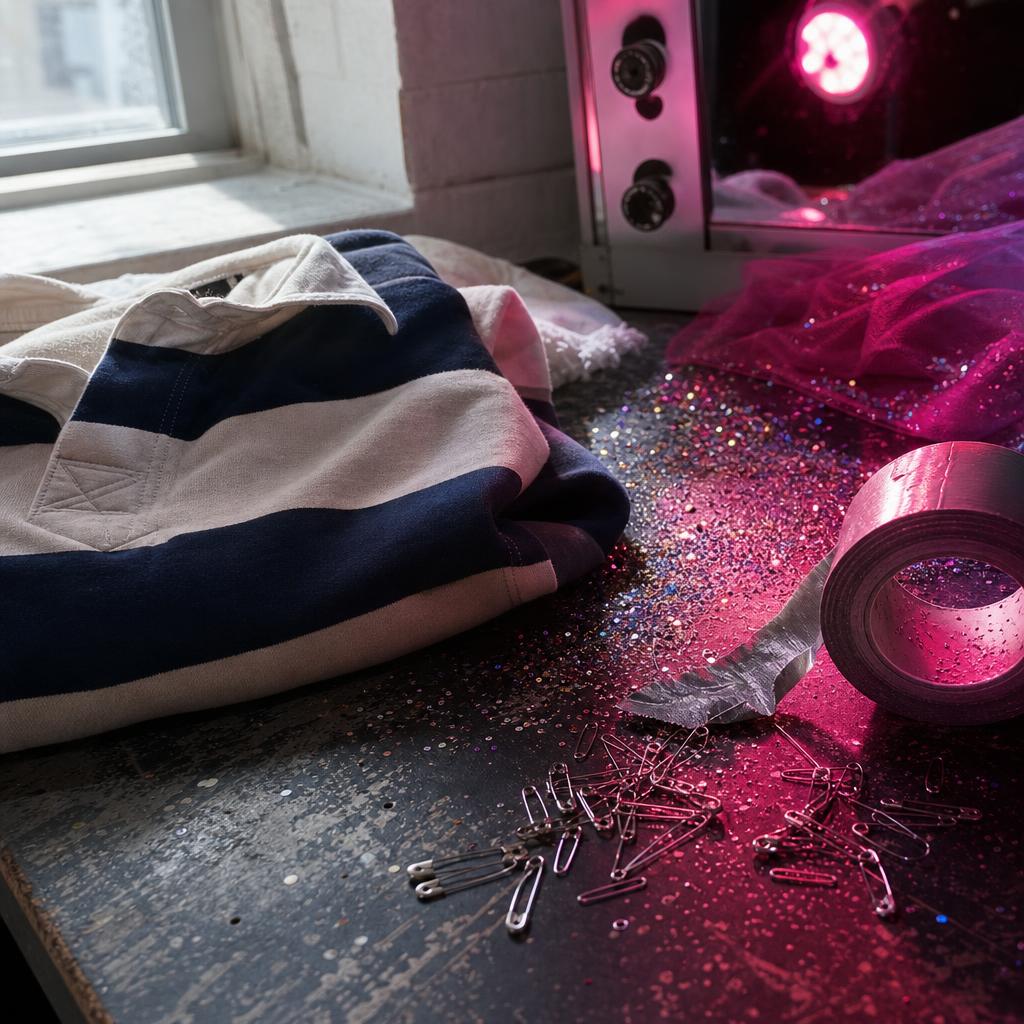
Club Kids and Streetwear, 1994–1997
Subscribe
https://meridian-archive.com/feed.xmlOpen in your app, or paste the link above into any other:
Reverse Marketing
By the middle of the 1990s the fashion trade had a routine name, printed in Women’s Wear Daily without a raised eyebrow, for a maneuver its labels were producing often enough to require one: reverse marketing, a company riding an audience it had not sought, had not designed for, and had not paid to reach.1 The trade press used the term the way it used markdown or overstock — a category of transaction, not an accusation — because by then the pattern had recurred across enough labels that a name, rather than an explanation, was what the situation called for.
The instance the trade had in mind above all others ran through a single half-hour of live television. On March 19, 1994, Snoop Doggy Dogg performed “Lodi Dodi” on Saturday Night Live in a rugby shirt striped red, white, and blue, the word TOMMY block-lettered across the chest, and by the next afternoon the shirt could not be found on a rack in New York.2 The label was five years old and had built its name on a visual vocabulary borrowed whole from East Coast yacht clubs — the crest, the flag stripe, the cable-knit sweater tied at the shoulders — worn, until that broadcast, mostly by the kind of customer the company’s own advertising had always pictured: a white, collegiate body standing on a dock its founder had never actually stood on himself. Two nights before the show, Snoop had called the company’s marketing office asking for more of the gear he had already been wearing around the city; Tommy Hilfiger’s brother Andy, who ran the relationship, brought fresh shirts to Snoop’s hotel room hours before air, and the shirt Snoop chose on camera sold out of the company’s own reorder stock within a day.2
The label had spent five years marketing an imagined East Coast leisure class to a national audience, and for one half-hour of live television the direction of the borrowing reversed. A garment built to signal inherited money became, in the space of a single televised song, legible to a much larger audience as something a hip-hop artist had chosen to wear — and the company did not resist the new reading. It restocked the same shirt at the same price and let the association stand, because the association was selling.
No one at the company had designed for that customer. The crest, the flag stripe, the boat-shoe styling had been drawn for a fictional country-club member the founder wanted to sell clothes to, not for the outer-borough teenager who eventually made the crest legible to the rest of the country. The company’s own catalog photography did not catch up for another season or two; the endorsement arrived before the marketing plan did, which is part of why it registered, when it landed, as a genuine reversal rather than a campaign the company had engineered from the start.
The label’s own origin story ran on a related trick of borrowed authority. In 1985 the advertising man George Lois had introduced Tommy Hilfiger to the country with a Times Square billboard that named three established American designers by initial only — R.L., P.E., C.K. — and then, beneath a fourth set of initials, declared Hilfiger “the great American designer” alongside them, before the buying public had any reason to agree.3 The city spent days asking who T.H. was. The company’s whole subsequent career ran on the same instinct: attach the name to an authority it had not yet earned and let the association do the earning. What changed in 1994 was only the direction the borrowing pointed — outward from old money’s initials toward a culture the company’s own catalog had never once photographed.
Two boroughs over, a more literal version of the same shift was already under construction — run not by a company absorbing a borrowed audience after the fact, but by young men from inside that audience who had decided to manufacture the look themselves and keep what it earned.
Hollis, Queens
Daymond John grew up in Hollis, Queens, in a house he later mortgaged for one hundred thousand dollars to buy the fabric, thread, and sewing machines that started a clothing line. He founded the company in 1992 with three friends from the same neighborhood — J. Alexander Martin, Keith Perrin, and Carlton Brown — and its first product was not a shirt but a tie-top wool hat, cut and sewn in John’s mother’s house before the four of them owned a factory of their own.4 They called the line FUBU, for “For Us, By Us,” a name that doubled as a business plan: clothing designed by people who already lived inside the culture the wider apparel industry was still learning to read correctly, sold back to the same audience without an outside label taking the margin for translating it. Before there was a company, there was a folding table: John and his partners sold the tie-top hats out of a car trunk outside a Queens mall on weekends, then out of a rented storefront, reinvesting whatever the hats earned into the next run of fabric. The apparel industry the four of them were trying to enter did not, at the start, return their calls; the capital that got the company off the folding table and into production came from a bank loan secured against the house John’s mother still lived in, not from any garment-district backer willing to bet on four unknown men from Hollis.4
Where Hilfiger’s company had licensed a look it had not originated and profited from the look’s adoption after the fact, FUBU manufactured directly from the source and kept the earnings inside the neighborhood that had produced the aesthetic to begin with — the same oversized silhouette, the same bold block lettering, that a company two subway lines away was still discovering it could sell. The company grew from a bedroom production run into a business reporting close to $350 million in annual revenue by 1998, built on hats and jerseys cut for bodies the mainstream apparel trade had spent a decade photographing but rarely employing.4 A different logo logic was working the opposite corner of the same media class in these same years — the Prada nylon backpack, expensive precisely because it named nothing at all, a story belonging to a different piece in this run entirely. FUBU’s argument ran the other direction: the name was the entire point, printed large enough to read from across a subway platform, and the people wearing it were, for the first time in the decade’s fashion economy, also the people being paid for it.
Both transactions ran on the same underlying test even as they pointed in opposite directions. A person fluent in either code — the Hilfiger flag stripe worn correctly, the FUBU block letters worn knowingly — was declaring a literacy no label alone could confer, and the literacy was the actual product being sold. What had changed by the middle of the decade was who got to write the exam. For years the outer boroughs had been the audience whose adoption of a look proved the look had arrived somewhere legitimate; by 1994 a piece of that audience had started grading the exam itself, manufacturing the correct answer directly and selling it back uptown at a markup uptown had once collected on its own.
A Costume Was the Credential
Downtown, the economics ran on a different currency altogether. The Limelight occupied the deconsecrated Episcopal Church of the Holy Communion at Sixth Avenue and West Twentieth Street, a Gothic Revival building Richard Upjohn had completed in the middle 1840s, its sanctuary serving as the dance floor and its old confessionals rebuilt into private booths.5 Michael Alig had promoted there since 1988, and by the middle of the decade his Wednesday party, Disco 2000, was the room’s defining night — a party where the price of entry was not a cover charge but a costume, judged at the door by staff Alig had trained himself; New York magazine had already put the scene on its cover that same year, evidence that the Club Kids’ visibility predated the party’s peak by several years.6
The materials were cheap and the effect was not: glitter, thrift-store fabric, hardware-store paint, a wig reshaped with scissors and a curling iron, assembled into a look built to be photographed rather than worn twice the same way. Patricia Field’s shop on East Eighth Street, a downtown institution that had outfitted the Village’s queer and creative youth for two decades, supplied pieces and, as often, employees drawn from the same scene it dressed.7 Between 1989 and 1993 the Club Kids appeared on Geraldo, The Joan Rivers Show, and Donahue — an underground that mainstream daytime television found irresistibly visual, a costume built for a camera lens rather than a runway. The fashion press spent the back half of the decade chasing designer logos; for these few years, downtown, it had chased homemade ones instead.
The transaction at the Limelight’s door inverted the one running two miles north. A shopper on Fifth Avenue paid for a name sewn into a garment and wore the name as evidence of having paid. A Club Kid paid nothing at the door beyond the labor of the costume itself — a night’s work with a glue gun and a mirror stood in for a receipt — and the payment came due afterward, in the photographers and the daytime bookers who paid for access to the look once it existed. The Flatiron building that housed the party sat roughly two miles from the department stores restocking Hilfiger’s rugby shirts that same season, and the distance was not only geographic: uptown, a company owned the label and sold it downward; downtown, the room’s regulars owned nothing but were, briefly, the label themselves.
The door staff Alig trained turned away more people than they admitted, and the standard had nothing to do with money carried in a wallet. A first-time visitor in ordinary clothes could wait behind a rope for an hour while a regular in a homemade headdress walked past the same line without breaking stride. The hierarchy inverted the uptown one point for point: spending power bought nothing at the door, and the currency that did work could not be purchased anywhere, only assembled that same night, alone, in a bathroom or a railroad apartment, with a mirror and whatever happened to be on hand.
The Church on Sixth Avenue
The scene’s most improbable crossover ran through a cosmetics counter. MAC, a Toronto-founded company that had never bought advertising in its history, made RuPaul — born RuPaul Andre Charles in San Diego on November 17, 19608 — the face of a new lipstick shade called Viva Glam in 1994, with every dollar the shade earned funding the newly created MAC AIDS Fund; the campaign made RuPaul, by then a fixture of the same Limelight circuit that produced the Club Kids, the first drag performer to front a national cosmetics line.9 RuPaul had reached the Billboard Hot 100 the year before with “Supermodel (You Better Work),” the first single by an openly drag performer to chart, released on Tommy Boy Records off the album Supermodel of the World.10 The Viva Glam contract was not an isolated crossover; VH1 gave RuPaul a weekly talk-and-variety hour, The RuPaul Show, premiering October 12, 1996, seven months after the Melendez murder and squarely inside the same season the downtown scene that produced RuPaul was collapsing under indictment and enforcement pressure.11 Both were true in the same season: the scene’s most visible face was moving further into the mainstream at the exact moment its home room was being padlocked.
The look surrounding both rooms in these years ran to extremes on either side of modesty at once: platform boots stacked several inches high, tartan skirts and knee socks worn as costume rather than uniform, slip dresses layered over plain T-shirts, baby-doll dresses cut for a body younger than the one wearing them. A dance floor at midnight in 1996 held all four silhouettes moving past each other without contradiction — a schoolgirl skirt beside a satin slip beside a platform boot laced to the knee — because none of it originated in a single designer’s studio. It circulated first through clubs and street style and only later through the magazines assigned to name it, which is why the vocabulary — “sexy schoolgirl” was the trade shorthand — arrived as a caption applied after the fact, to something that had already happened on its own, on bodies that never read the trade press that named them. The same inversion that put a hip-hop artist’s shirt on a WASP-coded label’s shoulders was putting a drag performer’s face on a cosmetics counter that had never before put anyone’s face on anything.
The End of the Costume
The costume economy ended in an apartment at 560 West 43rd Street, in a building called Riverbank West, on the night of March 17, 1996. Alig and his roommate, Robert “Freeze” Riggs, killed Andre “Angel” Melendez, a drug dealer who had worked the Limelight and argued with Alig that night over money Melendez said he was owed; Riggs struck Melendez with a hammer, and the body was kept in the apartment for several days before being dismembered and put into the Hudson River, where it surfaced weeks later.6 Michael Musto’s column in The Village Voice broke the story to the public that April as a blind item — “Mr. Mess” fighting “Mr. Dealer” — before the New York Post named names within the week.12 Alig and Riggs were arrested that December; both pleaded guilty to first-degree manslaughter on October 1, 1997, and were sentenced to ten to twenty years.6
The murder was not what closed Manhattan’s club economy — that closure was already underway, driven by a city administration turning a long-dormant dancing ordinance into an enforcement tool against the same rooms, a campaign belonging to nightlife’s own reckoning, told at length elsewhere in this run.13 Peter Gatien, who owned the Limelight, was indicted separately that same year on federal narcotics-conspiracy charges naming the club itself as the enterprise — a proceeding with its own timeline, its own prosecutors, and its own outcome, running alongside the murder case rather than growing out of it.13 What belongs to this account is narrower than either the raid campaign or the federal case: after March 1996, a photograph of face paint and a homemade wig stopped reading, in a newspaper, as fashion. It read as evidence.
The booking photograph taken when Alig entered custody showed a pale, unremarkable man in a jacket, hair dark and thinning, wire-framed glasses on his face — no wig, no paint, none of the constructed silhouette that had been the entire public argument of Disco 2000 for most of a decade.14 The costume had been the credential; without it, the man wearing it was ordinary in exactly the way the party had been built to make impossible. Fashion coverage of the Club Kids, which had run in The Face and Interview and briefly in Vogue’s pages through the scene’s peak years, had nowhere left to put a story that had turned into a courtroom transcript.6
By 1997 the two strands had reached opposite endings that were, underneath, the same ending told twice. FUBU kept growing through the murder, the indictment, and the raids, because its argument had never depended on any single room staying open — a hat sewn in Hollis did not need the Limelight’s sanctuary to keep selling. The Club Kids’ argument had depended on the room entirely: without Disco 2000, the costume had nowhere left to be worn as anything other than a costume, and a look that required a specific Wednesday night in a specific deconsecrated church could not survive the night’s cancellation. Both strands had proven, in their own registers, that a wardrobe could function as a credential. Only one of the two credentials could be manufactured, warehoused, and sold again the following season.
Two Wardrobes, Same Years
A single decade’s mid-cycle fashion ran two opposite arguments at once, uptown and downtown, and both treated clothing as a credential rather than a purchase.
| Look | Where it started | What it cost | Where it ended |
|---|---|---|---|
| Tommy Hilfiger rugby shirt | Outer-borough hip-hop wardrobe, adopted by a WASP-coded label | Retail price; sold out after one broadcast | National department-store distribution within months |
| FUBU tie-top hat | Sewn in a Hollis, Queens, house on a mortgaged loan | Startup capital, not a purchase | Roughly $350 million in annual sales by 1998 |
| Disco 2000 costume | Built from wigs, glitter, and thrift-store fabric | No admission price beyond the look itself | A courtroom, October 1, 1997 |
| Platform boot, tartan skirt, slip dress | Club floors and street style, mid-decade | Inexpensive, mass-produced | Absorbed as magazine shorthand for the look of the era |
Fashion in these years ran in two directions at once and called both of them the same decade. Uptown, a garment built to advertise inherited money became, in the space of one televised song, a garment read as a hip-hop artist’s choice, and the neighborhoods that had made the association desirable stopped waiting to be discovered by it and started manufacturing the look themselves. Downtown, a costume built from nothing more than wigs, glitter, and nerve bought its way onto a cosmetics counter and into the pages of the fashion press before the same room that produced it produced a killing no costume could outlast. Neither story was really about clothing. Both were about who got to decide, for once, what counted as the credential — and for a few years in the middle of the decade, on both ends of Manhattan, the answer was not the person who had always decided it before.
The Snoop Doggy Dogg reversal would have gone into The Front inside a month or two, the label’s own reorder numbers doing more of the telling than any interview line could have supplied — a company discovering, mid-broadcast, that a customer it had never sketched in its own catalog had chosen the shirt for it, and had chosen it faster than the fashion desk could file.
An articles editor would have claimed the Viva Glam launch for The City that same year: a cosmetics house’s first advertised product, and a drag performer off the Limelight circuit fronting it, funding an AIDS charity from a counter that had never before put anyone’s face on anything. The angle would have outlasted the lipstick shade itself.
Nothing would have been proposed on a Hollis, Queens, hat company in 1992, and so nothing would have needed killing. A bedroom operation two founders were still sewing on a kitchen table would have given the floor no hook to hang a piece on that year — no close to anchor it to, no number yet worth quoting — and the silence would have cost the magazine six years of a company nobody on staff had heard of before it was already worth quoting.
The City’s spring 1996 pages would have folded a piece on the end of the Limelight circuit into the larger dancing-ordinance story already running that spring, rather than running the killing on its own. The legal caution would have held the specific case back — the man who did it, the man who helped him, both left unnamed — until a plea existed for the desk to report cleanly instead of a rumor it could not yet stand behind.
Footnotes
-
Teri Agins, The End of Fashion: How Marketing Changed the Clothing Business Forever (William Morrow, 1999). ↩
-
Tommy Hilfiger with Peter Knobler, American Dreamer: My Life in Fashion & Business (Ballantine Books, 2016). ↩ ↩2
-
“The Visual Language of Tommy Hilfiger,” AnOther, February 10, 2014. ↩
-
Daymond John with Daniel Paisner, Display of Power: How FUBU Changed a World of Fashion, Branding and Lifestyle (Naked Ink, 2007). ↩ ↩2 ↩3 ↩4
-
Church of the Holy Communion and Buildings, Designation Report (New York City Landmarks Preservation Commission, 1966). ↩
-
James St. James, Disco Bloodbath: A Fabulous but True Tale of Murder in Clubland (Simon & Schuster, 1999). ↩ ↩2 ↩3 ↩4 ↩5
-
“Patricia Field’s Village Shops,” Village Preservation, October 25, 2023. ↩
-
RuPaul, Lettin It All Hang Out: An Autobiography (Hyperion, 1995). ↩
-
“RuPaul’s ‘Supermodel of the World’ Album Turns 25: Why It Was More Than a Novelty,” Billboard, June 8, 2018. ↩
-
“RuPaul’s Drag Race: The Story Behind RuPaul’s VH1 Talk Show From 1996,” Screen Rant, March 23, 2021. ↩
-
Michael Musto, “La Dolce Musto,” The Village Voice, April 26, 1996. ↩
-
Frank Owen, Clubland: The Fabulous Rise and Murderous Fall of Club Culture (Broadway Books, 2003). ↩ ↩2
-
“Michael Alig Did His Time for Murder — Now He Wants to Party,” Rolling Stone, December 25, 2020. ↩