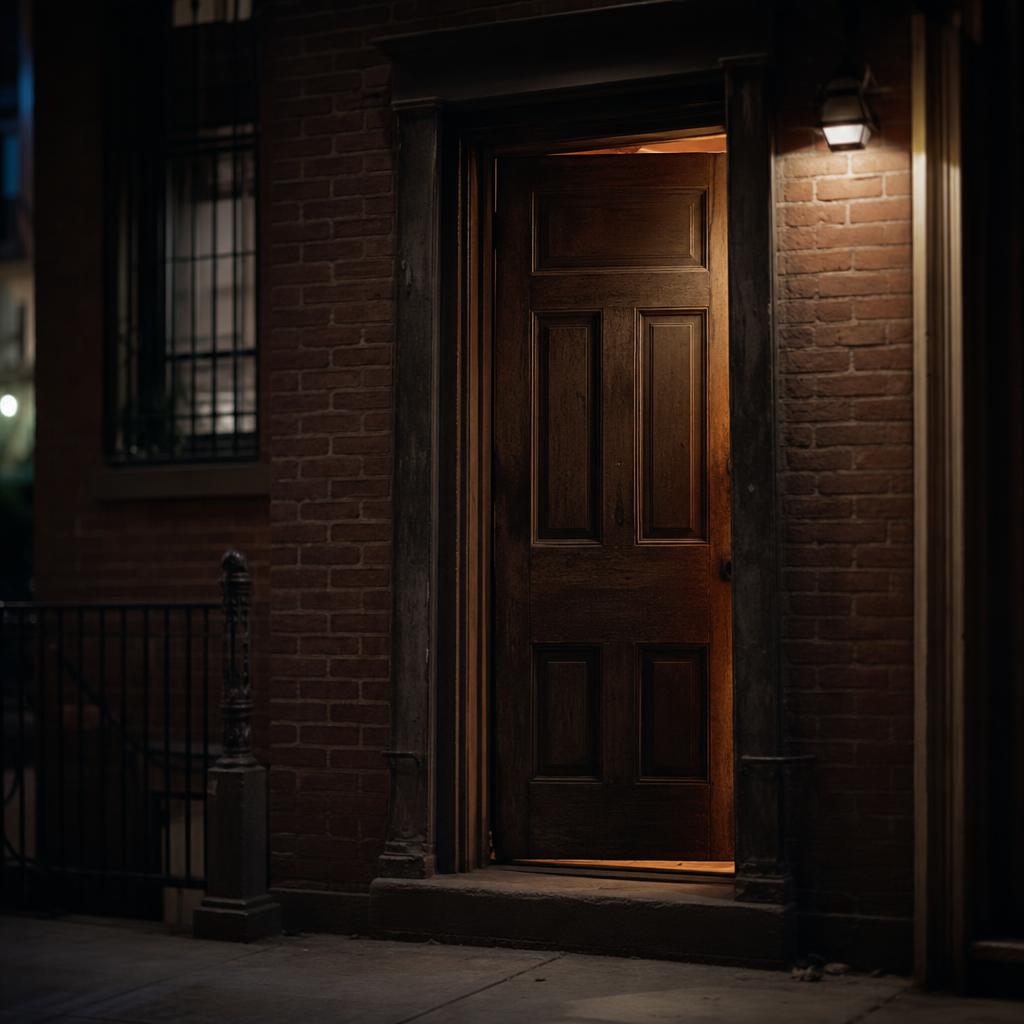
Chumley's: The Unmarked Door, 1989
Subscribe
https://meridian-archive.com/feed.xmlOpen in your app, or paste the link above into any other:
The Term Every Kitchen Knew
By 1989, a cook or a bartender anywhere in the country could scrawl “86” on an order pad — a dish pulled from the kitchen, a customer refused another round, a job ended outright — and be understood without a syllable of explanation attached; the shorthand had migrated out of any single bar’s private vocabulary decades earlier and into the standard working language of the American restaurant and bar trade, printed on tickets and spoken across kitchens that had never heard of where it came from.12 Where it came from was, in 1989, still an open question, professionally researched and never settled. A stubborn piece of city folklore assigned it a single address: 86 Bedford Street, in Greenwich Village, where a heavy wooden door sat in a plain brick facade with nothing above it — no sign, no awning, no lettering, not even a house number spelled out, only the numeral itself worked into the building’s ironwork. The story held that a Prohibition-era bartender, tipped that police were coming, sent the room’s occupants out that door while the law came in through the second entrance on Barrow Street — “86” the customer, “86” the bottle, at 86 Bedford. The claim had a real book behind it and real currency among the people who told it, but no documentary proof, and it competed with an older, simpler theory that “eighty-six” was merely rhyming slang for “nix” — a claim that belonged, by the honest accounting of the researchers who had gone looking, among a crowded field of unresolved candidates rather than a settled origin.12 The door the story pointed to needed no folklore to be strange on its own terms. A stranger walking the block in November 1989 had no way of knowing a bar operated behind it: no menu posted, no neon, no hours painted on glass, because there was no glass — the door was solid, rounded at the top, closer to a church door or a smithy’s door than a saloon’s. This had been deliberate for sixty-seven years. Leland Stanford Chumley opened the room as a speakeasy in 1922, converting a former blacksmith’s shop a few doors from the corner, and the unmarked entrance was not atmosphere but function: a door Prohibition agents could walk past without a second look was worth more than any decoration a saloon owner might otherwise have chosen.3 Prohibition ended in 1933. The sign never went up. By 1989 the absence of a sign was no longer a precaution against anybody; it was simply how the bar had always been, maintained past the reason for it by nothing more than the fact that nobody in fifty-six years had thought putting one up was worth doing.
The Architecture That Outlasted Its Reason
The building kept the rest of its Prohibition-era layout intact as well, and none of it had been removed for the six decades in between. A second entrance existed off Barrow Street, reached by crossing an unmarked courtyard called Pamela Court and stepping down through a rounded door of its own — a route a stranger could walk past twice without noticing it led anywhere. Inside, a section of what looked like a plain wall of bookshelves was in fact a door on a pivot, opening onto a back passage that waitstaff had long since repurposed as a kitchen shortcut; trap doors and a set of hidden stairs, built for clearing the room ahead of a raid, remained in the structure, unused for anything but the story attached to them.3 The two-exit floor plan had been a raid contingency: the bartender’s task, on a tip that the police were coming, was to get the room’s occupants out one door while the law came in the other. What the bar poured its regulars was a separate, better-documented story, carried elsewhere in this archive’s account of the decade’s drinking; the room’s argument was never the whiskey. It was the door, and everything built to protect what happened behind it.
The Room
Past the Bedford Street door lay a dining room, and past that, through an archway, the bar room proper — small, low, dark, the ceiling barely clearing head height in a building raised as a working smithy rather than a place anyone had planned to stand upright in for long. Booths of plain dark wood lined the walls, their tabletops carved over with sixty years of initials and dates cut into the grain by hands with nothing better to do while they waited for a drink or a friend; one table, by the fireplace, had belonged to F. Scott Fitzgerald, and no one had refinished it or any of the others. Sawdust lay scattered across the plank floor underfoot, gritty and slightly yielding, tracked through with street grime and spilled beer, and the room smelled of all of it — stale beer soaked deep into old wood, fireplace smoke, frying grease from the kitchen, the earthy note of the sawdust itself. The bar the room served off was small and stocked sparingly, a single bottle of most things. A fire worked in the hearth against the cold, the only light source in the room that moved. The New York Times had once called it “a beery place that was clean enough but never well lighted,” and neither half of the description had stopped being true.3 Ringing both the dining room and the bar room, in glass frames on the plaster walls, hung the jackets of the books that Chumley’s regulars had published — begun as a private courtesy by the founder, who had simply asked a newly published patron for a spare copy of the dust jacket and put it up, and continued past his death by whoever tended bar after him, until the wall held better than two hundred and fifty of them, curling at the edges, the print gone soft with age.4 A portrait of Chumley himself hung above the mantel; photographs of the writers whose jackets papered the room — Kerouac, Steinbeck, Cather, Edna St. Vincent Millay, John Dos Passos — hung above the jackets. The tradition had not lapsed with the founder. An author who published in 1989 could still walk a second copy of the jacket to the bar and expect it framed and hung within the year, which meant the wall was not a museum piece but a record still being added to — the accumulated evidence of who had sat there and gone on to publish something. Henrietta Chumley, who ran the bar for decades until 1960, had taken her evening Manhattan at the table nearest the fire for years before her death at that same table, by report in her sleep — a detail carried by the bar’s own telling more consistently than by any documentary record, and repeated in 1989 as the bar’s settled lore.4
The room’s other inheritance was harder to see and easier to miss. A radio behind the bar picked up, on a good night, the city’s one full-time jazz signal, broadcast not from Manhattan but from a transmitter across the river in Newark — a station built out of a donated public-school license a decade earlier, still years from moving its antenna into the city itself.5 Ten miles of urban air and an old brick building with thick walls and no windows facing west weakened the signal further; what reached the small speaker over the bar arrived already thinned, prone to fading, closer to mono than stereo. A number from Kind of Blue — a session cut thirty years earlier at Columbia’s Thirtieth Street studio, a couple of miles uptown and across town — did not so much play in the room as leak into it.6 The low ceiling and the wood and the sawdust together made a close, warm, muffled acoustic, more felt than analyzed — conversation from the next booth folded into a general murmur rather than resolving into words, glass on wood carried without ringing, the fire’s crackle stayed audible under all of it. A horn line drifting up from the shelf speaker, softened twice over — once by the weak signal, once by the room that absorbed its own top end — surfaced only in pieces: a phrase catching above a burst of laughter, then gone again under the room’s ordinary noise, audible only in fragments rather than as a continuous broadcast. Nothing about the room drew attention to the music; it was a room for sitting in.
A weeknight crowd was thin and local: a handful of neighborhood regulars in the carved booths, a scattering of students from New York University a few blocks north, occasionally a tourist working from a guidebook that had found the unmarked door and given away its location in print, which was the one form of publicity the bar could not prevent. The room did not fill the way a destination bar filled. It held the same dozen or twenty people for hours, the jukebox cycling through songs nobody had bothered to update, and on an ordinary Tuesday the low talk under the low ceiling never rose to the pitch of a room doing business.
A door with no sign on it in 1989 was not a curiosity of taste; it was a piece of engineering built for a threat that had stopped existing fifty-six years earlier, kept in place because taking it down would have cost something and putting a sign up would have changed nothing anyone in the room wanted changed. The trap doors nobody used, the bookcase that still turned on its hinge, the second entrance across a courtyard nobody but a regular could find — none of it served the purpose it had been built to serve. It served a newer one instead, quieter and harder to legislate: proof, walked past every night by people who never thought about it, that a room could hold its shape for six decades without anyone deciding it should. The bar did not advertise what it had survived. It simply had not yet been made to change.
Meridian’s City section would have known Chumley’s the way most of the floor’s junior staff would have known it — as a place a writer might have taken a source who wanted to feel he had been let in on something, or where an editor might have closed out a long night after a piece went to bed. A notice of the bar itself, though, would have been a hard pitch to land on its own merits: a fond paragraph about sawdust and a working fireplace, with no news reason to run it and no argument underneath the description, would have read as nostalgia dressed as reporting — a register the magazine would never have allowed itself. A junior editor might have raised the bar at a pitch meeting twice in a decade, and both times the room would have gone quiet not from objection but from the absence of an obvious hook — no anniversary, no closing, no fresh outrage to hang the description on — and the proposal would simply have gone unassigned, for want of a reason a reader could name.
The figure nobody on the masthead would have known to name would have been the woman who worked the register. She would have kept that register since before any of Meridian’s editors were born, through a change of owners and two generations of bartenders and regulars, present at every closing time and every quiet Tuesday for longer than the magazine itself had existed. She would have made change for a departing writer many times over the years without either of them trading a word beyond the transaction. She would have watched an editor’s face on the night his second book came out and watched the same face again the night his marriage ended, and given both the same brief attention before turning to the next customer. She would have known which of the framed jackets on the wall belonged to men who never published a second book, and which of the old regulars had stopped coming because they had died, and she would have kept that accounting the way she would have kept the register — exactly, and to herself. An editor might have sat across from her for twenty years without ever thinking to ask what she remembered. She would never have thought to tell him. The wall would have held the bar’s public memory, in glass and paper. She would have held the rest of it, and she would have kept making change.
Footnotes
-
Jef Klein, The History and Stories of the Best Bars of New York (Turner Publishing, 2006). ↩ ↩2
-
“What Are the Origins and Meaning of ‘86’?,” HISTORY, May 19, 2025. ↩ ↩2
-
“The Top 10 Secrets of Chumley’s, the Greenwich Village Speakeasy From 1922,” Untapped New York. The New York Times description (“a beery place that was clean enough but never well lighted”) is quoted there. ↩ ↩2 ↩3
-
“Literature, Murder & Prohibition: A History of Chumley’s,” Gothamist. ↩ ↩2
-
“After 35 Years, WBGO Is Still a Radio Station With a Mission,” NJ Arts. ↩
-
Ashley Kahn, Kind of Blue: The Making of the Miles Davis Masterpiece (Da Capo Press, 2000). ↩