Alcohol: The Slow Damage, 1989–2001
Subscribe
https://meridian-archive.com/feed.xmlOpen in your app, or paste the link above into any other:
The Only Drug on the Invoice
A staff member could cancel a morning meeting by citing a hangover, and the excuse closed the subject. It needed no doctor’s note, no discretion, no euphemism traded at a lower volume — it was accepted on its face, the way a subway delay was accepted, because enough of the floor arrived in the same condition on enough ordinary mornings that naming it cost the namer nothing. The condition this normalized had its own working description: functionally alcoholic, heavy daily drinking carried alongside an ability to still turn up and still file, common enough to pass for ordinary. The staff joked about needing a liver transplant by forty, and the joke did the same work the office’s euphemisms for cocaine did elsewhere in the building — it named the thing while agreeing not to treat it as one.
Alcohol was the only intoxicant on an editorial floor that the magazine paid for itself. A bump of cocaine on a closing night was carried in on someone’s own money and taken in a locked stall; a Klonopin came out of a purse under a doctor’s name. A bottle of wine at dinner was ordered in the open, charged to a corporate account, and reimbursed against a receipt the following week without comment. The distinction ran through the whole arrangement. Every other drug in the building required discretion because it was illegal, or a prescription because it was medical. Drinking required only an expense report, and the expense report had been built to receive it.
The three-martini lunch had thinned by 1989 without disappearing, and the expensed dinner that replaced it as the floor’s central ritual kept the same economics: wine arrived by the bottle rather than the glass, and the bottle was the unit that mattered. A single malt, a champagne, a serious Burgundy no staff writer could have justified against a magazine’s own pay scale — the willingness to underwrite it said something an assignment letter never stated outright, and everyone at the table could read it. What the expense account bought, beyond the alcohol, was a standing exemption. The one drug that could ruin a person as thoroughly as any of the others was also the one the institution ordered on his behalf and filed under business.
What the Publisher Sent For
The bottle a magazine sent out for carried more information than the occasion required. In New York the errand itself was constrained by law: under the state’s Alcoholic Beverage Control statute, in force since 1934, wine and champagne could be sold only at a licensed liquor store, never at a deli or a grocery, which carried beer and nothing stronger, so the assistant dispatched to fetch a bottle was walking to a specific kind of shop and choosing from a specific shelf.1 A publisher’s office sent to Sherry-Lehmann, the Madison Avenue wine merchant, or kept its own bottle cold in the office refrigerator against a good day.2
What sat on that shelf sorted the buyer as precisely as anything did. Moët & Chandon, sold in the American market under the White Star label it carried throughout the period, was the default real champagne, the bottle grabbed by someone who wanted the gesture without a decision, in the high teens to low twenties. Veuve Clicquot, in the orange-yellow foil trademarked more than a century before, cost a few dollars more; in 1989 it had not yet become the automatic choice, and reaching for it signaled that the buyer knew wine rather than merely knew champagne. A features editor with European taste reached past both for Taittinger. A reader of the shelf could go further still — Mumm under its diagonal red sash, Bollinger as the wine critic’s pick — but the distinctions past a certain point were legible only to the people who cared to make them. Dom Pérignon was reserved for an occasion that announced itself, and priced to match. At the bottom of the same wall stood Freixenet Cordon Negro in its frosted black bottle, Spanish cava at a fraction of the price, sophisticated enough from across a room that a broke assistant could pass it off and a colleague could decline to notice.
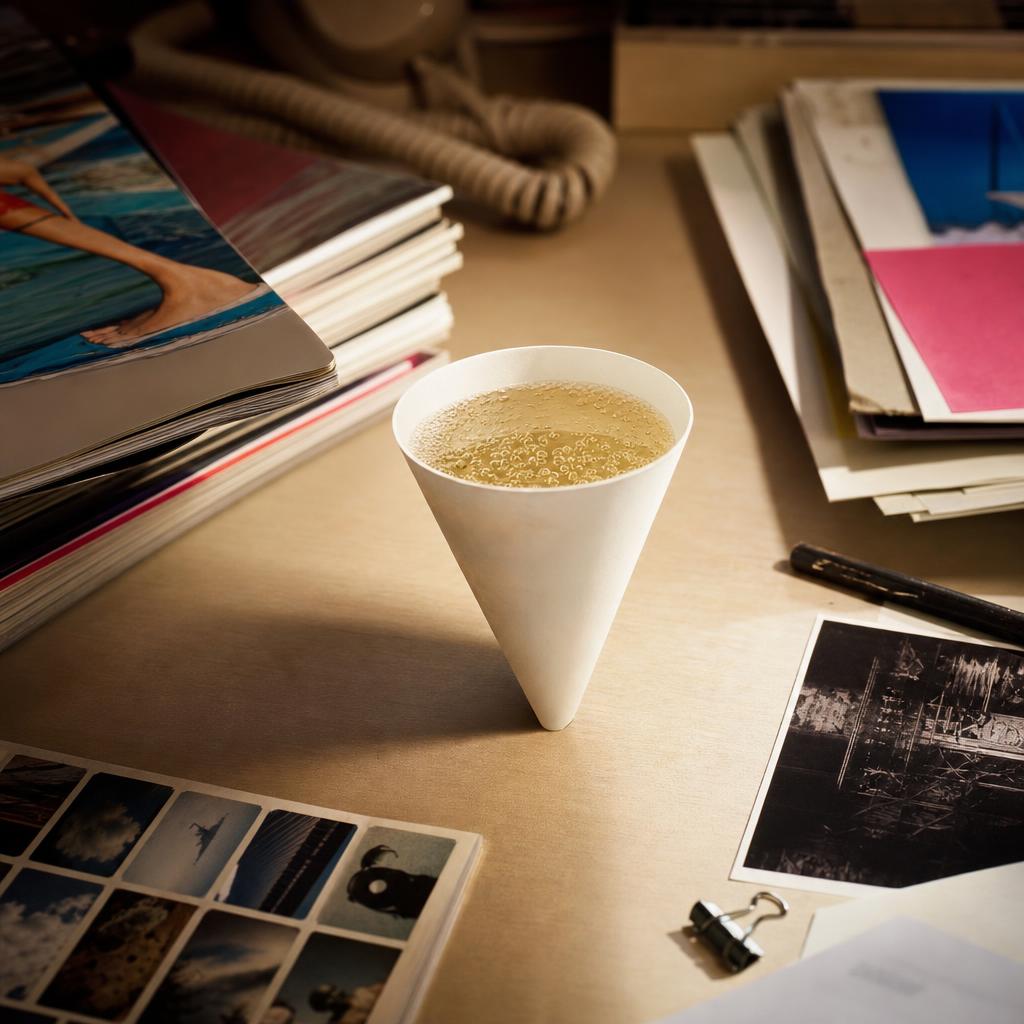
The morning of November 10, 1989 was one of the days the bottles came out before noon. The Wall had opened the evening before, and a magazine floor, whatever its beat, treated the news as a reason to send for champagne and pour it into the cone-shaped paper cups from the water-cooler dispenser or the Styrofoam ones from the office kitchen — the pre-flute, pre-HR vessel of an office celebration. Two or three bottles served the room. Nobody counted it against anyone, because it did not occur to anyone that it might be counted.
The Room the Writers Paid For
Above a certain rank the drinking happened where the magazine picked up the check. Elaine’s, at 1703 Second Avenue near East 88th Street, ran from 1963 under Elaine Kaufman as an annex to the literary economy, its back tables held for the writers — Mailer, Plimpton, Talese, Puzo, Didion among them — whose presence was the draw and whose tabs were often someone else’s.3 The Algonquin traded on a table two generations old; the Russian Tea Room seated the film and publishing trade beside Carnegie Hall. When the Royalton reopened in October 1988 behind a Philippe Starck lobby, its restaurant, 44, was taken over so completely by the editors of the Newhouse magazines that it acquired a house nickname — Club Condé, the Condé Nast café — a power-lunch room where the business of assigning and being assigned was conducted over bottles that went onto a corporate account.4
There was another kind of room, and the writers paid for it themselves. Chumley’s, at 86 Bedford Street behind an unmarked medieval door, had been serving without a sign since Leland Stanford Chumley opened it as a speakeasy in 1922, and in 1989 every surface still showed the decades between.5 The speakeasy’s original fittings were still in place — a second, unmarked entrance through a courtyard off Barrow Street, an interior door disguised as a bookcase of false spines, the trap doors and back stairs that had once cleared the room ahead of a raid. Sawdust lay scattered over the plank floor, added in the eighties and gritty underfoot, absorbing spilled beer. A fireplace worked against the November cold. The low ceiling held the smell in the room — stale beer sunk deep into old wood, fireplace ash, frying grease from the kitchen — and pressed the talk from the neighboring booths into a single warm murmur. Around both rooms ran a ring of book dust jackets in glass frames, hundreds of them by then, curling and yellow — a jacket for every patron who had published one, a tradition the bar still kept. The back bar stocked, by report, a single bottle of each thing: one whiskey, one rye, one vodka, one gin. It was not a place that offered choices, and its clientele — locals, a few NYU students, a writer nursing a beer in a booth carved with fifty years of initials — had not come for any. Henrietta Chumley had run it from the thirties into the sixties and taken her Manhattans at a table by that fire; one of the tables had been Fitzgerald’s. It was, in a later description, “a beery place that was clean enough but never well lighted.”6
The two rooms drew the same trade and divided it by who paid. Where the magazine settled the tab, the drinking was business; where the writer settled it himself, it was whatever he needed it to be.
Ask that bar for a whiskey and the pour arrived at the lowest point of American bourbon’s long collapse. The category had shed a great share of its volume since 1970 and had not yet reached the bottom, which came in the late 1990s; the young drank vodka, and bourbon had become an old man’s drink.7 The house pour was almost certainly Jim Beam, the bottle a bartender’s hand found by muscle memory. The private irony went unnoticed by everyone drinking it: because the distilleries were sitting on aging stock they could not sell, the cheap bourbon in that well bottle was very likely older and better made than its price implied.
The Slow Damage
The damage alcohol did was real and arrived on a delay that hid it. Crack collapsed a person in months, visibly, a subway ride from the office; the office watched and reported it. Its own default drug worked on a schedule of years — the liver, the marriage, the accident on a wet road, the slow dulling of a mind that still turned up and still filed. A functionally alcoholic pattern, heavy daily drinking carried alongside an ability to keep working, was common enough on the floor to pass for ordinary, and it wore the costume of a virtue. The hard-drinking writer was a figure the culture admired before it counted the cost, and the admiration mattered: it made the drinking look like the seriousness rather than the price of it. Pete Hamill, who put the glass down for good on New Year’s Eve 1972 and spent two decades sober before writing it out, titled the reckoning plainly — A Drinking Life — and located the drinking not at the edge of the newspaper world but at its center.8
The daily evidence sat below the level anyone chose to read. A large share of a mid-level staff carried a low-grade hangover into the building on an ordinary morning — a headache not quite cleared, a short temper before the second coffee, a day propped on caffeine and a cigarette in place of the sleep that had not happened. Nobody apologized for it and nobody asked, because the condition was too widely shared to mark anyone out. What separated a tolerated drinker from a problem was never the volume in the glass; it was whether the page still closed and whether the drinker had yet become an embarrassment the building had to manage. Showing up drunk at a launch party was survivable. Missing the close was not.
By the end of the decade the sanction had begun, unevenly, to withdraw. Expense-account budgets tightened as the magazine economy contracted; a human-resources apparatus that had not existed in 1989 arrived to take an interest in a masthead’s conduct; and the lunch that ran to a second bottle came to look less like the work and more like a liability the work could no longer carry. The bill for the drinking itself came due the way it always had, one body at a time, on no schedule a closing calendar could track. The glamour went first. The drinking stayed.
Alcohol was the one drug the floor never had to hide, and that was exactly why no one counted what it cost. The others announced themselves — by the law they broke, by the prescription that licensed them, by the fast, visible ruin of the people who lost to them. Drinking was legal, it was reimbursed, and it was admired, and a thing that carries all three protections is a thing a workplace stops seeing. Its damage came slowly, in the register the era was worst at reading: not the overdose but the decade, not the collapse but the erosion, a cost paid so gradually and so privately that it never quite arrived as news. The magazine that could report with care and sympathy on a drug crisis a mile uptown poured, on its own floor, from a bottle it had bought itself, and called the pouring an occasion rather than a habit. What the era read worst was never the sudden thing but the slow one, the cost that came due too gradually to reach the news, and the bottle on the expense report was only the nearest instance of a blindness the whole decade shared.
Pete Hamill’s memoir would have reached the floor in December 1994, and The Back would have carried it — a short book review, run the month a serious memoir on drinking asked only for the courtesy of notice rather than an assignment built around it. An editor at the back of the book would have judged it a known quantity by the time it reached Meridian’s desk: a newspaperman’s account of two decades sober, already excerpted and discussed elsewhere that fall, the kind of title the back pages existed to clear in a few hundred words. Nobody would have needed to argue for running it, and nobody would have needed to argue against it either — a memoir with that pedigree would have cleared the desk on its own weight. The review would have named the book and its author, set it beside the season’s other memoirs without ranking it above them, noted the decades of sobriety the title announced, and closed with the December issue.
Footnotes
-
New York State Alcoholic Beverage Control Law (1934), §§ 100–105, confining retail sale of wine and liquor to licensed package stores. ↩
-
“The Sad Decline of the Queen of New York Wine Stores,” Wine Spectator, January 6, 2023. Sherry-Lehmann traded at 679 Madison Avenue from 1948 until it sold the building in 2007. ↩
-
A. E. Hotchner, Everyone Comes to Elaine’s: Forty Years of Movie Stars, All-Stars, Literary Lions, Financial Scions, Top Cops, Politicians, and Power Brokers at the Legendary Hot Spot (HarperCollins, 2004). ↩
-
Dana Brown, Dilettante: True Tales of Excess, Triumph, and Disaster (Random House, 2022). The Royalton reopened October 10, 1988; the restaurant 44 became the Newhouse magazines’ de facto commissary in the early 1990s. ↩
-
“For Neighbors, a Wall Collapse Occasions More Than Nostalgia,” New York Times, April 17, 2007. Chumley’s, opened by Leland Stanford Chumley in 1922, closed after a chimney collapse on April 5, 2007. ↩
-
James Barron, “About New York,” The New York Times, August 29, 2008. ↩
-
Fred Minnick, Bourbon: The Rise, Fall, and Rebirth of an American Whiskey (Voyageur Press, 2016). ↩
-
Pete Hamill, A Drinking Life: A Memoir (Little, Brown, 1994). ↩