Two Rooms: Jazz Uptown and Down, 1989–2001
Subscribe
https://meridian-archive.com/feed.xmlOpen in your app, or paste the link above into any other:
The Same Twelve Years
A National Endowment for the Arts survey comparing jazz participation in 1982 against 1992 found attendance falling among listeners eighteen to twenty-four and rising only among those over thirty-four, with the sharpest increase of all logged among respondents seventy-five and older — in the same twelve years jazz acquired a funded department at Lincoln Center, a Pulitzer Prize, and a nineteen-hour public-television documentary, the full institutional apparatus of a canonized art.1 A federal cultural agency was, in effect, filing the paperwork on an audience dying of old age at the same moment three of the country’s most prestigious cultural institutions were declaring the music a national treasure. Both facts were true, they did not cancel each other, and almost no one covering either one wrote about the other.
In 1989, before that apparatus existed, a fluency in jazz sorted an editorial floor the way a fluency in French once had. It was not enough to enjoy the music; the credential required a position — on Miles Davis’s turn from the modal calm of Kind of Blue (1959) to the electrified sprawl of Bitches Brew (1970) to the final synthesizer-and-funk records of the middle 1980s, on whether Ornette Coleman’s The Shape of Jazz to Come (1959) or John Coltrane’s A Love Supreme (1964) had settled the question free jazz asked, on the difference between the hard bop of Art Blakey’s Jazz Messengers and the cooler, more restrained West Coast sound built around Chet Baker. None of it needed to be said aloud. It circulated unspoken among a specific cohort — largely male, largely college-formed in the late 1960s or 1970s, the kind of reader who owned Sonny Rollins on vinyl and had opinions about Alfred Lion’s Blue Note label against Norman Granz’s Verve. The music was Black American in origin, which gave the white liberal who loved it a second, unstated credential alongside the first: taste doubling as a kind of civic character reference.2
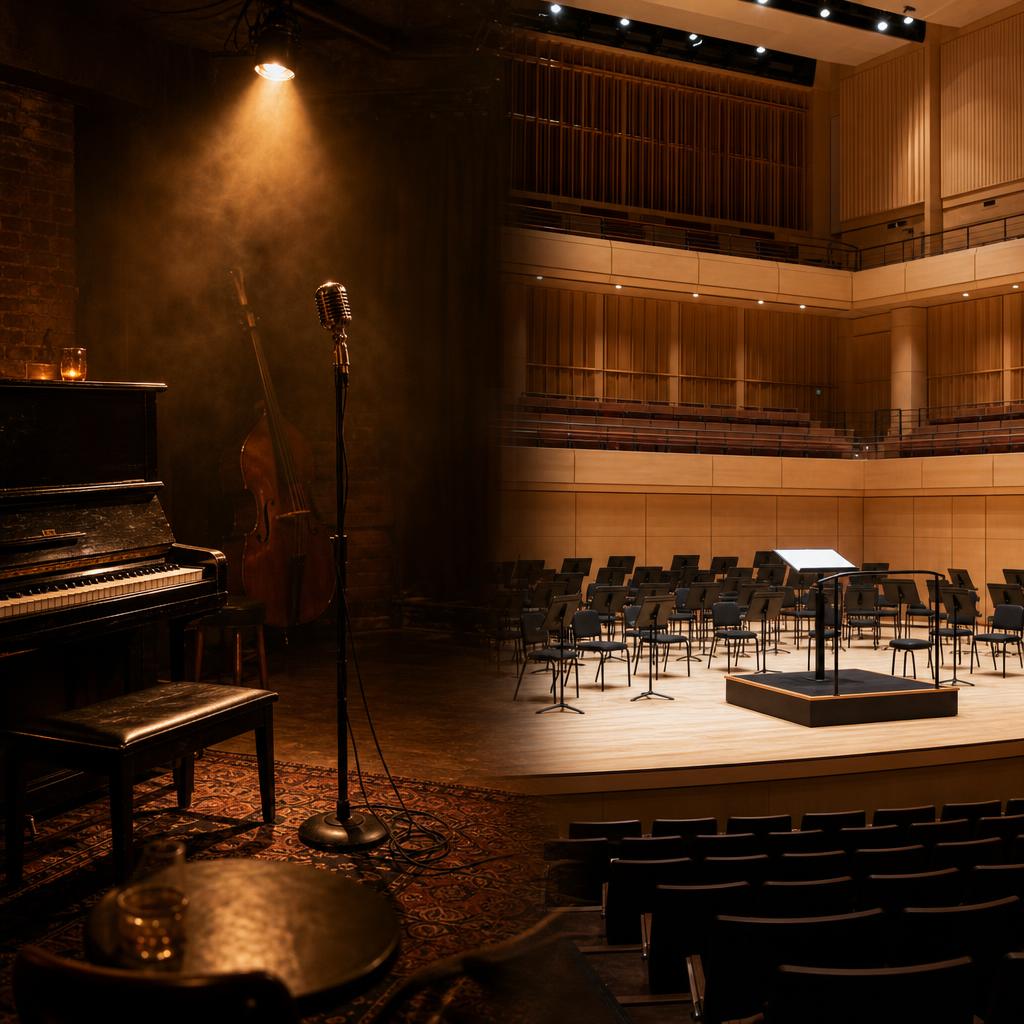
The rooms that carried this fluency in 1989 were small and precisely ranked. The Village Vanguard, in a basement at 178 Seventh Avenue South that held perhaps a hundred and twenty-five people when full, was the canonical listening room — founder Max Gordon died on May 11, 1989, and his widow Lorraine reopened the club the following day, a continuity nobody in the room that week would have called remarkable, because the Vanguard not closing was assumed the way weather was assumed.3 The Blue Note, a few blocks over on West Third Street, ran the same repertoire at higher cover charges and with waiter service, a room built for people who wanted to say they had heard Dizzy Gillespie in New York rather than people who came every week. A working sideman on the Vanguard circuit in 1989 might earn a hundred to a hundred and fifty dollars a night for two sets, with a week-long residency paying a bandleader twelve hundred to two thousand dollars divided among four or five musicians — a living, barely, for men who had spent thirty years inside a tradition that an uptown institution and a downtown scene were both, in that same year, quietly beginning to argue over how to honor.4
The Argument Uptown
The apparatus had a name and, eventually, an address. Wynton Marsalis arrived in New York from New Orleans to study at Juilliard in 1979 and by the early 1980s, recording for Columbia and winning Grammy Awards in jazz and classical categories in the same year — a feat he repeated in 1983 and 1984 — he had become the most visible jazz musician in the country. Lincoln Center’s Classical Jazz summer concert series, which Marsalis helped plan and lead beginning in 1987, hardened into a funded department in January 1991, with Marsalis as artistic director; in 1996 the board voted to elevate the department to full constituent status, alongside the New York City Ballet and the Metropolitan Opera.5 What Marsalis was building was not simply a concert calendar. It was an argument: that jazz was American classical music, entitled to the institutional scaffolding — the endowment, the hall, the board of trustees — that had never before been offered to it.
The argument had content, and the content excluded people. Marsalis’s model was Duke Ellington, the composer-bandleader as organizing intelligence; his repertoire ran from Charlie Parker and Dizzy Gillespie through Ellington and Thelonious Monk to Miles Davis’s work before 1969 and Coltrane’s through A Love Supreme. Fusion he treated as a betrayal of the music’s acoustic center, and free jazz, in his account, mostly forfeited the discipline that gave the tradition its authority. Miles Davis, who lived to see the department founded but not to see it consolidated — he died of a stroke on September 28, 1991, at St. John’s Hospital in Santa Monica, sixty-five years old6 — had dismissed Marsalis’s playing publicly on more than one occasion as constrained, a musician replaying a past Davis himself had already abandoned twice over. The argument’s institutional triumph arrived on schedule: in April 1997, Marsalis won the Pulitzer Prize for Music for Blood on the Fields, a two-and-a-half-hour oratorio on American slavery commissioned by Jazz at Lincoln Center — the first Pulitzer given to a work of jazz composition.7 The prize did not settle the argument. It certified one side of it.
The Room Downtown
Downtown and considerably fewer stories up, an argument ran the opposite direction. Michael Dorf and Louis Spitzer opened the Knitting Factory at 47 East Houston Street in 1987 as a gallery, cafe, and performance room with no fixed genre; it relocated in 1994 to a larger space at 74 Leonard Street, with a main hall and two subterranean stages given over chiefly to the avant-garde.8 John Zorn, the composer and alto saxophonist whose downtown career had run through game-piece compositions and hardcore-jazz hybrids since the early 1980s, founded the Tzadik label in 1995 as a home for work no larger label would carry — the Masada project among it, a quartet reading of Jewish liturgical and folk material through a Coltrane-quartet instrumentation and an Ornette Coleman harmonic freedom.9 Bill Frisell, Tim Berne, Marc Ribot, and Don Byron worked variations of the same territory: jazz vocabulary treated as raw material for something the uptown project would not have called jazz at all.
The critics who covered both rooms did not sort neatly by address. The Village Voice’s Gary Giddins, a swing-and-bebop partisan by formation, found the Lincoln Center project’s version of jazz history too narrow on its own bebop-era terms; his colleague Greg Tate argued the marginalizing went further, that the neo-traditionalist canon excluded the very avant-garde Black musicians — Zorn’s downtown collaborators among them, if not by race — who had carried the music forward after 1965. Lester Bowie of the Art Ensemble of Chicago, from the free-jazz side, dismissed the restorationist project as a retreat into imitation rather than a continuation of anything. DownBeat, by contrast, mostly welcomed having an articulate spokesman for jazz in front of Congress and the funding boards. The disagreement ran continuously in the music press from 1991 through the decade’s end, and the stakes were institutional and material — grants, teaching chairs, and bookings followed whichever definition of legitimate jazz prevailed in a given year.10
The Room That Closed
The clearest casualty of the decade belonged to neither argument. Bradley’s, the piano bar Bradley Cunningham had opened at 70 University Place in 1969, was not a concert room in either uptown’s or downtown’s sense — it was the place musicians went after their paid gig ended, open until four in the morning, a bar up front and a piano in back where pianists who might never fill a concert hall could hold a room rapt past midnight. It closed on October 17, 1996, its owner’s widow, Wendy, unable to sustain it, and the jazz press covered the closing as the end of something that could not be rebuilt: not a room that presented jazz, but a room where jazz’s people simply were, after the presenting was done for the night.11 Two years earlier, on May 20, 1994, a different kind of room had opened a few blocks away — Smalls, the no-liquor-license basement on West Tenth Street that Mitchell Borden ran, where ten dollars bought a seat until eight in the morning and young musicians built the kind of after-hours community Bradley’s generation had taken for granted.11 Smalls was not Bradley’s. It was scrappier, younger, further from the tradition either Lincoln Center or the Knitting Factory claimed to be defending. But it occupied, for the musicians coming up after 1994, some of the same function: proof that the informal room, the one neither institution could claim credit for, kept turning up again after 1994, with no help from either side of the formal argument between uptown and downtown.
The Audience That Didn’t Come
Neither room solved the problem underneath both arguments. Jazz’s share of total recorded-music sales fell from roughly 4.9 percent in the 1980s to 1.9 percent in the 1990s — near enough to half the market gone in a single decade — even as the Lincoln Center department, the Pulitzer, and a run of critically serious young players (Joshua Redman, Roy Hargrove, Christian McBride, Brad Mehldau) gave the music more press attention than it had received in a generation.12 What Jazz at Lincoln Center built was a narrative of importance that could be presented to funders and trustees; what it did not build was a next generation of listeners. The audience the neo-traditionalist revival reliably drew was the college-educated professional already inclined to buy a Wynton Marsalis record as a statement of seriousness — a real audience, and a static one.
The city’s dial made the shrinkage audible. WBGO, 88.3 FM, broadcasting from Newark since 1979 and the sole full-time jazz outlet in the New York market since its Manhattan rival WRVR flipped to country in 1980, held its straight-ahead format essentially unchanged across the period — hard bop, post-bop, and mainstream swing, presented by hosts who could talk knowledgeably for several minutes about a record’s personnel before playing it.13 Its ratings, through the 1990s, trailed those of CD101.9, the smooth-jazz outlet whose Kenny G and David Sanborn playlists had been stripped of the improvisational content that made the older station’s format jazz in any but the loosest commercial sense — a distinction Marsalis himself was emphatic about, and one the ratings did not honor.12 Jazz’s most productive collision of the period ran in a different direction entirely: hip-hop producers sampling the Blue Note and CTI catalogs through the early and middle 1990s, a collision that belonged to the hip-hop story more than the jazz one.
The Documentary That Closed the Argument
The decade’s canonization completed itself on television. Ken Burns’s Jazz aired on PBS beginning January 8, 2001 — ten episodes, roughly nineteen hours — and told the music’s history substantially on the neo-traditionalist premise: nine of the ten episodes covered the years before 1961, the last covered the four decades after, and Ornette Coleman’s harmolodic project received a few minutes where a fusion-era critic might have wanted an episode.14 Gary Giddins, who had participated in the filming, said afterward that the omissions troubled him even so. The documentary did not invent the Marsalis version of jazz history; it delivered that version to a national audience larger than any club or concert hall could reach, at the precise moment the music’s commercial audience had shrunk to a fraction of what it had been when the argument began.
One crossover event, in the documentary’s own year, showed how far institutional respectability had traveled without ever finding a new audience: Diana Krall’s When I Look in Your Eyes (1999) was nominated for the Grammy Award for Album of the Year, reportedly the first jazz record to receive that nomination in roughly a quarter-century.15 The nomination was proof the culture could still, on rare occasion, notice jazz as a going commercial concern. It was also, on the numbers, an exception large enough to be news precisely because it was an exception. By 2001 the men who had built the argument’s vocabulary in the 1960s — the fifty-year-old of 1989 was past sixty now — could turn on public television and watch their own formation certified as American art, in the same season a magazine’s youngest staff had never owned a jazz record they had not received as a gift.
The canonization, dated
| Date | Event |
|---|---|
| 1987 | Classical Jazz summer series begins at Lincoln Center, Marsalis leading |
| Jan. 1991 | Jazz at Lincoln Center founded as a funded department, Marsalis artistic director |
| Sept. 28, 1991 | Miles Davis dies, age 65, Santa Monica, California |
| 1994 | The Knitting Factory relocates from 47 East Houston Street to 74 Leonard Street |
| May 20, 1994 | Smalls opens on West Tenth Street |
| 1995 | John Zorn founds Tzadik Records |
| Oct. 17, 1996 | Bradley’s closes on University Place |
| 1996 | Lincoln Center board votes Jazz at Lincoln Center full constituent status |
| April 1997 | Marsalis wins the Pulitzer Prize for Music for Blood on the Fields, the first jazz composition so honored |
| Jan. 8, 2001 | Ken Burns’s Jazz begins its ten-episode run on PBS14 |
Nothing about the two rooms disproved the other. The uptown argument won every institutional contest it entered — a department, a hall, a Pulitzer, a place in the same sentence as the Ballet and the Opera — and the downtown argument kept a smaller, stranger tradition audible on Leonard Street outside Lincoln Center’s institutional frame, and both of these things happened while the audience for either kind of jazz kept getting older and thinner, a fact neither room’s victory changed. A magazine reader in 1989 who could place Kind of Blue against Bitches Brew without being told which one was correct held a kind of fluency that had once opened doors; by 2001 the fluency still worked, in the room where it had always worked, and the room had simply gotten smaller, quieter, and easier to miss on the way past.
An editor keeping The Back’s music column would have logged the founding of the department at Lincoln Center in January 1991 as an item of record, without editorializing on the two and a half years of summer-series argument that preceded it. Miles Davis’s death eight months later, that September, would have taken more space in the same pages — the obituary would have gone to whichever writer on the masthead could place the Columbia records against the final synthesizer albums without needing either explained, and it would have gone to press inside the same news week rather than waiting out a monthly’s usual lag.
Marsalis’s Pulitzer for Blood on the Fields in April 1997 would have landed in The City, pegged not to the prize itself but to the oratorio’s Lincoln Center premiere months before — the sort of item a monthly could justify running only once the occasion, not the award, gave it a date. The downtown counter-case — Zorn, Tzadik, the Knitting Factory’s move to Leonard Street, everything the neo-traditionalist project would not have called jazz — never got that far. A senior editor would have kept bringing the pitch back to more than one editorial meeting across the middle of the decade, out of something closer to affection for the music than any case for its urgency, and the pitch would have gone no further, in the gap between one editor’s private enthusiasm and a writer the desk could actually have staffed to it.
Bradley’s closing on University Place in October 1996 would have carried as an obituary for a room rather than an argument — the kind of piece that would have needed no side taken, only an account of a piano bar closing once Bradley Cunningham’s widow could no longer sustain it. Ken Burns’s Jazz would have reached the same pages five years later, in January 2001, as a ten-part documentary the magazine’s critic would have watched start to finish before deciding how much space the omissions after 1961 deserved against the nine episodes given to everything before it.
Footnotes
-
NEA Research Report 31, “Jazz in America: Who’s Listening?,” National Endowment for the Arts. ↩
-
Gene Santoro, Myself When I Am Real: The Life and Music of Charles Mingus (Oxford University Press, 2000); Ted Gioia, The History of Jazz (Oxford University Press, 1997). ↩
-
“Village Vanguard,” Wikipedia. ↩
-
Ted Panken, “The Bradley’s Hang,” DownBeat, 2006. ↩
-
“Jazz at Lincoln Center,” Wikipedia. ↩
-
“Miles Davis,” Wikipedia. ↩
-
“Wynton Marsalis,” The Pulitzer Prizes, pulitzer.org. ↩
-
“Knitting Factory,” Wikipedia. ↩
-
“Tzadik Records,” Wikipedia. ↩
-
“The Young Lions’ Roar,” Wynton Marsalis official website, wyntonmarsalis.org; “Radical Rhythms: On Ken Burns’ Jazz,” Against the Current. ↩
-
Ted Panken, “The Bradley’s Hang,” DownBeat, 2006; “Smalls Jazz Club,” Wikipedia. ↩ ↩2
-
“WBGO,” Wikipedia. ↩
-
“When I Look in Your Eyes,” Wikipedia. ↩