The Dial: A Map of Who Lived Where, 1989–2001
Subscribe
https://meridian-archive.com/feed.xmlOpen in your app, or paste the link above into any other:
The Instrument
New York radio in these years ran on an instrument no advertiser, program director, or general manager was ever recorded describing as improbable: the Arbitron diary, a paper booklet mailed each ratings period to a sample of the metropolitan area’s households, in which whoever in the house happened to fill it out logged, from memory and by hand, which station had been on in which room at which quarter-hour of the preceding week. A station’s ad rates, a DJ’s contract, a program director’s job, and a format’s survival all turned on the tally those booklets produced. The industry itself knew the instrument undercounted younger and non-white listeners, who filled the diaries less faithfully than older, whiter households did, and every general manager in the market understood the bias — yet the ratings book reported the diary’s numbers as fact each quarter, the trade press printed them without qualification, and no station declined to be measured by them. The diary was not treated as strange. It was simply how the size of an audience got established, the way a census established a population, and the entire economics of the dial — who got hired, who got flipped, whose format lived — were built on top of it.
In October 1993, a radio station at 97.1 FM changed what it played, and nothing about its ownership, its transmitter, its call letters, or its address changed with it. Emmis Broadcasting had held the frequency since 1987, renamed it WQHT the following year, and run it for five seasons as a pop-and-dance outlet that, by the end of 1992, had fallen to dead last among the city’s three top-40 stations.1 General manager Judy Ellis, who had told a young mix-show DJ named Funkmaster Flex the station would “never be able to sell hip-hop,” reversed course under program director Steve Smith’s urging over the first half of 1993; by autumn the station had committed fully, adopted the slogan “Where Hip Hop Lives,” and put Ed Lover and Doctor Dré — refugees from Yo! MTV Raps — on the morning show.1 Within about a year, the station calling itself Hot 97 and its Los Angeles sister station were the top-rated outlets in the two largest radio markets in the country, a pairing no company had achieved before.1 The change had cost Emmis nothing in infrastructure. It had cost the city’s older Black radio institution an audience it had never had to defend before.
Hip-hop had been on the city’s airwaves for most of the 1980s before that October, but only ever as a specialty confined to hours when it did not have to compete for the audience a station’s owners had spent a decade building. WBLS itself had carried Mr. Magic’s Rap Attack, produced with Marley Marl, on Saturday nights from 1983 — and had let the show lapse by the time the decade turned, ceding the genre entirely rather than daypart it into the daylight hours where its urban-contemporary format lived.2 What remained ran late and ran thin: Awesome Two’s overnight show on WHBI, Red Alert’s and Chuck Chillout’s mix-show slots on Kiss FM, and, from October 1990, a four-hour block from one to five in the morning on WKCR, the Columbia University station, where two DJs named Stretch Armstrong and Bobbito Garcia broadcast to listeners awake at that hour by choice rather than by habit.1 The genre had an audience large enough to fill an arena and a radio home that opened only after the rest of the city’s Black stations had gone to bed. Hot 97’s flip did not invent that audience. It simply moved the genre out of the small hours and into the daypart everyone else had always assumed belonged to somebody older.
That institution was WBLS, 107.5 FM, owned by Percy Sutton’s Inner City Broadcasting and shaped, a decade and a half earlier, by Frankie Crocker’s invention of what the trade called urban contemporary — a format built around adult-skewing R&B, a house style of unhurried on-air cool, and a listener the format assumed was already grown.2 WBLS did not answer the Hot 97 flip in kind, and it did not need to for several more years: its listeners were older, further along in their careers, and loyal to a station that had never asked them to be young. Then, in December 1994, Emmis bought WRKS — 98.7, Kiss FM, the station that under DJs Red Alert and Chuck Chillout had actually played rap first, years before Hot 97 wanted any part of it — from Summit Communications Group, forming the market’s first FM duopoly under relaxed federal ownership rules.1 Emmis did not run its new acquisition against its own hip-hop station. It flipped Kiss to old-school and classic soul, aimed the format at listeners over thirty-five, and let it absorb precisely the audience Hot 97 was aging out of underneath it.1 One company now owned both ends of a split it had built on purpose. WBLS, competing against a demographic pincer it had not designed and could not out-market, held its ground with the listeners it already had and lost the argument for the new ones. The dial had redrawn the city’s radio map in fourteen months, and almost no one who read a magazine for a living had noticed it happening.
The Dial as Census
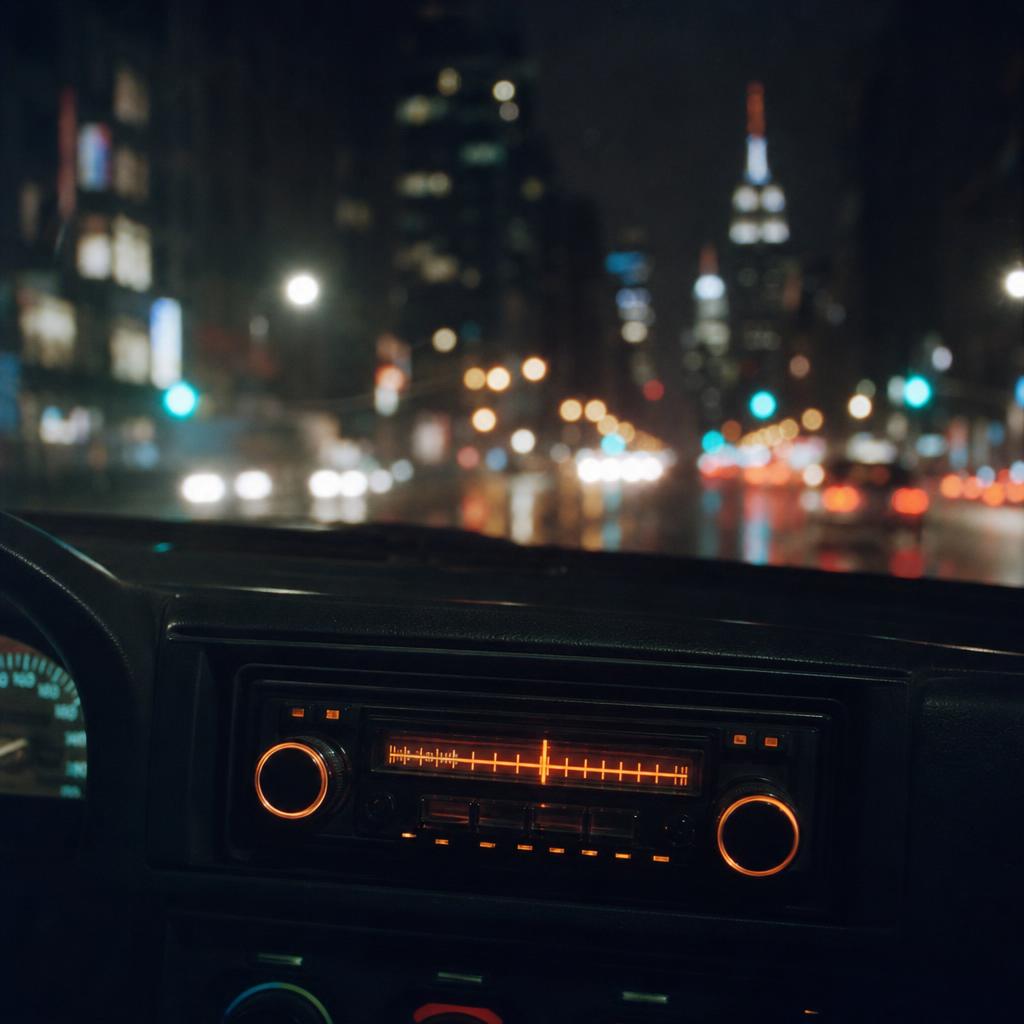
A New York car radio in these years was a demographic instrument as precise, in its way, as a census tract. Each frequency tracked a population — an income band, a generation, a language, sometimes a specific set of neighborhoods — and moving the dial half an inch moved a listener from one of those populations to another. The instrument worked because format radio in this period was built to be legible at a glance: a station picked an audience and then built everything — the music, the ad reads, the on-air voice — to hold that audience and no other. A stranger getting into a livery cab already knew, before the driver said a word, something about the driver’s world from whatever frequency the dashboard was tuned to.
The Dial, by Position
Formats and rough demographic footprints as the trade press and the stations themselves described them; the class readings especially carry no harder precision than the trade allowed.
| Frequency | Station | Format | Audience |
|---|---|---|---|
| 96.3 FM | WQXR | Classical | Upper East and Upper West Side old money and professional class, per the trade’s own class reading — a texture, not a measured share |
| 88.3 FM | WBGO | Straight-ahead jazz | Older, cross-borough, integrated listenership; broadcast from Newark |
| 107.5 FM | WBLS | Urban adult contemporary, quiet storm | Black professional class — St. Albans, Cambria Heights, Riverdale, the Brooklyn brownstone belt2 |
| 98.7 FM | WRKS (“Kiss”) | Hip-hop through 1994; old-school R&B and classic soul after1 | Black adults 35 and over after the 1994 flip1 |
| 97.1 FM | WQHT (“Hot 97”) | Hip-hop from October 19931 | Young Black and Latino outer-borough listeners, plus a white college-age fringe in the East Village and Williamsburg |
| 97.9 FM | WSKQ (“La Mega”) | Spanish-language tropical — salsa, merengue, bachata | The city’s Spanish-dominant Caribbean population — Washington Heights, the South Bronx, Bushwick |
| 100.3 FM | Z100 | Top 40 | Suburban and outer-borough white teenagers |
| 104.3 FM | Q104.3 | Classic rock | White men over 35, inheriting WNEW’s audience as that station’s format receded |
| 660 AM | WFAN | All-sports | Working-class Italian and Irish listeners in Queens, Long Island, and the Bronx |
| 1010 AM | WINS | All-news | Commuters across the metropolitan area, tuned in for the drive |
| 1190 AM | WLIB | Caribbean and West Indian talk | The West Indian community, largely in Brooklyn |
Two Kinds of Black Radio
The Hot 97/WBLS/Kiss triangle was not, on inspection, one story but two — a generational one and a class one, running on top of each other and easy to mistake for a single argument. The generational story was the one the trade press told: a younger audience wanted hip-hop, an older one wanted the R&B and gospel-adjacent soul that WBLS had built its Sunday mornings and Vaughn Harper’s late-night Quiet Storm around, and the two audiences simply wanted different records.2 The class story sat underneath it and was harder to see from a glass tower in Midtown: WBLS’s core listenership was not merely older, it was more settled — homeowners and civil servants and professionals in neighborhoods that had held their footing through the worst years of the city’s decline — while Hot 97’s core listenership skewed toward exactly the outer-borough blocks the settled listeners had been trying, for two generations, to leave. A magazine writer explaining the split as taste alone was not wrong; a writer who stopped there had explained perhaps half of it.
Wendy Williams’s own career followed the same split the dial did. She held Hot 97’s afternoon-drive slot from 1994 until her firing in 1998, moved to a station in Philadelphia, and returned to New York radio in 2001 — not at Hot 97, where she had made her name, but at WBLS, the station her original format had been built to compete against.3 The move was not read, at the time, as ironic; it was simply the shape of a Black radio career in New York, one that could run its whole arc without ever leaving a fifteen-mile radius, crossing back and forth over a line that had been drawn, in large part, by one company’s balance sheet.
The on-air voices themselves tell the same generational story from the inside. Funkmaster Flex, the mix-show DJ Judy Ellis had doubted could ever be sold to a mainstream audience, became Hot 97’s evening-drive fixture and the station’s most recognizable sound, his trademark siren-and-explosion drop turning a personal signature into a station identifier. Angie Martinez took afternoon drive and became, in the trade’s own phrase, “the Voice of New York” for a listener who had never known the station any other way. Across the dial at WBLS, Vaughn Harper’s Quiet Storm ran late into the night as it had for over a decade, playing Anita Baker and Luther Vandross to an audience that did not need a bomb drop to know which station it was on. Neither voice was reaching for the other’s listener, and neither needed to; the split had already been drawn by the frequency each of them worked.
The Far End of the Dial
The rest of the dial mapped the city the same way, at lower resolution and with less trade-press attention paid to any of it. WQXR, the Times-owned classical outlet at 96.3, and WFAN at 660 AM sat at opposite poles of white New York — one station’s audience buying subscription tickets to Lincoln Center, the other’s arguing about the Mets on a car radio in a Bay Ridge driveway — and the distance between those two audiences, more than income alone, was a distance in dialect, in schooling, in which neighborhoods still felt like home to which families; the reading is a trade texture, not a measured share, and is offered here hedged rather than pinned. WSKQ, “La Mega” at 97.9, ran Spanish-language salsa, merengue, and bachata to the city’s Spanish-dominant Caribbean population in Washington Heights, the South Bronx, and Bushwick, and was for long stretches the highest-rated station in the market that the English-language press never mentioned. WLIB at 1190 AM ran Caribbean and West Indian talk programming to an audience concentrated in Brooklyn that the mainstream press covered, if at all, only once a year, at the West Indian Day Parade. WBGO, broadcasting jazz from a transmitter in Newark, reached an audience older and more integrated than almost anything else on the dial, even as few of its listeners crossed in daily life the racial lines the rest of the dial mostly held. Q104.3 inherited its classic-rock format and much of its audience from WNEW as that older station’s signal receded through the decade, a changeover that older WNEW listeners felt as a loss and no one younger noticed. Z100 and its sister station PLJ tracked the suburban and outer-borough white teenager who consumed the decade’s Black-originated culture from a car radio rather than a subway platform — the same songs Hot 97 played, a signal-strength away, filtered through a station built for an entirely different audience. WNYC, the public station, was the frequency of the academics and the newly arrived professionals moving into blocks that had been, ten years earlier, majority Black or Latino.
None of this touched the records themselves — the golden-age albums moving out of Fulton Street bins and midtown mastering rooms, the deaths of 1996 and 1997 that turned two funerals into citywide events — which is hip-hop as sound rather than hip-hop as frequency and belongs to a separate accounting. Nor did it touch the mornings built entirely around a single host’s voice and a national audience’s outrage, Stern’s and Imus’s and the AM shouting matches that followed them, which is talk radio and a third accounting again. What the dial itself offered was narrower and, in its way, more useful: a legible, constantly updating map of who lived where, filed not in any census report but in the presets of every car radio in the city.
No one built the dial to be a map of the city, and no one needed to. Format radio worked by finding an audience and holding it, and an audience, in New York in these years, was very often a neighborhood, an income, a generation, or a color before it was anything else — which meant that a chain of business decisions made in conference rooms about ratings share and ad rates produced, as an unintended byproduct, the most legible social atlas the city had. A station’s owner did not set out to draw a boundary between Riverdale and the South Bronx, or between a Bay Ridge driveway and a Lincoln Center subscription; the split between them widened anyway, a little further each time a general manager chased a rating book. The dial told a story the city was otherwise reluctant to tell about itself, in a language — twelve numbers on a car radio, turned by a thumb without looking — that required no one to say the story out loud.
The dial’s own logic — that a car radio would have amounted, by decade’s end, to a legible map of the city’s segregation — would never have crossed a features desk at all. No beat would have covered it, and no one on staff would have had the listening habit to notice it needed covering; the observation would have stayed off the radar entirely, un-pitched rather than declined.
A flip at 97.1 that turned a struggling top-40 outlet into a hip-hop station and, within a year, the market’s top-rated frequency would have been exactly the kind of maneuver The City existed to explain — the loosened federal ownership rules, a program director’s bet paying off, a general manager’s turnaround vindicated — and an editor would have slotted it for the January 1994 issue. The next year’s purchase of Kiss FM, assembling the market’s first FM duopoly, an articles editor would have claimed for The City a year later, building the piece on the arithmetic of one company owning both ends of a format split rather than on either station’s sound.
Wendy Williams’s own arc across the dial — Hot 97’s afternoon slot, a 1998 firing, a return in 2001 to the station her format had been built to beat — would have gone furthest of any of it: a profile would have been assigned and filed, set in type, and pulled by a senior editor at the marked pages, unconvinced the house voice could have carried a radio-personality profile without condescension.