The Foreign Correspondent's Body: Re-Entry
Subscribe
https://meridian-archive.com/feed.xmlOpen in your app, or paste the link above into any other:
The War-Zone Rider
On the production ledger for a three-week Sarajevo assignment in 1993, the insurance premium allocation sat between the fixer’s day rate and the satellite-phone connect time, one line among the hotel bill and the per diem: $1,500 to $3,000, filed under the war-zone rider. Lloyd’s syndicates underwrote a correspondent’s death or capture in a combat zone the way any other underwriter priced a car or a warehouse, with named products — the war-zone rider, the kidnap-and-ransom policy — and annual premiums running $50,000 to $200,000 for outlets that carried full coverage; a magazine at Meridian’s tier more often carried the risk ad hoc, assignment by assignment, underinsured, but even that was a line an accountant who had never left Midtown filled in beside the cost of film stock and cab fare.1 The correspondent’s body, on paper, was a fully priced asset with a premium schedule, and no one who signed the invoice thought the entry strange.
What the premium schedule did not describe was what came back. A man home three days from three weeks in that besieged city undressed in a New York bathroom and found two colors of skin on one body, with a line between them. The face, the neck in a V where the collar had stood open, the forearms below a rolled sleeve, the backs of the hands — all of it darkened and roughened to a dry, leathery finish. Everything the clothing had covered stayed the pale it had been at the airport three weeks earlier. The border ran along the collar line and the cuff line and nowhere else, because the field wardrobe never changed and the sun found the same edges of him every day he was there.
The returning body was a record, and it was more exact than the dispatch the same man had filed. The dispatch had been shaped in transit — argued down a metered satellite line, cut to a page count, ranked against the month’s other news. The body had been shaped only by where it had been. On olive skin the sun did not redden; it darkened and coarsened, and where the man had gone short of water it took on a grey ashiness that no amount of washing lifted. The lips were cracked down the center, often with a healing split, and the corners of the mouth showed the small angular cracks that come with dehydration and a diet run down to cigarettes and coffee.2 Pinched at the back of the hand, the skin was slow to fall back. The hands themselves were the most-used part of him and showed it — dry, nicked, the knuckles chapped, a burn or a scrape somewhere on them healing at its own pace. The beard had come in untended, irregular and patchy, days past a clean shave and nowhere near a grown one. None of this was injury. It was residue, left by the place and not by any wound.
The Clothes That No Longer Fit
The face went gaunt before the body looked thin. The cheeks hollowed, the jaw came forward, and a collar that had closed easily three weeks earlier now stood off the neck with a finger’s slack. A belt had been taken in a notch, gathering the trouser waist into folds under it. Three weeks on the diet of a working correspondent — few hot meals, broken sleep, and the steady cortisol of a place where the body stays ready to move — stripped several pounds off a fit man in his thirties, sometimes more than several, and it came off the face and the waist first, so that the change read in how the clothes hung before it read anywhere else.
The clothes told the rest. In 1989 there was no synthetic quick-dry field cloth; a correspondent’s shirts and trousers were cotton, and cotton washed by hand in a basin or a stream loses its crispness for good. It hung slack, rumpled in a way that no longer pressed out, and it carried the marks of where it had been: salt lines from dried sweat, a general grey cast of embedded dust that survived laundering, colors that had faded unevenly so the shoulders and chest of a jacket were lighter than the seams. The elbows wore through first, from leaning and lying prone; the pocket edges frayed from hands going in and out of them. The wardrobe itself was cloth and nothing else. Through the start of the decade the press wore no armor — the flak jacket and helmet became standard for correspondents only across the siege of Sarajevo, in the middle 1990s, and even then a magazine at the lower end of the access ladder often outfitted its people ad hoc or not at all.3 A man came back from a war in a safari jacket and a pair of desert boots, and the jacket was the only protection he had worn.
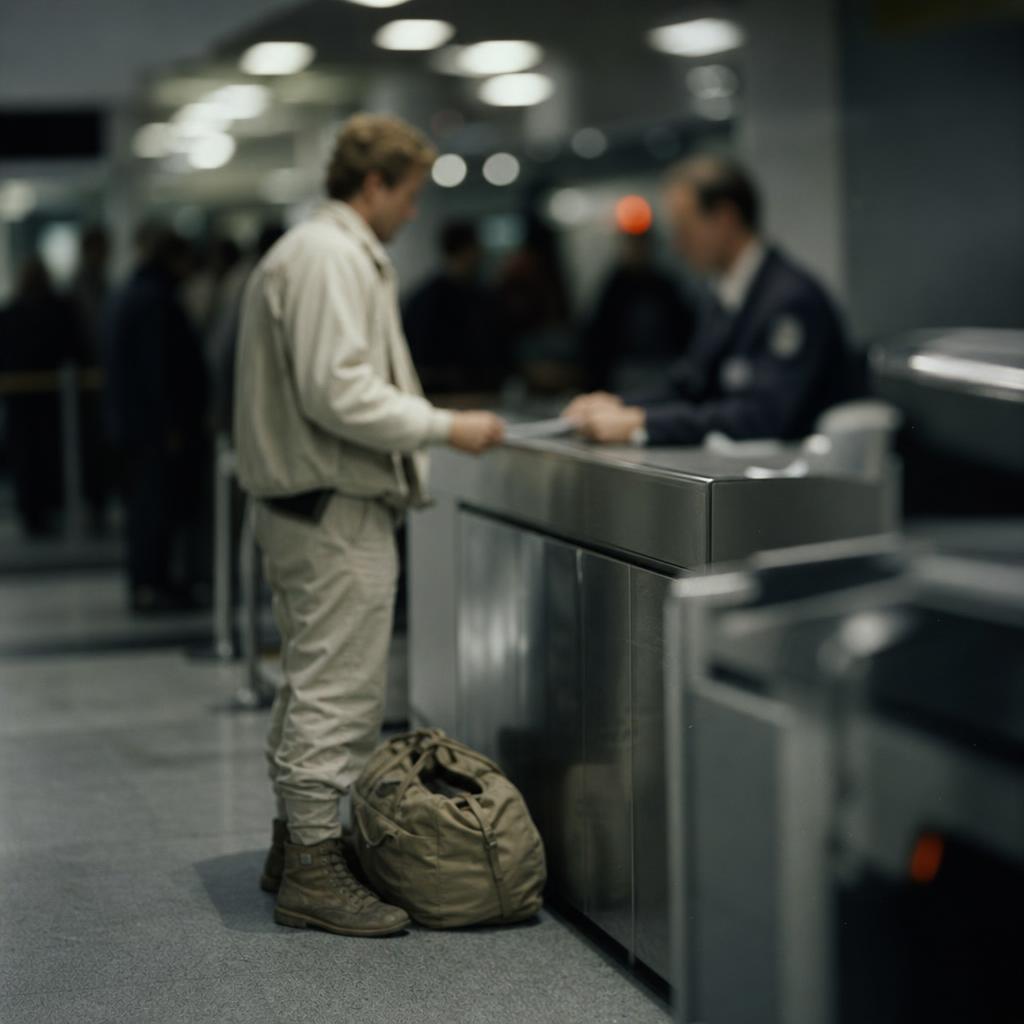
He also came back dressed for the wrong climate. The body that walked the thirty-six to forty-eight hours out of a warm-weather assignment — out over a mountain road, through one European airport and then another, into a customs line at Kennedy — arrived in November New York still wearing what it had needed a hemisphere away, layered inadequately for the cold, conspicuous in a terminal full of winter coats. The luggage carried the same evidence: a canvas shoulder bag gone soft and grey with use, a strap mended in duct tape, a reporter’s notebooks dog-eared and swollen from damp, the whole load carried on one side so the body leaned to it out of habit. One good object usually rode somewhere against the general wear: a decent pen, a school detail, or the watch — a cheap, tough digital thing bought to survive field conditions rather than to say anything about money, worn scratched and a little loose, the one piece of equipment that never failed.
The Nervous System
The clearest marks were around the eyes, and they were the marks of sleep taken in pieces. A correspondent back from a war slept in short cycles and woke at low sounds — a refrigerator compressor, a building settling — still alert at a level no one had told it to lower. The face carried the standard record of that: hanging eyelids most of all, then hollows and swelling beneath the eyes, reddened whites, fine lines the skin had not held a month before, and a downward set at the corners of the mouth.4 The eyes themselves had a glaze that was not sleepiness but its opposite — the wired, un-quiet alertness that Michael Herr, writing of an earlier war, described as a nervous system that would not go quiet, that kept running inside the skin as though something were still after it.5 It was exhaustion and vigilance at once, and it did not switch off at customs.
The body kept the habits of the place it had left. A dropped pan or a car’s backfire moved the hand before the face had time to compose, and then the face composed. In a room the man took the seat with his back to the wall and his eyes to the door, and did it without deciding to. He walked flat-footed and deliberate, the gait of someone used to watching where a foot came down among rubble, and in a clean Midtown office that careful walk was the thing that looked most wrong. The eyes moved even when the rest of him was still, taking a room’s exits and its other occupants in a low continuous sweep, an economy of attention that spent little and registered everything and did not switch off because the room was safe. His hand shook, faintly, lighting a cigarette or lifting a glass — the fine tremor of a nervous system that weeks of unbroken alertness had left unable to settle. A correspondent back from a war fought with heavy munitions carried a ring in the ears that never fully quit, and it made a loud restaurant or a crowded party its own kind of ordeal, more sound at once than the hearing could sort into parts.
Against all of it the body developed its own small management, and the most reliable instrument was the drink — not a slide into anything, but a measured, predictable dose timed to the onset of sleep, two and not a third, taken the same way each night. What broke the composure was scale. The first days back, an ordinary supermarket aisle read as an obscenity — choice stacked and lit past any conceivable need, for a body that had spent three weeks where a liter of clean water was a negotiation — and a man could set down a basket and leave without buying anything, unable to say to the person beside him what the trouble had been.
For this there was no name available. The clinical category existed — it had entered the psychiatric manual in 1980 and carried into the revision of 1994 — but correspondents were not yet counted among the people it was understood to describe, and so the return was managed in the folk vocabulary of the trade: jumpy, not sleeping, needed a drink.6 The re-entry ran to a rough clock. The first days were disorientation, ordinary problems failing to register as problems. Then, somewhere around the fourth or fifth day, the body came back into the room it was actually in. And then, not long after, it grew restless, and began to want the next assignment, which was its own kind of symptom, and went unremarked as such.7
The surface healed on its own schedule, and the schedule was slower than the paperwork. The tan faded over weeks; the weight came back more slowly than it had gone. For a month after the assignment had been filed and closed and forgotten by everyone who had edited it, the body was still visibly wearing it — gaunt at the cheek, dark along the collar line, quick at a sudden sound.
The body that came home was the truest thing the assignment produced. It had crossed the same distance as the dispatch, but where the written piece could be argued down a phone line and trimmed to fit a page, the body kept an unedited account: the weight it had lost, the border the sun had drawn at the collar, the sleep it could no longer take in one piece, the hand that answered a loud sound before the mind did. All of it was legible on the surface, to anyone who knew to read a surface. Almost no one did. The people who met the returning correspondent read the gauntness as intensity and the flat careful walk as reserve and the flinch as nerves, and set the whole of it down to temperament, because temperament was a thing a colleague could have and a casualty was not. The city took the body back the way it took back anyone home from a trip, set a drink in front of it, and asked how it had been. Of everything the assignment produced, the body was the one full account of it — and it is the account still legible, waiting to be read as what it was.
Meridian would have sent a correspondent into the decade’s wars and given his dispatches a standing place in the Foreign File, and the body that had gathered them would have come back up in the elevator and sat down at a desk on the editorial floor, gaunt and badly dressed for the weather, a few days after customs.
The piece it would never have run was the one about that body — not this correspondent’s alone but the returning bodies of the whole press corps, what the work wrote into those who carried it out. The obstacle would not have been the absence of someone able to report it. It would have surfaced once in an editorial meeting and been let go again because a serious floor would have flinched from it: to make a reported feature of the correspondent’s private wear would have been to turn the hazard into a laurel, and the prestige of the byline would have depended precisely on not pricing what the byline cost. The subject would have been judged, without the word being used, unseemly.
The floor would have met that body on every return, and read it wrong on every one. A senior editor would have taken the correspondent to lunch on the account and watched him take the chair against the wall, and thought him particular about seating. She would have seen him eat as though making up a deficit and thought him hungry. She would have caught the flat, deliberate walk across the pale carpet and the hand that jumped when a tray went down two tables over, and read the whole of it as the manner of a difficult, interesting man lately back from somewhere hard. It would not have occurred to her that the weight was a number that could have been weighed. That the tan stopped in a hard line under the shirt, where she would never have seen it. That the flinch was not a nerve but a habit the body had needed to survive and had not yet been able to give up. She would have signed the check and walked him to the elevator and told him it was good to have him back, and she would have meant it, and she would have been the last person on the floor equipped to say what had come back.
Footnotes
-
Insurance figures composited from Committee to Protect Journalists historical records and Lloyd’s of London war-correspondent-policy reporting: major outlets (Reuters, NYT, Time) carried $1M+ coverage via Lloyd’s syndicates at $50,000–$200,000/year premiums with full medevac and capture/ransom provisions; mid-tier glossies were often underinsured, coverage arranged ad hoc per assignment; the per-assignment war-zone-rider allocation on a 1993 Sarajevo P&L ran $1,500–$3,000. Kidnap-and-ransom (K&R) coverage was rare before 2000. ↩
-
Anthony Loyd, My War Gone By, I Miss It So (Atlantic Monthly Press, 1999). Loyd’s Bosnia memoir documents the correspondent’s diet of cigarettes, coffee, and local spirits across days without hot food or regular sleep. ↩
-
“How the siege of Sarajevo changed war reporting,” Al Jazeera, 2021. The siege is dated in the source as the period when armored cars, flak jackets, and helmets became standard equipment for the foreign press. ↩
-
Tina Sundelin et al., “Cues of Fatigue: Effects of Sleep Deprivation on Facial Appearance,” Sleep 36:9 (2013). The study identified hanging eyelids, red and swollen eyes, dark under-eye circles, paler skin, more fine lines, and drooping mouth corners as the visible markers of sleep loss, with glazed eyes most strongly associated with perceived fatigue. ↩
-
Michael Herr, Dispatches (Alfred A. Knopf, 1977). ↩
-
American Psychiatric Association, Diagnostic and Statistical Manual of Mental Disorders, third edition (1980) and fourth edition (1994); Anthony Feinstein, John Owen, and Nancy Blair, “A Hazardous Profession: War, Journalists, and Psychopathology,” American Journal of Psychiatry 159:9 (2002), the first sustained clinical study of the population. ↩
-
Janine di Giovanni, “Life During Wartime,” Harper’s Magazine, April 2013, on the disorientation of return and the pull back toward the next assignment. ↩