Foreign Correspondence: The Working Life, 1989–2001
Subscribe
https://meridian-archive.com/feed.xmlOpen in your app, or paste the link above into any other:
The Day Rate
Every foreign press corps that covered a war in these years hired local translators, drivers, and negotiators — fixers — under a single standard that held from Sarajevo to Kigali without any contract or professional body ever writing it down: a cash day rate running many times the collapsed local wage, and categorical exclusion from every protection the correspondent who employed the fixer carried for himself. Insurance, health coverage, a pension, a death benefit, support for a family left behind — a masthead furnished all of it to its own writers and none of it to the person who translated the interview, negotiated the checkpoint, and read a soldier’s mood in the half-second available to read it. In besieged Sarajevo an English-fluent fixer commanded $100 to $200 a day in hard currency against a local wage that had collapsed to a few dollars a month, a hundredfold multiple applied without exception by wire services, dailies, broadcasters, and monthlies alike.1 No hiring letter described the arrangement, because there was no hiring letter. It was simply the rate, quoted the same way in every capital where a war was being covered.
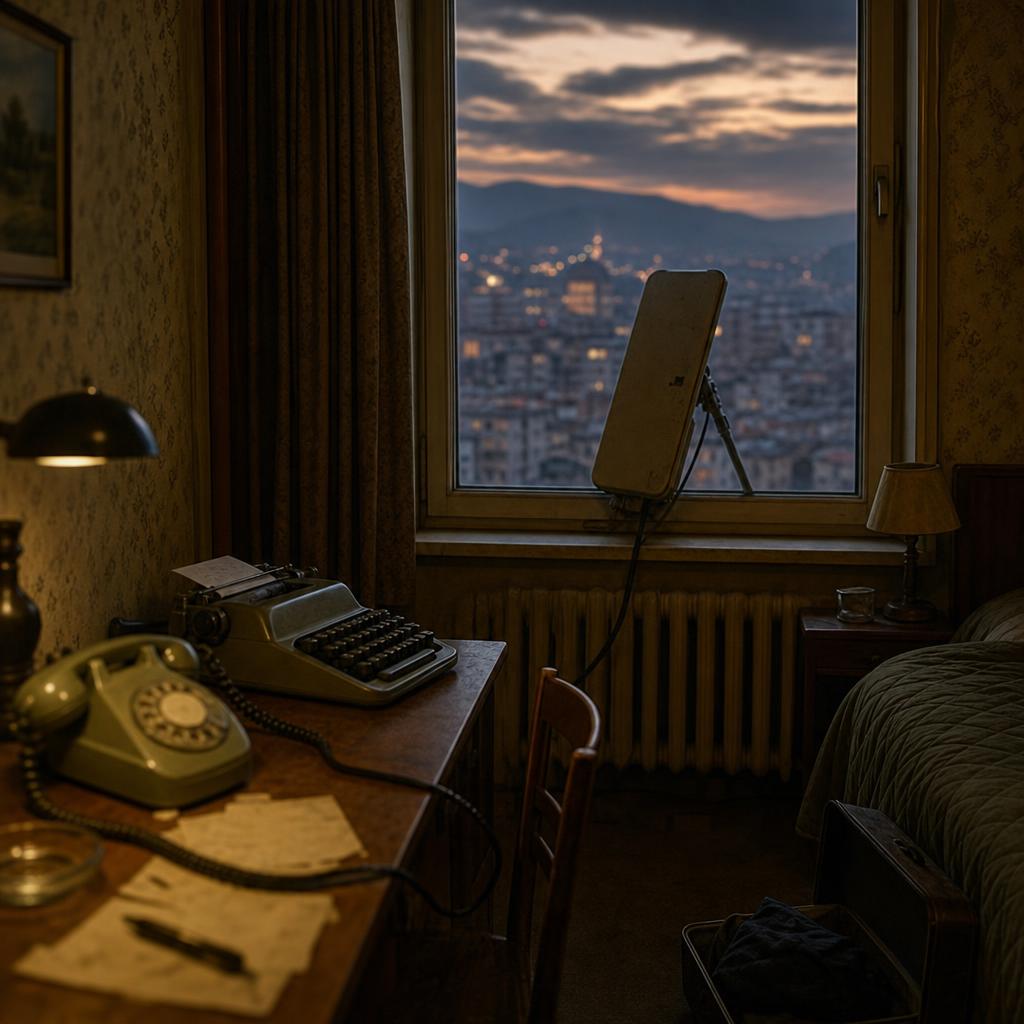
The correspondent’s own working conditions were shaped by an equivalent asymmetry, priced rather than named. On the roof of the Holiday Inn in Sarajevo, correspondents unfolded a flat antenna panel roughly a meter across, set a compass on the parapet, and aimed the panel by hand at a point in the sky above the Atlantic Ocean before they could place a call to New York. The satellite terminal was an Inmarsat-A, a device the size and weight of a full trunk that required line of sight to a fixed satellite, a manual bearing taken against an elevation table, and five to fifteen minutes to acquire a signal lock. Once the lock held, the correspondent connected a laptop by cable and transmitted text at 2,400 baud, roughly a page a minute under ideal conditions and slower with retries. Voice ran on the same circuit. The circuit cost several dollars a minute, hard currency, metered from the instant the call connected.
The meter was the governing fact of the correspondent’s working life, as the day rate was the governing fact of the fixer’s. A dispatch did not simply arrive in New York; it arrived on a line that was billing the magazine by the minute while an editor in a heated office read it back. The asymmetry inside that call was total. The editor had read the piece twice and had unlimited time; the correspondent had been awake for a day and a half, was working from a battery at half charge, and was paying to listen. An editor who pushed a structural rewrite in that call was arguing against a clock the correspondent could hear ticking, and the compromises that resulted were economic before they were editorial. The paragraph a correspondent might have defended for an hour across a desk in Manhattan, he conceded in ninety seconds on the roof, because every minute of argument was a minute billed. When the line dropped mid-sentence, as it did, the editor was left holding a dead handset with no way to know whether the correspondent had agreed or the satellite had failed, and the editor decided, reasonably and often wrongly, that he had agreed.
The hardware set the terms, and the hardware changed across the decade. The Inmarsat-A that defined filing at the start of the 1990s was an analog briefcase weighing as much as a person could carry; its successors shed weight steadily, until the Inmarsat Mini-M of 1996 fit in a laptop bag and the Iridium handheld of 1998 was a brick that fit in a coat pocket. The field computer followed the same curve, from the monochrome Toshiba laptops of the Gulf War to the IBM ThinkPad that became the war correspondent’s standard machine by the middle of the decade. What did not change was the structure the machine imposed. Before the satellite terminal, distance had meant a cable office or a shared wire-bureau slot booked hours ahead; the terminal put the newsroom on the roof, and the price of that intimacy was that the newsroom could now reach the roof at will and the meter never stopped for either of them.
Between filings there was silence, and the newsroom’s instrument for reading it was the television. An editor who had not heard from a correspondent in days watched the cable feed and looked past the reporter on the screen to the building behind him, checking the skyline against the one from the last dispatch; the fax that came through in the small hours carrying the single word ok was, for long stretches, the entire content of the relationship.
The Managed War
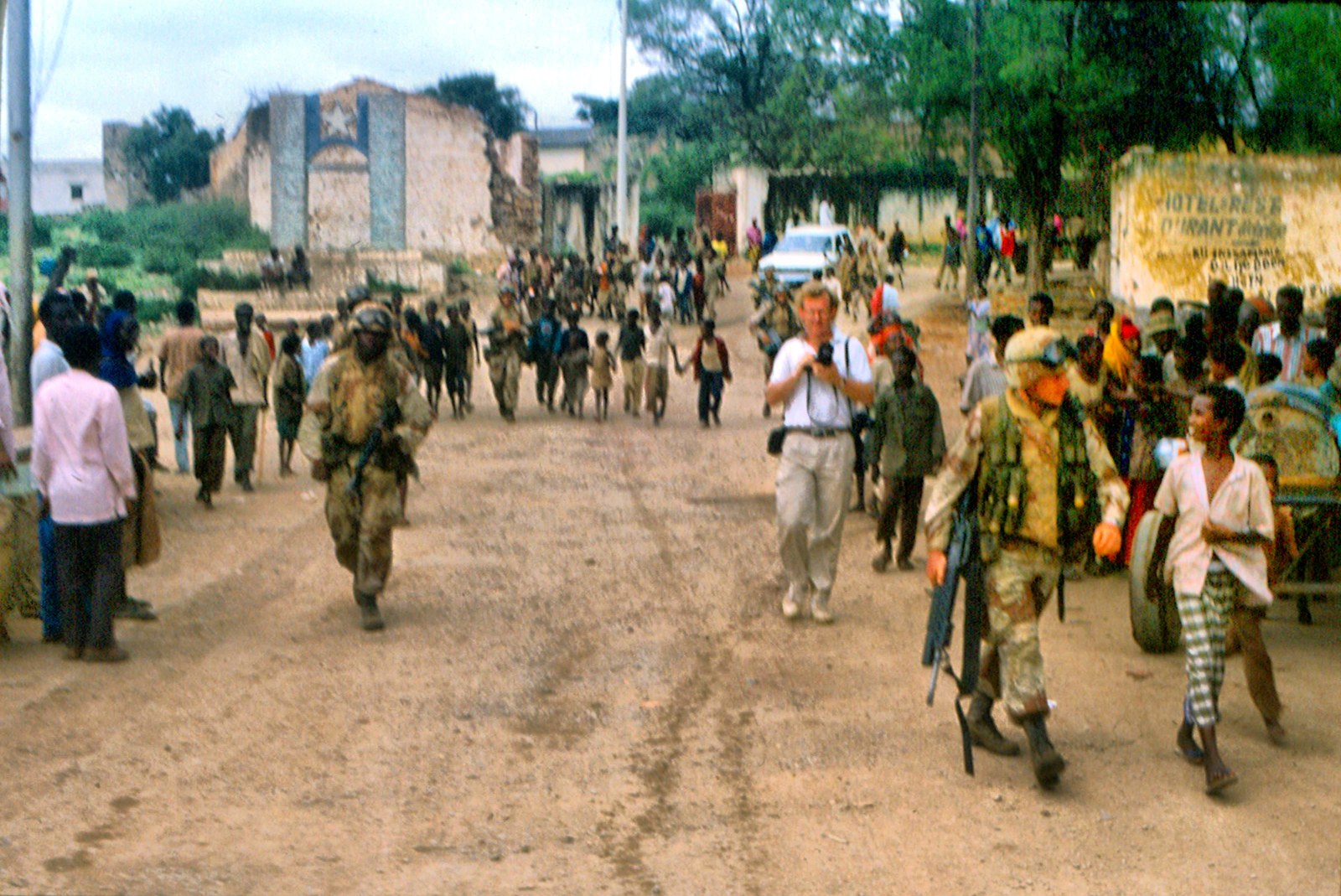
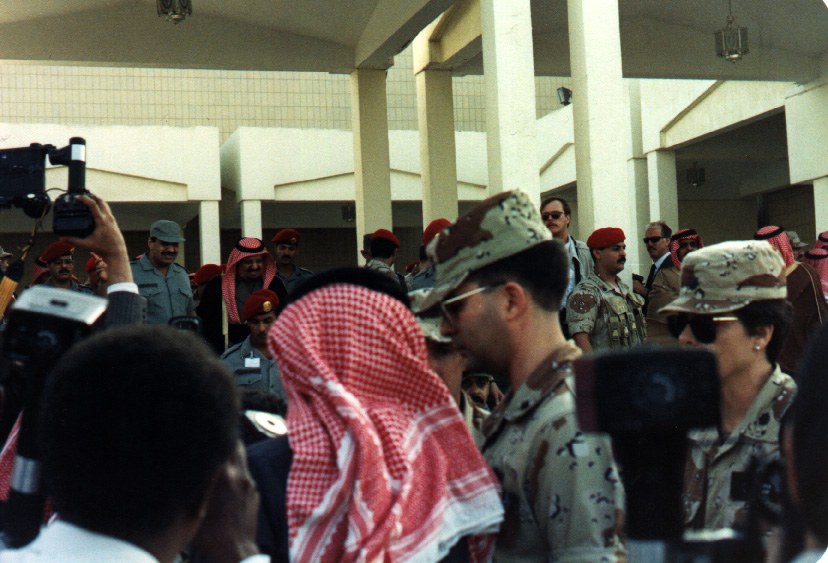
The Gulf War of 1991 was the most heavily attended and least freely reported conflict of the period. Roughly fourteen hundred correspondents accredited themselves to the coalition in Saudi Arabia, and the overwhelming majority of them never saw combat.2 Access ran through a pool system codified in a ten-page set of ground rules drafted by a Central Command public-affairs officer, Captain Ron Wildermuth, and titled Annex Foxtrot. The document’s central provision was blunt: “Media representatives will be escorted at all times. I repeat, at all times.”3 A small number of reporters were assigned to combat pools attached to military units; a smaller number sat in the National Media Pool; the rest, well over a thousand, remained in Dhahran, rewriting the pool reports that a handful of colleagues fed back and attending the daily military briefing that the press corps, reviving a term from Vietnam, called the five o’clock follies. Every word a pool reporter filed passed a public-affairs officer’s security review before transmission.
The war that reached American readers, in other words, was the one the system permitted, and the exceptions to the system were the stories that lasted. Three correspondents for CNN — Peter Arnett, Bernard Shaw, and John Holliman — were in Baghdad at the Al-Rasheed Hotel when the bombing began on the night of January 17, and they broadcast live through the first sixteen hours of the war from a ninth-floor room; of the roughly forty foreign journalists in the hotel, only CNN had secured a dedicated telephone line out through Amman, and that single line was the scoop.4 Chris Hedges of The New York Times refused the pool entirely, was arrested by the U.S. Army and stripped of his credentials, and continued reporting without them, crossing into Kuwait with Marine units that shared his contempt for the Army’s press controls.5 Bob Simon of CBS drove with his crew toward the Kuwaiti border ahead of the ground war, was captured by Iraqi forces, and was held for forty days.6
For a monthly magazine, the pool arithmetic was worse still: long-lead publications sat at the bottom of the access hierarchy, behind the wire services and the networks and the dailies, and a correspondent for such a magazine had little prospect of a combat-pool slot and less interest in one. The productive posture was the unilateral one — to refuse the pool, absorb the loss of official access, and write afterward not about the war but about how the war had been managed. The argument the conflict produced inside journalism was precisely that: three book-length indictments of the pool system appeared in its immediate aftermath — John MacArthur’s Second Front, John Fialka’s Hotel Warriors, and Jacqueline Sharkey’s Under Fire — each written into a live crisis over whether the public had been shown a war or a production of one.
The Yellow Hotel
The siege of Sarajevo gave the decade its central image of the working life: a bright-yellow hotel, built for the 1984 Winter Olympics and standing exposed on the avenue that the press named Sniper Alley, functioning as the press corps’ home for nearly four years. Its south-facing rooms, which looked toward the Serb-held heights of Grbavica, were abandoned to the snipers; the north side was occupied. Power, water, and heat were intermittent to absent, and the rate was hard currency, cash. The correspondent Janine di Giovanni lived on and off in Room 437 for three years.7 The Bosnian daily Oslobođenje kept publishing throughout the siege from the basement of its shelled tower, and its journalists, when their own paper could not carry them, became the pool of local staff on whom the foreign press depended.8
Filing out of the city meant choosing among bad options: the uplink at the repeatedly shelled television building, a shared wire-bureau slot, a satellite call from the exposed rooftop, or the road over Mount Igman to the Croatian coast, six to eight hours each way across sniper-covered stretches in a vehicle with the letters TV taped large on its doors and roof — markings that were as often a target as a shield.9 The danger fell unevenly. David Kaplan, a producer for ABC News, was killed by a sniper on his first day in the country in August 1992, shot through the back of an unarmored van near the Sarajevo airport; he was the first American killed in the Yugoslav wars.10 But the correspondents who carried the bylines were not, across the Balkan wars, the majority of the dead. More than a hundred and fifty reporters, photographers, camera operators, producers, and fixers were killed in the region between 1991 and 2001, and the toll fell heaviest on local staff.1
The fixer was the figure the published work could not name. What the magazine paid for beyond the day rate was narrow — fuel, the vehicle, food during working hours — and stopped exactly where the rate stopped. A fixer who saved a correspondent’s life created a debt that could not be discharged in print, because describing the rescue would advertise how close the call had been and might expose the fixer to reprisal, and so the rescue went unmentioned and the fixer thinly credited or not credited at all. The byline ran in New York. The danger stayed in Sarajevo.
The Ranking
Rwanda in the spring of 1994 exposed the deepest structural feature of the working life: the gap between where a story happened and where it was ranked. The killing began on the night of April 6, after the aircraft carrying the presidents of Rwanda and Burundi was shot down over Kigali, and it was systematic within hours. Within days the Western governments evacuated their nationals, and most of the foreign press left with them; on the day the killing began the country held only two foreign reporters — the freelance correspondent Lindsey Hilsum and the Belgian radio reporter Katrin van der Schoot — and through April and May the foreign press in the country stayed a very small group.11 The people most exposed were the local journalists. Thomas Kamilindi, who had resigned from Radio Rwanda months before the killing, was named on the killers’ lists and survived to testify later before the international tribunal; forty-eight Rwandan journalists who publicly opposed the killing were themselves killed during it.12 The framing that reached American readers in those weeks was the framing of ancient tribal hatred — a chronic-disaster register applied to Africa that ran directly against the civilizational, explicitly anti-fascist register the same publications had brought to Bosnia.13
The magazine problem sat inside the calendar. A monthly worked on a lead time of weeks: killing in April became filing in May became a cover date of August, and by August the pictures that had reached the West were the pictures from the refugee camps at Goma, where a cholera epidemic among a million people who had crossed into Zaire produced exactly the kind of visible, aidable, apolitical catastrophe that American media knew how to cover. The genocide had been reframed as a refugee crisis, and the reframing was the industry’s documented failure of the decade, not the failure of any single desk.14 The cover competition made the ranking concrete. In the summer of 1994 the American glossies were not weighing atrocity against glamour; they were weighing a distant African genocide against a domestic murder case, the arrest of O. J. Simpson, which had seized the newsstand in June and did not release it.15 A dispatch that named what had happened in Rwanda plainly, and named it in time, arrived at an editorial floor already committed elsewhere and already watching its foreign budget contract in the general judgment that the end of the Cold War had made the world less urgent. The piece, when it ran, did not run on the cover. It ran deep in the well, behind the front-of-book and the advertising — and the placement was itself the magazine’s judgment about where a distant genocide stood against the news the reader was thought to want.
The Framing, April–May 1994
| Date | Development |
|---|---|
| Apr. 6 | Aircraft carrying the presidents of Rwanda and Burundi shot down over Kigali; systematic killing begins within hours.16 |
| Apr. 15 | The New York Times runs Elaine Sciolino’s “For West, Rwanda Is Not Worth the Political Candle.”17 |
| Apr. 21 | The UN Security Council reduces its peacekeeping force in Rwanda to a token contingent of 270.18 |
| May 15 | The Observer runs Lindsey Hilsum’s “The radio station whose call sign is mass murder,” on the incitement broadcasts of RTLM.19 |
The Body That Came Back
The return itself was a documented passage: from Sarajevo out over Mount Igman to the coast, then Zagreb, then Vienna or Frankfurt, then a commercial flight to New York, thirty-six to forty-eight hours from a besieged city to a customs line at the airport. What arrived was a body that had been somewhere the paperwork of its own life could not reach. The clinical category existed — post-traumatic stress disorder had entered the diagnostic manual in 1980 and been carried into its revised edition in 1994 — but journalists were not yet counted among the populations understood to be at risk, and the sustained clinical literature on the trauma of covering war did not begin to appear until the very end of the period.20 In the absence of the vocabulary there was only the folk description: jumpy, trouble sleeping, needed a drink. A correspondent slept in short cycles and woke at low sounds. A dropped pan moved his hand before his face composed. He could not summon concern for an expense report or a cover meeting, and the flatness read, to the people around him, as indifference.
What held the arrangement in place was professional, not social. The symptom was the credential: the capacity to go to the worst places and come back with the work was the entire value of the correspondent, and to say plainly that the places had done damage was to raise the question of whether the magazine could still send him. “I’m fine” preserved the asset; the truth threatened it. So the wound stayed unnamed by the one person positioned to name it, and the people who might have asked did not, out of a respect that was indistinguishable, in its effects, from neglect. The cost surfaced later and elsewhere. The correspondents of the Bosnia generation carried a documented pattern of aftermath — heavy drinking, breakdown, and death in other wars years after the siege they had survived. Kurt Schork, who had come through Sarajevo, was killed in an ambush in Sierra Leone in May 2000.21 The pattern was structural, not a run of individual bad luck, and it was legible only in retrospect, to people who had the word for it by then.
The working life of a foreign correspondent in these years was governed less by courage than by distance, and distance was a set of concrete mechanisms: the metered satellite line that made an editor’s rewrite an economic transaction, the pool that decided which war the public would see, the fixer who bore the risk that the byline could not acknowledge, the lead time that ranked a genocide against a murder trial by the accident of the calendar. Each mechanism worked in the same direction, pulling the account back toward the place that paid for it and away from the place it described. The people who did this work knew the mechanisms intimately, argued with them nightly, and lost most of the arguments, because the mechanisms were made of money and access and the clock, and those were not things a correspondent on a rooftop could outlast. What reached the reader was real and hard-won and shaped, at every stage, by conditions that had nothing to do with what had happened and everything to do with how far away it was. The distance was the story the reporting could not quite tell, and it is the one worth reading now.
The Foreign File would have carried the Gulf retrospective in MER-1991-05, filed after the ceasefire and arguing the war had been a managed production rather than a covered one. The live broadcast out of Baghdad that January would have been assigned as its own item first — a look back at the single line CNN alone would have secured out of the Al-Rasheed — and it would have gotten as far as typeset pages before the room cut it on the marked galley, folded instead into the larger argument as one exhibit rather than a piece standing on its own.
Rwanda would have meant two losses for the Foreign File. The correspondent sent that spring — who would have come back down several pounds from the winter’s assignment, one ear that would still have been ringing from a mortar round in the Gulf three years on — would have filed something that named the killing plainly and in time, and it would have gone nowhere: the Foreign File’s budget would have been contracting all that year under the sense that the peace dividend had made the world safe to stop watching, and the August closing would have set the piece against the Simpson arrest for the cover, an argument it would not have won. No one would have pitched against it out of spite; it would simply have missed the closing date.
A sniper’s round finding an ABC producer outside the airport road would have run as only a paragraph — the death of a correspondent not the magazine’s own would never have stretched to the twelve hundred words a piece would have needed, and there would have been no length between a paragraph and a feature for it to occupy.
Schork would have run in The Front, MER-2000-07: a notice on a correspondent killed in an ambush in Sierra Leone that May.
Footnotes
-
“Last Despatches: Why the Balkan Wars Were So Deadly for Journalists,” Balkan Insight (BIRN), 2021. ↩ ↩2
-
John Fialka, Hotel Warriors: Covering the Gulf War (Woodrow Wilson Center Press, 1991). Fialka’s account, contemporaneous with the war, documents the pool numbers and the confinement of most accredited correspondents to Dhahran; MacArthur and Sharkey’s books appeared in the same window. ↩
-
John R. MacArthur, Second Front: Censorship and Propaganda in the Gulf War (Hill and Wang, 1992). MacArthur documents Annex Foxtrot and Captain Ron Wildermuth’s authorship of the ground rules. ↩
-
Peter Arnett, Live from the Battlefield: From Vietnam to Baghdad, 35 Years in the World’s War Zones (Simon & Schuster, 1994). ↩
-
Chris Hedges, War Is a Force That Gives Us Meaning (PublicAffairs, 2002). ↩
-
Bob Simon, Forty Days (G. P. Putnam’s Sons, 1992). ↩
-
Janine di Giovanni, “Life During Wartime,” Harper’s Magazine, April 2013. ↩
-
Tom Gjelten, Sarajevo Daily: A City and Its Newspaper Under Siege (HarperCollins, 1995). ↩
-
Anthony Loyd, My War Gone By, I Miss It So (Atlantic Monthly Press, 1999). ↩
-
“TV Producer David Kaplan, 45, Killed in Sarajevo,” The Washington Post, August 14, 1992. ↩
-
Allan Thompson, ed., The Media and the Rwanda Genocide (Pluto Press, 2007), including the accounts of Lindsey Hilsum, Mark Doyle, and Thomas Kamilindi. ↩
-
“‘A fragile period’: Journalism in Rwanda, 25 Years After the Genocide,” Columbia Journalism Review, 2019. ↩
-
Melissa Wall, “A ‘Pernicious New Strain of the Old Nazi Virus’ and an ‘Orgy of Tribal Slaughter’: A Comparison of US News Coverage of the Crises in Bosnia and Rwanda,” Gazette: International Journal for Communication Studies 59:6 (1997). ↩
-
Alan J. Kuperman, “How the Media Missed Rwandan Genocide,” American Journalism Review, 2000. ↩
-
Time, cover of June 27, 1994 (the darkened O. J. Simpson mug shot). ↩
-
Philip Gourevitch, We Wish to Inform You That Tomorrow We Will Be Killed With Our Families: Stories from Rwanda (Farrar, Straus and Giroux, 1998). ↩
-
Elaine Sciolino, “For West, Rwanda Is Not Worth the Political Candle,” The New York Times, April 15, 1994. ↩
-
United Nations Security Council Resolution 912, April 21, 1994. ↩
-
Lindsey Hilsum, “The radio station whose call sign is mass murder,” The Observer, May 15, 1994. ↩
-
American Psychiatric Association, Diagnostic and Statistical Manual of Mental Disorders, third edition (1980) and fourth edition (1994); Anthony Feinstein, John Owen, and Nancy Blair, “A Hazardous Profession: War, Journalists, and Psychopathology,” American Journal of Psychiatry 159:9 (2002). ↩
-
“Journalists Killed in 2000: Kurt Schork,” Committee to Protect Journalists. ↩