Money Out of Pocket: Gambling, Vice, and the Cash Economy, 1989–2001
Subscribe
https://meridian-archive.com/feed.xmlOpen in your app, or paste the link above into any other:
The Agent at the Register
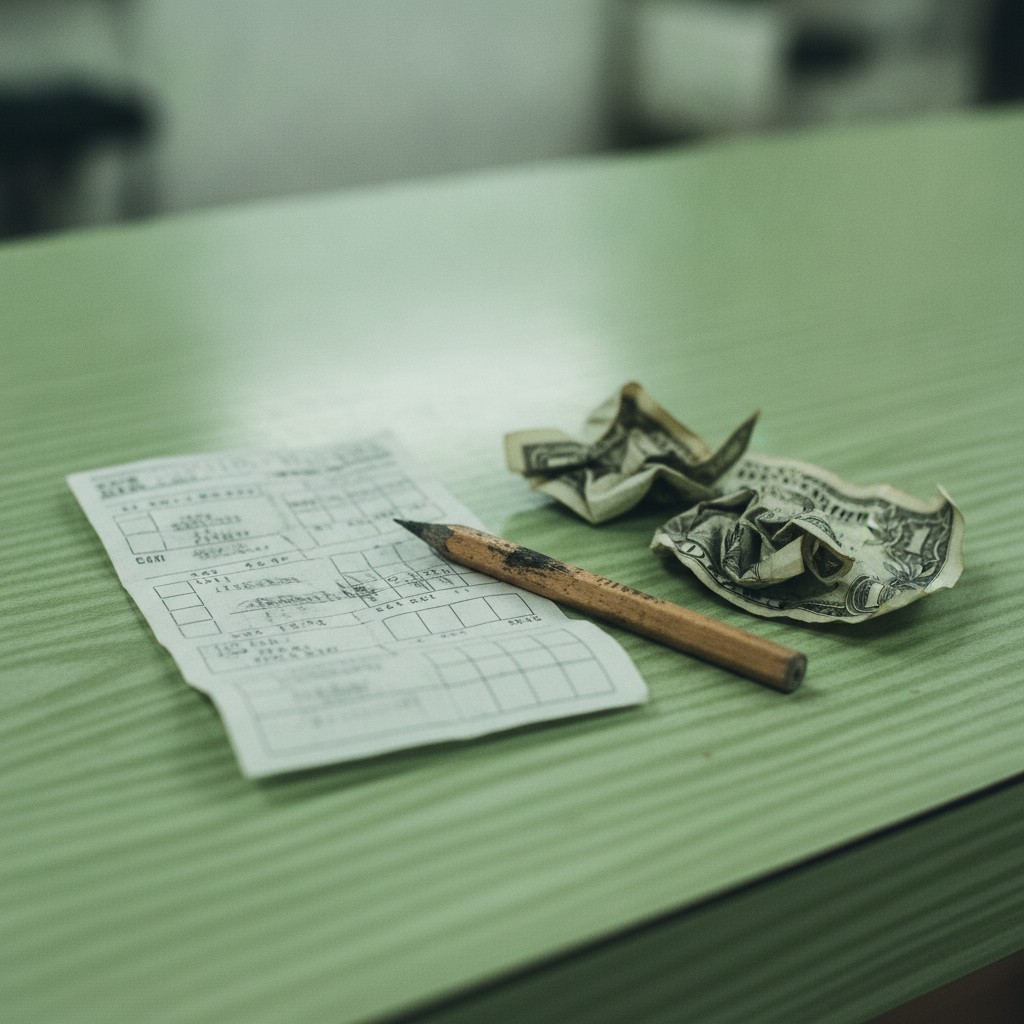
Across the boroughs, a counterperson who rang up a customer’s coffee was, in the same motion, as often as not taking a bet: a folded slip marked in pencil with three digits and a dollar amount, palmed and dropped into a coffee can or under the register, no signature and no receipt, the transaction finished before the coffee cooled. The arrangement carried a fixed price, worked out independently at bodega counters across Harlem, Washington Heights, Bedford-Stuyvesant, and the South Bronx without a union scale, a franchise agreement, or a state licensing board to set it: the counterperson kept five to ten percent of whatever handle passed through the register in a given week, and the store’s owner, who carried the greater risk if the operation drew a raid, collected a flat weekly fee simply for letting the numbers runner’s morning route pass through the door.1 No ledger recorded either payment and no tax form acknowledged either income; the commission was, at thousands of stores a numbers operation never had to advertise, simply how the job paid.
A different dollar, wagered under the opposite arrangement, moved a few blocks away through a cashier’s window the City of New York itself operated. On April 8, 1971, a clerk at a storefront near Vesey Street and Broadway took a bet from the mayor of New York and handed him a printed ticket in return, and with that transaction the City went into the bookmaking business — the first government in the United States to open a legal off-track betting parlor.2 The New York City Off-Track Betting Corporation had been chartered by the state the year before as a public-benefit corporation, a piece of every dollar wagered routed to the city, the state, the racing industry, and the corporation’s own operations, and the arrangement was odd on its face: a government agency standing behind a cashier’s window, taking bets on horses it did not own and paying out on races it did not run, competing for the same dollar the corner bookie and the numbers runner had been taking without a license for decades. By its own accounting the corporation was not, across the years that followed, reliably good at the one thing a bookmaker is supposed to be good at.
By 1989 the corporation ran roughly seventy branches across the five boroughs, down from a mid-1980s peak near a hundred and twenty, and the money moving through them was substantial: total handle — the sum wagered, not kept — passed a billion dollars that year alone, a volume no illegal operation in the city’s history had matched openly.3 A 1992 survey of the branches found a clientele that ran better than nine in ten male, with a median age past fifty and roughly half retired or otherwise out of the workforce — the doorman on his break, the sanitation worker between shifts, the retired transit man for whom the daily two-dollar bet on the double was less a habit than an appointment.4 A narrower slice of the regulars, by some estimate one in ten or fewer, treated the Racing Form as a text to be studied rather than skimmed, kept their own ledgers of past performances, and broke even or better across a season — a literate handicapping subculture with its own reading list and its own quiet pride, indifferent to whether the government or a runner was paying out the winnings. That reading list had an author: the Washington Post handicapper Andrew Beyer, whose 1975 Picking Winners and 1993 Beyer on Speed set out a method for extracting a horse’s true effort from the Racing Form’s raw times, a system serious OTB regulars studied and argued over the way another kind of reader argued over a box score.5
Manhattan branches, by address
| Branch | Notes |
|---|---|
| Vesey Street and Broadway | The first branch, 1971; financial-district lunch crowd |
| Eighth Avenue near 41st Street | High-volume Times Square branch |
| 116th Street and Lexington Avenue | East Harlem; bilingual handicapping arguments |
| 86th Street and Third Avenue | Older professional men, doormen on break |
| 14th Street near Union Square | Mixed-class crowd |
| Astor Place | NYU-adjacent; occasional student walk-in |
| 125th Street and Lenox Avenue | Harlem flagship, on ground long worked by the numbers game |
Sources: 1989–98 New York Yellow Pages branch directories; contemporaneous New York Times and Newsday coverage.
Magazine writers working in Midtown walked past the Eighth Avenue branch twice a day for most of the period this account covers and, by every visible measure, rarely walked in. The columnist Pete Hamill was the standing exception, writing in 1989 about his own father’s life at the window with the ease of someone reporting from inside rather than looking through the glass — a habit his generation of newspaper columnists could claim more comfortably than the magazine floor could.6 The idea of a piece on the OTB regulars, before whatever came for the institution came for it, was available every year of the period; almost no one on a Midtown masthead thought to file it.
The Slip Across the Counter
A different dollar never came near a government window at all. The illegal numbers game ran on the last three digits of a designated track’s daily pari-mutuel handle — after 1980, the state’s own daily Lottery number served as an equally public reference — so that any player with a copy of the next day’s Daily News could confirm a win without trusting the man who took the bet. A dollar on three digits paid six hundred to one from a runner; the same dollar on the state’s daily Numbers game, launched in 1980 expressly to compete with the illegal trade, paid five hundred to one, reported the winnings to the Internal Revenue Service above six hundred dollars, and extended no credit at all. A runner would carry a regular for a week against next Friday’s pay. On exactly those three points — payout, tax, credit — the illegal game outcompeted the legal one for two decades running. A Harlem runner, asked late in the period why the game endured, put it plainly: “We still here. We always going to be here. Some people just don’t trust the state.”1 A March 1992 raid on a Brooklyn-Queens numbers ring made the same bodega mechanics visible in a single case file — runners, controllers, and a network of corner stores that had moved bets for years before an indictment finally set the operation down on paper.7
The trade had deep roots in Harlem, run in the 1920s and 1930s by Stephanie St. Clair and by Ellsworth “Bumpy” Johnson after her, taken over by Italian crews under the Lucchese and Genovese families through the middle of the century, and ceded in large part, by the 1980s, to Dominican and Black operators working the same Harlem and Bronx blocks. Its most durable Manhattan figure through the period was Raymond “Spanish Raymond” Márquez, who had run a Harlem numbers operation since the 1950s and had already survived one federal case in 1971 before the government came for him again in the years this account covers: arrested in April 1994 on state gambling charges, indicted the following year on 221 counts of running a criminal enterprise, and convicted in 1996 on a reduced charge after a plea agreement. Indicted again in 1998 on 52 counts, Márquez and three co-defendants were acquitted after a three-month trial, and he retired from the trade in 2001, at the close of the period.8 The bodega runner’s morning route — in the counterperson between nine and noon, cash and slips changing hands, an envelope of the previous day’s payouts left behind — worked the same East Harlem and Washington Heights blocks Márquez’s operation had worked for decades, and the higher a bettor’s stakes climbed, the more likely the bet moved by telephone rather than paper; the same pager-and-payphone circuitry that let a runner’s customer reach him without a fixed address is treated at length elsewhere in this archive, in an account of a different kind of order placed the same way.9
The Thirty-Five-Dollar Ticket
Atlantic City had been legal since Resorts International opened on the Boardwalk on May 26, 1978, the first casino to operate outside Nevada; by 1989 a dozen casinos ran along the Boardwalk and the Marina, the newest of them the Trump Taj Mahal, which opened on April 2, 1990, after a run-up of publicity its own owner did much to generate.10 The city sat roughly a hundred and twenty-five miles south of Manhattan, a two-and-a-half to three-hour run down the Garden State Parkway, and the casinos paid bus operators by the head to make the trip cheap enough that the ride itself became the point. A standard round-trip ticket ran thirty-five to forty dollars; a passenger who bought one and boarded received twenty-five dollars in casino cash and five dollars in food vouchers on arrival, so that the net cost of getting to Atlantic City and back, before a single card was played, came to something like five or ten dollars.11
The buses left from a handful of recognizable curbs. Port Authority sent coaches under half a dozen operator names, mostly to a racially mixed, older, weekend clientele. Pike Street and East Broadway, in Chinatown, ran a parallel and heavily used route of their own, serving restaurant workers on their days off, garment workers, and retirees living on fixed incomes, most of them favoring pai gow, baccarat, and fan-tan over the slot machines that drew other lines.12 Brighton Beach sent Russian-speaking retirees, largely women, on Friday-night and Sunday-morning runs; Flushing sent Korean- and Chinese-language coaches; Harlem sent church groups organized by their own social secretaries for a Sunday-afternoon outing after service, on buses branded for the casino that had bought the block of seats.
Casino-bus origins, 1989–2001
| Departure point | Typical operators | Riders |
|---|---|---|
| Port Authority Bus Terminal | Greyhound, Academy, Trans-Bridge | Mixed, weekend, older |
| Pike Street / East Broadway | Eastern Travel, New Century Travel, Lucky Star | Chinatown restaurant and garment workers |
| Penn Station vicinity | Casino-branded coaches | Resorts and Trump Plaza regulars |
| Brighton Beach / Sheepshead Bay | Russian-language operators | Older Russian-speaking women |
| Flushing, Main Street | Korean and Chinese operators | Korean- and Chinese-speaking riders |
| 125th Street and Lenox Avenue | Harrah’s-branded coaches | Sunday church groups |
Sources: 1990 and 1995 New York Yellow Pages, “Bus Lines — Charter & Tour”; contemporaneous New York Times coverage.
The trip itself ran on a fixed choreography — a curb boarding, a card game or a dubbed film on the ride down, a comp slip exchanged at the casino’s own marshalling driveway, six to eight hours on the floor at the lowest-minimum tables, a rigid reboarding at eight or midnight. Friday and Sunday afternoons, hundreds of these coaches were visible in Manhattan, the Chinatown line most visibly of all, a queue of retirees with folding stools reaching down the block; a 1995 newspaper feature on the phenomenon was the rare piece of coverage it got. The bus, loaded every weekend for thirteen years running, was closer to the actual civic fact of Atlantic City than the boardwalk decay or the bankruptcy filings a Midtown magazine more often sent a writer to cover.
The Bus That Went North
The map changed in February 1992. The Mashantucket Pequot Tribal Nation, federally recognized in Connecticut in 1983 and already running a high-stakes bingo hall since 1986, opened Foxwoods High Stakes Bingo & Casino with full table games on February 15, 1992, under a state-tribal compact negotiated by the tribal chairman, Skip Hayward; a slot floor followed in January 1993.13 It was the first full-scale Indian casino on the East Coast, roughly a hundred and twenty-five miles north of Manhattan by way of I-95, a run of about the same length as the drive to Atlantic City in the other direction — and it grew, within a few years, into one of the largest casino floors in the Western Hemisphere, its revenue climbing past what Atlantic City’s own largest single property took in.
Before 1992 a New York gambler’s day-trip options ran essentially one way, south. After it, Foxwoods sat north, Atlantic City south, Saratoga’s harness track and Yonkers Raceway closer still, and the wider geography opened the casino trade to an audience Atlantic City had never drawn — the affluent Connecticut and Massachusetts weekender, and, for the Manhattan magazine floor specifically, a leisure option within the same driving radius as a Hamptons house, reachable by the same kind of car most of the floor already owned. Bus subsidies to Foxwoods from New York began in 1993, spreading to Chinatown routes by 1995 and running eight to twelve New York departures a day within a few years, in part because Foxwoods had begun courting the Chinese-American high-stakes baccarat trade in 1994 and had pulled a share of the Atlantic City Chinatown bus economy north with it. Mohegan Sun, a second Pequot-adjacent Connecticut casino ten miles from Foxwoods, opened October 12, 1996, diversifying the same market further. By the middle of the decade the property had also become a less overtly seedy alternative to Atlantic City for an outer-borough wedding party choosing a weekend destination — a use nobody had designed a tribal casino for, and one that filled its hotel rooms all the same.
A New York Times travel piece marked the Foxwoods opening, and Connecticut Magazine covered the casino steadily thereafter, but New York and The New Yorker treated it as sparingly as a Connecticut oddity could be treated by editors for whom Connecticut was, outside its old-money enclaves, beneath sustained notice — Mohegan Sun drew more attention four years later chiefly for its architecture and for the competitive threat it posed to Atlantic City, and a couple of longer magazine profiles of Pequot tribal politics appeared across the decade at the level the subject was permitted: politics, not the bus.
The Tables and the Tiles
Above the storefronts of Mott, Pell, and Doyers Streets ran a gambling economy the tourist walking to a restaurant on any of them rarely suspected. A 1993 newspaper survey counted eight to twelve active rooms operating on upper floors along Mott Street between Canal and Worth alone, with four to six more on Pell Street and two or three on Doyers, one of them above the Nom Wah Tea Parlor at 13 Doyers.14 The rooms ran under the protection of the neighborhood’s tongs — the On Leong Merchant Association at 83 Mott Street and the Hip Sing Tong at 16 Pell chief among them — offering pai gow, fan-tan, baccarat, sic bo, and, most ubiquitously, mahjong, at stakes from five dollars a hand at a neighborhood table to a thousand dollars or more in the invite-only rooms upstairs that served visiting players from Hong Kong and Macau. Most ran around the clock, busiest from Friday night through Sunday afternoon, when late-shift restaurant and garment workers came off a shift with cash and time to spend it. The clientele shifted with the neighborhood itself: a Cantonese-speaking majority through the 1980s gave ground across the 1990s to a growing Fukienese population arriving from Fuzhou, and the mahjong tables, unlike the high-stakes rooms upstairs, drew a crowd that was never as strictly male as the rest of the trade.
It fell to a book rather than a magazine to finally set the tongs’ own protection arrangements down on paper at length: T. J. English’s 1995 account of the Lower East Side’s Vietnamese gangs, built from years spent reporting a beat no magazine’s masthead had assigned anyone to walk.15
The Fifth Precinct’s approach to the rooms was containment rather than eradication: two to four high-profile raids a year closed specific addresses, which reopened on another floor within weeks. A federal indictment unsealed in January 1994 named the leadership of the On Leong gambling network in both Chicago and New York, the first time in court the tongs’ own economics of protection and payment had been confirmed rather than assumed.16
A different and more visible cash economy ran the concrete tables at the southwest corner of Washington Square Park, where a stable cohort of fifteen to twenty-five hustlers played from morning to midnight for stakes that ran from a dollar a game at the low end to a hundred among the strongest regulars, mostly in blitz time controls of three, five, or ten minutes.17 Among the park’s stronger and better-documented players were Israel Zilber, a Latvian champion who had once defeated a teenage Mikhail Tal and who lived on the street near the park through most of the 1980s, regarded as one of its two or three best players, and Asa Hoffmann, a FIDE Master and lifelong hustler whose six decades of park and club play he later set down in his own memoir.18 Fred Waitzkin’s 1988 book on his son’s chess education gave the park’s tables a literary account of their own regulars, and the 1993 film made from it, with Laurence Fishburne playing a composite hustler at those same tables, gave the corner a wider audience than any other piece of the cash economy this account covers received — chess, alone among the games, carried enough prestige to be treated by the editorial world as a subject rather than a curiosity.19
The same walk through lower Manhattan passed a great deal more than chess and mahjong. Three-card monte tables worked Canal Street and the Bowery on folding cardboard through the middle of the period; cee-lo games ran Friday and Saturday afternoons on stoops in Bedford-Stuyvesant and Harlem; Brighton Beach ran Russian cardrooms above its restaurants, a scene the reporter Robert I. Friedman documented at book length rather than any magazine ever assigning it;20 a “Cherry Master” gray-market slot machine sat behind the bar in outer-borough taverns from Sunnyside to Bensonhurst, paid out by the bartender from the till, and got replaced within weeks of every raid that shut one down. None of it required a license, a storefront decal, or a mention in a magazine to keep running.
The Record
Raymond “Spanish Raymond” Márquez ran a Harlem numbers operation from the 1950s, survived a federal prosecution in 1971, was arrested again in April 1994 and indicted in 1995, pleaded guilty in 1996 to a reduced charge, was indicted again in 1998 and acquitted after trial, and retired from the trade in 2001.
Israel Zilber, a Latvian chess champion who defeated the teenage Mikhail Tal in 1952, lived on the street near Washington Square Park through most of the 1980s and was counted among the strongest players at its tables.
Asa Hoffmann, a FIDE Master and Washington Square regular for six decades, later published a memoir of his career hustling chess, checkers, backgammon, and cards across New York’s parks and clubs.
Skip Hayward, tribal chairman of the Mashantucket Pequot Tribal Nation, oversaw the 1983 federal recognition of the tribe and opened Foxwoods casino under his chairmanship in February 1992.
Every dollar wagered in this economy came back as cash or as nothing, and the government’s own bookmaking operation was, by that measure, no steadier a business than the runner working a bodega counter or the bus idling on Pike Street on a Friday afternoon. What separated the OTB window from the numbers slip was never the odds — the illegal game paid better on every count that mattered to the person placing the bet — but which economy the city was willing to admit it was running. New York spent these years operating a legal, taxed, well-lit way to lose money beside an untaxed, unlit, better-paying one, and depended on both without much acknowledging the second existed at all. A magazine that covered the lit half and missed the other was not covering less of the city. It was covering the half willing to be found, and leaving the rest of the story exactly where it had always been — in plain sight, in cash, on a folding table, waiting for someone to look.
Trump’s Taj Mahal, opening on the Boardwalk in April 1990 after a run-up of publicity its own owner did much to generate, would have gone into The Feature Well as a business story — the casino built as much from noise as from steel, and the noise itself the more reportable material.
The City’s April 1992 pages would have carried Foxwoods at a paragraph’s length: a tribal bingo hall turned casino, a weekend’s drive from a country house the reader would already have owned. When Mohegan Sun rose beside it four years later, an articles editor would have reclaimed the story for The City a second time, but reframed around the building rather than the bus — its architecture, and the competitive threat it posed to Atlantic City, standing in for the gambling floor and the highway trade a fuller account might have followed. Whether the driveway crowd was a reader the floor recognized as its own would have been the doubt sitting under the substitution.
The Back, that October, would have taken the Washington Square hustlers gladly, once Searching for Bobby Fischer reached theaters — a hustler with a book behind him and a movie credit attached counting, on the floor, as a legitimate subject in a way the same man’s twenty-dollar hustle the week before would not have.
Two other stories would have died at the water cooler rather than the desk. The April 1994 arrest of Raymond Márquez, the Harlem numbers man, would have broken into a calendar already closed — the May issue done, the June issue too distant to catch a story that belonged, by every deadline the floor kept, to the daily papers alone. And the January 1994 indictment naming the On Leong tong’s own leadership in gambling would have read, to an editor scanning the wire that week, as a story sized for a city desk rather than a national readership — true enough of the tongs’ own arrangements, but of no wider concern to a reader who lived outside the block where it happened.
Footnotes
-
“In Harlem, the Numbers Game Is Still Running Strong,” The New York Times, October 19, 1999, on the 600:1 versus 500:1 payout comparison, the credit and tax advantages of the illegal game, and the trade’s lineage from Stephanie St. Clair and Ellsworth “Bumpy” Johnson through the Lucchese and Genovese families to later Dominican and Black operators. ↩ ↩2
-
“City’s OTB Bookie on Vesey St. Takes Its First Bet From Mayor,” The New York Times, April 9, 1971, on the April 8, 1971 opening of the first branch at Vesey Street and Broadway and the public-benefit corporate structure chartered by the state in 1970. ↩
-
“After Decades of Hoarse Voices and Pencil Stubs, OTB to Lose Its Last Bet,” The New York Times, December 6, 2010, on the 1989 handle exceeding a billion dollars and on OTB’s persistent operating losses; the corporation would continue in some diminished form for years after the period this account covers before its city branches finally closed. ↩
-
“Sluggish Revenues Imperil Bets on OTB,” The New York Times, April 22, 1992, citing internal OTB demographic surveys on branch clientele. ↩
-
Andrew Beyer, Picking Winners: A Horseplayer’s Guide (Houghton Mifflin, 1975) and Beyer on Speed: New Strategies for Racetrack Betting (Houghton Mifflin, 1993); Beyer was The Washington Post’s racing columnist from 1978. ↩
-
Pete Hamill, “Handicapping Life With His Father and the Races,” The New York Times, February 6, 1989. ↩
-
“Numbers Game Ring Broken, Officials Say,” The New York Times, March 24, 1992, on a Brooklyn-Queens bodega-based numbers network. ↩
-
“Raymond Márquez,” Wikipedia, on the 1971 federal case, the April 1994 arrest, the 1995 indictment on 221 counts, the 1996 guilty plea to a reduced charge, the 1998 indictment and acquittal, and the 2001 retirement. ↩
-
The same pager-and-payphone infrastructure that let a numbers customer reach a runner without a fixed address is treated at length elsewhere in this archive, in its account of a different order placed the same way. ↩
-
“Resorts Casino Hotel,” Wikipedia, on the May 26, 1978 opening as the first casino outside Nevada; “Hard Rock Hotel & Casino Atlantic City” (formerly Trump Taj Mahal), Wikipedia, on the April 2, 1990 opening. ↩
-
“The Day-Trippers: They Come, They Bet, They Go Home,” The New York Times, March 24, 1991, on bus-subsidy economics, the standard voucher package, and the Brighton Beach ridership. ↩
-
“Casinos Find New York’s Chinatown Fertile Ground,” The New York Times, March 30, 1995, on the Pike Street and East Broadway bus routes, the Chinatown ridership’s game preferences, and the scarcity of editorial coverage of the phenomenon. ↩
-
“Foxwoods Resort Casino,” Wikipedia, on the 1983 federal recognition of the Mashantucket Pequot Tribal Nation, the 1986 bingo hall, the February 15, 1992 casino opening, the January 1993 slot floor, and the October 12, 1996 opening of Mohegan Sun; “Connecticut Q&A: Skip Hayward — Laying Down Bets in the Pequot Casino,” The New York Times, February 16, 1992, on Hayward’s role as tribal chairman. ↩
-
“The Tense, Fragile Balance in Chinatown,” The New York Times, December 16, 1990, on the Mott-Pell-Doyers gambling-room geography and tong rivalries; “Inside Chinatown’s Casinos,” Newsday, July 11, 1993, on the room count along Mott, Pell, and Doyers Streets. ↩
-
T. J. English, Born to Kill: America’s Most Notorious Vietnamese Gang, and the Changing Face of Organized Crime (William Morrow, 1995). ↩
-
“3 Named as Leaders in Gambling Empire,” The New York Times, January 14, 1994. ↩
-
“Chess Hustlers Paying the Rent,” The New York Times, April 16, 1989, on the Washington Square stakes, the size of the regular cohort, and the hustle’s mechanics. ↩
-
“Israel Zilber,” Wikipedia, on his 1952 win over the teenage Mikhail Tal and his years living on the street near Washington Square Park; Asa Hoffmann and Virginia Hoffmann, The Last Gamesman: My Sixty Years of Hustling Games in the Clubs, Parks and Streets of New York (Gatekeeper Press, 2022). ↩
-
Fred Waitzkin, Searching for Bobby Fischer (Random House, 1988); the 1993 film adaptation, directed by Steven Zaillian, starred Laurence Fishburne as a composite Washington Square hustler. ↩
-
Robert I. Friedman, Red Mafiya: How the Russian Mob Has Invaded America (Little, Brown, 2000), on Brighton Beach cardrooms. ↩