The Score: Drug Acquisition as Lived Practice, 1989–2001
Subscribe
https://meridian-archive.com/feed.xmlOpen in your app, or paste the link above into any other:
The Page
In January 1994, the New York Telephone Company converted roughly two hundred fifty of the city’s outdoor payphones from touch-tone dialing back to rotary, a technology the rest of the network had retired years before, and it did so for a single stated reason: touch-tone was how a caller navigated a paging service’s automated menu, and rotary phones generate pulses rather than tones and cannot navigate one at all.1 The conversion followed a quieter step the utility had already taken — disabling roughly a quarter of its citywide inventory of some 8,400 street phones from receiving incoming calls in the first place — and both measures were aimed at the same unremarked routine: a caller dialing a pager’s number, keying in the ten digits of whatever booth he was standing in, and hanging up to wait for the booth itself to ring.1 That the city’s phone utility had judged the practice widespread enough to justify re-engineering its own street hardware, phone by phone, said more about how ordinary the routine had become than any single account of running it could.
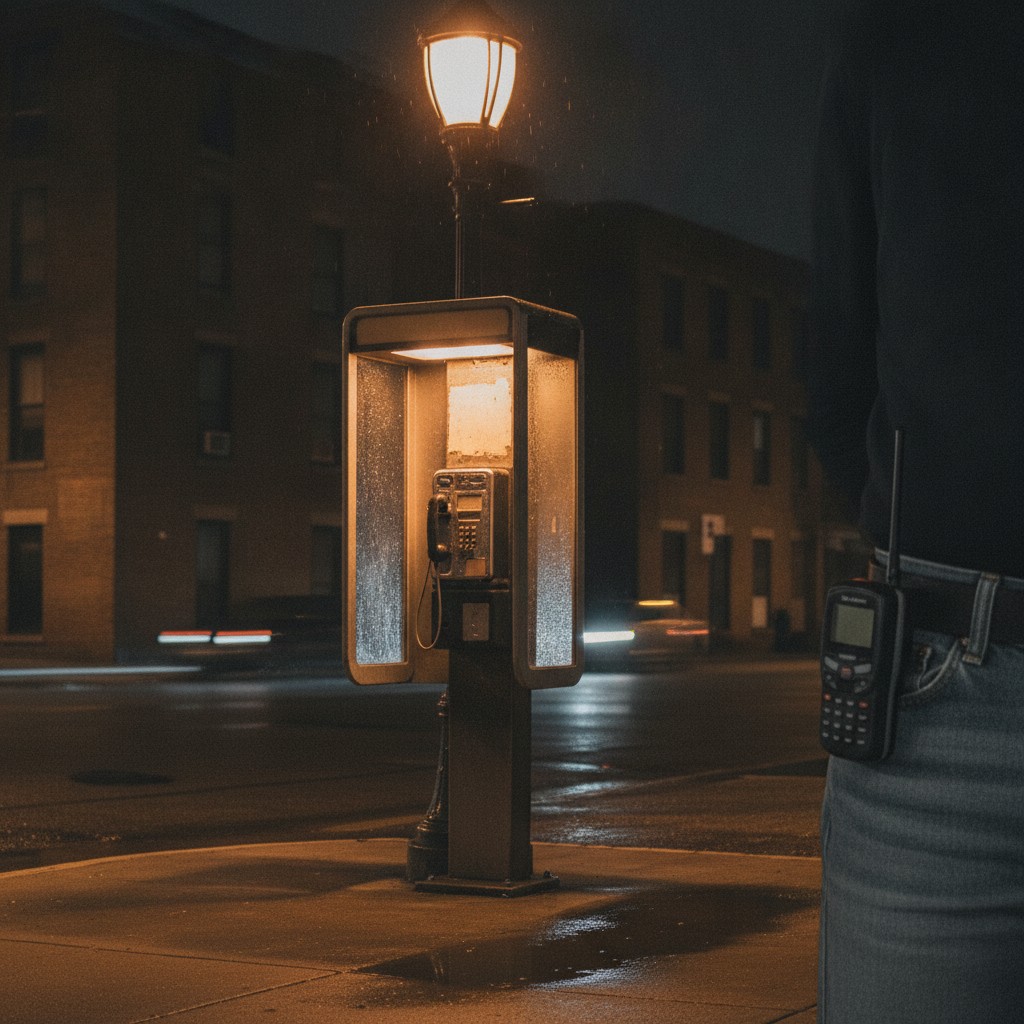
Saturday night, 1993, before the conversion reached his corner: the pager clipped to a belt buzzed, and the ten digits scrolling across its LCD sent the man carrying it out the door and down the block, not to the nearest payphone but to a specific one — the booth on the corner that still rang when a call came in. The booth itself was unremarkable — a chrome-cabineted NYNEX payphone with a scarred steel cord, its glass panes fogged from whoever had stood in it before — and its only virtue that Saturday night was the one that mattered: it still rang. A quarter went into the slot. The paging service answered with a recorded tone; he keyed in the booth’s own ten digits, added a two- or three-number suffix the dispatcher used to tell one regular caller from another, and hung up. The pager itself had been cheap to come by — a numeric model leased for ten to sixty dollars a month since the mid-1980s, registered, where it was registered at all, to a name that was not the carrier’s own — and by the mid-1980s federal agents were estimating that nine dealers in ten carried one.2 What came next was the part no hardware could speed up.
The wait, by the reconstructed accounts of the trade, usually ran only a few minutes on an ordinary night; a markedly longer one was a bad sign, and a call that never came back at all meant he was not coming. A man standing at a payphone with no one on the other end of the line had a short list of postures available to him — lean on the booth, work a folded newspaper, watch the corner without watching it — and he cycled through all of them, because a man standing still and watching the street too plainly was the thing a plainclothes officer had been trained to notice. He had counted his cash before he left the apartment, no bill larger than a twenty, so that nothing about the exchange itself would take longer than it had to. The order was already decided; only the confirmation was pending. Other men worked the same fifteen minutes at other booths within a few blocks of him, each running his own version of the same wait, none acknowledging the others, all of them, in the aggregate, keeping a citywide paging system profitable enough that a paging company had no particular interest in knowing what its subscribers were buying.
The ritual began before he ever left the apartment. He had memorized the pager’s number rather than write it anywhere, and if a dispatcher had assigned him an identifying suffix of his own — the last two or three digits of his own phone, or a personal handle given out the first time he ever called — he carried that number in his head as well, alongside the order itself, already decided before the quarter went into the slot. None of this made him unusual. It made him one member of an unremarked population: the same short list of preparations governed a Wall Street employee arranging a cocaine delivery to a lobby on the Upper East Side, a Tribeca tenant ordering an evening’s marijuana, and a Lower East Side walk-up heroin buyer three neighborhoods east, whose 1993 market still required no pager at all, since his corner was still, that year, conducted in the open air.
The Callback and the Meet
The phone rang before the second full ring finished, and he had it off the hook before the sound could carry. The voice on the other end did not always identify itself — sometimes only “Yeah” — and the order went out in language built to mean nothing to anyone listening in: “Two of the usual,” or “a half,” or, on the Lower East Side, the brand name of a heroin stamp asked for the way a customer asked a bartender for a drink by name. The dealer, or his dispatcher, answered with a place and a window: a short wait and the corner of a specific block; or, for a delivery order, a longer one and an instruction to buzz the apartment. Reconstructed practice, consistent across the surviving accounts of the trade rather than pinned to any single transcript, has the caller reading back an identifying number if one was asked for — “you twenty-one?” “Yeah” — the only verification most street transactions performed at all.
The journey to the meeting point differed by product and by neighborhood. A heroin buyer on Avenue B or C walked there; a cocaine buyer waiting on a Midtown delivery sat in a lobby or a bar until a livery cab pulled up, since federally documented dispatch operations in these years routed runners to residences on the Upper East Side, the Upper West Side, and in Midtown by car service rather than on foot.3 The hand-off itself, once it happened, was fast on both ends of the market: cash into one hand, a folded glassine or a small paper packet into the other, both hands already withdrawing before the exchange had visibly finished, no count taken in front of the other party, no lingering afterward. He did not open what he had bought on the street. He walked at least a block, in a direction that was not the direction he had arrived from, before he counted or looked at what was inside — and if the count came up short, or the stamp on the bag was not the one he had asked for, there was no one to complain to. What he had bought stayed unopened again until he was indoors, the last public moment of the whole transaction the walk itself, unremarkable to anyone who passed him on it.
Discovery, for a first-time buyer, usually ran through a referral rather than any advertisement — a delivery number scrawled on a matchbook or passed along at a party, worth nothing until someone vouched for the caller. A cocaine delivery ordered this way by a Wall Street employee or a magazine writer typically reached a dispatcher who took the coded order over the phone, quoted a meeting time twenty minutes out, and sent a runner dressed unremarkably enough to clear a doorman with a single word — “delivery” — the whole exchange, door to buzzer to hand-off, far quicker than the wait a street corner demanded. A heroin buyer working the Lower East Side’s open-air market in these same years skipped the page altogether, walking straight to Avenue B, C, or D, where a steerer met him with a question — what did he need, what stamp — and pointed him toward whichever building or doorway was filling orders that hour. A marijuana buyer’s version of the same call was the least guarded of the three: “you around?,” “stopping by,” a friend’s apartment rather than a corner, since a marijuana delivery in these years carried less legal exposure than a harder-drug transaction and required correspondingly less of its etiquette.
What a Buy Cost, and What It Was Called
The price figures below are working estimates reported in secondary sources rather than documented sales; they are included for texture, not as fixed numbers.
| Item | Unit | Price (early-mid 1990s NYC, approximate) | Trade name |
|---|---|---|---|
| Cocaine, gram | 1 g | $60–$80 | ”a gram” |
| Cocaine, eighth-ounce | 3.5 g | roughly $200–$250 (uncited estimate) | “an eight-ball” |
| Heroin, single glassine | ~0.1 g | $10 | ”a bag,” “a dime,” “a deck” |
| Heroin, ten-bag unit | 10 bags | $80–$100 | ”a bundle” |
| Heroin, wholesale | 5 bundles | — | “a brick” |
| Marijuana, commercial | ~1.6 g | $10 | ”a dime” |
| Marijuana, designer/“kind” | ~2–2.5 g | $50 | ”a cube” |
| MDMA | 1 pill | $20 | ”a roll” |
The Delivery Economy
Not every score in these years required a walk to a corner. By the early 1990s a customer with the right number could have cocaine, marijuana, or heroin brought to a doorman lobby or a bar stool inside the hour, a service model the trade itself had been quietly moving toward since pagers first spread through it in the mid-1980s. The clearest documented instance belonged to marijuana rather than harder drugs. Michael “Micky” Cesar, a Lower East Side operator who advertised his toll-free number, 800-WANT-POT, on the radio, ran the service out of a storefront at 13th Street and Hudson he called the Church of Realized Fantasies, its windows visibly lined with plants. At its peak the operation employed five bicycle messengers and two phone-takers, filled an advertised forty-minute delivery window, fielded on the order of a hundred to two hundred calls a day, grossed a reported forty thousand dollars on its best days, and delivered without charge to customers who identified themselves as AIDS patients.4 Police raided the Church of Realized Fantasies on November 14, 1990; Cesar was convicted the following year and paroled in February 1993, and was arrested again that August on a new marijuana charge.5 He died in 1995.
Cesar’s operation was the best documented of its kind, not the only one. Similar toll-free or beeper-based marijuana and cocaine delivery services multiplied through the 1990s, most of them smaller and shorter-lived, none advertising on commercial radio the way his had. Fieldwork conducted at the end of the decade found delivery accounting for the large majority of designer-marijuana purchases citywide and a shrinking but still substantial share of street sales, and found the buyer population reached by delivery to have become noticeably whiter than the population still buying on the sidewalk — the leading edge of a market the delivery model had itself helped move indoors and, in the same motion, upmarket.3
The delivery model and the street corner were not simply two ways of buying the same thing; they sorted customers by what each was willing to risk and what each could afford to wait for. A street buy asked nothing of a customer but cash, a location, and a tolerance for being seen; a delivery asked for a phone, patience, and — increasingly, as the decade went on — a doorman willing to wave a stranger up without asking whom he was visiting. What a delivery buyer bought, along with the drug itself, was the removal of his own body from the transaction’s most exposed moment.
The Corner and the Stamp
The street market that a delivery order was built to avoid had its own history through these years, one of enforcement and adaptation rather than of disappearance. Operation Pressure Point, launched on the Lower East Side on January 19, 1984, deployed more than two hundred officers to Avenues A through D and produced more than a hundred arrests on its first day; by August 1986 the cumulative arrest count on the initiative stood above twenty-one thousand.6 Before the sweep, by contemporary account, the trade had operated in something close to full daylight: buyers reportedly drove in from across the region and stood in lines winding around the corner of Avenue A or B to buy a plastic envelope of powder in plain sight of the sidewalk. The heroin trade did not close. It fortified. By the early 1990s the open sidewalk lines of the early 1980s had given way to dealing conducted from inside buildings, the customer stopped at the door rather than on the curb, and by the middle of the decade one operation on East 7th Street between Avenues B and C — run by Hector Santiago, and known on the block as the Laundromat, for the storefront his mother had once kept there — had refined the model into something close to a machine.7 A buyer called up an order, “C or H,” from the sidewalk; a plastic basket, the kind sold for carrying hot dogs at a ballgame, descended on a string from an upper floor; ten dollars went into the basket; the basket rose, and came back down with the bag. A lookout worked the roofline with a walkie-talkie and a second lookout patrolled the block on a bicycle, and the crew rotated which window filled the order from day to day so that no single apartment carried the exposure for long. Santiago’s operation moved, by report, ten thousand dollars a night at its peak, and Santiago kept paying any of his crew who got arrested, on the condition that they did not talk.7
A spot run this way divided its labor by exposure. The rooftop lookout and the bicycle scout extended the crew’s warning perimeter outward from the building itself; a pitcher, who at some operations never came down to street level at all, filled the order once the money was in hand; and a steerer worked the sidewalk in front, directing an arriving customer to whichever entrance or window was live that hour. Operation Pressure Point’s street-level successor, the Tactical Narcotics Teams the police department began deploying from 1988 onward, kept the arrest counts high through these same years without reversing the trade’s move indoors.8 One ring broken up on a ten-block stretch of the Lower East Side in May 1998 was documented as having used children as lookouts, runners, and steerers — confirming both how routinized this division of labor had become by the decade’s later years and how far down the payroll a crew was willing to reach for cheap, deniable labor.9
Marijuana’s own open-air market kept a single emblematic address for most of the period: the perimeter of Washington Square Park, where dealers worked the paths around the fountain and the arch, offering a low murmured patter — “smoke, smoke,” “sensi” — to anyone who slowed. The trade there ran on far lower stakes than the heroin corners to the east, a dime bag or a loose joint changing hands near the benches, and it proved durable enough to outlast repeated police sweeps until a concentrated crackdown late in the decade pushed most of it off the square and into the same delivery and phone-order channels the rest of the market had by then adopted.
What a buyer asked for by name at a corner like this was a brand, since New York heroin had been sold under stamped trade names since the 1970s, a marketing habit no other American heroin market fully adopted.10 A crew’s stamp lived only as long as the crew did; when a bust took down the operators, the name usually died with them, or was cloned by whoever moved into the same corner next.
Some Documented Stamps, 1989–1994
| Stamp | Active | Fate |
|---|---|---|
| Blue Thunder | 1986–Aug. 1992 | Eric Millan’s organization; first arrests began August 1991; convicted after a later retrial.11 |
| Tango & Cash | From February 1991 | Fentanyl-laced; blamed for a still-uncertain number of overdose deaths across the New York area, reported at the time as at least a dozen.12 |
| Poison, Cash, Heavy D., Satisfaction | Competing East 3rd Street/Forsyth Street brands, October 1992 | Brand life bounded by the operating crew’s arrest |
| DOA, Body Bag, Grim Reaper | Through the 1990s | Documented in period retrospective accounts; specific crews unrecorded8 |
The Hardware Changes
The pager that had made the whole system possible was itself a mid-1980s import to the trade, and its dominance did not survive the decade whose middle years it defined. Through the years it dominated, the device was rarely more than a black plastic rectangle clipped to a belt — a numeric model like Motorola’s Bravo, prized for a plain LCD readout and a vibrate setting that could be felt rather than heard in a crowded room or a pocket. A higher-volume operator by the middle 1990s sometimes carried two: the cheap numeric pager for anonymous incoming calls, and a second, alphanumeric unit — Skytel’s two-way Tango, introduced in 1995 at around four hundred dollars — reserved for longer written orders from regulars trusted enough to have the number. Numeric pagers, cheap and anonymously registered, gave way after 1993 to alphanumeric services like Skytel’s SkyWord, and by 1995 a two-way pager could take a typed reply as well as a numeric page — a twenty-four-dollar-a-month convenience that still required, at bottom, a working payphone somewhere in the loop.
That dependency was the vulnerability New York’s phone utility had already moved against directly, with the rotary conversion described above.1 The effect was to push the callback leg of the transaction indoors, into bar and hotel-lobby payphones the utility had not touched, since a bar’s owner had no incentive to make paging harder for a paying customer.
The pager did not disappear so much as get out-competed. Analog cellular service existed in 1993 but at a cost — a seven-hundred-dollar handset, fifty cents to a dollar a minute of airtime — that put it out of reach for a dealer’s working hardware, however common it already was among the Wall Street and publishing customers a dealer might be delivering to. The Telecommunications Act of 1996 accelerated cellular competition and cut into that price;14 by 1998, prepaid cellular service, sold without a contract or an identity check, put a phone within reach of anyone who wanted one and left no paper trail at all — the kind of anonymous handset that came to be called a “burner.” Fieldwork conducted on the Lower East Side between January 1999 and January 2001 found the shift from street sale to phone-ordered delivery “nearly complete,” the pager itself by then a generational marker: a dealer still carrying one, by the decade’s end, was reliably one of the older heads on the block.3
The pager, the payphone, the basket on a string, and the bicycle were not incidental to buying drugs in these years; they were the form the transaction was forced to take by a market that could never advertise and a customer who could never complain. Every adaptation the trade made — the storefront delivery service, the fortified stairwell, the rotating window, the rotary-dial countermeasure the phone company built specifically to break it — answered the same problem from a different direction: how to move a product whose buyer and seller could trust nothing about each other except the transaction itself. The choreography looks, from outside, like a kind of professionalism, and in its way it was one — a set of rules worked out by people with no court to enforce them, refined against a police department working the same corners from the other side. What changed across the decade was the hardware. What stayed constant, corner to lobby to basket to bar payphone, was the wait.
An articles editor pitching Michael Cesar’s beeper-and-bicycle delivery service would have found a small, containable subject: a name, a storefront, a radio spot, and the appeal of runs given free to the sick. The Front would have taken the piece for the January 1991 issue, genericized down to the shape any front-of-book entrepreneurship item took — the toll-free number, the fleet, an owner’s own patter about who he served and why — with the actual working number never printed and the raid itself folded in as color rather than as news. The harder version, the one that would have named a number a caller could still dial, would not have advanced past the same desk, since the checking desk would have had nothing to stand behind it with, and a good half of whoever vouched for the story would, on paper, have turned out to be a customer.
An item on NYNEX’s rotary conversion would have reached readers by way of the March 1994 close. The City would have carried it as a small piece of infrastructure news — two hundred fifty street phones switched back to a dial the paging services could no longer read — without needing to name what the switch had been built to defeat; the mechanism would have been the whole story, the pager and the corner left for the reader to supply.
Not everything from those years would have reached a pitch meeting at all. The fentanyl-laced stamp blamed for a run of overdose deaths would have broken and burned out inside the dailies’ own week, gone from the stack before a monthly’s calendar could have closed on anything resembling it. The East 7th Street spot moving a reported ten thousand dollars a night would have gone the way of the Bronx’s other single-building stories: too local, and too small a readership beyond it, to interest a national monthly.
Footnotes
-
“Phone Company Brings Back Rotary Dialing to N.Y.,” Baltimore Sun, Jan. 10, 1994. ↩ ↩2 ↩3
-
“Street Smart,” Time, Oct. 6, 1986. ↩
-
Ric Curtis et al., “The Gentrification of Drug Markets on Manhattan’s Lower East Side,” National Institute of Justice, 2002. ↩ ↩2 ↩3
-
“The First NY Delivery: Micky, the Pope of Pot,” NuggNotes, Rolling Through History (blog series). ↩
-
“Greenwich Village’s ‘Pope of Pot’ Busted Again,” UPI, Aug. 4, 1993. ↩
-
Lynn Zimmer, Operation Pressure Point: The Disruption of Street-Level Drug Trade on New York’s Lower East Side, NYU School of Law Center for Research in Crime and Justice, 1987. ↩
-
“A Brief History of the Heroin Scene in New York City,” Vice. ↩ ↩2
-
“NYPD Busts Manhattan Heroin Ring,” UPI, May 15, 1998. ↩
-
Travis Wendel & Ric Curtis, “The Heraldry of Heroin: The Branding of Heroin in New York City,” Journal of Drug Issues 30(2), 2000. ↩ ↩2
-
United States v. Millan-Colon, 829 F. Supp. 620 (S.D.N.Y. 1993). ↩
-
“A New Market for a Lethal Drug,” Newsweek, 1991. ↩
-
Ann Marlowe, How to Stop Time: Heroin from A to Z, Basic Books, 1999. ↩
-
Telecommunications Act of 1996, Pub. L. 104-104. ↩