Marijuana: From Street Weed to Kind Bud, 1985–2001
Subscribe
https://meridian-archive.com/feed.xmlOpen in your app, or paste the link above into any other:
The Charge the Search Invented
By 2000 the single most common misdemeanor arrest made by the New York Police Department carried a name that ran through incident reports, arraignment sheets, and criminology tables without quotation marks: marijuana in public view, filed in the paperwork under the acronym MPV. The charge required no plant grown, stashed, or found in a car — only marijuana visible to an officer at the instant of looking, a condition the officer’s own stop-and-frisk search routinely created by pulling a decriminalized violation out of a pocket and into daylight. Misdemeanor marijuana arrests in the city rose from fewer than a thousand in 1990 to roughly fifty-one thousand in 2000.1 Each one moved through a court system built, by a 1977 statute, expressly to keep small-scale marijuana possession out of criminal court.2 The arrest was not a rupture in the system’s routine; it was the routine, absorbed into the quality-of-life policing the Giuliani administration ran after 1994 as ordinary docket volume, a Class B misdemeanor no different in form from any other.
Underneath the acronym sat a cheap and disreputable drug. In 1989 marijuana was the cheapest intoxicant sold on a New York street and the lowest in social standing. It moved in nickel and dime bags — five and ten dollars — of low- to mid-grade Mexican and Colombian “brick weed,” pressed into seedy, harsh blocks for transport and bought from a neighborhood dealer, a campus connection, or one of the men who held up the lampposts along the western edge of Washington Square Park. The park kept a soundtrack of low pitches that the musician Moby, recalling the fountain in the early 1980s, transcribed as a sung catalogue: “smoke, smoke, mescaline, smoke, smoke, weed, smoke, dust, smoke.”3 By the late 1990s the sung list had contracted, under pressure of a decade’s policing, to a low “Smoke, smoke?” from a man holding up a lamppost and a wait for eye contact — but the fountain still sold, and the drug it sold still belonged, in the professional-class imagination, to other people.
Those other people were legible as a set. Marijuana was the shared soft drug of Rastafarian and hip-hop circles, of jam-band followers, of college students expected to put it down at graduation, of the counterculture a senior editor at a good magazine might have smoked with in 1971 and quit for good around 1981. It was the working person’s default high, cheaper and less trouble than a night’s drinking, and it was smoked indoors, in rent-stabilized apartments and artist lofts, where the smell of it in a stairwell was a routine feature of certain buildings and a marker of what kind of building it was. In the white middle-class mind the drug had already begun to acquire a reputation that set it apart from the harder ones — illegal, but gentle, natural, and harmless next to the cocaine and heroin that frightened the same people. In 1989 that reputation had bought it nothing. The bag was still five dollars, still full of seeds, still from the corner, and no one who ate lunch on an expense account admitted to buying one.
Kind Bud
What climbed first was the product. Through the 1980s the marijuana on a New York corner had been imported brick — brown, compressed, heavy with seed and stem. In the early 1990s a stronger and cleaner grade reached the city: sinsemilla, the unpollinated female flower grown without seed, and hydroponic strains raised indoors under lights, fragrant and green and several times the potency of the brick they displaced. They arrived through upstate growers and West Coast connections rather than the old import channels, and they cost more — often several times more — than a bag off the street.
The price opened a distinction inside the drug itself. Ethnographers studying the city’s retail marijuana markets in the period came to divide them in two: a commercial market in cheap, seedy, low-grade weed, and a designer market in premium domestic flower sold by weight to buyers who cared about the strain.4 An older or working-class user might still buy a five-dollar bag on a corner; a college-educated professional paid a premium for strong, fragrant “kind bud” — sometimes “chronic,” sometimes “KB” — and the premium was the entire point. The gap in price was not marginal. A corner bag held its old five or ten dollars; an eighth-ounce of premium flower ran to a different order of money, sold by weight to a buyer who asked what strain it was and expected an answer. A drug that had signified the margins now, in its expensive form, signified discernment: the buyer chose it by strain and grade and paid for the choosing. The product had grown a top shelf, and the top shelf did the sorting.
The Number You Called
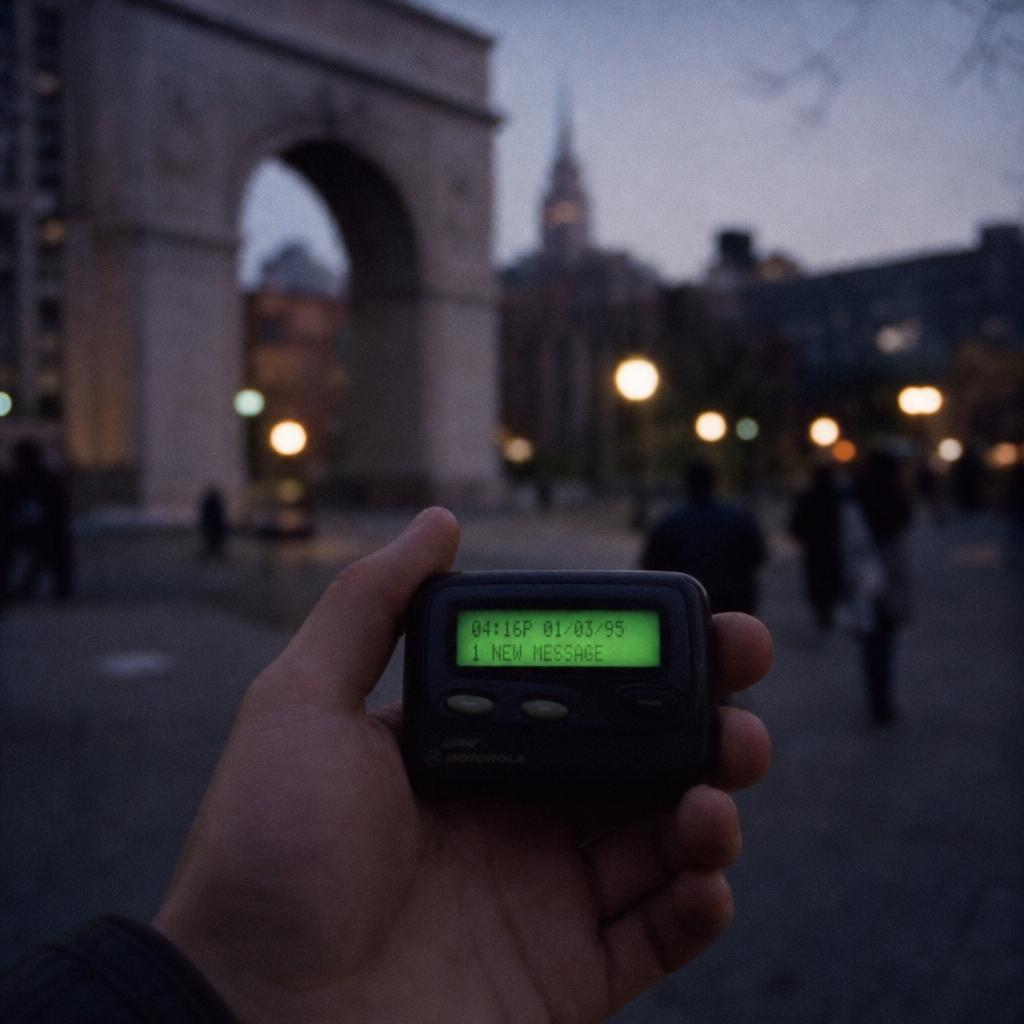
The second thing that climbed was the manner of buying. Standing at the fountain to score was a transaction with a location, a face, and a risk, and the professional market wanted none of the three. The spread of the pager and then the cellular phone through the late 1980s and 1990s turned marijuana into a delivery business — dialed, dispatched, and carried to an apartment door, a restaurant, or a lobby on the model of a pizza — and by the end of the decade the designer trade ran largely this way, off the street and out of view.4 The mechanic was the same one that ran the era’s other errands: a customer dialed a pager, left a callback number, and waited a few minutes for a dispatcher to ring back and take the order. The unit changed with the channel. The street had sold by the five-dollar nickel and the ten-dollar dime, weighed by eye on a corner; the designer trade sold the fifty-dollar “cube,” a couple of grams by weight, delivered to the door.4 The buyer never went to the drug. The drug came to the buyer, on a schedule, the way a restaurant delivered.
The emblem of the new model was Michael Cesar, who called himself the Pope of Pot. From a meatpacking-district storefront he named the Church of Realized Fantasies, Cesar ran a marijuana-delivery service reachable at 1-800-WANT-POT: five bicycle messengers, two employees taking phone orders, a promised delivery inside the hour, a business he claimed grossed forty thousand dollars a day at its peak, with product delivered free to AIDS patients as what he insisted was the sacrament of his church.5 The police raided the operation in November 1990; Cesar was convicted, paroled in February 1993, and arrested again that August.6 His own service did not survive the busts, but the form he had built did. A person with money and a telephone no longer went anywhere to buy the drug or was seen buying it; the drug came to the door.
The dealer, in this market, was often a friend of the house. In creative fields the person who delivered might also be a musician, a DJ, or a junior colleague, and the line between the sale and the friendship blurred until buying became a kind of socializing — a visit, a shared joint, gossip carried in along with the bag. The transaction lost its last resemblance to the corner. It arrived the way anything arrived to the comfortable: quietly, on request, without a trip to the edge of anything.
The Gloss
The third thing that climbed cost nothing to manufacture and mattered most: the gloss. Across the decade a run of public moments moved marijuana from the margins of respectable conversation toward its center. In March 1992 Bill Clinton, then a candidate for president, was asked on a New York television program whether he had ever used it, and answered that as a student in England he had “experimented with marijuana a time or two” but “didn’t inhale.”7 The evasion was itself the event. A man could now concede past marijuana use on the road to the White House, provided he narrated it as a thing he had failed to enjoy. The next year Cypress Hill released “Hits from the Bong” on Black Sunday, an album that entered the national chart at number one, carrying casual and unembarrassed marijuana reference into the pop mainstream.8 In November 1996 California voters passed Proposition 215, the first state law to permit marijuana as medicine, attaching to the drug a vocabulary of treatment and compassion the law had never before extended to it.9
None of this altered a milligram of the drug’s chemistry or a line of its legal standing. What it altered was association. By the late 1990s marijuana in the professional imagination was the safe drug — illegal but natural, gentle, clean next to the powders that had scared the same class a decade earlier — and with safety came altitude. The weed that in 1989 had belonged to the corner and the dorm was, by 1999, a writer’s drug, an architect’s drug, an actress’s drug, a thing passed among analysts at Goldman Sachs. When a major studio released the stoner comedy How High at the end of 2001, the drug’s arrival in the mainstream was no longer an argument anyone had to make.10 It had climbed the whole height of the city without changing itself at all.
In Public View
The climb had a floor beneath it that most of the people climbing never saw. The drug’s legal status did not soften as its reputation did. Marijuana remained a Schedule I substance under federal law throughout the period, and in New York it sat under a statute passed in 1977 that had reduced private possession of small amounts to a violation — a hundred-dollar fine, not a crime — while preserving a single exception: marijuana burning or “in public view” stayed a criminal misdemeanor, whatever the amount.2
That exception was the instrument already at work in the opening’s fifty-one thousand arrests. It also sorted the arrested by more than the search itself. In 2000, Black New Yorkers were under a quarter of the city’s population but more than half of those arrests, and Hispanic New Yorkers a further third of the arrests; the surveys of who actually smoked showed use running even across race, and in some measures higher among whites.1
So the same act carried two meanings, sorted by the body performing it. A joint passed after dinner in a downtown apartment was ambient, unremarked, a transgression that had lost the power even to interest the room. The identical joint in the pocket of a young man stopped on a street in Brownsville or the South Bronx was a misdemeanor arrest, a night in a cell, a mark on a record that followed him into every job application afterward. The drug rose for one set of people while the law came down on another, and the rise and the descent were not two stories. They were one drug, seen from opposite ends of the city.
Marijuana rose through the 1990s without changing what it was. Its chemistry held, its federal schedule held, the 1977 statute held. What moved was the gloss laid over it — the premium grade, the delivered convenience, the candidate’s confession, the language of medicine — and the movement reached only the people positioned to receive it. For everyone else the same plant stayed where it had always been, on the wrong side of a misdemeanor line the decade’s policing made busier than at any point in its history. The distance between the dinner-party joint and the arrest was never the drug. It was the pocket the drug was found in, and who could reach into that pocket in public and who was made to turn it out. The most democratically used drug in the city was among the least democratically punished, and everything unequal about it was added by the people standing around it.
California’s Compassionate Use Act, passed by voters in November 1996, would have reached Meridian as an assignable subject for The Essay: a magazine that had already treated the drug as an ambient, half-decriminalized nuisance would have found in the new medical vocabulary a way to write about marijuana without writing about the corner, and the piece would have run in an early-1997 issue without much argument on the floor.
The other pitch would not have survived the room. Someone would have carried in the misdemeanor-arrest numbers — the year the public-view stops crossed fifty thousand — and proposed setting them beside the season’s other marijuana copy, the light item on the joint’s return to the downtown dinner table. Counsel would have been consulted, and would have reached for the language of exposure without quite meaning libel: printed straight, the arrest figures would have indicted a readership that smoked the same drug and paid nothing for it, in the same well as a piece that treated the drug as harmless. The room would have called it a legal problem because that word traveled further than the true one, and the pitch would have gone back into the queue behind stronger claims on the well.
Footnotes
-
Andrew Golub, Bruce D. Johnson, and Eloise Dunlap, “The Race/Ethnicity Disparity in Misdemeanor Marijuana Arrests in New York City,” Criminology & Public Policy 6, no. 1 (2007): 131–164. Marijuana-in-public-view arrests rose from fewer than 1,000 in 1990 to roughly 51,000 in 2000. The study reports Black residents as under a quarter of the city’s population (23 percent) but 52 percent of MPV arrestees, and Hispanic residents as 32 percent of arrestees, while self-report surveys showed marijuana use running even across race or higher among whites. ↩ ↩2
-
New York Marihuana Reform Act of 1977, amending N.Y. Penal Law article 221. Unlawful possession of twenty-five grams or less (§221.05) is a violation carrying a fine of up to one hundred dollars; possession of marijuana burning or open to public view (§221.10) is fifth-degree criminal possession, a Class B misdemeanor punishable by up to three months. ↩ ↩2 ↩3
-
Moby, “In the Early ’80s My Friends and I Spent a Lot of Time in Washington Sq. Park,” moby.com (journal). The catalogue of dealer pitches is the musician’s own recollection of the park in the early 1980s; “dust” in the patter denoted PCP. ↩
-
Stephen J. Sifaneck, Geoffrey L. Ream, Bruce D. Johnson, and Eloise Dunlap, “Retail marijuana purchases in designer and commercial markets in New York City: Sales units, weights, and prices per gram,” Drug and Alcohol Dependence 90S (2007): S40–S51. The “designer” and “commercial” market distinction, and the movement of the designer trade toward delivery, are the authors’. ↩ ↩2 ↩3
-
Mike Sager, “The High Life and the Strange Times of the Pope of Pot,” Rolling Stone, June 13, 1991. Cesar learned the trade in Amsterdam in the 1970s before opening what the piece describes as an early New York delivery operation. ↩
-
“Greenwich Village’s ‘Pope of Pot’ busted again,” United Press International, August 4, 1993. ↩
-
“Clinton admits to marijuana use in past,” United Press International, March 29, 1992. The remark was made on the WCBS program Sunday Edition. ↩
-
Cypress Hill, Black Sunday (Ruffhouse/Columbia, 1993). The album entered the Billboard 200 at number one on release in July 1993. ↩
-
California Proposition 215, the Compassionate Use Act of 1996, approved by voters November 5, 1996 — the first state law to permit the medical use of marijuana. ↩
-
How High, dir. Jesse Dylan (Universal Pictures, 2001), released December 21, 2001. ↩