Communication: The Phone, the Pager, the Payphone, 1989–1996
Subscribe
https://meridian-archive.com/feed.xmlOpen in your app, or paste the link above into any other:
The Beeper on the Belt
A pager clipped to a teenager’s belt could get him suspended in a New York City school in the early 1990s, and the administrators who wrote that policy did not have to argue for it: the device belonged, in the public mind, to two groups at opposite ends of respectability, and the overlap between them was processed by the city’s institutions as routine rather than remarkable. It belonged to the on-call professional — the physician, the contractor, the trades supervisor, the field technician — for whom being findable at any hour was the unlisted condition of the work. And it belonged, in the same public mind, to the street drug trade, for which a number that summoned a man without recording a word of what passed between the parties was an operational asset built to order; the association was firm enough that a teenager wearing a beeper drew a particular kind of look on the sidewalk, and some schools banned the devices outright on that reasoning alone, filing a consumer electronics purchase in the same disciplinary category as a weapon.1 By 1994 roughly twenty million pagers were in operation in the United States, worn by about seven percent of the population — doctors, foremen, messengers, dealers, and everyone between them carrying the identical small plastic box, legible to a principal or a patrolman as evidence of one trade or the other before it had made a sound.1
What made the device necessary at all was a condition the city’s institutions had adapted to without remarking on it, the same way they had adapted to the beeper’s double life. A person who walked out of a Midtown building at noon in 1990 could not be reached again until he decided to be. Nothing rang in his pocket. Between the moment he stepped onto the sidewalk and the moment he next stopped at a telephone — a booth on the corner, a diner’s wall unit by the register, the phone on a colleague’s desk across town — he was, to everyone trying to find him, simply gone. The gap was not a failure of the system. It was the system. Reaching one named person at one named minute was not a thing the city’s wiring was built to do, and the people who lived inside that wiring arranged their days around the fact: they left word where they were going, named an hour they would call in, and treated the interval between messages as dead air nobody could cross.
The machinery that filled the interval was a set of unconnected technologies, none of which spoke to any of the others. A pager could reach a man on the street but could not carry his answer back. A payphone could carry the answer but had to be found, in working order, with the right coins in hand. A machine at home could hold a message but only for whoever was willing to stand and listen to it play. Each device closed one edge of the gap and left the others open, and moving a single piece of information from one person to another often required all of them in sequence, each adding its own small tax of labor and time. The period had a rhythm of contact that later decades lost: not instant, not constant, but staged — a series of deliberate stops at fixed points where a person made himself briefly available and then went dark again.
The Beep and the Booth
The pager was the one instrument that reached across the gap, and it reached in one direction only. It could summon; it could not converse. A small plastic box worn on the belt, it received a signal broadcast over a dedicated radio frequency, sounded a tone or buzzed against the hip, and displayed a telephone number on a narrow liquid-crystal strip — the number of whoever wanted the wearer to call back. That was the whole of what it did. It told a person that he was wanted and where to aim his return call, and then it left him to find a telephone on his own.
The device spread through everyone whose work sent them out of reach of a desk: the messenger, the sound engineer, the caterer, the freelance anything who could not afford to miss the call that carried the next job.
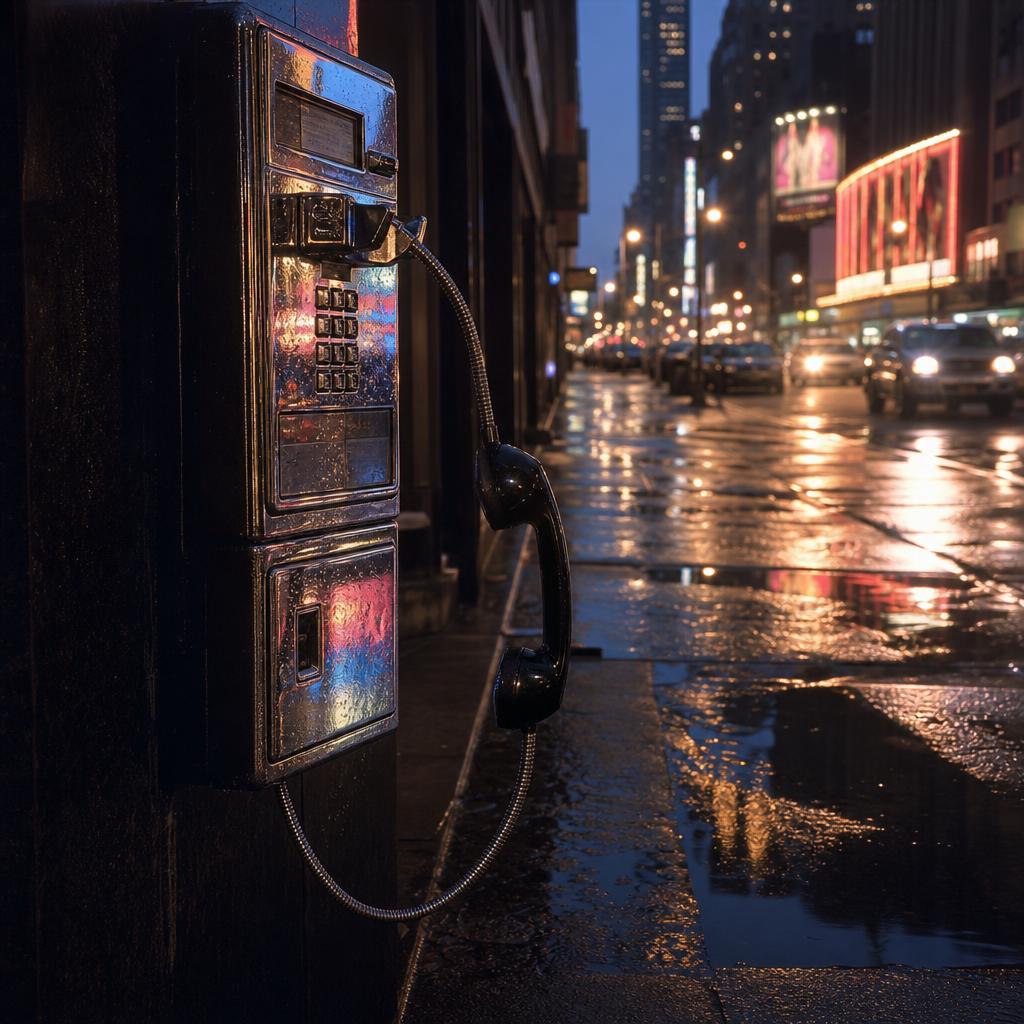
What the pager set in motion was the payphone dance — the search, on foot, for a public telephone that worked. New York in the early 1990s carried tens of thousands of them, bolted to building faces and standing in aluminum half-booths at the curb, and a meaningful fraction of any given day’s inventory was broken: receiver cut from its armored cord, coin slot jammed with a matchbook, dial tone absent, mouthpiece gone. A person with a number blinking on his hip walked until he found one that gave a tone, fed it a quarter — the price of a local call, standardized at twenty-five cents through the decade2 — and dialed with a finger while the street went on around him at full volume. The receiver carried the accumulated grime of every hand that had held it. The traffic behind him did not lower itself for his conversation. If the call ran long, a line formed, and the pressure of the person waiting was a physical thing at his back. Those who made many such calls carried a plastic calling card with a prepaid balance and a personal code, punched in ahead of the number, to spare themselves the pocketful of quarters the day would otherwise demand.
The Blinking Light
The machine that waited at home ran on a cassette and a relay. A caller who reached no one heard a short recording in the resident’s own voice, then a tone, then a fixed span of tape on which to leave whatever he had come to say; the machine logged the message and, on most models, lit a small red indicator that blinked until someone pressed a button to hear what had accumulated. By the middle of the 1990s a majority of American households owned one.3 The blinking light was the first thing a person saw on coming home — a count of obligations logged in his absence, waiting in a fixed order to be discharged.
The machine changed the etiquette of the telephone in two directions at once. It made a person reachable when he was out, which was its purpose; it also made him reachable when he was in and did not wish to be, which its designers had not intended but which its users immediately exploited. Screening entered daily practice as a standard maneuver: the resident let the machine answer, stood beside it while the caller’s voice came through the small speaker, and decided in real time — hearing who it was and, often, what they wanted — whether to lift the receiver and interrupt or to let the tape run to its end. The caller talking into the void frequently knew, or suspected, that the person he was addressing stood a few feet from the speaker listening to every word and choosing not to answer. This was understood on both ends and rarely spoken of.
The outgoing message was a small composed performance, thirty seconds of self-presentation that every caller would hear, and its conventions divided along temperament and class. Some recorded a flat, correct announcement of the number reached and an instruction to leave a message. Some read a line of studied wit. Some let a child deliver it, or a piece of music run under the voice. Getting it wrong — too long, too clever, too casual for a professional line — was a minor social exposure, replayed to everyone who called until the resident thought to change it. The cassette itself imposed limits the later technology dropped: tape ran out, and a machine that had taken a full reel’s worth of messages accepted no more until someone listened through and reset it; a caller reaching a full machine heard the tone cut short and the line drop. Toward the end of the period the cassette gave way to a memory chip, the moving tape to solid-state storage, and the fixed-length reel to a message capacity measured in minutes of silicon — a quiet change in the hardware that left the social choreography of the blinking light exactly where it had been.
The Ocean
A call that crossed the Atlantic in this period traveled one of two paths, and the person placing it had no say in which. The signal left the caller’s line, reached a switching center, and was handed to whatever transatlantic circuit had capacity at that instant — either a satellite parked in geostationary orbit more than thirty-five thousand kilometers above the equator, or a fiber-optic cable lying on the ocean floor. The first transatlantic fiber cable, TAT-8, had entered service in December 1988, built jointly by American, British, and French carriers to carry tens of thousands of simultaneous conversations at once, and its capacity was filling fast; but the older satellites remained in the rotation, and a given call took whichever route the switch assigned.4
The difference was audible in the first second. A satellite call climbed to orbit and came back down, a round trip that imposed most of a second of delay between a word spoken and the same word heard at the far end — enough to break the reflex of ordinary conversation, so that both parties learned within a sentence to wait, to leave a beat before answering, to speak in turns like operators on a radio. A cable call carried the same voices with a delay too small to feel. On either route the sound arrived thinner than a local call, a faint hiss under it, the dynamic range flattened by the compression the distance required. And once the connection reached a foreign exchange, it announced its arrival in a foreign grammar: the ring a caller heard was not the American double tone but whatever pattern the destination country used — in much of Europe a single clipped tone, held a second and followed by a long silence, a sound that told the caller, before anyone picked up, that his voice had crossed an ocean and reached another system.5 The call was expensive enough that its cost governed its length — a dollar or more a minute in daytime hours, dropping in the evening and again late at night, so that transatlantic calls to family clustered after dark and stayed short, watched by one eye on the clock.
For a magazine with a correspondent abroad, this was the working reality of the foreign desk: a reporter in a distant capital or a war zone was reachable only through the same staged, costly, latency-bruised channel, and the interval between filings was governed by when he could next reach a line that would hold. The story came home down a wire that thinned the voice and metered the minutes, and the editor on the New York end learned to say what mattered first, before the connection or the budget gave out.
The devices of the interstitial years were not primitive versions of what came after. They were a different arrangement of human contact, built around an absence that later technology closed and that the period simply lived inside. To reach another person took work and luck: a pager to summon, a working payphone to answer, a coin or a card, a machine to catch what the summons missed, an operator or an ocean cable to carry the rest. The labor fell unequally, as such labor does — the editor with an assistant to take her calls and a service to hold them stood at one end of it, the messenger hunting a working payphone with a number blinking on his hip at the other — but the underlying condition was shared across the whole city. A person who left the room was gone until he chose to return, and everyone he knew arranged their expectations around the gap. What the era possessed, and what its ease of contact had not yet dissolved, was the plain daily experience of being, for hours at a stretch, genuinely out of reach — and the small deliberate rituals by which a person, when he wanted to, made himself found.
Meridian would have taken the technology piece as the decade turned: the office going digital, the first cellular handsets appearing in the hands of the people who could bill them, the promise that a person might soon be reachable anywhere at any hour. A clean forward-looking story, sourced to the carriers and the handset makers, it would have sat well in the well and read as progress. The harder assignment, the one nobody would have made, would have concerned the people at the other end of the same wire — the overnight operators at the answering services that doctors and lawyers and a few senior editors would have paid to hold their calls, the women in outer-borough rooms taking down messages by hand through the small hours for clients they would never meet. The editors would have turned it over once and let it drop, because the access could not have been gotten: the services would have sold confidentiality, and no manager would have seated a reporter at the overnight board to listen in on other people’s messages. Without the board there would have been no scene, and without the scene nothing to write, and the idea would have slid off the list by the next budget meeting.
A senior editor would have carried a pager for a few months, found it an intrusion, and let the battery die. She would have reached her own doctor’s service at eleven at night and given her message to a live voice in Canarsie or Astoria, a woman writing on a pad in a room the editor would never picture, and she would have thanked her and hung up and forgotten her by morning. She would have stood at a payphone on Sixth Avenue in the rain, a quarter warming in her glove, waiting behind a man who would have been shouting a number into the grime because someone would have beeped him and he would have had nowhere else to answer from. The woman in Canarsie would have been doing work, and the editor would never have learned her name. The man in the rain would have been answering a summons from a booth in the weather because the system would have left him nowhere else, and the editor would only have wished he would hurry. The piece would have been standing at the next phone, and no one on the floor would ever have called it in.
Footnotes
-
International Directory of Company Histories, Vol. 11 (St. James Press, 1995), entry on Paging Network Inc.: pagers used by roughly seven percent of the U.S. population, nearly twenty million units in operation, in 1994. ↩ ↩2
-
“Payphone,” Wikipedia, on the history of U.S. local coin-call rates: five cents in the 1930s, ten by the 1960s, fifteen in the 1970s, and twenty-five cents standardized from the mid-1980s through the 1990s. ↩ ↩2
-
David Morton, Off the Record: The Technology and Culture of Sound Recording in America (Rutgers University Press, 2000), on the diffusion of the home answering machine to a majority of U.S. households by the mid-1990s. ↩
-
IEEE Engineering and Technology History Wiki, “Milestones: Trans-Atlantic Telephone Fiber-Optic Submarine Cable (TAT-8), 1988”: in service December 14, 1988; built by AT&T, British Telecom, and France Télécom; carrying roughly forty thousand simultaneous circuits. ↩
-
“Ringing tone,” Wikipedia: the North American ring-back is a dual 440-plus-480-hertz tone, two seconds on and four off; the German Freizeichen is a single 425-hertz tone, one second on and four off. ↩