Communication: The Digital Transition, 1994–2001
Subscribe
https://meridian-archive.com/feed.xmlOpen in your app, or paste the link above into any other:
The Machine That Screamed
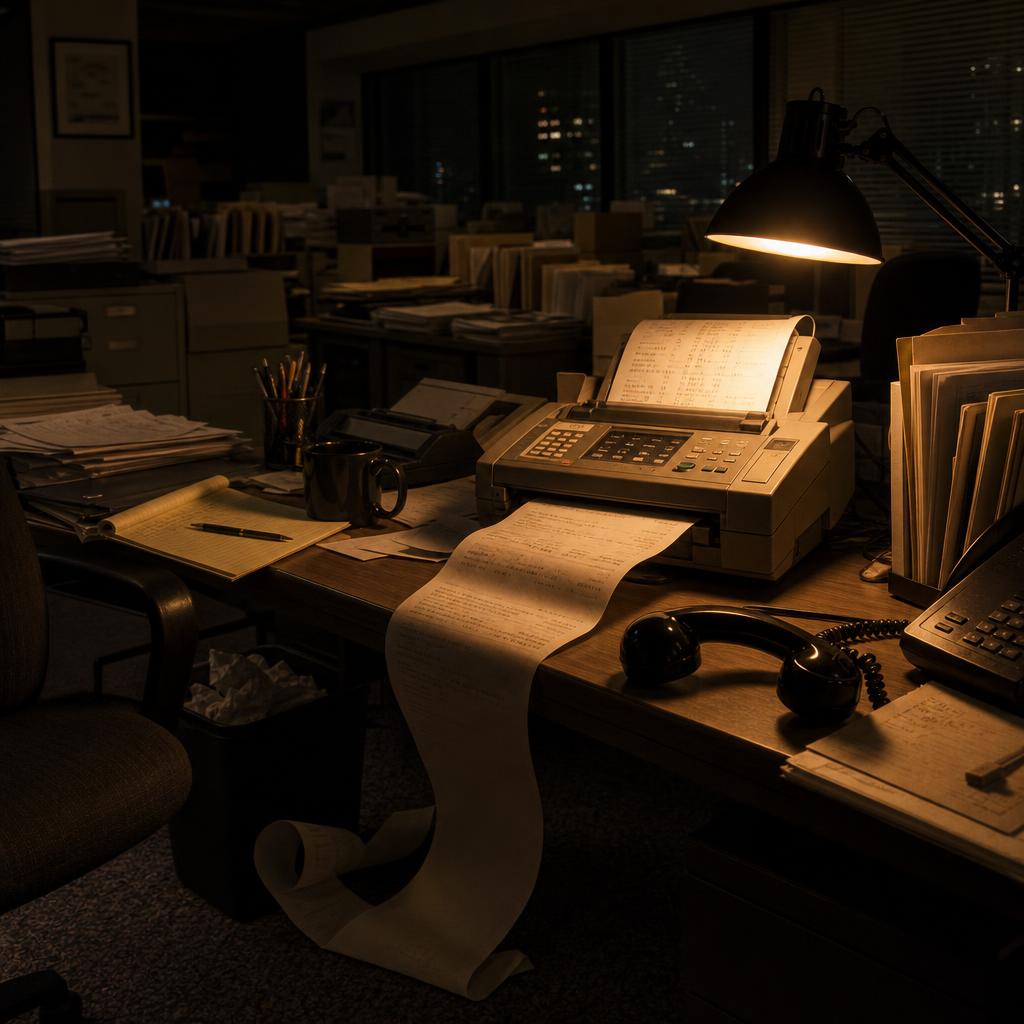
A fax machine answered a call by screaming, and an international standards body had written the scream down to the hertz. The receiving machine, on picking up the line, emitted a continuous tone at 2,100 hertz and held it for between two and a half and four seconds — the CED tone, the called-station signal, specified in ITU-T Recommendation T.30 down to its frequency tolerance, whose stated purpose was mechanical: it disabled the echo suppressors on the phone circuit so the two machines could hear each other cleanly.1 Anyone who lifted a voice handset on a shared line while a fax was coming in got the tone directly in the ear and hung up fast. On the calling side there was a thinner sound, the CNG tone at 1,100 hertz, pulsed half a second on and three seconds off — the beep, beep, beep of a machine dialing out, likewise specified to the hertz. Between them came the warble of the modems training on each other, five to ten seconds of ascending and descending squeal, and then the page began to move. In a Midtown magazine office in 1990 the sequence played a dozen times a day and no one looked up.
A signature transmitted by fax carried no settled legal standing through most of the 1990s. It was not reliably binding on a contract of consequence until the federal Electronic Signatures in Global and National Commerce Act, signed the last day of June 2000 and in effect that October;2 until then, standard commercial practice — printed on no form, codified in no statute, understood in every office that used one — ran on a phrase attached to countless transactions: fax with originals to follow. A contract, a lease, a syndication agreement closed in minutes on a signature that a court, tested, might not have enforced; the paper that would actually have settled the question trailed behind it for days, by mail, unremarked.
What the fax produced, and what mattered, was a record at both ends. The sending machine printed a transmission report — a single extra page, almost an afterthought, that said TRANSMISSION OK and listed the number dialed, the pages sent, the time. The receiving machine put the pages themselves into a tray. A document sent by fax existed, physically, in two places, and its sender held proof of the fact. That redundancy was the medium’s whole character. A galley proof marked in pencil by a typesetter reached the copy desk as an image of the marked page, not a description of it, faster than a messenger could carry it and slower than a phone call that could carry no marks at all. A fact-checker sent a source the disputed paragraph and asked for confirmation by end of day. A contract went out for signature and came back with a signature on it, the original to follow by mail.
The machine that did this was communal, and communal meant public. The central fax stood in the editorial bullpen or by reception, and anything emerging from it could be read by anyone walking past. A cover sheet stamped CONFIDENTIAL in capitals was the only available security, and it secured nothing; the protocol that actually worked was a phone call first — I’m sending a fax now, are you at the machine — and a person standing at the tray until the pages finished. A confidential fax sent to a public machine and left sitting was a document anyone could pick up, and a leak was often nothing more sophisticated than that. The etiquette that governed the rest was unwritten and self-enforcing: a fax for someone above you, you did not read; a fax for someone below you, you read the cover sheet and, if it looked interesting, the first page; and no one enforced any of it.
The paper itself was provisional. Through the early 1990s the workhorse machines printed on thermal stock: a slick roll, faintly warm off the platen, faintly chemical to the nose, that curled back into its roll shape within minutes and smeared under a thumb. Thermal print faded — legible for months, gone in a few years under desk light — so anything important that arrived on it was photocopied onto plain paper for the file before it could disappear. By 1993 the central machines had gone to plain-paper laser and the thermal rolls retreated to the copy desk and the home office. The morning began with the overnight roll spilling onto the floor, half of it unsolicited: real-estate pitches, mortgage rates, ATTENTION OFFICE MANAGER. Unsolicited fax advertising had been federal law’s target since the Telephone Consumer Protection Act of 1991, which banned it outright; enforcement was thin, and the junk kept coming.3 The ritual was to tear the roll along its perforations, drop the junk, and find the contract or the legal letter or the filed story buried in the middle.
Filing From the Field
For a correspondent abroad, the fax was not office furniture but the instrument that turned a written story into a filed one, and the ritual around it was elaborate because every step could fail. The story was typed in a hotel room on a portable — through the early 1990s often a notebook-sized machine with a built-in modem and days of battery life on a handful of cells, the text editor that had filed newspaper copy from the field since 1983. It was printed at a press center, or handwritten clean and re-typed on a rented typewriter where no printer existed. Then came the search for a working fax.
In besieged Sarajevo the fax was at the Holiday Inn, a building designed for the 1984 Winter Olympics that sat a couple of hundred meters off the front line, on the stretch of boulevard the press called Sniper Alley, and served as the base for the foreign press for the length of the siege, from 1992 until it lifted in February 1996.4 In Mogadishu it was the Sahafi — the name is Arabic for journalist — on the K4 roundabout. The correspondent dialed an international operator or an AT&T calling-card access number, then the New York fax number, then stood at the machine and fed pages one at a time, watching for the confirmation tone on each. If the line dropped on page four of seven, the redial began: dial, busy, hang up, sixty seconds, dial again, an afternoon of it. A story sent at nine at night in Sarajevo reached New York at three in the afternoon, in time; a story sent at two in the morning sat on the machine until the assistant arrived at nine. And a story could transmit perfectly into a New York machine that had run out of paper, so the last step was always a phone call: did pages one through seven come through. A correspondent who had lost the number once, dictating it from memory under fire, might carry it written in his own hand on a folded paper in his wallet, trusting the paper over the memory. For him the answer tone at the far end was not noise but reassurance — proof of a building with power, a working line, a place to sit afterward — and the scream that emptied a New York office of attention was, an ocean away, the sound of being safe enough to file.
The killing in Rwanda in 1994 broke the ritual, because there was no press hotel to file from. Most foreign correspondents covering the genocide were based not in Kigali but in Nairobi, in neighboring Kenya; the reporters in Rwanda when it began numbered two, and most foreign nationals were evacuated within the first days.5 The Hôtel des Mille Collines, later made famous, was a refuge where more than a thousand people sheltered — not a press base; the similarly named Radio Télévision Libre des Mille Collines was the station broadcasting the killing. Reporters like Catherine Bond reached the interior by chartering light aircraft toward the Ugandan border and catching UN aid flights into Kigali, then processing and transmitting from Nairobi days later. Coverage in the first weeks was sparse and badly framed, much of it filed from Nairobi after a flight out, the lag between event and page longer than any siege had imposed.5
Photographs did not travel this way at all. A fax rendered an image at 200 dots per inch in pure black and white, no gray — a photograph came out a high-contrast smudge, useful only to say this is the frame I mean, never to print. The image itself moved by its own hierarchy of machines. The portable negative scanner-transmitter that the wire services carried by the late 1980s could send a single color photograph over an ordinary phone line in about half an hour.6 The first commercial digital camera reached the field in May 1991 — a Nikon body tethered to a storage unit, 1.3 megapixels, roughly twenty thousand dollars — and remained wire-service equipment for years.7 For a magazine working on film, a photograph shot in a place without a lab was couriered out on the next flight, developed elsewhere, contact-printed, the sheet faxed back as a smudge for frame selection, the chosen negatives shipped again. The gap between what a photographer saw through the lens and what a reader saw on the page ran, in the worst cases, five to ten days, and no amount of standing at a machine could close it. The lag was not anyone’s failure. It was how the technology worked.
Moving a photograph before digital, 1988–1995
| Method | From | Time per image | Note |
|---|---|---|---|
| Portable negative scanner-transmitter | 1988 | ~30 min, color, over phone line | Briefcase-sized; wire-service standard |
| Digital camera, tethered storage | May 1991 | Transmit by modem | 1.3 megapixels; ~$20,000; wire-service tier only |
| Fax machine | Throughout | Minutes | Unprintable; frame-selection proxy only |
| Air courier, film originals | Throughout | 2–5 days international | The default for negatives and transparencies |
The Silence
Email arrived inside the office before it reached the outside world, and it arrived by rank. Internal electronic mail — the closed systems that carried a message from one desk to another but not past the building’s walls — appeared for senior staff around 1992, good for lunch? and the internal calendar and nothing external. Through 1993 and 1994 accounts on the services that could reach outside proliferated, but they were handed down the masthead in order: senior editorial received addresses first, the assistant tier last. For a stretch of the mid-1990s an editor’s reachability by email was a fact about the editor’s standing. By 1996 the order had inverted at the bottom, and a new assistant got an account on the first day; by 1997 the fax was for legal correspondence, signed documents, and the older subjects who still worked that way.
What email killed first was the apparatus of the fax: the pre-printed cover sheet with its boilerplate confidentiality block that the lawyers had written and no one read, the morning roll of thermal paper, the sound. What it killed that people missed was the transmission report. An email left, and nothing printed to say it had arrived; the sender was left with silence, and silence was distrusted at first by everyone who had spent a decade holding a page that said TRANSMISSION OK. A correspondent who had learned to file in a war kept faxing the story and emailing it for a year, belt and suspenders, and said nothing about why.
The change registered on the business card. A card printed before 1990 carried one number; through the mid-1990s it stacked telephone over fax, the two given equal weight; by the end of the decade email had taken the second line and the fax number had slid to the bottom, parenthesized, or dropped. The holdouts were consistent. Lawyers lagged, and faxed legal correspondence stayed standard. A profile subject in his seventies, sent a draft to check, returned it as a fax with his corrections in pen across the page — the handwriting on the transmitted sheet being exactly the thing email could not carry.
Some things email could not yet carry: the hand-marked galley proof, still an image no email attachment of the period reproduced, and the legally settled signature, still years off. And a class of people worked without either machine. A freelance writer with no fax could not be sent a contract on Friday to sign by Monday, and the writer without an office had one public utility for the problem: the copy shop.
The largest of them had been founded in 1970 by Paul Orfalea, whose nickname, from his red hair, was Kinko — a hundred square feet of former hamburger stand near a California campus, a five-thousand-dollar loan, four cents a copy.8 Its decisive policy was to stay open twenty-four hours, which drew the students, then the paralegals and screenwriters and freelancers on deadline, and by the mid-1990s a Midtown branch rented Macintoshes by the hour and sent faxes at a dollar or two a page domestic, more abroad. For a writer without an office it was where a document went home. A freelancer paying seven dollars a page to fax a letter across an ocean kept the receipt.
The fax-to-email handover at a magazine, 1992–1997
| Year | Inside the office | External correspondence |
|---|---|---|
| 1992 | Internal mail for senior staff; calendar, short notes | Everything external is fax |
| 1993 | Outside-reaching accounts for senior editorial only | Drafts circulate internally; external is fax |
| 1994 | Accounts proliferating internally | Formal external is fax; informal is email |
| 1995 | Email normal on the floor | Most non-legal external is email; legal and galleys fax |
| 1996 | Junior staff get accounts on arrival | Contracts and legal fax; most else email |
| 1997 | Email dominant | Fax for signed and legal documents and older subjects |
The Destination
At home the internet arrived through a single company and a single sound. America Online was, for most New Yorkers who got online in the mid-1990s, the gateway itself — the disc came in the mail, the software dialed a local number, and the modem’s negotiation played out loud through a speaker: the dial tones, the ring, the two-note handshake, the long grinding hiss of two modems agreeing on a speed. Then a voice said You’ve got mail — three words a voice actor had recorded at home on a cassette recorder in 1989 for two hundred dollars, and that a decade later named a movie.9 Mail was a place one went to, on a machine that occupied a desk. The internet was a destination, entered and left, not a condition one carried through the day.
The economics that made it a mass medium changed on a single date. Through 1996 AOL billed by the hour; on the first of December that year it went to a flat rate of $19.95 a month for unlimited use, and more than a million people acted on the arithmetic within weeks.10 The network could not carry them. Callers got busy signals for weeks — the press called it America On Hold — and several state attorneys general opened investigations into a company selling access it could not deliver. The value of the thing had crossed a threshold: it was worth joining because so many others had joined, and the rush of the newly persuaded overwhelmed the wires they were persuaded onto. For a stretch of weeks the network’s proof of value and its failure to deliver had the same single cause.
The Machine in the Wall
The same arithmetic had already reshaped money. The automated teller machine was worth adopting for a bank in proportion to how many machines already stood in how many places, because a cash card was useful only where a compatible machine could be found; a formal study of the period found that a bank’s move to adopt tracked the number of its branches and the size of its deposits, the network effect and the scale effect together.11 The visible residue of that logic was three different banks’ machines on a single block and a customer reading the logos for the right one. By the second half of the decade the machines had multiplied past the threshold and become the default, and the human teller who had counted the cash out onto the counter and stamped the deposit slip in front of the depositor was, for most routine transactions, no longer part of the exchange.
What replaced the teller was silent in the same way email was silent. A deposit went into a machine and produced a receipt printed on thermal paper — the same slick, fading stock the fax had used — that grew lighter with the months until the record of the transaction was a blank white slip. The count happened out of sight, inside the machine, and was trusted because there was no alternative to trusting it. Getting cash, meanwhile, had become an act performed under observation: a city law of the middle of the decade required mirrors and cameras at the machine, and the ordinary business of withdrawing forty dollars acquired a reflex of the shoulder-check, the wallet held over the keypad. The transaction that a whole line could once watch a teller complete had moved inside a box, behind glass, into a receipt that did not last the year.
What the digital transition took was not speed — the fax was already fast, the teller already quick — but the confirmable transaction: the thing you could hold, hear finish, and prove had happened at both ends. The fax printed a report that said the pages had arrived; email replaced it with a silence that everyone distrusted before they learned to trust it. The teller counted the bills onto the counter and stamped the slip where you could see it; the machine did the counting inside itself and returned a receipt that faded to nothing. The new systems obeyed a single rule the old ones had not: they were worth joining only once enough others had joined, so their arrival came not as a line but as a rush, the busy signal and the crossed threshold. The city that had run on the audible handshake and the stamped slip did not decide to give them up. It found, transaction by transaction, that the confirmation had gone quiet, and that quiet, after a while, was simply what getting through to someone felt like.
Meridian’s own turn onto the wire — the disc in the mail, the flat-rate rush, the busy signal that overwhelmed America Online in December 1996 — would have been a story an editor could have assigned without indicting anyone on the floor, and it would have gone into The City for the February 1997 issue, charmed and a little pleased with its own competence, the arithmetic of $19.95 a month quoted so a reader could feel he had done the sum himself.
A second piece, raised once in conference and no further, would have gone at the room itself: the paste-up hands the account order would have made redundant, and the reachability that would have become a fact about rank on the floor. The copy chief would have gotten his address in the first wave and thought little of it; his best copy editor, a single mother junior enough to wait two years for hers, would have noticed the wait without saying so. The doubt would have been simpler than truth: whether a reader outside the building would have cared what an account meant inside one — and not clearly, the room would have decided, the reader the magazine edited for.
An articles editor would have claimed the E-Sign Act’s signing that October for The Front’s December 2000 issue — the desk’s own contracts, faxed for a decade, would now have been legally sound over the wire.
Footnotes
-
International Telecommunication Union, ITU-T Recommendation T.30, Procedures for document facsimile transmission in the general switched telephone network. The 2,100 Hz CED tone is specified identically to the echo-suppressor-disabling tone of ITU-T Recommendation G.164. ↩
-
Electronic Signatures in Global and National Commerce Act, Public Law 106-229, signed June 30, 2000, effective October 1, 2000. ↩
-
Telephone Consumer Protection Act of 1991, Public Law 102-243 (enacted December 20, 1991), which prohibited unsolicited fax advertising; FCC implementing rules followed in 1992, with meaningful enforcement deferred to the Junk Fax Prevention Act of 2005. ↩
-
“War Hotels — Holiday Inn Sarajevo: In the Eye of the Siege,” Al Jazeera, 2018. The hotel, designed by Ivan Štraus for the 1984 Winter Olympics, housed the foreign press through the 1992–1996 siege. ↩
-
Allan Thompson, ed., The Media and the Rwanda Genocide (Pluto Press / International Development Research Centre, 2007), on the Nairobi press base, the near-absence of foreign correspondents in Kigali when the killing began, and the mischaracterization of the early coverage. ↩ ↩2
-
“This Is How AP Journalists Sent Photos From the Field in the 1980s,” PetaPixel, October 13, 2021, on the AP Leafax 35 portable negative scanner-transmitter (introduced 1988), housed in a briefcase and requiring roughly thirty minutes to send a color photograph over an analog line. ↩
-
Jim McGarvey, The DCS Story: Seventeen Years of Kodak Professional Digital Camera Systems, 1987–2004 (self-published monograph, 2004), on the Kodak DCS 100 (May 1991), a Nikon F3 body with tethered storage, 1.3-megapixel sensor, launch price approximately $20,000. ↩
-
Paul Orfalea and Ann Marsh, Copy This! Lessons from a Hyperactive Dyslexic Who Turned a Bright Idea Into One of America’s Best Companies (Workman, 2005), on the 1970 founding in Isla Vista, the $5,000 loan, the four-cents-a-copy start, and the twenty-four-hour policy. ↩
-
Bill Chappell, “Elwood Edwards, the Voice of AOL’s ‘You’ve Got Mail’ Alert, Dies at 74,” NPR, November 8, 2024, on the 1989 home recording, made on a cassette recorder for $200. ↩
-
Kara Swisher, AOL.com: How Steve Case Beat Bill Gates, Nailed the Netheads, and Made Millions in the War for the Web (Times Business / Random House, 1998), on the December 1, 1996 move to $19.95 flat-rate unlimited access and the busy-signal crisis that followed. ↩
-
Garth Saloner and Andrea Shepard, “Adoption of Technologies with Network Effects: An Empirical Examination of the Adoption of Automated Teller Machines,” RAND Journal of Economics 26, no. 3 (Autumn 1995): 479–501. ↩