Sound: The Auditory City, 1989–2001
Subscribe
https://meridian-archive.com/feed.xmlOpen in your app, or paste the link above into any other:
The Discount That Bought Noise
New York State’s insurance regulations entitled the owner of a car fitted with an anti-theft alarm to a discount on the annual premium — a line item written into the rate schedule that asked only whether the device was installed, not whether it worked. It did not, in any way that mattered. A practiced thief could disarm a common alarm in about two seconds, four in five thieves could take an alarmed car anyway, and the great majority of the alarms that actually sounded were false — set off by heavy trucks, by temperature swings, by thunder, by a cat crossing a warm hood.1 The state kept the discount on the books regardless, and a booming aftermarket industry — Viper, Hornet, Clifford, Code-Alarm, names chosen to sound like the thing they were sold against — sold the hardware into that incentive at a rate that built it into a $500 million business. The device guarded the individual car poorly and degraded the shared night comprehensively, and the statute that subsidized it never asked which.
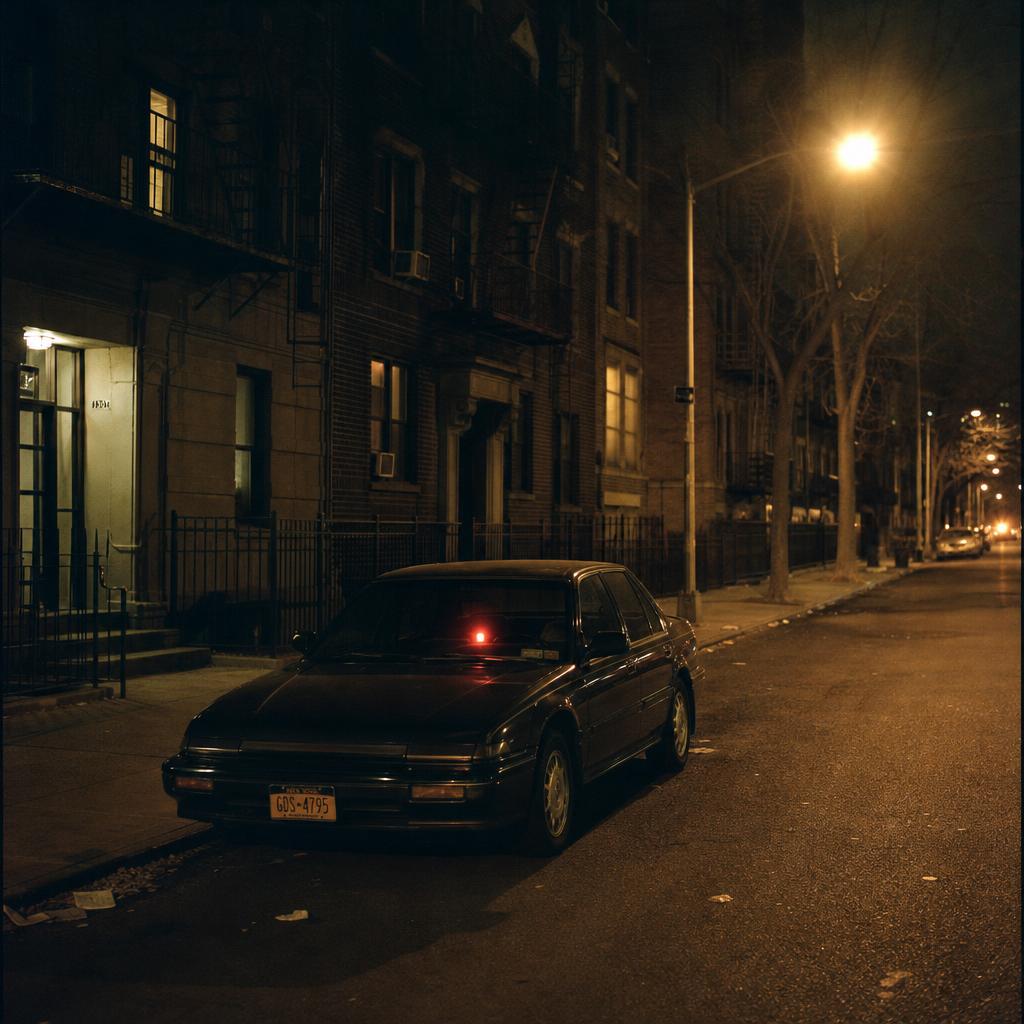
By 1990 the sound a New York block most reliably made after midnight was not a voice or a police siren but a parked car defending itself. A car left at the curb on an outer-borough street was, more often than not, wired to a six-tone electronic alarm that ran through its full repertoire in sequence — a rising-and-falling wail, a faster yelp, a descending swoop, an ascending glide, a two-tone warble, a run of flat percussive beeps — and then, half a minute to a minute later, started the cycle again. The city noise code required an alarm to silence itself after three minutes. Compliance was close to theoretical. An alarm tripped by a passing truck at two in the morning could run twenty minutes before a battery drained or an owner came down, and on a bad night a single residential block might register three or four separate events, each one waking the next by sympathetic vibration and shared nerves.
The alarms answered a real emergency, which was what let the discount survive as long as it did. Through the late 1980s the city was losing cars at a rate that crested around 1990, when — in the account of one policy quarterly — an ill-managed and demoralized police department “had all but decriminalized car theft,” and thieves lifted upward of a hundred thousand vehicles a year.2
The burden did not land evenly. The pitch of the siren sat in the band where the human ear is least able to let a sound go, and the constant shifting between tones was engineered precisely so that no listener could adapt to it and stop hearing it. On a residential street of facing brick walkups, the sound bounced off the parallel façades and doubled back, so that a body four floors up, behind a single-pane window with worn weatherstripping, took in the cycle at roughly the volume of a conversation held in the room — not loud enough to be an event, loud enough to keep a light sleeper awake. The neighborhoods that lost the most cars, the Bronx worst among them, were the neighborhoods that ran the most alarms, which meant that the people with the least also slept the least soundly, guarded by a device that guarded almost nothing.
To the readers of the city’s conservative policy journals, the alarm was not a nuisance but a text. “Their dystopian wails were a desperate S.O.S., signifying that no one was in charge,” City Journal wrote; the screech itself, read this way, was a broken window — a standing announcement that public order had failed and no authority would answer.2 The reading held together. An alarm is a request that a neighbor or a passing patrol intervene, and by 1990 every New Yorker within earshot had learned to grant that request nothing at all. What the device broadcast, thousands of times a night across the five boroughs, was the fact of its own futility.
What Silenced the Street
The alarm receded in the second half of the decade, and it receded for reasons that had almost nothing to do with the complaint against its noise. It went quiet because the theft it answered went away. Steering-wheel locks that clamped across the wheel for the price of a few tens of dollars, embedded tracking systems that let the police recover a car after it was taken, and factory immobilizer chips built into the ignition of newer models each attacked the theft directly, and each did so without adding a decibel to the street.1 The aftermarket siren, a poor bargain that cost sleep and stopped no competent thief, simply stopped being the rational purchase it had briefly been.
The enforcement climate moved in the same direction from the other end. The 1994 policing program the Giuliani administration published as Police Strategy No. 5: Reclaiming the Public Spaces of New York folded street noise into the broad category of visible disorder it set out to suppress, on the theory — borrowed from the broken-windows argument — that small signs of an unpoliced city produced larger crimes.3 A car alarm running unanswered at three in the morning was, by that logic, exactly the kind of standing disorder the strategy existed to end. The instrument the city built to measure the problem told its own story: of the ninety-seven thousand calls the Police Department’s Quality of Life Hotline took in 2001, noise complaints made up eighty-three percent, with car alarms near the top of the noise column throughout.1 By then auto theft had fallen by roughly three-quarters from its peak, and the alarm that had been the sound of the theft epidemic was fading out along with the epidemic itself — not banned, not shamed into silence, but obsolete.
What replaced the alarm on the night street was, increasingly, a lower and more even wash: less shouting between buildings after eleven, fewer of the alarm conversations that had once run block to block, the streets of the neighborhoods that were turning expensive emptying earlier and staying emptier. The city that was getting safer was getting quieter, because the enforcement and the technology that removed the theft removed, along with it, the noise the theft had generated. What ended was not a single sound but a whole register of them, and the enforcement reports and the theft statistics recorded the ending without ever naming it as a sound.
The Register That Beeps Instead of Clangs
The retreat was not only of alarms. The voices went too. The outer-borough Italian-American accent — the vowel shift and the hard stops that a listener placed instantly in Bensonhurst or Howard Beach or the East Bronx — was already thinning at the start of the period and was very nearly gone by its end, as the working-class Italian and Irish families who had carried it sold and moved to Staten Island and the farther edges of Brooklyn and the Long Island suburbs, and their children, raised elsewhere and schooled toward the middle, did not keep it.4 The Yiddish-inflected speech of the second-generation Lower East Side — the rising sentence-final pitch, the tag questions, the diction a listener knew from a certain register of comedy — survived by 2001 mainly among the Hasidic households of Borough Park and Williamsburg and among a shrinking number of Upper West Side intellectuals past seventy. An accent is not a thing a city can preserve deliberately; it lives only in the mouths that carry it, and those mouths were leaving or aging out.
What a listener could still read cleanly off the air was class, encoded in the dial. A radio tuned to WQXR, the classical station, tended to sit in an apartment on the Upper West or Upper East Side; a radio tuned to Hot 97 or WBLS tended to sit in the boroughs the WQXR listener rarely rode to. The same frequency band carried both, and few crossed it by accident. Elsewhere the period’s transitions ran their own sonic course, each documented in its own place: the editorial floor’s fluorescent hum and duct whoosh, the typewriter’s clatter giving way to a computer’s cooling fan; the Bronx dawn of a steam radiator and a clock radio carrying the morning’s news; the clink-and-clack of a token dropping through a turnstile. Sound left the city the way it had filled it — object by object, unremarked, on a schedule set by machinery no one at street level had chosen.
The smallest changes were the ones that told most. The deli register that had rung a sale with a mechanical clang came to acknowledge it with an electronic beep. The manual typewriter and then the electric one went silent on the desks that had run them. A car door in a good neighborhood locked with a soft electronic chirp rather than a scream. The city of 1989 had announced itself constantly and at volume — the alarm, the boombox, the bus, the shouted transaction — and much of that announcement was the sound of a place where a great many people lived close together and could not afford to seal themselves off from one another. The city that came after sealed better. Its quiet was real, and it was bought.
The auditory city of 1989 was loud in a specific way: it was loud with the sounds of a place under strain and packed tight, where a parked car screamed for help no one would give, where the morning came in through single-pane glass carrying the radiator and the bus and the street, where being broke meant hearing everything. Over the following twelve years the city grew quieter, and the quieting was not one thing but a bundle of them arriving together — the theft that the alarm answered solved by a chip in the ignition, the disorder the noise signaled pursued by a police strategy, the voices that had carried the old neighborhoods thinning as the neighborhoods turned over, the register learning to beep instead of clang. None of it was engineered as sound. It was the audible residue of safety and money reaching a city that had gone without both, and it fell, like everything else those two things touched, unevenly: the people who could now afford the silence were rarely the people who had lived longest under the noise. What a New Yorker heard in 2001, standing on a block that stayed calm at eleven at night, was a genuine improvement, and it was worth hearing clearly for what it was: a quiet that safety and money had bought, distributed the way a city distributes everything it buys, to the people already positioned to receive it.
The Front, in August 1994, would have carried the car alarm as a broken window: the six-tone cycle read the way the policy quarterlies read it, an audible sign of a city that had stopped governing itself, filed by a writer inclined to trust the disorder argument over the theft numbers. The pitch would have reached the room on its own merits, with no one at the meeting positioned to say what the noise sounded like from underneath it.
A second version would have circulated at the water cooler first and nowhere after: a week of nights inside a Bronx walkup, filed from the bed instead of the sidewalk, the argument dropped entirely in favor of the sound itself. It would have died on an old grudge rather than its own merits — a senior editor still nursing a slight from some junket circuit against the freelancer who kept bringing it back, and the idea would have gone with him rather than on the strength of the pages. Nobody at the table would have called the reason by its name.
Off the floor, the alarm would have meant something plainer to a checking-desk hire’s mother on the same block, home from a twelve-hour shift at Lincoln and trying to sleep through the cycle at two in the afternoon behind a window that never quite kept it out — an enemy of the day’s sleep rather than the night’s, unrelated to any pitch anyone at Meridian would ever have carried to the well.
Footnotes
-
Aaron Friedman, David Naparstek, and Mateo Taussig-Rubbo, Alarmingly Useless: The Case for Banning Car Alarms in New York City (Transportation Alternatives, March 21, 2003). ↩ ↩2 ↩3
-
Brian C. Anderson, “Let’s Ban Car Alarms,” City Journal, Winter 2002. ↩ ↩2
-
Police Strategy No. 5: Reclaiming the Public Spaces of New York (City of New York, Office of the Mayor and the Police Department, 1994). ↩
-
William Labov, The Social Stratification of English in New York City, 2nd ed. (Cambridge University Press, 2006). ↩