Light: The Visual City
Subscribe
https://meridian-archive.com/feed.xmlOpen in your app, or paste the link above into any other:
The Amber Regime
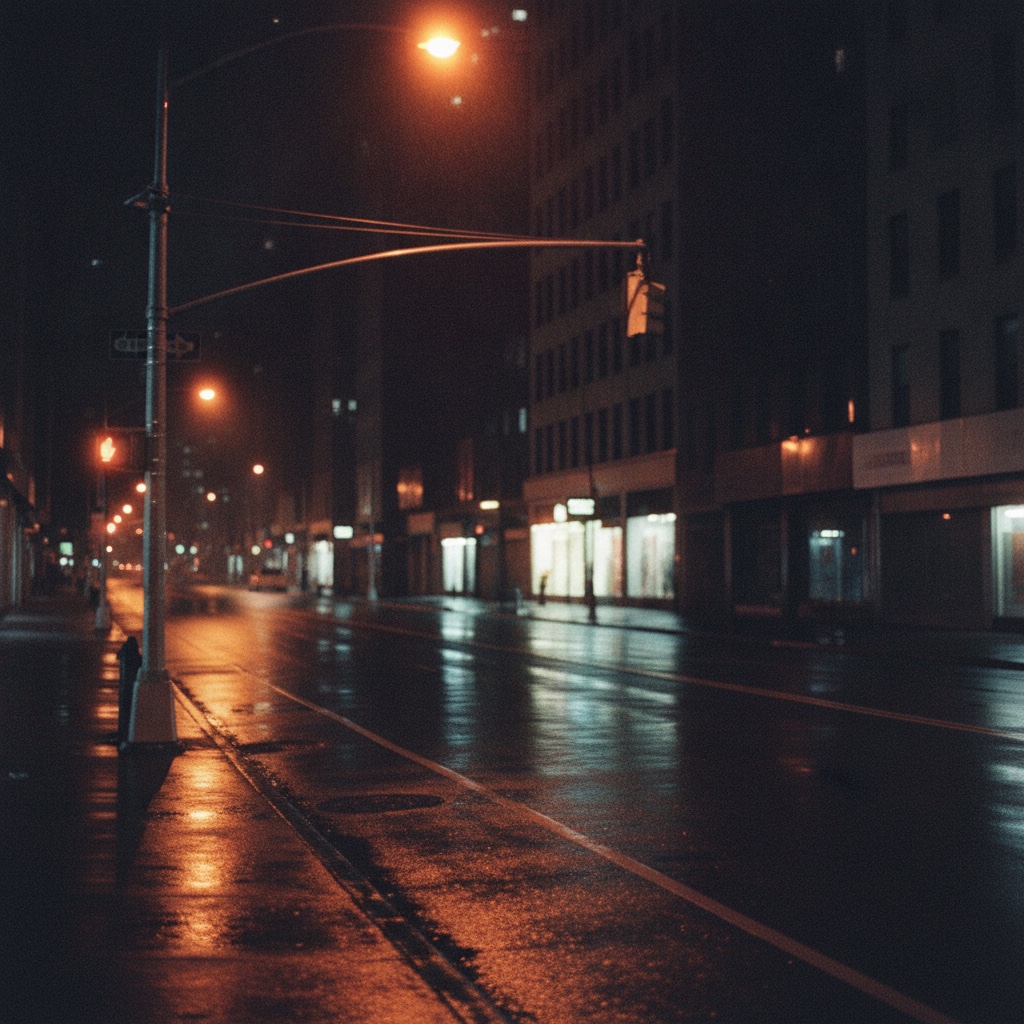
Every fluorescent tube and street lamp sold in the United States by 1989 carried a number, printed on the manufacturer’s spec sheet and weighed in purchase orders alongside wattage and price, for exactly how badly it distorted the human face: the Color Rendering Index, a 0-to-100 scale maintained by the Illuminating Engineering Society of North America and consulted by building engineers and city lighting departments as a routine procurement figure, no different from lumens or amperage.1 High-pressure sodium, the fixture over nearly every Midtown street after dark, carried a CRI of roughly 22 — a rating that meant most of the visible spectrum was simply discarded, bought that way on purpose because the sodium lamp was cheap to run and durable, and installed by the tens of thousands as ordinary city infrastructure with no more controversy than a choice of asphalt. The consequence sat in plain sight every night and drew no comment: at night a blue car parked on a Midtown street was gray. A green awning was brown-black. A red scarf held some of its color and a yellow taxi held most of its own, but the blues and the greens fell out of the world entirely, and a face passing under a streetlight was a warm amber mask with the life drained toward orange. This was not weather and not mood. It was a lamp, specified and graded like any other fixture — a discharge lamp whose light concentrated at the 589-nanometer sodium emission line, at a color temperature of about 2100 Kelvin, deep amber-orange. It flattened everyone the same direction and by a different amount: a light-skinned face went jaundiced under it, and a dark-skinned face lost its contrast as the features compressed into a single amber-brown, because the light carried too little of the spectrum to separate one tone from another.
The technology was fifteen years established. New York had begun swapping its blue-green mercury-vapor streetlights for sodium in the early 1970s, neighborhood by neighborhood, and by the late 1970s the amber was dominant across the arterials.2 The fixture overhead was, on most major streets, a cobra head — a curved cast housing on a davit arm, mounted thirty to thirty-five feet up a steel pole, throwing an elliptical pool of light onto the roadway below. A 400-watt lamp in a Midtown arterial fixture pushed a great deal of light down through that housing, enough to read a newspaper by at the curb, all of it the same sodium orange.3
The amber was layered against other sources that kept their own color and lost their reflections to it. Neon signage stayed the red and blue and green of its own excited gas, but the wash it threw onto brick and wet pavement turned amber. Store windows spilled cool fluorescent white at sidewalk level, a competing 4100-Kelvin pool with a faint green cast. Car headlights in 1989 were sealed-beam halogen — warm and yellowish, complementing the sodium rather than fighting it — and the incandescent traffic signals were warmer still. The net was an orange world punctuated by neon and cold-white storefront, and it reached its fullest form on a wet night, when high-pressure sodium reflected off rain-slicked asphalt and every cobra-head fixture drew a long orange streak down the road. The amber was not quite total. On residential side streets a few of the older mercury-vapor lamps survived, cooler and blue-green, leaving occasional pockets where the sodium had not yet reached; and a handful of the brightest business districts, Times Square among them, had already begun lighting their sidewalks with metal halide, a whiter source that stood out sharply against the surrounding orange.
The Sallow Floor
Indoors, the light failed color in the opposite direction and with the same result: people looked ill. The workhorse of American commercial lighting in 1989 was the F40T12 Cool White fluorescent tube — forty watts, four feet long, on a magnetic ballast — and it burned at 4100 Kelvin with a color rendering index of about 62.1 The phosphor ran rich in yellow and orange-yellow and poor in red and green, so that under it skin turned pale, sallow, faintly greenish; reds and greens read darker and duller than they were. A “Deluxe” cool-white tube existed at a CRI near 90, but it produced roughly a third less light for the same wattage and cost more, and a cost-conscious editorial floor bought the ordinary tube by the case. The fixtures were recessed troffers in the dropped ceiling, three or four tubes apiece, throwing fifty to seventy foot-candles flat across every desk — bright, shadowless, and unkind to the face.
The one relief was the window, and the window worked only near the glass. A Midtown tower of 1960s construction was glazed in single-pane bronze-tinted glass — PPG’s Solarbronze and its competitors — a body tint that passed roughly half the visible light and warmed what it passed by a few hundred Kelvin.4 North-facing offices that never saw the sun got their daylight secondhand, bounced off the limestone and glass of the buildings across the canyon, warmed again a little by the pale stone. In late November the sun never climbed past about 28 degrees at noon and sat near 13 degrees at half past eight in the morning, so its light arrived low and raking and already warm from the long slant through the atmosphere, warmer still through the bronze, and it drove deep into the floor. The result was a gradient anyone who worked the floor could see without naming it. Within ten feet of the glass, daylight dominated: warm, directional, and kind to a face. Past twenty feet, the 4100-Kelvin fluorescent took over, flat and greenish. In the transition zone the two mixed, warm window pools against cold overhead, a visible line across the carpet. An editor with a window office stood in daylight. An assistant at an interior desk stood in the sodium’s indoor cousin, and looked it.
Two Cities of Light
The light a New Yorker lived under depended on where the money was, and the divide ran between the boroughs as clearly as it ran across an office floor. Morris Heights in the Bronx was built in five- and six-story walkups on sixty-foot streets, a height-to-width ratio near one to one, and it stood open to a wide dome of sky. Low November sun cleared the rooflines and fell directly into the streets and through south-facing windows, throwing a strong warm beam across a vinyl floor and up the opposite wall. The trees were bare and mostly young — the mature canopy had died in the 1970s and the replantings were still thin — so the light came through in graphic skeletal shadows, and the dark red-brown brick of the walkups absorbed most of it, holding the contrast high: amber direct sun against cool blue shadow. It was the signature look of the late-autumn outer boroughs, warm and directional and hard-edged.
Midtown, twenty minutes south, was a different light world entirely. Towers of thirty to sixty stories over sixty-foot cross streets made canyons five and ten times as deep as they were wide, and the direct sun reached the pavement for only a few hours; most of a winter day the street floor lived in shadow. But the glass curtain walls bounced a fifth to two-fifths of the light that struck them, so the shadow filled with cool reflected daylight and sudden specular flashes off distant windows. Midtown light read cool, blue-gray, ambient, punctuated. The Bronx read warm, orange, raked. Neither was chosen; both were the residue of what had been built.
What both shared, after dark and indoors, was the incandescent bulb — the 60- and 75-watt A19 at about 2700 Kelvin, the near-perfect color rendering of a heated tungsten filament, the warmest domestic light the century had.1 It was the light of the lamp beside the bed and the bulb over the kitchen table, in a Morris Heights walkup and an Upper West Side apartment alike, and against the sodium street and the fluorescent office it was the one source that showed a face as it was. In November 1989 it was still the default bulb in nearly every socket in the city, and its warmth was so ordinary that no one thought to defend it.
The Cooling
Across the decade the color of New York rose up the Kelvin scale, but not on the street. The arterial cobra-head lamps stayed sodium-amber through the whole period and well past it; the city did not begin trading its cobra heads for cooler white LEDs until long after the period closed.5 The cooling entered the city from inside — through the glass and the renovation, in the buildings where money was moving. A cast-iron loft in Tribeca or SoHo that in 1989 had held a warm bodega fluorescent and a few incandescent windows was, by the end of the decade, gut-renovated and lit with halogen track at 3000 Kelvin and recessed cans bouncing off white walls. New construction at the edges rose in glass curtain walls that returned cool blue daylight by day and burned 5000-Kelvin office-white by night. The metal halide that in 1989 had lit only a few showpiece districts spread outward across more plazas and rebuilt blocks, four thousand cool Kelvin at a time, each installation a little whiter than the sodium it stood beside.1
The shift was legible as class. The warm amber that had been simply what the city looked like became, in the renovated interior, the mark of the unrenovated — and the cool white that had once read as clinical became the light of money and newness. Michael Ballhaus had shot Martin Scorsese’s downtown in After Hours in 1985 under exactly the sodium and incandescent warmth that still ruled the streets in 1989, and that amber was already, by the film’s own light, becoming a record of something rather than a description of it.6 The same block that glowed orange at the start of the decade was, by its end, increasingly lit from its windows in white.
The color of a city is a technology, and a technology has a start date and an end date that the people living inside it rarely see. New York in 1989 was an amber city — high-pressure sodium overhead, tungsten in the lamp, and between them a cold fluorescent floor that made everyone look a little unwell — and none of it was chosen for its color; it was chosen for its cost and its output, and the color was what came with the bargain. Across the following years the light of the city’s interiors climbed toward white, halogen and metal halide and curtain-wall office glare, and the amber that had meant nothing in particular came to mean age and the warm bulb came to mean the places money had not yet reached. The streetlights held their orange for years after, so that the same New Yorker could walk home from a white-lit renovated loft through streets still washed in the sodium of the 1970s and feel nothing strange in the crossing. The light was always changing and always seemed permanent, which is the condition of living inside any light at all.
Meridian would have covered the relighting of the city as urban design — the new brightness of a rebuilt Times Square, the metal-halide white going up over the plazas, the argument about whether the amber city had been dingy or simply itself — and it would have sat in the City section without argument, illustrated with a photographer’s night work and pitched at the level of taste and streetscape and public money. It would have been a piece about how the city looked, written from inside that taste.
The piece it would have declined would have looked inward, at the floor itself — the fluorescent light that left the interior desks sallow while the window offices kept their daylight, a fact of the building measurable at a color rendering index of 62. Nobody would have pitched it, because the pitch would have implicated the room it was made in. There would have been no distance to write it from. A senior editor would have granted, if asked, that the bullpen was badly lit, and would not have thought there was anything in it worth a writer’s month. It would not have reached the budget meeting.
She would have left the building at seven on a November evening, down through the fluorescent lobby, the brass door handles olive-green under the tubes, and out through the revolving door into the sodium street, and at the threshold her own face would have shifted from sallow green to amber orange and she would not have seen it change. She would have stood a moment under the cobra-head light waiting for the walk signal, lit at 2100 Kelvin by a lamp installed years before, and she would have thought, if she thought anything, that this was what the city looked like at night. She would not have known the color had a date on it. She would not have known the warmth she was standing in was a technology, installed within her own lifetime and already, one renovated window at a time, being replaced by a light that would not flatter anyone.
Footnotes
-
Mark S. Rea, ed., The IESNA Lighting Handbook: Reference & Application, 9th ed. (Illuminating Engineering Society of North America, 2000). Source color temperatures and rendering indices: high-pressure sodium ~2100K, CRI ~22; F40T12 Cool White fluorescent 4100K, CRI ~62; incandescent A19 ~2700K; tungsten halogen ~3000K; metal halide ~4000–4600K. ↩ ↩2 ↩3 ↩4
-
Sandy Isenstadt, Electric Light: An Architectural History (MIT Press, 2018), on the mid-century displacement of mercury-vapor street lighting by high-pressure sodium across American cities through the 1970s. ↩
-
North Star Highways: Overhead Streetlights — A History and Spotter’s Guide (2016), on the General Electric M-400 / M-400A2 “cobra head” luminaire as the standard American arterial streetlight of the sodium era. ↩
-
PPG Industries, “Performance Data — Tinted Glasses” (form 041012, 2005), tabulating monolithic Solarbronze (53% visible light transmittance) and Solargray (44%) — bronze- and gray-body-tinted single-pane glazing standard in 1960s commercial towers, the bronze tint both reducing and warming transmitted daylight. ↩
-
Office of the Mayor, City of New York, “Mayor Bloomberg Announces All 250,000 Street Lights in NYC to Be Replaced with Energy-Efficient LEDs,” press release 343-13, October 24, 2013. The citywide conversion to roughly 4000K LED fixtures postdated the sodium regime described here. ↩
-
After Hours, dir. Martin Scorsese, cinematography by Michael Ballhaus (Warner Bros., 1985), shot on location in SoHo and Lower Manhattan under the period’s sodium and incandescent light. Ballhaus went on to shoot Goodfellas (1990). ↩