The Digital Transition as Ontological Event, 1993–2001
Subscribe
https://meridian-archive.com/feed.xmlOpen in your app, or paste the link above into any other:
The Same Broadcast
By 1995 a subscriber to America Online sat down at a desk, connected a modem to the household’s only telephone line, and set off a sound in the next room: a ninety-second sequence of dial tone, touch-tones, screech, and static, audible over a spouse reading or a child doing homework, because the visit used the whole of the line and there was no other.1 The disk that made the connection possible had usually arrived unbidden months before — floppy, later compact, bound into a magazine or stacked at a checkout counter or mailed to an address America Online had bought in bulk — one more object of household clutter, indistinguishable from a menu or a catalogue, until the day it was opened and used the household’s only outside line to reach a machine three million other households were also, at that hour, dialing into.1 Getting onto the network cost a room and a telephone.
Five years earlier no telephone line had needed defending, because the possession was already total and asked for no dialing at all. On an ordinary weeknight in 1989, some forty million Americans sat down to one of exactly three television programs, each running the same twenty-two minutes, each assembled by the same small trade under the same conventions, and each drawing, night after night, roughly ten to twelve million of that total to itself.2 Twenty-four hours later a comparable convergence recurred in print: something over eight million households received, on the same Monday, one of two newsmagazines carrying a packaged verdict on the week just ended, the cover image itself an editorial act. The number of people who decided what would appear in either — which story led, which was dropped, which fact made the sentence and which did not — ran to the hundreds, not the thousands, across the entire country. No one had voted them into the position.
This was the shape of a pyramid, and the shape was not a metaphor — it was a count. At the top, three broadcast networks: ABC, NBC, and CBS, whose evening newscasts had drawn a combined average of 53 million viewers a night in 1980 and still commanded, at the decade’s turn, that audience in the neighborhood of forty million.2 ABC’s World News Tonight under Peter Jennings held the top rating continuously from February 1989 through the autumn of 1996. Below the networks sat the wire services — above all the Associated Press, a not-for-profit cooperative founded in 1846 whose daily file supplied the raw material of nearly every newspaper and broadcast in the country. Below the wires, the national dailies: the New York Times as the paper of record, the Wall Street Journal with the largest paid circulation in the country, the Washington Post with the authority Watergate had bought it. Total daily newspaper circulation in the United States peaked at 63.2 million copies in 1990 — the absolute apex of print’s reach, though no one at the time had reason to call it a peak.3 Below the dailies, the newsweeklies: Time at roughly four million subscribers, Newsweek close behind, together the source of the Monday convergence.
The prestige monthlies — the Atlantic, Harper’s, the New Yorker in its weekly exception, and Meridian in its tier — sat at none of these volumes and at the apex of a different function. They did not deliver news; they delivered meaning. A monthly’s profile of a political figure did not update facts its readers already possessed. It framed the figure’s significance, and the framing stuck. The long-form piece — three months of a staff writer’s time, layers of editing, a fact-checking department — was possible only in a world where readers would wait a month for the deeper account, and readers would wait only because the daily and weekly versions were finite. The scarcity paid for the apparatus, and the same scarcity decided what counted as known. When all versions of a story were curated, the deeper account was worth its delay. The whole proposition rested on scarcity — and in 1989 there was no abundance anywhere on the horizon that an editor could see.
The Price of a Fact
The scarcity was not a philosophical condition. It was a cost structure. A metropolitan daily required presses that could run to $40 million, a newsprint supply measured in tons per day, a fleet of trucks that had to finish before dawn, and union contracts — pressmen, mailers, drivers, compositors — that could not be shed in a bad quarter. A national monthly required coated paper stock, printing contracts in the hundreds of thousands of copies, the second-class postal rate (a federal subsidy structure dating to 1792, which treated magazines as educational material), a newsstand distribution network, and a subscription fulfillment operation; advertising supplied roughly 70 to 80 percent of revenue, with circulation covering the physical costs. An evening newscast required satellite uplinks, foreign bureaus, an affiliate network, and anchor contracts that ran to eight figures. No individual and no small organization could replicate any of these economics. To reach a national audience with credibility in 1989 required capital that only established institutions possessed — and that requirement, not any doctrine, was the gate.
The people who kept the gate were few, and they were alike. The political scientists Maxwell McCombs and Donald Shaw, studying the 1968 presidential election, had documented a nearly perfect correspondence between the issues the media ranked as important and the issues voters then ranked as important — the finding, published in 1972, that the press did not tell people what to think but told them, with great success, what to think about.4 The sociologist Herbert Gans, embedded in the newsrooms of CBS, NBC, Time, and Newsweek in the 1970s, had found that the journalists of the four most powerful news organizations in the country shared a homogeneous and unarticulated set of values — ethnocentrism, altruistic democracy, responsible capitalism — that shaped news judgment without ever being stated as ideology.5 The convergence was structural, not conspiratorial: the senior editorial ranks of the national press were drawn from a handful of universities, lived in a contained geography of Manhattan and its near suburbs and Washington, and competed for the same talent through the same pipeline. Close to half the staff of the Times and the Journal came from a handful of elite schools.6 What fell outside their shared range of questions did not get covered, not by suppression but because it did not register as news to people of similar formation.
The Wire into the Wall, 1993–1995
Tim Berners-Lee had proposed his hypertext system to CERN in May 1989 and put a working browser and server on the laboratory’s network by the end of 1990; the protocols reached the public internet in August 1991 and were made royalty-free in April 1993.7 Through 1993 the Web remained a specialist instrument — a scattering of academic sites, reachable only from institutions that had both the connection and the fluency. What changed the count was Mosaic, the graphical browser built at the University of Illinois and released in April 1993, the first to set images inline with text and to make the Web legible to a person with no training. By December of that year Mosaic was on the front of the Times business section; within eighteen months it had more than a million users.
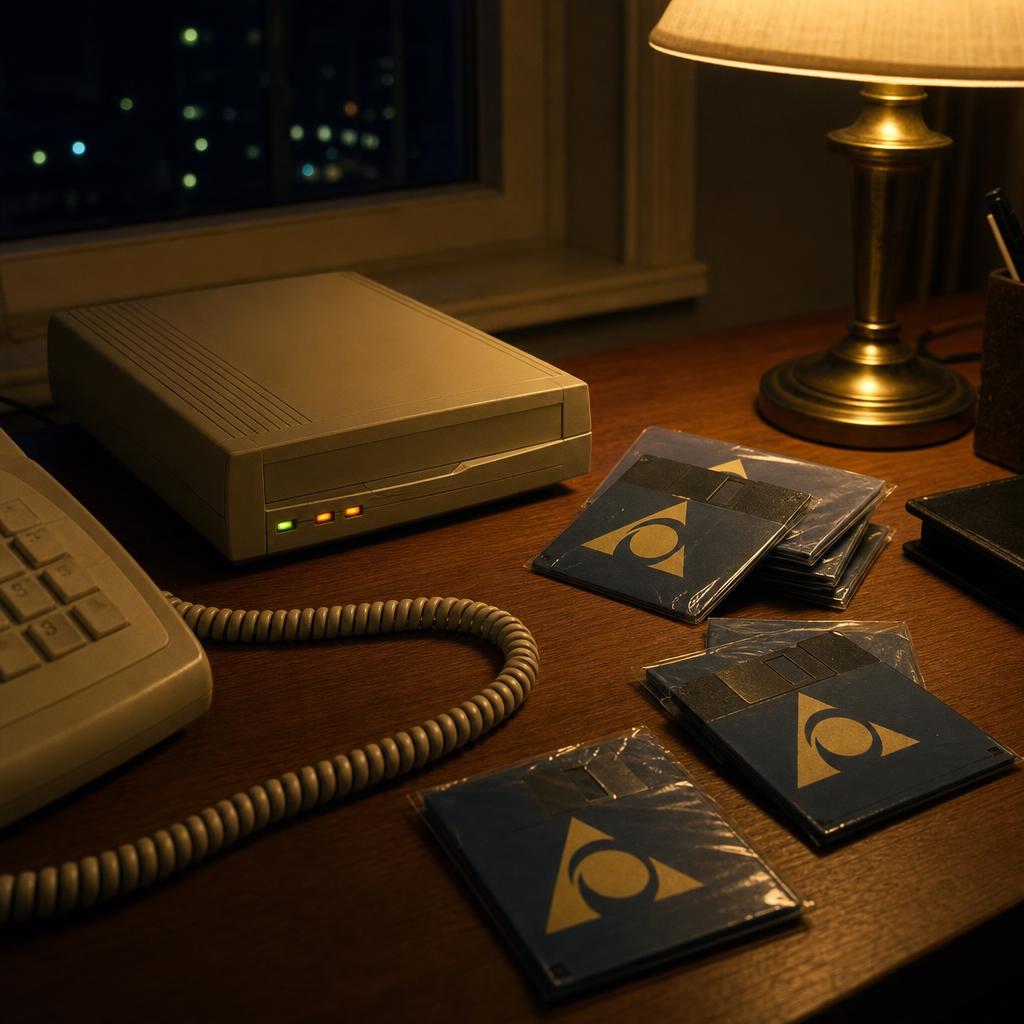
But for most New Yorkers the internet did not arrive through a university. It arrived through the mail. America Online, which had 300,000 subscribers in mid-1993, passed one million in August 1994 and roughly three million by 1995, and it grew by a marketing method of almost agricultural bluntness: free trial software mailed in the millions, disk after disk, to household after household.1 AOL opened its gates to the internet proper in 1994. What its millions of subscribers reached was not yet a rival to any publication. It was a destination — a place one went, and then left. Nothing about it traveled in a pocket. The visit had edges: a connection made, minutes metered, a disconnection. The temporality it trained was retrieval on demand — the answer fetched at the moment of the question rather than delivered on the institution’s schedule — and that training, more than any single site, was the new thing in the apartment.
The Authority to Narrate, 1995–1997
By the middle of the decade the institutions had begun building on the new ground — the Times opened its website in January 1996, Salon and Slate launched as web-native magazines in 1995 and 1996, and the first banner advertisements had appeared on HotWired in 1994; the business consequences of that wave, the ad-page arithmetic and the circulation slide, are chronicled elsewhere in this archive. What belongs here is the quieter question underneath the business one: what, exactly, a magazine’s authority had been made of, and which of its materials the new medium dissolved.
The authority was structural, and it had at least four load-bearing members. First, the subscription list as credential: to subscribe to a prestige monthly was a self-sorting act, and the resulting audience — educated, professional, metropolitan, affluent — was audited, documented, and sold to advertisers with a precision that made the list itself the institution’s central asset. Second, the advertiser’s investment as index: when a financial house or a book publisher bought the page opposite the table of contents, the purchase was a continuous external validation of the magazine’s standing, revenue and endorsement in a single transaction. Third, the byline as platform: a byline in a magazine of Meridian’s tier meant the piece had been assigned, reported, edited, checked, and published by an institution with a known standard, and it converted downstream into book contracts, returned calls, and fellowships — the writer’s name carrying the institution’s reputation as a rider. Fourth, the essay as the sole timely vehicle by which an intellectual could address the educated general public: the academic journal reached specialists, the op-ed page was short, the book was slow; the magazine essay had no substitute.9
Every one of these members assumed scarcity. The list was valuable because attention had to be aggregated before it could be sold; the banner ad, however crude, could report exactly how many readers had clicked, which the magazine page could not. The byline was valuable because publication was rationed; a medium in which anyone could publish rationed nothing. The essay’s monopoly held only while there was no other channel of comparable speed and reach. None of this was visible as fragility in 1996, because the web-native ventures were small, the household connections were slow, and the institutions’ own websites were understood on the editorial floors — accurately, for the moment — as reductions of the real product. The database terminals then changing the mechanics of reporting itself are chronicled elsewhere in this archive. What no one on those floors was required to notice was that the argument for the institution had quietly changed tense: it now rested on quality, which was defensible, rather than on necessity, which was gone.
The Breach, January 1998
The demonstration, when it came, took one weekend. Matt Drudge had started the Drudge Report in 1995 as an e-mailed newsletter, priced at ten dollars a year, and added a website in 1997; he worked alone, from an apartment in Hollywood, with no editor, no checker, and no standards apparatus of any kind. On the night of January 17, 1998, he published an item reporting that Newsweek had possessed, and had declined at the last hour to run, a story about a sexual relationship between the President and a 23-year-old former White House intern.10 The underlying reporting was Newsweek’s own — Michael Isikoff had spent months on it — and the editors’ decision to hold it another week reflected exactly the deliberative machinery that distinguished the institution from the website: sourcing thresholds, legal review, an awareness of what the story would detonate.11
The gate count had already been rising at the edges — CNN’s Gulf War coverage had shown a wire-speed alternative to the evening broadcast, MSNBC and the Fox News Channel both launched in 1996, and the search engines of mid-decade indexed the web without employing a single editor — but each of those was an institution, with offices and standards of its own. In the old architecture a story the gatekeeping tier declined to publish did not, for the national conversation, exist; no other institution had it, and there was no other channel. Drudge’s item did not refute Newsweek’s judgment — the judgment may well have been sound — it simply made the judgment irrelevant. Within hours the item was being discussed; within days the mainstream outlets were reporting on the report and then on the underlying story, and Newsweek published its own material online rather than wait for its next issue. “This was the first time a story broke in Drudge and migrated to the mainstream,” the White House press secretary, Mike McCurry, said afterward.10 The establishment’s first response was contempt — a website, unedited, unconfirmed — and the contempt was accurate in every particular and useless in effect. The gate still stood. The audience walked around it. What January 1998 established was not that a lone operator could out-report a newsweekly; Drudge had reported nothing. It established that the power to decide whether a story existed had been separated from the power to decide whether it was ready, and the second power, the only one the institutions actually held, no longer implied the first.
The End of Theory, 1996–2001
The intellectuals whose trade was interpretation registered the transition late, and mostly as a literary event. The academic toolkit that had dominated the late 1980s — the theory shelf of the Duke literature department and the October circle — was, by the end of the 1990s, widely felt to be inadequate to the actual texture of the moment, and the writers who came closest to describing that texture were novelists. David Foster Wallace had argued in a 1993 essay that television had installed irony as the default posture of American consciousness and that fiction had not yet found a way past it;12 Infinite Jest, published by Little, Brown in February 1996, was his thousand-page attempt to render a media-saturated interior that academic theory could only gesture at. Zadie Smith’s White Teeth, published in January 2000 in London and that June in New York, made the multiethnic city the central subject of Anglophone fiction and declined every single-frame explanation of it. And in July 2000, in The New Republic, the critic James Wood gathered Smith, Wallace, Pynchon, DeLillo, and Rushdie under a coinage of his own — “hysterical realism” — and accused the maximalist novel of “vitality at all costs,” of knowing a thousand things and no human beings.13
The argument was serious, and it was conducted, on all sides, in the last rooms of the old architecture — a weekly magazine of small circulation, the review sections of the dailies, the quarterlies. What nearly every party to it missed was how fast the apparatus beneath the argument was being replaced. By 2000 a first wave of self-published web writers was posting daily — the weblog tools that appeared at the end of the decade, Blogger among them, had reduced the act of publishing to a form and a button — and a writer with no institution behind him could respond to the morning’s news by the afternoon, at a length of his choosing, to an audience limited only by who chose to look. The tenured professor and the magazine critic were debating which framework fit the culture; the apparatus that had made their debate consequential — the pipeline that ran from the seminar through the quarterlies to the Atlantic and its peers — was being bypassed at the rate of the culture’s attention. The older intellectuals largely could not see it, for the same reason Gans’s newsroom subjects could not see their own values: no one inside a functioning system perceives the system as one arrangement among possible others. Neil Postman had supplied the general form of the point in 1985, writing about television — a medium is not a neutral carrier but a condition, determining what kinds of knowledge can circulate at all.14 The magazine intellectual of 2001 had read Postman. He had not, on the whole, applied the argument to the machine in his own study, on which his niece’s messages arrived, and on which — though the sentence would have struck him as category confusion — his profession’s necessity was being repriced toward zero. The people whose trade was description were, on this one subject, the last to file.
What arrived down the telephone line between 1993 and 2001 was not a competitor and not a format. It was a change in what information was — from a scarce good, gathered and ranked by a few hundred people in a few buildings, into an ambient condition, present in the apartment like water in the walls. Every authority the decade’s magazines held — the audited list, the courted advertiser, the byline that opened doors, the essay no other channel could carry — had been built on the scarcity, so quietly that the builders had mistaken the architecture for the ground. The writing did not get worse when the architecture failed; much of it got better. But better sentences answer a quality problem, and the problem was never quality. A reader who could reach everything no longer needed anyone to decide what mattered — and deciding what mattered, not writing well, had been the thing the institutions were paid in trust to do. The decade that watched the wall come down in Berlin had one more wall in it, and the people who lived on top of this one were the last to feel it go.
A single line in the sidecar would have resisted the floor entirely. The protocols that put the web onto the public internet in August of 1991 would have arrived as a specification, not a subject, and no essayist on the masthead would have found a register for it — a monthly built to render meaning in prose would not have had a paragraph for a standard. The idea, pitched once at a Monday meeting, would have gone quiet there, correctly: the piece that could have carried it in the house’s own voice would not yet have existed.
Mosaic would have found the register the protocols never could. A browser that put a picture and a headline on the same screen would have been, by the spring of 1993, a City subject — young, local, demonstrable — and The City would have carried it that July: two programmers out of an Illinois lab, the software free, downloaded by the thousand and climbing. AOL’s own crossing, a year on, would have made the same ground on different footing: a million subscribers by August of 1994 would have read less as a technology story than a circulation story, and the November issue’s City pages would have told it that way — the modems, the disks mailed by the millions, the sound of a household’s second telephone line.
A different desk would have claimed the other candidate the sidecar names. Wallace’s novel, arriving that February, would have gone to The Back as a review proper — a thousand pages, an argument about irony television had installed, nothing that would have belonged anywhere near the City’s shorter measure — and the April issue would have run it there, at length.
Footnotes
-
Kara Swisher, aol.com: How Steve Case Beat Bill Gates, Nailed the Netheads, and Made Millions in the War for the Web (Times Books, 1998). ↩ ↩2 ↩3 ↩4
-
Project for Excellence in Journalism, The State of the News Media 2004 (Pew Research Center, 2004), network television audience trend data, 1980–2000. ↩ ↩2
-
Pew Research Center, “Newspapers Fact Sheet,” circulation series; U.S. daily circulation peaked at 63.2 million in 1990. ↩
-
Maxwell McCombs and Donald Shaw, “The Agenda-Setting Function of Mass Media,” Public Opinion Quarterly, vol. 36, no. 2, 1972. ↩
-
Herbert J. Gans, Deciding What’s News: A Study of CBS Evening News, NBC Nightly News, Newsweek, and Time (Pantheon Books, 1979). ↩
-
“Graduates of Elite Universities Dominate the New York Times and Wall Street Journal Newsrooms,” The Intercept, 2018. The study measured then-current staff — 43.9 percent of Times and 49.8 percent of Journal staff had attended elite schools — and is cited here as the closest available measurement of a recruitment pattern the period’s own accounts (Gans’s fieldwork among them) describe qualitatively. ↩
-
Tim Berners-Lee with Mark Fischetti, Weaving the Web: The Original Design and Ultimate Destiny of the World Wide Web (HarperSanFrancisco, 1999). ↩
-
ITU-T Recommendations V.32bis (1991), V.34 (1994), and V.90 (1998), the successive consumer modem standards. ↩
-
Michael Janeway, The Republic of Denial: Press, Politics, and Public Life (Yale University Press, 1999). Janeway’s subject was the press’s failure to cover the transformation of the political institutions it depended on; the critique applied with equal force to its coverage of its own transformation. ↩
-
“Twenty years ago, the Drudge Report broke the Clinton-Lewinsky scandal,” Washington Post, January 17, 2018. ↩ ↩2
-
Michael Isikoff, Uncovering Clinton: A Reporter’s Story (Crown, 1999). ↩
-
David Foster Wallace, “E Unibus Pluram: Television and U.S. Fiction,” Review of Contemporary Fiction, vol. 13, no. 2, 1993. ↩
-
James Wood, “Human, All Too Inhuman,” The New Republic, July 24, 2000. ↩ ↩2
-
Neil Postman, Amusing Ourselves to Death: Public Discourse in the Age of Show Business (Viking, 1985). ↩