Knowing Things for a Living, 1989–2001
Subscribe
https://meridian-archive.com/feed.xmlOpen in your app, or paste the link above into any other:
The Morgue
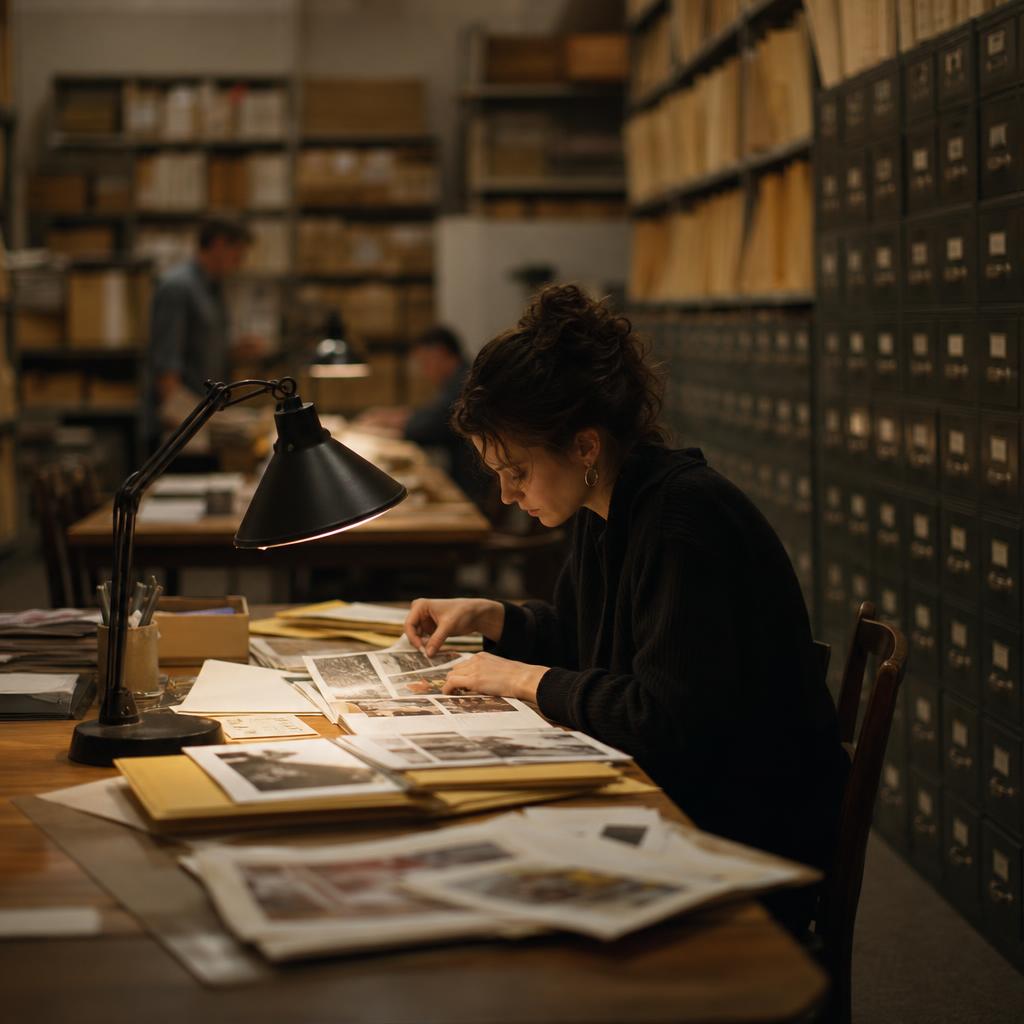
A federal agency granting a Freedom of Information Act request in 1993 did not simply withhold what the statute exempted; it produced the rest with the withheld portions physically blacked out, rectangle by rectangle, before the pages went through the copier — black tape or black marker laid over an exempt name or passage by a records clerk following a standard, statute-governed procedure, so that a released FBI file came back as a page more black than white, the surviving text showing as pale lines between the bars. This was not an improvised precaution but a routine administrative step, performed the same way at the SEC, the FTC, the FBI, the EPA, on a timetable Congress had legislated and the courts enforced, for any citizen or reporter who filed the request and cited 5 U.S.C. § 552. A reporter’s other standing tool for finding out what was already known about a subject was less exotic and far older: a walk to a room and a question put to the woman who ran it. The room was the morgue — a clipping archive that every serious newspaper and magazine maintained, floor-to-ceiling with filing cabinets and shelves of labeled manila envelopes. Each envelope held the publication’s accumulated coverage of one subject: articles cut from its own back issues and from other magazines, filed by proper name, by organization, by topic. An envelope marked junk bonds might carry forty clippings reaching back to the first time the term had appeared in print. An envelope marked Ivan Boesky held everything, in date order, that the magazine had ever run about him.
The filing system was idiosyncratic to each publication, and its logic was usually the creation of one person. The research librarian — the position was disproportionately held by women, and the title varied: morgue librarian, researcher, head of the library — maintained the physical files, processed each new issue as it arrived, clipped what mattered from the competition, and served as the human interface for every reporter’s request. A writer starting a profile called the library and asked for everything they had on a name. The librarian pulled the envelope and delivered it, or summoned the writer down to read it at the reading table the morgue kept for the purpose.
What she held was not only paper. An editor twenty years into a career carried a mental index of the whole archive — which envelope was thin because the magazine had touched the subject once, which was thick because it had returned to it for a decade, which held the one forgotten piece that changed the story. A new hire had none of this and had to ask. The question of whom to ask — who had been in the building long enough to remember — was itself a form of knowledge, and the librarian who ran the morgue often knew more about what the magazine had published than any editor on the masthead.
The clippings carried their own stratigraphy. Older ones had yellowed at the edges, the newsprint gone brittle, the ink faded. Many were annotated in the hands of the researchers who had read them first: a name circled, a question mark in a margin, a cross-reference to another envelope in the librarian’s own writing. A reporter reading a file in 1991 was reading, at the same time, the physical record of how many people had asked about the subject before, and what they had noticed.
The morgues began to close in the middle of the decade. As databases made it possible to search a magazine’s own back issues electronically, the clipping function stopped, and the physical files were digitized, boxed for storage, or thrown out. At most large publications the morgue was effectively defunct by 1997 or 1998. What went with it was not mainly the documents — most survived in other forms — but the intelligence embedded in the filing system and in one person’s decades of knowing where things were.
The Terminal
The machine that promised to replace the morgue sat in an alcove off the library and charged the magazine every time someone used it. Lexis-Nexis was two services in one: Lexis, the legal database launched in 1973, and Nexis, the news and business archive launched in 1979, both run by Mead Data Central out of mainframes in Dayton, Ohio.1 By the late 1980s the major newsrooms used Nexis as a supplement to the physical files. A magazine reached it, in the early period, through a dedicated terminal — a specific workstation wired by modem to Dayton, a keyboard and a monochrome screen — and later through emulation software on an ordinary office computer. The connection was slow enough that a long document arrived on the screen a line at a time.
Nexis did not take questions in plain language. A search was built from terms joined by AND, OR, and AND NOT, narrowed by date range and by publication, and the system returned a numbered list of documents that the researcher called up one at a time by number. Constructing the search was a skill; a badly built query returned ten thousand documents or none.
It was also metered. Lexis-Nexis billed per search and per document retrieved, and an institutional account ran to several hundred dollars a month before heavy use pushed it higher. The cost was steep enough that access was gated: at most magazines a reporter who wanted a search submitted the request — the terms, the date range, the purpose — to the librarian or a senior researcher, who ran it, printed the results, and handed back the printout. What the expense bought was speed, and the speed was real. Backgrounding a subject that had taken a morning in the morgue took twenty minutes on Nexis.
What it did not buy was completeness. Nexis in the early 1990s indexed the major dailies, the wire services, and the big news magazines well, and smaller publications, newsletters, and academic journals barely or not at all. It found what had been published in prominent outlets; it did not find what had not been published, which was frequently where the story actually was. And it manufactured a hazard of its own. A wrong date in a wire story, picked up and reprinted by a dozen papers, appeared in Nexis as a dozen sources in agreement — a single error wearing the costume of corroboration. A researcher who confirmed a fact against three Nexis hits could be confirming the same mistake three times.
By 1995 and 1996 the terminal had become an ordinary computer on individual desks, and senior editors and researchers ran their own searches. The change democratized the search and, in the same motion, dissolved the librarian’s part in it — the moment when a person who knew the archive read what the search had returned.
The Rolodex
Reaching a person, as opposed to reading about one, ran on a different set of tools, all of them physical. The white pages listed residential subscribers by name, with address and telephone number, and a reporter who needed a source looked up the home number and called in the evening. The practice was standard and carried no stigma: most professionals had listed home numbers and no way to screen a call, and being telephoned at home by a writer from a national magazine was a credential, not an intrusion. It meant you were worth reaching.
When a reporter had an address and needed the name attached to it — or had a number and needed the person — the tool was the reverse directory, the criss-cross book organized by street and by telephone number rather than by name. A writer with an address from a court filing found the resident; a writer profiling someone found, in the same book, the neighbors on either side, and called them.
Around the researcher’s desk stood a shelf of standing references, the apparatus for knowing who someone was before the telephone was ever picked up.
The Research Shelf
The books a senior researcher kept within reach, each consulted before a source was called.
| Reference | What it held |
|---|---|
| Who’s Who in America | Biographical entries for prominent Americans — birth, education, career, memberships, family |
| Standard & Poor’s Register | Every officer and director of every public company, with their firms and addresses |
| Encyclopedia of Associations | Every registered trade group and nonprofit, with contacts and membership counts |
| Social Register | The old-money families — addresses, clubs, summer residences |
| Current Biography | Monthly career summaries of the newly prominent |
| The World Almanac | Population figures, election returns, historical dates, government rosters |
The instrument that held it all together was the Rolodex. The spinning card file was a working journalist’s most valuable single possession — the phone numbers and the annotations of an entire career, indexed by name. The notes on a card, sometimes layered in pencil and in inks of different ages, recorded what a source knew, when you had last spoken, whether the source could be trusted, what the source wanted in return. It was not backed up anywhere. When a journalist changed magazines or died, the Rolodex went with them, and the relationships it represented did not transfer.
The same card system reached the people who filed from elsewhere. A stringer was a freelance contributor with a standing relationship to the magazine — not staff, not a one-time writer, but someone in a particular city or on a particular beat who could be called and who understood the magazine’s requirements. The card carried the beat, the home and office numbers, a rate set in some earlier negotiation, and a capsule verdict: “fast, reliable on quotes,” or “good on color, needs an edit on structure.” An editor who needed three quotes from a labor lawyer in Chicago by Thursday called the stringer with the beat, who worked her own local sources and filed by phone or, by the early 1990s, by fax. The fee ran from a few dozen to a couple hundred dollars, paid by a check that arrived weeks later.
The arrangement had its failure modes. A stringer who was unreachable on deadline — filing for another magazine, traveling, simply not answering — was a small crisis when the close was Thursday, and a stringer whose copy arrived needing near-total rewriting could cost an editor more time than making the calls himself would have. Senior editors held firm views about which names in the card file could be trusted to file usable copy and which could not.
The foreign version was the most valuable and the most fraught. A stringer in Warsaw kept the relationship alive through expensive international calls, through the fax machine that carried documents across borders before email, and, by the middle of the decade, through the first tentative email accounts. What the foreign stringer supplied was not quotes but context — the local politics, the texture on the ground, the network no database could reproduce. The reliable one was an asset of real value. The unreliable one was a liability of a specific kind: nearly every local stringer had some economic or political stake in the story he was covering, and the reporter relying on a Warsaw correspondent to explain Polish privatization could not always see, from the Rolodex card, where that stake lay.
The Request
A Freedom of Information Act request in 1993 was a physical letter — typed, increasingly word-processed, signed, and dropped in the mail to a federal agency’s FOIA office. It named the records wanted, cited the statute (5 U.S.C. § 552), identified the requester, stated the purpose, and asked for a waiver of fees on the ground that disclosure served the public. Then the reporter waited.
The law set a clock, and the clock and the reality were different things. The agencies a magazine dealt with — the SEC for financial stories, the FTC, the FBI, the EPA, the Defense Department — varied enormously in how long they actually took, from weeks to years, and the FBI was notoriously the slowest. New York State’s Freedom of Information Law and the city’s own access rules governed requests to state and city agencies; a story about the police department or a contracting scandal went by mail to a records-access officer, and the wait began again.
The waiting had its own procedure. A request that had gone unanswered for six weeks needed a follow-up letter, which cited the date of the original and the agency’s statutory obligation and then required another wait; serious magazines assigned a researcher to keep a log of what had been filed, when, and when the deadline had passed. It worked sometimes.
When a request was granted, the documents arrived as photocopies in a large manila envelope, redactions already applied, sometimes clean, sometimes dark and skewed from a bad machine. Finding the one useful fact — the name, the date, the figure — on the eighty-seventh page of an eighty-seven-page production meant reading all eighty-seven pages.
The fee waiver was routinely requested and not always granted. Denied it, a reporter faced a charge for the agency’s search time and a per-page fee for copying, and a large production could run to hundreds of dollars. The big magazines budgeted for it. Freelancers and small publications sometimes could not, and the document went unread for want of the copying fee.
The Dinner
Feature journalism ran on access, and access was cultivated over meals. The four-martini lunch was largely mythology by the 1990s, but the two-glasses-of-wine source dinner at a midtown restaurant was not, and it appeared on an expense account as a line item with a receipt behind it.
An investigation that ran six months carried a budget: travel, hotels above a threshold requiring advance approval, research services, international telephone calls at several dollars a minute, and meals with sources at restaurants chosen to match the source’s standing — professional calibration, not extravagance, since taking a managing director to a coffee shop lost the relationship and taking a junior clerk to a temple of French cooking was merely strange. The receipts collected in a labeled envelope over the life of the project, went onto a printed form, passed to the editor for approval and then to the finance department, and came back as a reimbursement check three to six weeks later.
The ethics of it were understood more than they were written. The major wire services and the largest newspapers had explicit rules against taking hospitality from a source — no meals, no travel, no gifts — while magazines were more variable, many operating on the expectation that a reporter would exercise judgment. The line was that you could take a source to dinner and could not let a source take you. The subtler transaction was the one the dinners were for: a relationship built over several friendly meals eventually produced, on the page, information the source had offered across a table half-understanding that this was what the meals had always been about. A source who said something across a dinner table had said it to a journalist, whether or not he had meant to. An entire profession existed, in part, to manage that fact.
That profession was public relations. By the early 1990s the major corporations placed a press officer between their executives and the press, and the officer took the reporter’s call, decided whether and how the executive would answer, supplied background without a name attached, and arranged conversations with people who would not be quoted. When a magazine story threatened to be unfavorable, the tactics escalated in a set order. The press officer would offer an interview on the condition that the reporter show the relevant passage before publication — which serious magazines refused as a matter of policy. Failing that, a written statement: the declined-to-comment-except-to-say. Then a call to the editor, over the reporter’s head. And at the end of the line, a letter from the company’s lawyers to the magazine’s general counsel.
The Check
Everything the reporting produced then passed to the person whose job was to doubt it. The magazine fact-checker worked from a hard copy of the manuscript and a set of colored pencils, marking every assertion in the text that had to be verified — every name, date, figure, quotation, and attributed paraphrase — in a color-coded system that varied by publication but always separated the unchecked claim from the confirmed one from the one that could not be nailed down and needed a hedge. The New Yorker’s department was the industry’s model, its checkers reading a piece not for its prose but for each of its verifiable bones, and a checker there might spend days on a single article.45
The foundational checks ran against the reference shelf — the almanac, the dictionary, the encyclopedia, the stylebook, Who’s Who — and the quotes ran against the sources themselves. The checker called each person quoted, at home in the evening if necessary, and confirmed not the exact wording but the substance of what had been said; reading a quote back verbatim only invited the source to improve it, which was a different and worse problem.6 The experienced source knew the choreography. The inexperienced one sometimes tried to relitigate the interview, and the checker’s line — the reporter’s notes indicate you said this; can you confirm you made a statement to that effect — was the practiced answer to the attempt.
The database changed the speed of the work without changing its nature. A biographical date that had meant a trip to the library could be checked in three minutes on Nexis by 1993 — provided the date had been published in a paper the database carried, and provided it was right, since the same propagation that made a single wire-service error look like three confirmations fooled the checker exactly as it fooled the reporter.
Toward the end of the decade the primary documents themselves began to come online. Government systems — the SEC’s EDGAR database of corporate filings, the federal courts’ case records — put primary documents within reach of a desk that had previously required a trip to a courthouse or an order to an agency’s records room. But the early web was also a faster, more accessible, more authoritative-seeming source of wrong information than the reference books it sat beside. There was no Wikipedia; there were personal pages and fan sites and corporate sites of wildly uneven accuracy, and the checker who went online first and found nothing reliable went to the shelf second and did. The professional habit — verify by the most authoritative source, not the fastest — was suddenly in tension with the tool on the desk.
Google, incorporated in September 1998, was the default first step for most journalists by 2000.7 The quick query — the spelling of a name, the year of a law, a company’s address — went there first and came back right often enough. The discipline the job now required was the judgment to recognize when a question was not quick, when the answer had to be run back down to a primary source. And as the searching grew faster, the expectation of thoroughness grew with it: a checker in 2001 was asked to verify more than a checker in 1989 had, in the same time, with a smaller staff, using tools that were quicker but no more authoritative for the claims that actually mattered.
The Rupture
The full distance the decade traveled showed in a single research task. To background a subject in 1989, a reporter pulled the morgue file, checked Who’s Who and the S&P Register, and called two people who knew the man — a day’s work. By 1994 the Nexis search had compressed the first hours into twenty minutes while leaving the phone calls exactly where they were. By 1997 and 1998 email had begun to change the source relationship itself: the emailed request was a different act from the cold call, less immediate and more easily ignored, and it reached sources who screened their phones while leaving, for the first time, a written record of what had been asked and answered — useful to a reporter whose work was later challenged, and useful in a different way to a source who now had a transcript of his own words. By 2001 the quick verifications were instant, and the illusion had formed that research itself had become instant. The things that had become instant were the easy things. Finding the source who did not want to be found, prying documents out of an agency that was stalling, checking a claim that no one had ever checked before — those remained as slow and as expensive as they had been in 1989.
What the faster tools could not do was exposed by the decade’s defining fabrication. In May 1998 The New Republic discovered that Stephen Glass, one of its young writers, had invented much of what he had published — fake sources, fake companies, fake events, run through a magazine with a working fact-checking department.8 At least twenty-seven of the articles he had written for the magazine were found to contain fabrication.9 Glass had himself worked as a fact-checker, and he defeated the process from inside it: for the imaginary technology company at the center of the story that exposed him, he built a fake website, printed fake business cards, and set up a voicemail box that would answer a checker’s call. The lesson was structural and unwelcome. A fabricator motivated enough to work within the checking system rather than against it could beat any verification that depended on the reporter’s cooperation — which every verification did.
The response was procedural. Magazines began, after Glass, to require that a reporter submit the primary materials — the interview notes, the tapes, the documents — along with the manuscript, a layer slower and more intrusive than the older practice of trusting that the notes existed. It also settled, at many publications for the first time, what the checker’s relationship to the writer actually was. It was not trust. It was verification.
The methods by which people came to know things were not incidental to the knowing. A reporter who had spent a morning in the morgue reading a subject’s clip file and an afternoon on the telephone had a different hold on the story than one who had run a search and read the top results, and the difference was not sentimental. The slowness bought a kind of contact. It put a person in a room with the physical record of everyone who had asked the same question before, on the phone with sources at their own kitchen tables in the evening, in the position of having to decide whom to trust and how much. The tools that replaced these were faster, and speed was a real good; the morning in the morgue was not more virtuous than the twenty minutes on the terminal. But the faster tools were faster mainly at the easy things, and their limits were the kind a person notices only later. The database that agreed with itself three times could be wrong three times. The search that returned everything published returned nothing that had been kept out of print. What a career of knowing where things were had held in one person’s head did not survive being boxed. The decade found its facts faster than it ever had, and did not see, while it was happening, what it was giving up to get them. No one inside a change of that kind ever quite does.
The Stephen Glass affair would have reached the desk within a day of the story breaking, and it would have been shaped at once into an assignment: an essay for the July close, run in The Essay, on what a fabricator working from inside a fact-checking department exposed about the whole enterprise of trusting a reporter’s cooperation. The discomfort would have sat close to home, since the process Glass had defeated at The New Republic — a checker calling sources to confirm the substance of a quote — would have been, mechanically, the same process the checking desk down the hall ran every month. A writer capable of holding that discomfort without turning the essay into confession would have been found, and the piece would have run.
Google’s incorporation that September would have crossed a different desk and gone nowhere. A search-engine company registering itself in Delaware would have read, to whoever decided what belonged in a monthly’s pages, as a story that belonged to the trade press covering search technology and venture rounds, not to a magazine built around the feature well and the profile. The item would have been noted and set aside, a beat nobody on the floor would have worked.
Footnotes
-
International Directory of Company Histories, vol. 27 (St. James Press, 1999), s.v. “Mead Data Central, Inc.” ↩
-
“Criss-Cross Directories,” Address and Telephone Directories research guide, Library of Congress. ↩
-
Electronic Freedom of Information Act Amendments of 1996, Pub. L. No. 104–231, 110 Stat. 3048 (October 2, 1996), amending 5 U.S.C. § 552. ↩
-
John McPhee, “Checkpoints,” The New Yorker, February 9, 2009. ↩
-
Ben Yagoda, About Town: The New Yorker and the World It Made (Scribner, 2000). ↩
-
Susan Choi, “My Days as a Fact-Checker at The New Yorker,” The Yale Review, 2025. ↩
-
John Battelle, The Search: How Google and Its Rivals Rewrote the Rules of Business and Transformed Our Culture (Portfolio, 2005). ↩
-
Adam L. Penenberg, “Lies, Damn Lies and Fiction,” Forbes Digital Tool, May 11, 1998. ↩
-
Buzz Bissinger, “Shattered Glass,” Vanity Fair, September 1998. ↩