
The Taxonomy of Classes
Subscribe
https://meridian-archive.com/feed.xmlOpen in your app, or paste the link above into any other:
The Book That Listed Children From Birth
Every winter the Social Register issued a volume that priced its subscribers by a fact no dollar figure could enter: not what a family had, but who had already vouched for it. A household admitted to the book was tracked from the cradle — children entered the listing at birth rather than, as the older convention had required, at thirteen — so that a person’s standing predated any choice or achievement of their own, an infant on the page before it could speak.1 Wedged into the summer supplement, under a heading the book called Dilatory Domiciles for the addresses submitted too late for the winter edition, ran the one category the Register printed nowhere else: member households’ yachts, by name, tonnage, and country of registration. The book stated no admission criteria and granted no appeal. A family simply stopped receiving the letter that invited its data each year, and the volume moved on without them; a secondhand copy circulating decades later carried a dealer’s penciled note on one such household, struck from the book after a daughter’s marriage displeased it, the entry ending “all out of the book now.”1
The Register’s silence about its own method was the year’s most literal instance of a fact New York’s institutions otherwise obscured: that standing, once conferred, required no further proof and tolerated no cross-examination. The family reading its own listing without ever learning what had earned it, the compiler subtracting a household without stating why — each side of the transaction treated the book’s authority as self-evident, in an exchange the city’s other, showier machinery of exclusion, the co-op board among them, never had to justify either.
New York across these twelve years was not a single ladder of income. It was a set of at least three currencies that did not convert into one another: inherited standing, liquid money, and cultural authority. A person rich in one could be poor in the others and occupy, as a result, a position no income figure would predict. Pierre Bourdieu had named the underlying mechanism habitus, the manner absorbed in childhood that money made later could not purchase or convincingly fake; the city’s institutions, from co-op boards to magazine mastheads, screened for it directly, alongside and sometimes against the bank balance.2 The result was a hierarchy that had to be read as a taxonomy of fractions rather than a scale of amounts, each fraction keyed to a different form of wealth, and none of them fully commensurable with the rest.
The non-convertibility was the whole of the drama. The trader with a seven-figure year could not buy the standing that the frayed chinos carried, because the thing on sale in the co-op interview was not the apartment but the manner, and the manner took a generation. The heiress with the standing was often asset-poor, holding a name and a lease and a diminished trust while the money that had once matched them moved south to the trading floors. The editor who could put a novelist on a magazine’s cover, and in doing so make the novelist’s career, went home to a rent she met by the margin. Each fraction held a wealth the others wanted and could not purchase with the wealth they had, and each tended to misread the others’ signals as a failure rather than a different denomination — the trader reading the heiress’s thrift as poverty, the heiress reading the trader’s display as vulgarity, both of them unable to place the editor at all.
The Money That Was Old
By 1989 the Social Register families — the Astors, the Whitneys, the Phippses, the Rockefellers — were no longer the masters of the city’s economy, and remained the gatekeepers of its most prestigious institutions. Their wealth, largely inherited and increasingly outnumbered by the liquid fortunes forming downtown, had thinned as a share of the city’s money while their cultural authority held. They lived in the “Good Buildings,” the prewar cooperatives of the Gold Coast running up Fifth and Park Avenues from the East 50s into the 90s, addresses whose value lay as much in who had been refused as in who lived there.
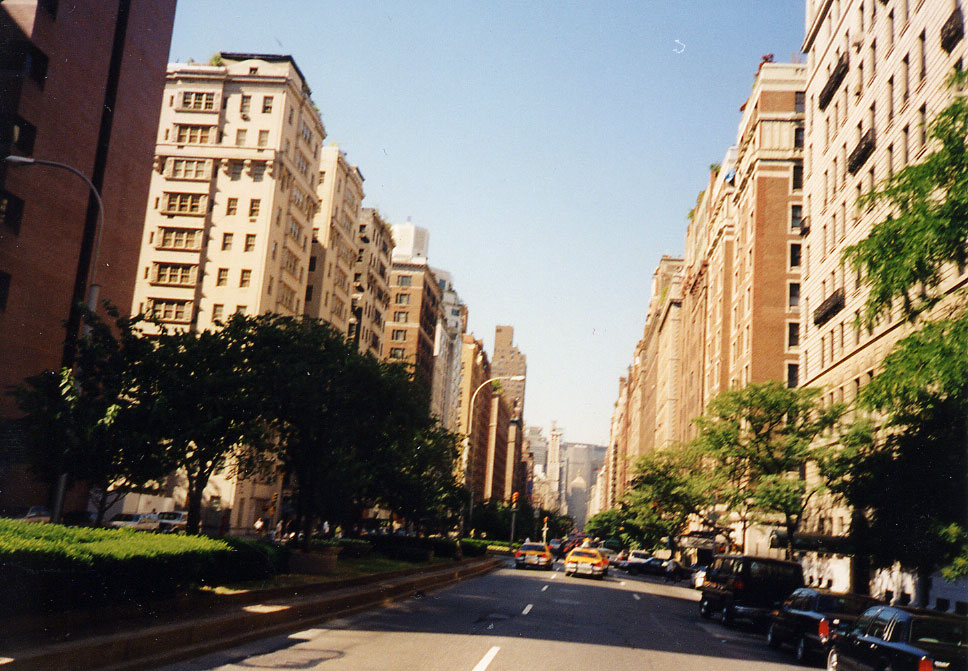
The mechanism of preservation was the co-op board, described above, which assessed a buyer on grounds a mortgage officer would not have recognized: manner, discretion, the right names behind the right schools.3 The buildings that turned away the famous — the San Remo’s board, with only Diane Keaton voting to admit Madonna — did so on the reasoning that a celebrity’s crowds and cameras would disturb the house, the polite form of the older principle that money and fame alike were no substitute for the manner the board screened for.
The manner itself was manufactured, slowly, by a pipeline that a bonus could not shorten: a day school like Buckley or Chapin, a boarding school like Groton or St. Paul’s, an Ivy League college, and a set of summer coordinates as fixed as the schools — the old, unfashionable end of East Hampton north of the highway, Fishers Island, the quiet harbors of the Maine coast. The status markers ran the same way, toward the unmarked. Logos were vulgar; a watch was inherited rather than bought; the correct dinner service had belonged to a grandmother.4 It was a class whose central skill was the performance of not trying, and whose command of that performance was precisely the asset the newer money could not buy at any price.
The Money That Was New
The fortune that had thinned the old money’s relative position was made a few miles south, and it behaved in every respect as the opposite of what it was displacing. The leveraged-buyout and bond boom of the 1980s consolidated, at the decade’s turn, into a more institutional and no less lucrative dominance. Its two loudest symbols fell early: Drexel Burnham Lambert, the house that had built the junk-bond market, filed for bankruptcy in February 1990, the first Wall Street firm forced under since the Depression;5 the following year, Salomon Brothers — whose bond desk Michael Lewis had made the emblem of the era’s trading-floor swagger6 — was caught submitting false bids in Treasury auctions, and its chairman was gone by the end of the summer.7 The center of gravity moved to Goldman Sachs and to a young hedge-fund class, but the culture held: a fortune measured not in acres or lineage but in a single number delivered once a year.
That number was the December bonus, the pivot around which the whole fraction turned. Where old money renovated nothing and let a good apartment wear, new money hired an architect — Peter Marino, Robert A.M. Stern — to gut a prewar floor-through and rebuild it as something engineered. Where old money hid the label, new money wanted it seen: the visible logo, the imported car parked at a garage rate that exceeded a schoolteacher’s rent. Tom Wolfe had already supplied the fraction its self-image and its name, the bond trader as a “Master of the Universe,” and the description stuck because the men it described were content to be described that way.8 What the money bought was everything except the one thing it most wanted, which was to stop being new. It could buy the price of the apartment in the Good Building and still fail the interview, and the failure could not be appealed, because the thing being judged was not for sale.
The Currency of the Byline
Between the two moneyed fractions, and legible to neither, stood a third that traded in cultural authority and lived, much of it, in cash precarity. This was the media and creative elite, the world of the magazines and the publishing houses and the galleries, whose members held enormous power to confer attention and comparatively little liquid wealth of their own. Its institutional center was Condé Nast, where Anna Wintour had taken over American Vogue in 1988 and Tina Brown, having remade Vanity Fair across the 1980s, moved in 1992 to edit The New Yorker.9 Their power was real and their salaries, at the top, substantial; the fraction they led was defined less by either than by a currency the other elites did not deal in — the byline, the masthead line, the name on the guest list.
The clearest map of the fraction’s internal order was a room. When Condé Nast consolidated its titles in a Times Square tower at the end of the decade, the cafeteria Frank Gehry designed for it was read inside the company as a seating chart of status: the star editors — Graydon Carter, Anna Wintour — at the visible tables, the assistant class arranged toward the edges. The order it made visible — the stars at the center, the assistants at the rim hoping to be seen — was the one Toby Young had chronicled from inside those magazines.10 The paradox of the fraction sat in those edge seats. An editorial assistant on a salary in the low twenties frequently lived in an apartment whose rent her wage could not have covered, the gap closed by a parental subsidy or a trust — so that the entry tier of the fraction that traded in cultural authority was, in practice, quietly filtered by the inherited money it did not like to discuss.
The Two Middles
Below the star editors, and sharing their fluency without their safety net, was a media middle: the associate editors, the junior designers, the publicists and assistants who had the cultural literacy and none of the trust fund. They lived in Chelsea or Murray Hill rather than the West Village, carried the nylon Prada backpack that, by the mid-1990s, signaled being in the know rather than being rich, and treated a table at a downtown brasserie as an achievement rather than a habit. Theirs was the true precarity of the creative world — the position that required the manner of the fraction above it on an income that could not sustain the manner, sustained anyway by rent-stabilized luck, roommates, and debt.
A different middle entirely lived in the outer boroughs, and was rarely grouped with the first. In Forest Hills, in Bay Ridge, in Bensonhurst, a class defined by homeownership held property that most of Manhattan’s cultural elite would never own: the attached house, the small front yard, the finished basement, the deed. Here class ran close to ethnicity — Italian, Jewish, Irish, Greek — and its markers were the ones the island fractions had abandoned or disdained, the paid-off mortgage, the family restaurant on the avenue, the parish or the temple. The two middles occupied the same city and almost never the same room. Both were, for the most part, invisible to the taxonomy that the island’s own magazines printed, which recognized the fractions above them in detail and the fractions below them scarcely at all.
The Fractions at a Glance
The period’s own shorthand for placing a stranger ran through three coordinates: where the person slept, what they carried, and where they would take you to lunch.
| Fraction | Typical address | Primary marker | The table it kept |
|---|---|---|---|
| Old money | A Fifth or Park Avenue “Good Building” co-op | Inherited, unlabeled | La Grenouille |
| Finance and deal class | Greenwich, or a downtown loft | The December bonus | Daniel |
| Creative elite | A West Village or SoHo floor-through | The byline and the guest list | Michael’s, at Wednesday lunch |
| Media middle | Chelsea or Murray Hill | The nylon Prada backpack | Balthazar |
| Outer-borough middle | Forest Hills or Bay Ridge | The deed to the house | The neighborhood restaurant |
The mistake would be to read these fractions as a single line with the rich at one end and the poor at the other, because the thing that separated them was not principally how much they had but what kind of wealth it was. Old money held a standing that money could not buy and time could not quickly make; new money held the money and was learning, slowly and in public, that some doors did not open to it; the creative elite held the power to confer attention while borrowing against it to pay the rent; and two middles, one fluent and broke on the island, one solvent and unseen in the boroughs, lived in the same city without meeting. A person’s income placed them on none of these maps with any confidence. Where they slept, what they wore without thinking, and the ease with which they ordered in a particular room placed them at once — and it is those coordinates, not the paycheck, that the rest of the city’s streets and dinner tables were quietly organized to read.
The taxonomy of the city’s moneyed fractions would have made a natural City-section subject: an anatomy, access-driven and elegant, of a single Good Building’s co-op board, or of the December bonus as it moved through the restaurants — the kind of piece the floor could have reported from inside, because its own senior editors would have lived at those addresses and eaten at those tables. The reporting would have been unusually easy to get. The sources would have returned the calls.
The harder assignment would have been raised and set down in a story conference: a City piece taking one of the outer-borough middles — Bay Ridge, Forest Hills — seriously as a class world in its own right, reported on its own terms rather than as a crime dateline or an ethnic flashpoint. It would have been declined on the reasoning the floor would have used for such things, that the subject would have had no national audience — itself the taxonomy at work, the floor mistaking the limits of its own map for the limits of the territory itself.
The man at the freight elevator in the building’s core would have carried the boards and the mail up to the bullpen each afternoon, pressed and unhurried, and would have been, on the floor’s own instrument, unplaceable. The senior editors could have fixed any stranger on Madison Avenue within a sentence — the school in the vowels, the money in the shoes, the fraction in the coat. They would have had no reading at all for a man who had been a doctor in a city their Foreign File had covered only by cable, and who now would have pressed the button for seven and held the door of the car. That he had a class at all, in the sense they meant it, would not have entered their reckoning. The floor would not have known to ask what he had been. And the taxonomy they read so fluently would have stopped, without their noticing, at the edge of the men who carried it up to them.
Footnotes
-
Stephen Higley, Privilege, Power, and Place: The Geography of the American Upper Class (Rowman & Littlefield, 1995), on the Social Register’s “Dilatory Domiciles” supplement, junior listing from birth, and yacht listings; the 1965 marginal dealer’s note on a purged listee is a period bookseller artifact. ↩ ↩2
-
Pierre Bourdieu, Distinction: A Social Critique of the Judgement of Taste, trans. Richard Nice (Harvard University Press, 1984). ↩
-
Steven Gaines, The Sky’s the Limit: Passion and Property in Manhattan (Little, Brown, 2005). ↩
-
Nelson W. Aldrich Jr., Old Money: The Mythology of America’s Upper Class (Alfred A. Knopf, 1988). ↩
-
“Drexel Files for Bankruptcy After Defaulting on Payments,” The Washington Post, February 14, 1990. ↩
-
Michael Lewis, Liar’s Poker: Rising Through the Wreckage on Wall Street (W. W. Norton, 1989). Lewis worked at Salomon Brothers in the mid-1980s; the false-bidding scandal that cost the firm’s chairman his position broke in 1991, two years after the book appeared. ↩
-
Martin Mayer, Nightmare on Wall Street: Salomon Brothers and the Corruption of the Marketplace (Simon & Schuster, 1993). ↩
-
Tom Wolfe, The Bonfire of the Vanities (Farrar, Straus and Giroux, 1987), which supplied the era its enduring name for the bond trader, “Master of the Universe.” ↩
-
Tina Brown, The Vanity Fair Diaries: 1983–1992 (Henry Holt, 2017). Brown edited Vanity Fair from January 1984 and left to edit The New Yorker in 1992; Anna Wintour became editor of American Vogue in 1988. ↩
-
Toby Young, How to Lose Friends and Alienate People (Little, Brown, 2001), a memoir of the author’s years inside Condé Nast’s status hierarchy at Vanity Fair. ↩