The Outer Boroughs: Tribal Underlay, 1989–1993
Subscribe
https://meridian-archive.com/feed.xmlOpen in your app, or paste the link above into any other:
The Instrument of the Boundary
On July 2, 1990, Julio Rivera, a twenty-nine-year-old Puerto Rican bartender who lived in Jackson Heights, was lured into the schoolyard of P.S. 69 by three young men who had gone out that night looking for a gay man to attack, and was beaten with a hammer and stabbed.1 The New York City Police Department entered the killing into its own recordkeeping as drug-related, a standing intake category that required no bias-crime unit, no motive inquiry beyond the category itself, and no count toward the department’s separate tally of anti-gay violence — a killing could pass through the department’s books as one thing while having occurred, on the ground, as another.1 The neighborhood’s gay residents and the newly formed anti-violence organizers refused the classification, held the first gay-rights march in the history of Queens, and carried the case to Mayor Dinkins’s office until the department reversed it.1
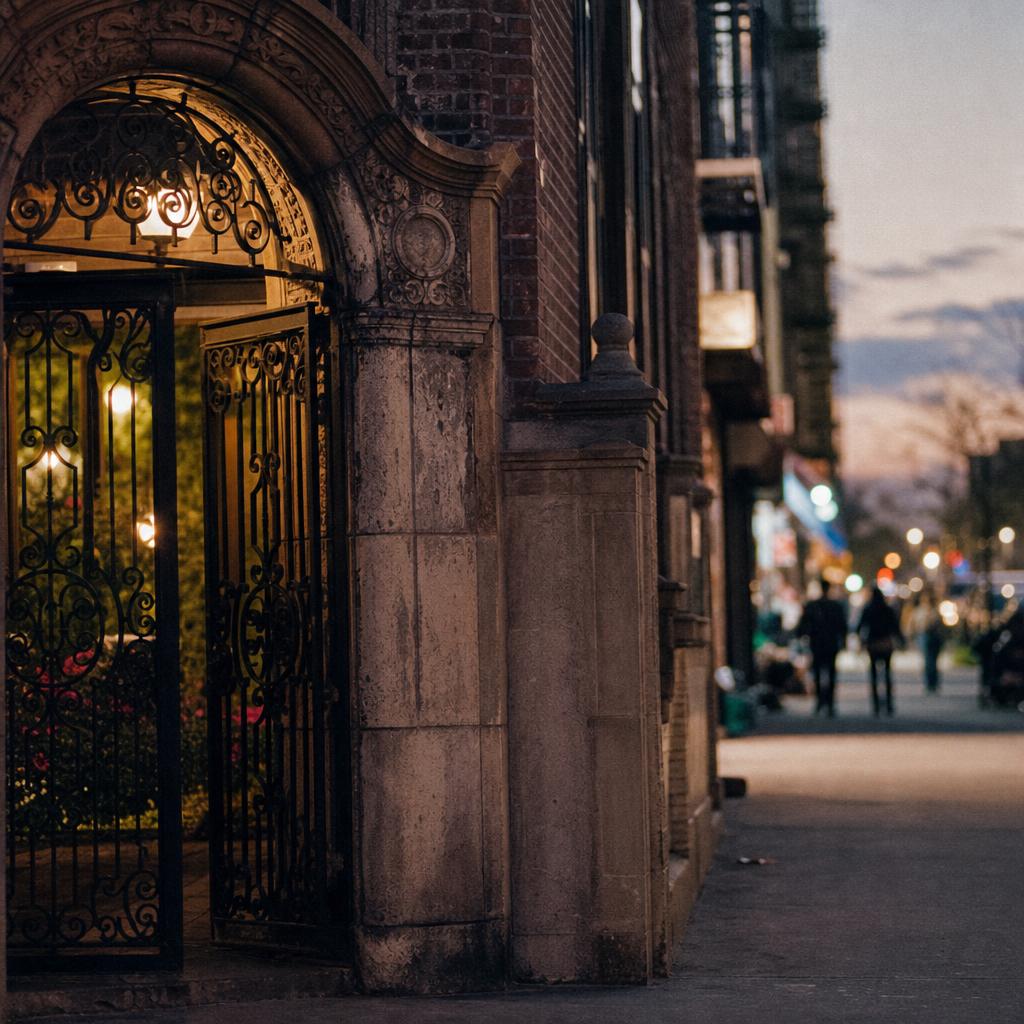
The schoolyard sat inside a neighborhood built, seventy years earlier, on a different kind of instrument. Edward A. MacDougall’s Queensboro Corporation bought the drained farmland in 1909, marketed it as Jackson Heights, and coined the term garden apartment for blocks of housing wrapped around private interior parks.2 In 1919 the corporation opened Linden Court, the first of the co-ops, under what it called the Cooperative Ownership Plan: residents bought shares in the building rather than deeds to a unit, and the shareholders — not any deed restriction filed with the city — decided who could buy in after them. The screening was not a byproduct of the form. It was the selling point. The early buildings carried restrictive covenants as well, and the neighborhood’s own recollection of how the discretion was used, preserved in its histories, was blunt — no Catholics, no Jews, no dogs.2
The covenants did not hold. State and federal courts made racial covenants unenforceable in the late 1940s, and Jewish families moved into the apartment blocks through the 1950s; Black residents remained effectively barred until the Fair Housing Act of 1968.3 By 1990 the neighborhood held the opposite of what its founders had built it to exclude. The stretch of 74th Street south of Roosevelt Avenue had become one of the metropolitan region’s densest concentrations of South Asian shops — sari houses, jewelers, electronics dealers, groceries, several dozen businesses in a few blocks. Roosevelt Avenue, under the elevated tracks of the 7 line, carried a Colombian and Ecuadorian commercial strip that the borough called Little Colombia. Jackson Heights held one of the largest concentrations of gay men in Queens. The most exclusionary residential instrument in the city’s history had produced, within seventy years, one of the most heterogeneous square miles in the United States — the interior gardens still private, still keyed and hedged, the streets around them now filled with arrivals from every part of the hemisphere, among them the bartender the schoolyard would take.
In the autumn of 1991, after three days of deliberation, two of Rivera’s assailants were convicted of second-degree murder — the first killing prosecuted as an anti-gay hate crime in New York State.1 In June 1993 the neighborhood held the first Queens Lesbian and Gay Pride Parade, an answer to the schoolyard carried through the open street.4 That October the Landmarks Preservation Commission designated roughly thirty-six blocks of the garden apartments a historic district, placing the architecture of the old exclusion under the permanent protection of the state.3
The Garden and the Compromise
Forest Hills had been built to the same purpose by different hands. In 1909 the Russell Sage Foundation bought a hundred and forty-two acres and hired Frederick Law Olmsted, Jr., and the architect Grosvenor Atterbury to lay out Forest Hills Gardens as a model English village, with a commuter station at its center at Station Square and curving streets of Tudor houses behind it.5 The Gardens’ covenants named no race and no religion; they operated on price and architectural control, and the effect was the exclusion of the working class by the cost of the door. North of the Long Island Rail Road, in the apartment houses and co-ops that were not the Gardens proper, a Jewish professional and managerial class settled through the postwar decades — the doctors, lawyers, teachers, and accountants for whom Forest Hills was the achieved address, neither the tenement left behind nor the Manhattan that had never been available.
The genteel version of the boundary sat at the neighborhood’s own center. The West Side Tennis Club, inside the Gardens, hosted the U.S. National Championships — the U.S. Open after 1968 — every year until the tournament left for Flushing Meadows in 1978, and it barred Jews and Black applicants from membership. It did so without a written rule, through the proposal-and-blackball procedure by which a handful of negative votes could reject any candidate; the arrangement became public in 1959 when the club refused Ralph Bunche, the United Nations undersecretary and Nobel laureate, and his son.6 The instrument was the same one the co-op board used and the same one the Gardens’ covenants used: exclusion by manner rather than by statute, defensible as private taste. The Jewish professionals filling the co-op blocks a few streets away could not join the club at the heart of their own neighborhood.
The neighborhood’s defining public fight was not a killing but a hearing. In 1971 the city’s Board of Estimate approved a plan to build eight hundred and forty units of low-income public housing in three twenty-four-story towers in the middle of Forest Hills.7 The organized residents — the largely Jewish middle class of the surrounding blocks — resisted with a ferocity that stopped the project cold and carried its opposition to the door of the lawyer Mayor Lindsay eventually appointed to mediate. Mario Cuomo produced a compromise by the end of the summer of 1972: the project cut roughly in half, its height reduced, forty percent of the apartments reserved for the elderly.7 The instrument that defended Forest Hills was procedural and legal — the zoning hearing, the co-op board, the deed — and it left no body on the ground. It did the same work the covenant had done, by other means.
By the 1990s the covenant was two generations dead, the tennis club’s championships had gone to Flushing Meadows, and the boundary in Forest Hills was purely a matter of money. The co-op board remained the screen, and it screened for the ability to carry the maintenance and the manner that the balance alone could not buy. The neighborhood absorbed the decade’s new arrivals accordingly — Bukharian Jews from Central Asia and Iranian families settling into the neighborhood’s apartment blocks, admitted through the screen rather than turned back by it, because they met its price. The families who moved in were not the families the Sage Foundation had drawn its village for, and it did not matter, because the mechanism had never been about who they were. It had always been about who could pay. Class had become the whole of the boundary.
The Avenue and the Bat
Bensonhurst had neither the garden co-op nor the restrictive covenant. It was a neighborhood of attached two-family brick houses, owner-occupied and handed down through families, the upstairs unit rented to a cousin or a newlywed and the mortgage carried by both floors. Its commercial spine was 18th Avenue, co-named Cristoforo Colombo Boulevard, lined with small Italian family businesses — the salumeria, the pork store, the social club with the espresso machine and the folding chairs — many held in the same families across three generations. It was the largest Italian concentration in Brooklyn, still the borough’s Little Italy at the decade’s end, and by the late 1980s an aging one, its population beginning to thin as Chinese and Soviet arrivals reached its edges. It had no legal instrument for controlling who bought in and who did not. What it had instead was the collective certainty of who belonged on the block, enforced on the sidewalk by whoever happened to be standing on it.
On the night of August 23, 1989, Yusuf Hawkins, a sixteen-year-old from East New York, came to Bensonhurst with three friends to look at a used car advertised for sale. A crowd of young white men had gathered on the block, expecting Black or Hispanic men said to be coming to the birthday party of a neighborhood girl, Gina Feliciano, who had quarreled with a local youth and let it be known she had Black and Hispanic friends; several of the crowd carried baseball bats and at least one a handgun. They took Hawkins and his friends for the expected visitors, surrounded them, and shot Hawkins twice in the chest.8 The instrument here was the body — the bat, the gun, the crowd that formed on the corner within minutes because a rumor had said the boundary was about to be crossed. There was no board to appeal to and no covenant to invoke; the screening happened in the street, in real time, at the speed of a phone tree. In May 1990 Joseph Fama was convicted of second-degree murder and sentenced to twenty-five years to life; Keith Mondello, who had assembled the crowd, was acquitted of murder and convicted of riot and lesser counts, and most of the young men charged were acquitted of the killing itself — an outcome that kept the marches coming for another year.8
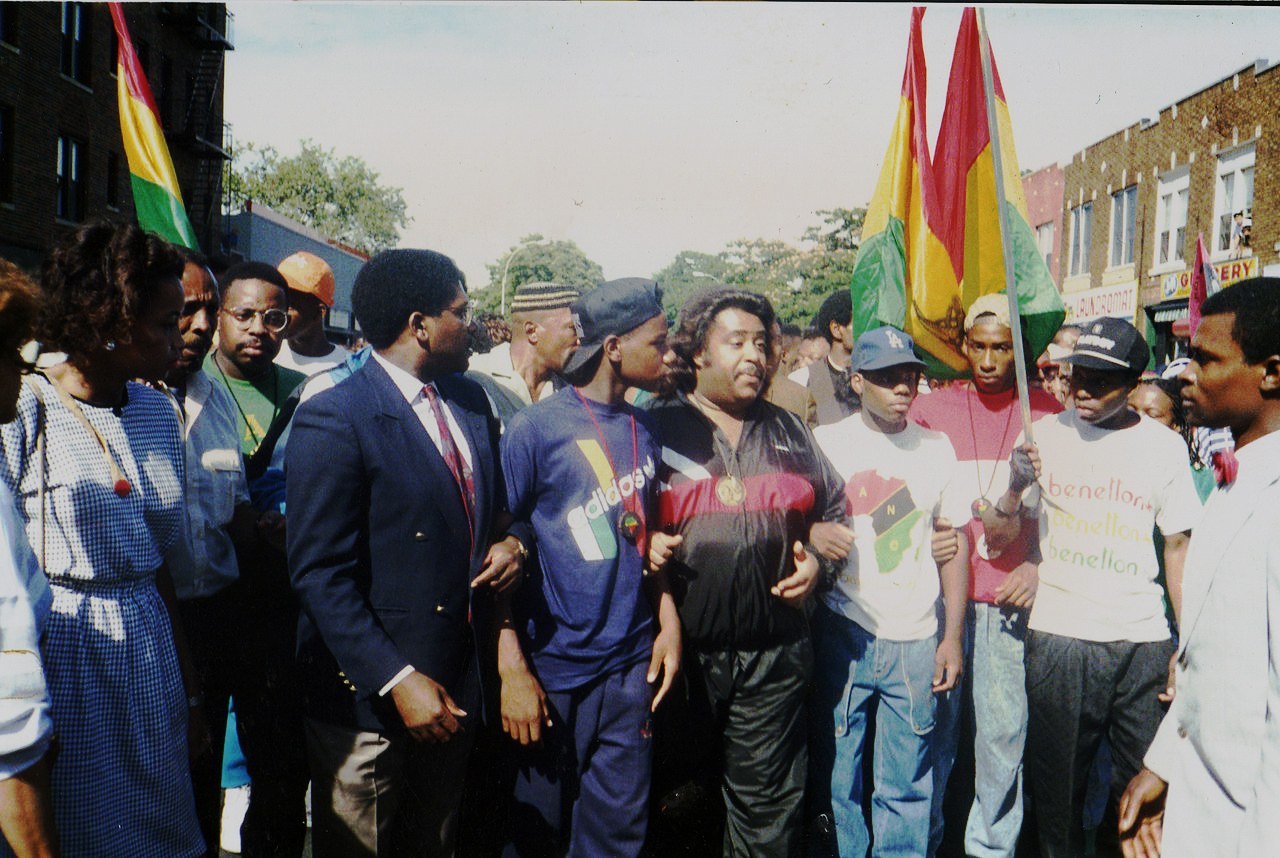
The marches came through the neighborhood in the weeks after the shooting and returned for a year and a half, met on the sidewalks by residents who held up watermelons and chanted the boundary in the plainest available terms. On January 12, 1991, as the Reverend Al Sharpton stepped from a car to lead a demonstration with Hawkins’s parents, a Bensonhurst resident named Michael Riccardi broke from the assembling marchers and drove a knife into his chest, one block from the corner where Hawkins had died.9 Sharpton survived. The neighborhood had defended, with a blade of its own, a line that appeared on no deed and in no covenant and lived only in the shared and unwritten knowledge of whom the block was for.
In the outer boroughs, class and ethnicity were the same fact under two names, and each neighborhood kept its edge with the instrument its history had handed it. Jackson Heights and Forest Hills had inherited the paper instruments — the cooperative share, the restrictive covenant, the zoning hearing, the board that screened the incoming buyer — and when the racial covenants were struck down, those neighborhoods did not lose their boundary so much as convert it into a boundary of price, which the courts did not reach. Bensonhurst had inherited no paper at all. It held its line with the body, and the body left a sixteen-year-old dead on an August sidewalk and a knife in a minister’s chest a block away. The three neighborhoods looked, from Manhattan, like three separate stories — a landmarked garden, a settled middle-class quarter, a violent Italian holdout. They were one structure seen at three settings of the same dial: a community deciding who belonged inside it, and reaching for whatever tool of exclusion it had been left. The tools differed in their legality and their mess; what they enforced did not. And the boundary the outer boroughs still drew with a covenant or a bat was the boundary the whole city was learning, block by block and lease by lease, to draw with a price.
The killing of Julio Rivera in the P.S. 69 schoolyard would never have entered Meridian’s pages as its own subject. What would eventually have reached The Essay, closing toward the spring of 1991, would have been a different piece entirely — a survey of hate-crime law’s uneven reach, built around the pattern of police departments misreading anti-gay killings as drug disputes, Rivera’s death folded in as one instance among several and never named as the piece’s occasion. The magazine would have trained itself, across the AIDS-coverage years, to handle anything touching gay life with a caution it would have reserved elsewhere only for a category a publisher’s advertiser might read as a statement; no single account would have stood over this piece in particular, but the reflex would have been the same one, worn by then into habit.
The first Queens Lesbian and Gay Pride Parade, two years later, would have gone unassigned for a plainer reason. No writer in the stable would have been both fluent in the borough’s gay community and trusted to file the parade as more than a march down an avenue, and the gap would have outlived the story itself.
What the magazine would have run, it would have run in The City. Sharpton’s stabbing, one block from where Hawkins had died, would have carried there within the same winter’s close. The conviction that November of two of Rivera’s killers — the first in New York State prosecuted as an anti-gay hate crime — would likewise have belonged to The City, a few paragraphs among the month’s court dispatches. Two years further on, when the Landmarks Preservation Commission designated the garden-apartment blocks a historic district, that notice too would have found its way to The City, entered as a paragraph among the ordinary civic record for the month.
Footnotes
-
Joseph P. Fried, “2 Accomplices Guilty of Murder in a ‘Gay Bashing’ Case in Queens,” The New York Times, November 21, 1991. Julio Rivera was killed July 2, 1990; the case was the first tried in New York State as an anti-gay bias killing. ↩ ↩2 ↩3 ↩4
-
Daniel Karatzas, Jackson Heights: A Garden in the City (self-published, 1990). Karatzas documents the Queensboro Corporation’s coinage of “garden apartment,” the 1919 Cooperative Ownership Plan beginning with Linden Court, and the covenants and social exclusions of the early community. ↩ ↩2
-
New York City Landmarks Preservation Commission, Jackson Heights Historic District Designation Report (LP-1831, October 19, 1993). The report covers the garden-apartment plan and the restrictive covenants; the district encompasses roughly thirty-six blocks. ↩ ↩2
-
“Starting Point of the First Queens Pride Parade,” NYC LGBTQ Historic Sites Project (project record, nyclgbtsites.org). The inaugural Queens Lesbian and Gay Pride Parade was held in Jackson Heights on June 6, 1993, organized by Daniel Dromm and Maritza Martinez in the wake of the Rivera killing. ↩
-
Susan L. Klaus, A Modern Arcadia: Frederick Law Olmsted Jr. and the Plan for Forest Hills Gardens (University of Massachusetts Press, 2002). Klaus documents the Russell Sage Foundation’s 1909 purchase of the 142-acre tract and the Olmsted-Atterbury plan, built for middle-class commuters as an alternative to the city’s flats. ↩
-
“New York Tennis Club Bars Jews and Negroes; President ‘Explains’ Ban,” Jewish Telegraphic Agency, 1959, reporting the West Side Tennis Club’s refusal of Ralph Bunche and his son and the club president’s confirmation that the club barred Jews and Black applicants. ↩
-
Mario M. Cuomo, Forest Hills Diary: The Crisis of Low-Income Housing (Random House, 1974). Cuomo’s contemporaneous account of mediating the 1971–72 dispute records the original 840-unit, three-tower plan and the compromise that halved and lowered it and reserved 40 percent of the units for the elderly. ↩ ↩2
-
John DeSantis, For the Color of His Skin: The Murder of Yusuf Hawkins and the Trial of Bensonhurst (Pharos Books, 1991). ↩ ↩2
-
“Activist Sharpton Stabbed Before Bensonhurst March,” The Washington Post, January 13, 1991. ↩