The Fourth Wave, 1989–2001
Subscribe
https://meridian-archive.com/feed.xmlOpen in your app, or paste the link above into any other:
The Daisy Chain
Federal and state investigators came to call it the daisy chain: diesel and gasoline moved through a lengthening string of shell fuel distributors, each one invoiced to the next long enough to make the excise taxes owed at every link disappear before a state comptroller or the IRS could collect them, a fraud investigators measured, by the mid-1990s, in the hundreds of millions of dollars.1 It was not run as a Russian monopoly operating past an established New York underworld’s notice, nor around it. It was a negotiated joint venture: the Genovese and Colombo crime families supplied the distribution networks and the political protection an immigrant syndicate newly arrived from Brighton Beach could not yet buy for itself, and took an agreed share of the proceeds in return.1 The arrangement outlasted any single man’s tenure running it.
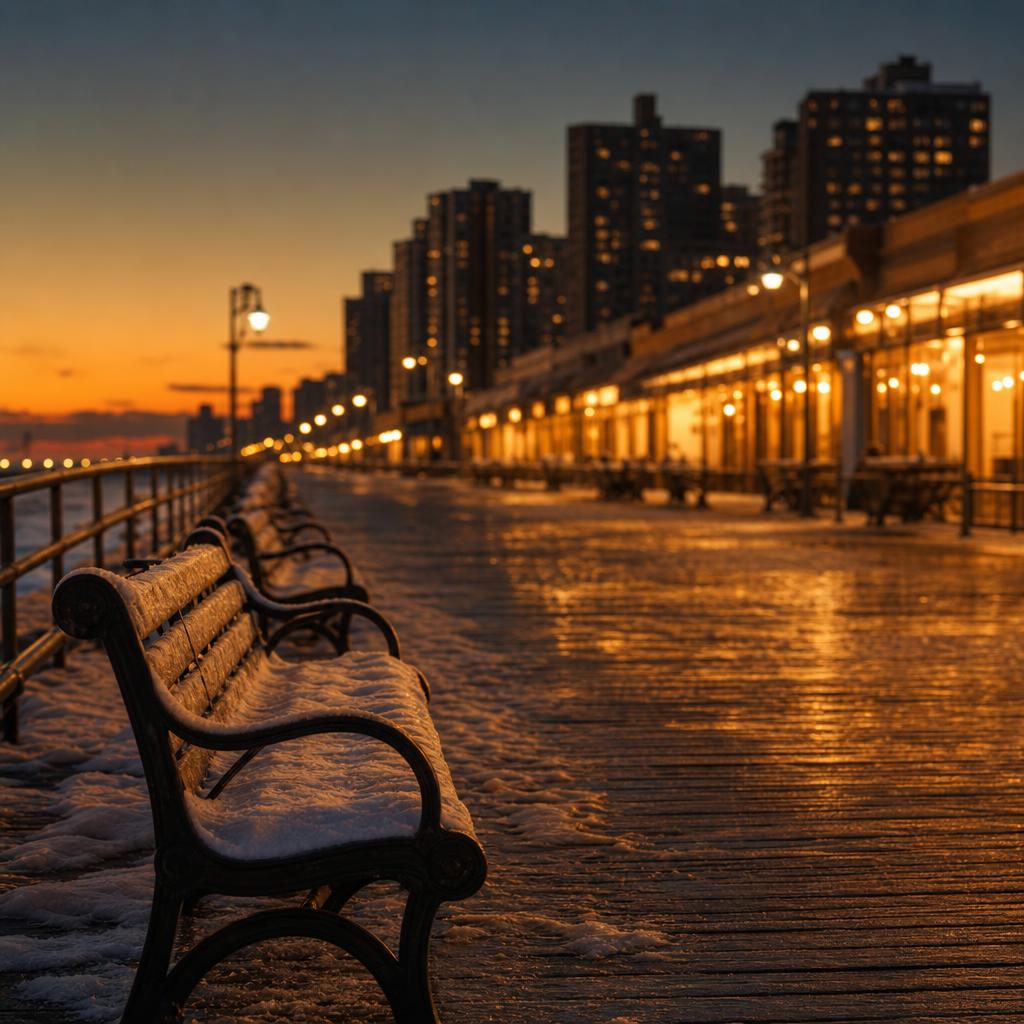
Before dawn on June 8, 1995, FBI agents pounded on the door of a modest apartment two blocks from the Brighton Beach boardwalk and arrested a man in his fifties dressed only in underclothes and a black T-shirt, carrying papers under more than one name and a green card obtained, agents already knew, through a marriage arranged specifically to defeat a deportation order. Booked, he gave his occupation as businessman. He was in fact Vyacheslav Ivankov — Yaponchik, “Little Japanese,” to the Russian-speaking underworld that had sent him to Brooklyn three years earlier to organize an emigre criminal economy that had, until his arrival, operated without central discipline. Convicted in Moscow in 1982 on charges that included firearms possession and fraud, he had served roughly a decade of a fourteen-year sentence before his release in 1991, obtained, by the account American investigators later pieced together, through a bribed Russian Supreme Court judge and a well-placed political sponsor. He reached New York the following March on an ordinary business visa that listed his occupation as film producer — a cover, not a credential — arriving not as a refugee but as an appointee, sent to run an operation his sponsors back home could not yet reach themselves. A senior FBI official in Washington told reporters the arrest was “equivalent to arresting a Gambino” — a comparison that assumed, correctly, that the reference still meant something to an American newspaper reader in 1995, and, less correctly, that the population Ivankov had come to organize was itself already legible to the city hosting it.1 The extortion charge against him — a scheme to squeeze $3.5 million from the owners of a Russian-emigre investment firm — was, measured against the population it was extracted from, a small case.1
That population was not small, and it was not one thing. A wave of Soviet Jewish emigration in the late 1970s had already put close to forty thousand people into Brighton Beach, most of them Ashkenazi Jews from Russia and Ukraine arriving with little English and less money, resettled with the help of caseworkers from HIAS and the New York Association for New Americans.2 The Soviet collapse of 1991 produced a second, larger, and structurally different wave: in 1992 alone, more than twenty thousand Eastern European immigrants arrived in New York, a share of them not Jewish at all, many carrying university credentials the first wave had rarely had time to acquire before it left.2 Layered onto both were Georgians, Azerbaijanis, and Armenians following the same Brighton Beach settlement pattern; Bukharian Jews from Uzbekistan and Tajikistan building a separate corridor in Queens; Poles renewing a Greenpoint neighborhood that had been Polish since the previous century; Bosnian, Serb, and Croat refugees fleeing a war the decade had not expected to have; and Albanians arriving by lottery rather than by flight. A magazine writer who called all of it “Russian” was making an ethnographic error that also functioned, without anyone intending it to, as a class marker: it meant the writer had not looked closely enough to notice the difference. By the end of the run, the Russian-speaking population alone — Jewish and non-Jewish, settled since the 1970s and arrived since 1991 — numbered in the several hundred thousands across the five boroughs, a linguistic community without precedent in the city’s postwar immigration history for the speed of its arrival.
The legal machinery sorting these populations into New York ran on three separate tracks, and the differences between the tracks did more to determine a given immigrant’s first year in the city than any difference in skill or ambition. The Lautenberg Amendment, attached to that autumn’s foreign-operations appropriations act, granted Soviet Jews and designated Evangelical and Pentecostal minorities a presumption of refugee status that did not require proving individual persecution.3 The Immigration Act of 1990 created, the following year, a Diversity Visa lottery for countries the existing quota system had underrepresented — Poland and Albania among the earliest and largest beneficiaries.4 Temporary Protected Status, granted to Bosnians beginning August 10, 1992, and to Kosovars beginning June 9, 1998, gave a third population a legal footing that had to be renewed annually, or not, at the discretion of an agency in Washington neither community controlled.5 A Soviet Jewish arrival in 1992 had a caseworker, an English class, and a resettlement stipend waiting. A Diversity Visa winner from Kraków had a green card and a cousin’s phone number in Greenpoint. A Bosnian family had a status that could, in principle, be revoked. From a Manhattan office, all three looked like the same event.
Six Names for One Word
Brighton Beach absorbed the largest share and kept the nickname it had earned in the 1970s: Little Odessa, after the Black Sea port, a name new arrivals from that coast noticed made a certain visual sense — the boardwalk and the Atlantic sat exactly where an Odessan expected a shoreline to sit. Storefront signage went up hand-painted in Cyrillic, sometimes with Hebrew beside it; newsstands carried Novoye Russkoye Slovo, a daily founded in New York in 1910 and by the 1990s the largest Russian-language paper the wave inherited rather than created.2 Restaurants ran to a particular banquet format — the National, Primorski, Tatiana — four-hour Saturday tables, vodka, sturgeon, a band playing music that sounded, depending on the listener, either Soviet or Las Vegas; the Brighton Bazaar grocery down the block sold black bread, smoked fish, and cured meats unavailable at any other counter in Brooklyn. Trump Village, a seven-tower cooperative complex built in 1963–64 by Fred Trump and designed by Morris Lapidus, anchored the neighborhood’s mid-century housing stock and gave the emigre wave, a decade later, its first large stock of affordable co-op units.6
Greenpoint had been Polish since the nineteenth century, and the 1990s wave, arriving mostly through the Diversity Visa lottery, thickened rather than founded the neighborhood: Manhattan Avenue and Nassau Avenue lined with bakeries and butchers selling kabanosy and kielbasa, basement bars running an old-country drinking culture the neighborhood’s slower gentrification had not yet disturbed, Mass in Polish at St. Stanislaus Kostka packed on Sundays through the decade, the Polish Slavic Center on Driggs Avenue running English classes and legal aid, newsstands carrying the Polish-language daily Nowy Dziennik. A Polish nanny from Greenpoint holding a graduate degree from Łódź and a Manhattan employer who had no occasion to learn this were not a hypothetical case; the same credential gap ran through the neighborhood’s construction crews and drivers as much as its cleaning trade. Rego Park and Forest Hills held a different and older institution — a Bukharian Jewish community center founded decades before the Soviet collapse, which gave the much larger 1990s wave of Persian-speaking Jews from Uzbekistan and Tajikistan a settlement point already prepared for them along 108th Street between 63rd Road and 65th Avenue, the strip its residents called Bukharian Broadway.7 The trade specialization that came with them was specific rather than generic: Bukharian families moved into the diamond and jewelry trade on Manhattan’s West 47th Street in numbers substantial enough, by the decade’s end, to have altered who staffed the counters of a district that had been Hasidic-dominated for generations. Astoria, already Greek and Italian, took in Bosnians, Serbs, Croats, and Albanians, whose cafés ran arguments over what exactly was happening at home — a war, a civil war, an ethnic cleansing — that tracked, reliably, which side of a recent border a given customer had left, and whose Temporary Protected Status made a customer’s whole household arrangement provisional in a way none of the neighborhood’s earlier immigrant waves had had to live with. Sheepshead Bay, north of Brighton Beach, became the wave’s second-generation address: a mother still in Brighton, a daughter married to a Sheepshead Bay professional, a granddaughter at a city university, three generations compressed into one decade — a compression the neighborhood’s earlier Italian and Irish arrivals had taken two generations longer to complete.
Six Populations, One Decade
| Population | Primary Settlement | Legal Channel | Starting Position |
|---|---|---|---|
| Soviet Jews | Brighton Beach, Sheepshead Bay | Lautenberg Amendment refugee status | State-assisted: HIAS/NYANA caseworkers, resettlement stipend |
| Ethnic Russians and Ukrainians | Brighton Beach | Diversity Visa, employment channels | Mixed; often credentialed, no state assistance |
| Bukharian Jews | Rego Park, Forest Hills | Standard family and employment visas; no dedicated refugee channel | Trade-specialized (jewelry, diamond district) |
| Poles | Greenpoint | Diversity Visa Lottery | Working- to professional-class; foreign credentials often untransferable |
| Bosnian, Serb, and Croat refugees | Astoria | Temporary Protected Status | Displaced professional and working class |
| Albanians | The Bronx, Queens | Diversity Visa Lottery | Working class |
The Runway
The magazine industry’s own contact with the wave ran through its fashion pages, and it ran early. John Casablancas had built Elite Model Management’s “Look of the Year” contest into a scouting apparatus reaching sixty countries by the early 1990s, and Elite’s Eastern European circuit — casting calls held in Prague, Warsaw, and Budapest hotel ballrooms — became one of the decade’s most productive supplies of new faces.8 IMG, Ford, Wilhelmina, and the smaller Next agency opened parallel relationships with the same regional scouts over the same years, competing for the same fourteen- and fifteen-year-olds a season before any of them had finished secondary school at home. Eva Herzigová, born in Litvínov, Czechoslovakia, in 1973, won a Prague modeling contest run by the French agency Metropolitan Models in 1989 at the age of sixteen and moved to Paris; her international breakthrough came in 1994, fronting a Wonderbra campaign built around two words on a billboard.8 Daniela Peštová followed the same route out of Czechoslovakia a few years later. Agencies scouted the same circuit for Polish and, by the late 1990s, Russian candidates, and the economics were consistent across nationalities: a teenager recruited from a provincial town, flown to Paris or Milan or New York, housed several to an apartment, and paid against an agency-held account she rarely controlled outright. A single day’s booking rate could exceed, several times over, what a parent back home earned in a month; the same economic collapse that had put an engineer behind the wheel of a Brighton Beach livery car was, on the other end of the pipeline, what made a fifteen-year-old’s face a marketable commodity in the first place. Trade coverage of the era’s fashion economy rarely applied to Eastern European recruitment the same racial and economic scrutiny it was, by the decade’s second half, beginning to apply when the same agencies scouted Black models from Africa and the Caribbean — a double standard that went almost entirely uncommented upon in the press that covered both.
The pipeline’s most visible late-decade destination was not the runway but the marriage that sometimes followed it. Melania Knavs, born in Slovenia in 1970, modeled in Milan and Paris through the early-to-mid 1990s before moving to New York in 1996; two years later, at a Fashion Week party thrown by the modeling agent Paolo Zampolli at the Kit Kat Klub, she met Donald Trump. Trump asked for her number while still seated with his own date; Melania later recounted her answer: “I am not giving you my number; you give me yours, and I will call you.”9 The pattern was not new — Trump’s first wife, Ivana, had come from Czechoslovakia by way of a modeling and skiing career of her own — but it had, by the 1990s, become a recognized feature of the city’s upper social layer rather than an isolated match.6
What the Agencies Sold
The model pipeline sat inside a larger marketplace that magazines of the period wrote about unevenly and, more often, not at all. Marriage-introduction agencies marketing Russian and Ukrainian women to American men grew through the decade from mail-order catalogues into escorted “singles tours” to Moscow, St. Petersburg, and Kyiv. Whether a given magazine piece on the subject looked closely at the women’s own calculations — often economic, often willingly made, sometimes coerced — or settled for the leering frame the male readership was assumed to want was a decision an editor made every time the subject came up, and it was rarely made the same way twice.
The same pattern, in its highest social register, was visible at the benefit dinners and gallery openings a city magazine’s social pages routinely photographed. An Eastern European wife or girlfriend at the elbow of an older New York man of means became, by the second half of the decade, simply part of the visual furniture of a party photograph, present in captions that named the man and never had occasion to ask how the couple had met, what she had done before New York, or what she had given up to be in the frame at all.
The grimmer end of the same marketplace involved outright trafficking. Robert I. Friedman’s reporting through the decade, and prosecutions that followed some of it, documented networks moving women from Ukraine and Moldova through Israel and Western Europe into the American sex trade, with Russian organized crime figures among the operators.1 Distinguishing an economically strategic marriage, a coerced one, and a criminal trafficking operation required exactly the kind of sustained, unglamorous reporting a monthly magazine’s Feature Well could support and its advertising department, on a bad month, might not welcome.
The Organization
Ivankov’s June 1995 arrest was the decade’s single most-covered organized-crime event out of Brighton Beach, but the criminal economy he had been sent to discipline outlasted his conviction and nine-year, seven-month sentence.1 The gas-tax daisy chain was the wave’s single most lucrative scheme; Medicare and insurance-fraud rings, in some documented cases, involved Brighton Beach physicians directly; and laundering ran through Manhattan real estate, high-rise condominium purchases functioning as a plausible destination for money that needed one.1 Stock manipulation ran through Long Island brokerage houses, pump-and-dump operations on small-capitalization stocks that used the same emigre networks Ivankov had been sent to discipline.1 Stephen Handelman’s companion account of the Moscow side of the same economy gave American readers, for the first time in accessible form, the organizational logic — how a command structure built under one system adapted itself to another.10
Friedman had built his reporting career, before Brighton Beach, on an earlier and equally unwelcome subject — Meir Kahane and the Jewish Defense League — and carried into the Russian material the same willingness to write about a community from close enough in that the community itself objected. He did not survive the decade by much: a heart condition, traced to a rare disease contracted on assignment in Bombay, where he had been reporting on human trafficking for Vanity Fair, killed him not long after Ivankov’s conviction ran its course; the FBI had separately warned him that a Russian organized-crime figure had put a price on his life.11 The reporter who did the most to make the decade’s Russian criminal economy legible to an American readership had spent much of that same decade absorbing costs the readership never saw and would not, from the finished magazine pages alone, have had any way to guess at.
The Building
The wave’s least visible effect on the magazine world was also its most direct. Doormen in prewar Manhattan buildings, staffed through the 1980s largely from Black, Puerto Rican, and Irish applicant pools, were by the late 1990s increasingly drawn from Albanian and Polish networks working through informal referral chains inside the buildings themselves. Cleaning work in the same buildings ran predominantly through Polish networks centered on Greenpoint — women who arrived with credentials, in some documented cases advanced ones, that no American employer had a mechanism to recognize. Caribbean women remained the dominant population in New York’s nanny economy through the decade, but Polish and, in smaller numbers, Russian women entered the field substantially during the 1990s, changing which languages a Manhattan playground’s benches were likely to be spoken in on a given weekday morning.2 Black-car services catering to media-industry New York drew increasingly on Russian, Ukrainian, Uzbek, and Bukharian drivers, a labor pool that included, without any obvious way for a passenger to know it, engineers, physicians, and university lecturers whose credentials had not crossed the ocean with them. Renovation and cleanout crews working the same Upper East and Upper West Side apartment buildings ran heavily Polish and Albanian by the second half of the decade, two-man van operations that undercut established contractors on price precisely because the wave had not yet organized itself into its own union locals. Midtown’s strip clubs, staffed through the 1980s by a dancer population the clubs themselves rarely tracked by nationality, shifted markedly toward Russian and Eastern European women over the same years — the same displacement, applied to a different room.
The Diaspora’s Own Papers
None of this ran without its own press, stage, and soundtrack, largely unread by the readership a Midtown monthly served. Novoye Russkoye Slovo anchored a Russian-language daily press that included Russkaya Reklama, effectively Brighton Beach’s classified section, and V Novom Svete, more diaspora-focused still. Russian-language editions of Vogue, Harper’s Bazaar, and Cosmopolitan launched in Moscow over the same years, producing a cross-pollination — Russian editors and stylists corresponding with their New York counterparts about the same designers, the same models, sometimes the same photographers — that ran directly parallel to Meridian’s own well without once touching it. The Millennium Theater in Brighton Beach hosted touring Moscow companies and satirical revues; Mikhail Baryshnikov, dancing with his own White Oak Dance Project from 1990 onward, worked a few subway stops away from a neighborhood whose Saturday-night entertainment he never shared a stage with. Willi Tokarev, who had driven a New York taxi for years after emigrating from the Soviet Union to save enough to record his first album, performed for years afterward, alongside Mikhail Shufutinsky, in the Brighton Beach restaurant circuit — Sadko, Primorski, Odessa — songs about emigre life that circulated back into the Soviet Union unofficially even while barred from its airwaves. James Gray’s 1994 film Little Odessa, shot in the neighborhood and awarded a Silver Lion at Venice, and Darren Aronofsky’s Requiem for a Dream six years later gave the neighborhood its two most durable screen images — both crime stories, joined before the decade closed by lesser genre pictures that mined the same territory for the same reason: a Brighton Beach setting signaled criminal menace to an American audience faster than exposition could. None of them described the much larger population that never appeared in any of them — the jewelers, the caseworkers, the taxi drivers, the nine-to-five majority a crime-picture backdrop had no use for.
The wave had a shape no single arrest could show. Ivankov’s case ran a year and a half in a Brooklyn federal courtroom and closed with a number attached to one man; the migration that produced the neighborhood he had come to discipline ran the length of the decade and produced hundreds of thousands of people, nearly all of whom extorted no one and appeared in no affidavit. Brighton Beach absorbed them, and so did Greenpoint, and the stretch of 108th Street an older community center had marked out for a community not yet arrived. The fashion pages, the lobby desks, the taxi meters, and the Saturday-night restaurant bands in Brighton Beach were all downstream of the same collapse, arriving by different doors, under different laws, at different speeds, into different rooms of the same city. It was the pattern the decade kept repeating: a city rebuilt, continuously, by people its own institutions had not yet learned to see.
Ivankov’s arrest would have offered the Feature Well exactly the material a monthly could recognize without a second read, and the August 1995 issue would have run it: a name, a number, a courtroom, an organization behind all three. The Front, five and a half years earlier, would have taken a shorter turn on the Lautenberg Amendment in the issue closing for January 1990 — a policy already decided in Washington rather than argued on the floor. The Essay the following January would have gone longer, reading the Immigration Act of 1990 and its Diversity Visa lottery for the slower effect neither headline nor courtroom could carry: what a lottery ticket would have done, over years, to Greenpoint and to Brighton Beach. The Foreign File would have carried Bosnia’s Temporary Protected Status designation that October, and would have gone back to the same instrument almost six years later for Kosovo’s, in the August 1998 book — the same bureaucratic mechanism, drawn on twice, each time filed as somebody else’s war rather than a New York story.
The harder piece would not have run at all. The one that would have followed the agencies’ Eastern European circuit past the contact sheet and into the held passport and the agency-held account would have been pitched more than once by 1994, and would have died in the same room each time, on the same ground: that Vanity Fair and the fashion glossies already owned the beat, and Meridian, arriving after them, would have had nothing but someone else’s story to chase.
Footnotes
-
Robert I. Friedman, Red Mafiya: How the Russian Mob Has Invaded America (Little, Brown, 2000). ↩ ↩2 ↩3 ↩4 ↩5 ↩6 ↩7 ↩8
-
Annelise Orleck, The Soviet Jewish Americans (Greenwood Press, 1999). ↩ ↩2 ↩3 ↩4
-
Foreign Operations, Export Financing, and Related Programs Appropriations Act, 1990, Pub. L. No. 101-167, § 599D (1989). ↩ ↩2
-
Federal Register 57 FR 35604 (Aug. 10, 1992) (Bosnia-Herzegovina TPS designation); Federal Register, Vol. 63, No. 110 (June 9, 1998) (Kosovo TPS designation). ↩ ↩2
-
Gwenda Blair, The Trumps: Three Generations That Built an Empire (Simon & Schuster, 2000). ↩ ↩2
-
“In Queens, Bukharian Jews Keep Their Tradition and Their Community Strong,” Brick Underground, August 31, 2017. ↩
-
Michael Gross, Model: The Ugly Business of Beautiful Women (William Morrow, 1995). ↩ ↩2
-
Alex Kuczynski, “Melania Trump’s American Dream,” Harper’s Bazaar, January 6, 2016. ↩
-
Stephen Handelman, Comrade Criminal: Russia’s New Mafiya (Yale University Press, 1995). ↩
-
“Inconvenient Truth,” The Village Voice, July 9, 2002. ↩