Immigration Beyond the Eastern Bloc, 1989–2001
Subscribe
https://meridian-archive.com/feed.xmlOpen in your app, or paste the link above into any other:
The Debt
By the end of the 1990s, an intelligence estimate compiled by the Immigration and Naturalization Service put a specific traffic at twelve to twenty-four thousand undocumented Chinese arrivals a year, more than eighty percent of them from Fujian province alone, and the Congressional Record logged the mechanism that moved them in the trade’s own working term, without quotation marks: snakeheads, 人蛇 (rén shé), who advanced the passage as a debt against wages not yet earned.1 The fee climbed like any other market price across the years the smuggling routes operated — several thousand dollars in the early 1980s, twenty-five to thirty-five thousand by the early 1990s, fifty thousand and more by the decade’s close — and its collection back home depended on nothing more exotic than a dishwasher’s cash wage of two hundred to two hundred fifty dollars a week, diverted near-total for years until the debt cleared: not a loan an arrival serviced alongside a life, but the standing condition of the job itself, tracked by federal intelligence as an annual statistic rather than an aberration.2
The population this financed was not headed for Chinatown’s Cantonese core, the neighborhood bounded loosely by Canal Street, Baxter Street, and the blocks east of the Bowery that Toisanese-speaking families had held for two or three generations. It belonged to a newer migration out of Fuzhou, the capital of Fujian province, one that had been building through the 1980s and surged after the Chinese government’s June 1989 crackdown at Tiananmen Square, which supplied both a reason to leave and, in Washington’s sympathetic posture toward Chinese nationals citing it, a basis on which an asylum claim could be argued. The traffic surfaced publicly just once, at approximately 2:00 AM on June 6, 1993, when a rust-streaked freighter called the Golden Venture ran aground on a sandbar off Fort Tilden, on the Rockaway peninsula of Queens, in water measured that night at 52 degrees Fahrenheit. The ship had left Fujian province two hundred twenty-two days earlier and had covered some seventeen thousand miles by way of Bangkok, Mombasa, and the Cape of Good Hope, carrying two hundred eighty-six passengers and thirteen crew who had spent the crossing in a cargo hold on a diet of rice, peanuts, and water gone foul.2 When the hull struck the sandbar, passengers who had not seen open sky in months began jumping into the surf rather than wait for rescue; ten drowned or died of exposure within sight of the beach.2 Emergency crews pulled the rest from the water and wrapped them in blankets for the cameras already arriving; by afternoon the photographs were on every front page in the city — a single hull’s cargo, standing in for a traffic the INS estimate had already sized in the tens of thousands a year.
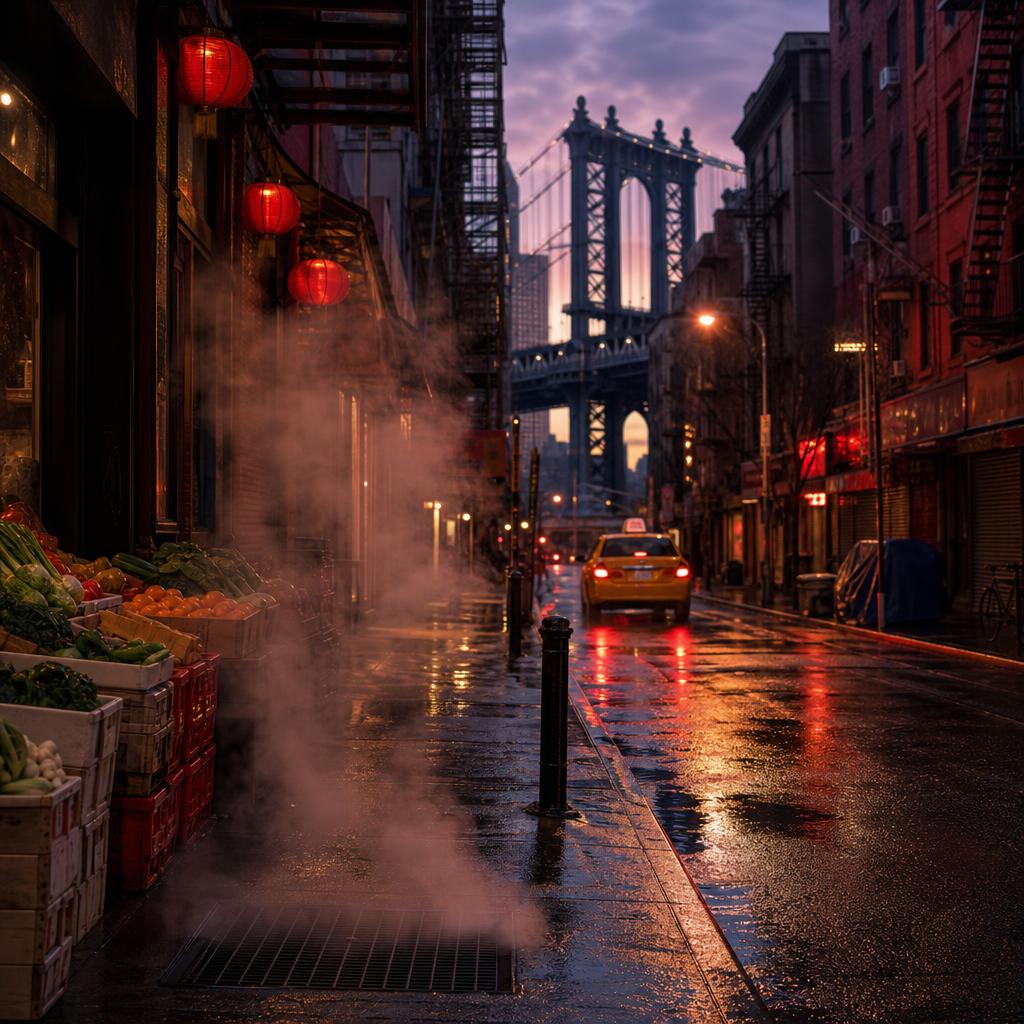
On East Broadway, running east from the Manhattan Bridge anchorage toward Rutgers Street, the new arrivals built a district legible within a few years as Little Fuzhou: Fuzhounese-inflected Mandarin displacing Toisanese on the sidewalk, oyster cakes and fish-ball soups displacing the roast duck and dim sum carts of Mott Street. The Fuk Ching, a Fujianese criminal organization that had organized in the same blocks through the 1980s, took the collections that came with the new district — protection payments from merchants, a cut of the smuggling fees, a hand in who worked where.3 Its friction with the established Cantonese tongs was economic before it was anything else: a labor force willing, by debt and necessity, to work for less than the neighborhood’s going wage.
The survivors’ asylum claims — persecution under China’s one-child population policy, retaliation for sympathies shown in 1989 — went mostly unrecognized by an immigration system unwilling to treat flight from a country the United States was simultaneously courting on trade as a refugee matter. Most spent close to four years in custody, dispersed among York County Prison, Rikers Island, and other federal facilities, before a Pennsylvania congressman’s personal appeal to President Clinton produced, in February 1997, an order paroling those who remained.2 By then the population the grounding had made briefly visible had already spread past Manhattan into Sunset Park, Brooklyn, building a restaurant district of its own on Eighth Avenue, one that generated no comparable photograph and no comparable coverage.
The Puebla Pipeline
A different, older mechanism carried Mexican labor into the city’s kitchens, and it produced no single dramatic photograph at all. By the mid-1990s a specific corner of Mexico — the mixteca poblana, the rural municipalities of Puebla state that included Izúcar de Matamoros, Chinantla, Atlixco, and Piaxtla — supplied so much of the city’s restaurant labor force that reporters and researchers had begun calling New York “Puebla York.”4 The mechanism was chain migration in its purest form: one man from a pueblo found work in a Manhattan kitchen, sent money and word home, and within a decade an entire village might be represented in a specific kitchen’s hierarchy. Behind that mechanism sat a harder economic push. Mexico’s currency and debt crises through the 1980s had already strained the countryside; the North American Free Trade Agreement, effective January 1, 1994, phased out the tariff protecting Mexican corn even as the government wound down the domestic price supports that had cushioned subsistence farmers, and rural Puebla absorbed a share of the resulting displacement felt across the Mexican countryside through the decade.5
What a border crossing cost in the 1990s and how long it took varied by route and by year, rising as enforcement tightened; what awaited a new arrival in New York did not vary nearly as much. The first stop was typically a boarding house in Corona, Queens, or a block in Sunset Park, Brooklyn, held by earlier arrivals from the same pueblo. The first job was almost always dishwasher, paid in cash and under the table — a documented case from the Waverly Diner in Greenwich Village put Miguel Romero Lara’s pay, as a newly arrived dishwasher in 1991, at $280 a week, and a busboy’s at the same diner, Miguel Gonzaga, at $150 for a sixty-six-hour week.6 The kitchen hierarchy above the dishwasher’s station was consistent enough across the city’s restaurants to function as a map of who had arrived when and from where: prep cooks more often Mexican or Central American with some tenure, line cooks more often Dominican, Puerto Rican, or longer-settled Mexican, the sous chef and executive chef almost always white American or European, the name on the menu belonging to the person furthest from the dish pit.
New York’s own posture toward this workforce was more permissive than the federal government’s. Since an executive order Mayor Koch signed in 1989, city employees had been barred from asking a resident’s immigration status or reporting it to federal authorities absent a criminal matter — a policy Dinkins continued without incident and Giuliani’s administration, whatever his private reservations, defended in federal court rather than rescinded.7 Enforcement, in practice, was a distant hazard rather than a daily one through the middle of the decade. That changed after 1996, when a federal welfare-reform law cut off most public benefits for undocumented immigrants and raised the political temperature around enforcement generally, even where the city’s own policy held.8 The kitchens that had absorbed Puebla’s rural exodus kept running through both climates, at the same wage, under the same informal arrangement, mostly out of sight of the dining rooms they fed.
Little Senegal
116th Street between Malcolm X Boulevard and Frederick Douglass Boulevard carried almost no West African presence in the mid-1980s. By the early 1990s the block had a name — Little Senegal — built by Senegalese, Malian, Guinean, and Gambian arrivals bound together less by nationality than by a shared French colonial inheritance and, for many, the Mouride Sufi order’s commercial networks, which financed import shops selling wax-print cloth and cassette tapes of mbalax and griot recordings.9 Hair-braiding salons run largely by Guinean and Senegalese women operated in a regulatory gray zone, since state cosmetology licensing did not address braiding; halal restaurants served thieboudienne and mafé from storefronts with a single menu taped to the wall; street vendors worked a daily circuit from 116th Street down into Midtown. Legal pathways into the country varied by nationality and by decade: overstayed tourist visas for many Senegalese and Malian arrivals of the late 1980s, asylum claims for some fleeing Mali’s dictatorship under Moussa Traoré, overthrown in a 1991 coup, and — increasingly through the decade — the visa lottery Congress had created the year before.
That lottery’s largest regional beneficiary was Africa, and its reach extended well past this one block, reorganizing whole stretches of Harlem and the Bronx around communities that had barely existed there a decade earlier. What the lottery could not do was make Little Senegal legible to the city that surrounded it, any more than a French-speaking street vendor’s presence made him legible to the customers who bought socks and incense from his folding table without asking where he had come from or what he had been before he arrived.
Amadou Diallo was one of those vendors. Born in 1975 to a Guinean family with roots in the Fulbe trading networks, he came to the United States in 1996 and settled in a Soundview apartment in the Bronx, at 1157 Wheeler Avenue, selling videocassettes, gloves, and socks on 14th Street and around Midtown while he took computer science courses and saved to bring his mother, Kadiatou, to the country.10 At 12:40 AM on February 4, 1999, four plainclothes officers of the NYPD’s Street Crime Unit — Sean Carroll, Richard Murphy, Edward McMellon, and Kenneth Boss, part of a unit expanded under Commissioner Howard Safir to roughly 380 officers with the unofficial motto “We own the night”11 — approached him in the doorway of his building while searching for a serial rapist. Diallo retreated into the vestibule and reached into his jacket for his wallet. The officers fired forty-one rounds; nineteen struck him, and he died where he stood.10 In 1997, the unit’s aggressive stop-and-frisk tactics had produced more than eighteen thousand street stops and a small fraction of that number in arrests — a ratio that meant the overwhelming majority of people stopped had done nothing that led anywhere.11 A Bronx grand jury indicted the four officers on murder charges; the trial moved to Albany on a change of venue, and on February 25, 2000, a jury of four Black and eight white jurors acquitted all four of every charge.12 The Street Crime Unit was disbanded a few years later.
The Lease
The medallion system that governed who could drive a yellow cab in New York created, by design, a permanent division between those who owned the right to work and those who rented it. A medallion — the metal plate bolted to the hood, without which a cab could not legally hail a fare — traded for roughly a hundred fifty thousand dollars in the mid-1990s and kept climbing as the decade went on. Individual drivers did not own medallions; they leased them from fleet owners for around eighty dollars a twelve-hour shift. A driver working the shift six days a week in the mid-1990s might gross something under a thousand dollars in fares and tips; after the lease, gas, and the Taxi and Limousine Commission’s fees, a full-time lessee’s documented annual take-home ran to somewhere in the range of eighteen to twenty-two thousand dollars — a living wage by the era’s low end, and nowhere near the value of the medallion the driver would never own.13
By the 2000 Census, eighty-two percent of the city’s roughly sixty-two thousand cab drivers were foreign-born; South Asian drivers — Bangladeshi, Indian, Pakistani — made up close to a third of the workforce, Caribbean drivers close to a quarter.14 Bangladeshi drivers concentrated in Jackson Heights, Flushing, and Woodside, neighborhoods that by the 1990s supported Bengali-language weeklies including Thikana and, from 1996, Bangla Patrika.14 Navigation ran on paper street guides and memory rather than any electronic aid that did not yet exist; a driver’s negotiation with a passenger over an unfamiliar cross street was a small, constant social transaction repeated on every unfamiliar block. Cab driving carried the highest rate of fatal on-the-job injury of any occupation in the city through most of the decade, and after a run of driver killings in 1994 and 1995, the TLC mandated the bulletproof partitions that defined the physical geometry of every cab interior for the rest of the decade.14
On May 13, 1998, roughly ninety-eight percent of the city’s twenty-four thousand yellow cab drivers parked their cars, the largest taxi strike in the city’s history, organized by the newly formed New York Taxi Workers Alliance under Bhairavi Desai, who had come to Harrison, New Jersey, as a child from Gujarat.14 The immediate trigger was a seventeen-point TLC plan raising the maximum fine for a violation from $350 to $1,000 and instituting a points-based license-suspension system;14 for twenty-four hours, Midtown hotel doormen who normally whistled up a cab within a minute or two stood on empty curbs. Mayor Giuliani dismissed the walkout publicly, and his administration, in remarks that drew wide notice given the workforce’s composition, took to calling the strikers “taxi terrorists.”15 The strike won no immediate concessions from the city.16 It did establish the NYTWA as a standing political voice for a workforce that had, until that week, been organized only informally, pueblo by pueblo and village by village, the way most of the city’s newer immigrant labor still was.
The Lottery
President George H.W. Bush signed the Immigration Act of 1990 on November 29, 1990. The law raised the annual ceiling on legal immigration, created the H-1B visa for specialty-occupation workers, and established the Diversity Immigrant Visa program: fifty-five thousand permanent-resident visas distributed each year by random lottery to natives of countries that had sent fewer than fifty thousand immigrants to the United States over the preceding five years.17 A transitional version of the program ran from 1992 through 1994 under a formula its congressional author, Bruce Morrison of Connecticut, had built with a specific constituency in mind: forty percent of the transitional visas — forty-eight thousand of a hundred twenty thousand — were reserved for natives of Ireland and Northern Ireland, a set-aside that gave Woodside, Queens, a new cohort of young, recently arrived Irish immigrants distinct from the Irish-American community already thinning out of the neighborhood.18 The first fully permanent lottery ran for fiscal year 1995.
Where the Diversity Visa’s Winners Came From
A cumulative country-by-country tally of the program’s winners, compiled years after the fact and covering its entire run since 1995, showed six countries far outpacing the rest.18
| Country | Visas issued |
|---|---|
| Ethiopia | 65,224 |
| Nigeria | 58,548 |
| Egypt | 53,944 |
| Ukraine | 50,624 |
| Albania | 44,806 |
| Bangladesh | 40,847 |
Africa took thirty-nine percent of all diversity visas issued in that span, by far the largest regional share, and the effect showed on specific blocks of the city: the West African presence on 116th Street, the Ethiopian community building in the Bronx, the Nigerian professionals settling in Queens.18 Albanian immigration followed a different push — the collapse of Enver Hoxha’s regime and the chaotic years that followed through 1997 — and concentrated in the Bronx around Pelham Parkway, Belmont, and Fordham, and in pockets of Staten Island; Albanian New Yorkers were, through most of the decade, among the least visible immigrant communities in the city’s own press, with no established prior diaspora to receive them.19
The H-1B category Congress created in the same law was aimed at a narrower population: workers in occupations requiring a specific bachelor’s degree, a photographer or translator or engineer for whom an employer filed a labor-condition application with the Department of Labor and then a petition with the immigration service, a process that in the 1990s commonly took weeks to a few months to clear. The visa ran three years, renewable once, six years total before a green card or departure became the only options — and the sponsorship stayed with the employer throughout, so that losing the job meant losing the status inside a narrow grace period.17 A magazine hiring a foreign-born photographer or correspondent under this category was, in effect, hiring someone whose legal presence in the country the magazine itself now controlled.
Two Doors
On September 30, 1991, a military coup led by General Raoul Cédras overthrew Haiti’s president, Jean-Bertrand Aristide, not eight months after his February 7 inauguration, and Haitians began fleeing by boat within days. They fled into a policy already a decade old: the Coast Guard had patrolled the Windward Passage intercepting Haitian vessels since 1981, screening passengers briefly at sea and returning most of them without a US hearing. The Supreme Court upheld the practice’s legality eight to one in 1993.20 Bill Clinton had called the policy cruel on the campaign trail in 1992; six days before his own inauguration he told reporters he would continue it rather than change course “on a dime.”21 Interdiction continued and intensified under his administration through 1994; at its peak, the Guantanamo Bay detention population held roughly twelve thousand Haitians at once, including a separate compound, Camp Bulkeley, holding those who had tested positive for HIV and could not be repatriated without access to treatment. Judge Sterling Johnson Jr. ruled in June 1993 that the camp violated the detainees’ constitutional rights and ordered their release; the camp closed the following month; the crisis itself ended only when the threat of an American invasion forced Cédras from power in October 1994 and Aristide returned to the National Palace.22
New York’s Haitian population, concentrated in Flatbush, Crown Heights, and East Flatbush in Brooklyn, was already the largest Haitian community outside Haiti itself by the early 1990s, and its politics on interdiction were not divided the way the policy’s defenders sometimes assumed. The Haitian Centers Council, the community’s primary advocacy organization, pressed the legal challenges to interdiction through the federal courts under its executive director, Marie St. Clair; the argument that boat people fleeing a documented military dictatorship were merely economic migrants read, inside the community, as a double standard measured against the case one door down.
That case was Cuban. The Cuban Adjustment Act of 1966 made any Cuban who reached American soil eligible for permanent residency after a single year — no equivalent existed for any other nationality, Haitians included. The policy held through the 1994 crisis known as the balseros exodus, when Coast Guard and Border Patrol vessels intercepted more than thirty-seven thousand Cubans attempting the Florida Strait crossing on rafts and inner tubes, a post-1980 high that forced Washington to the negotiating table with Havana.23 The resulting agreement, announced in May 1995, narrowed the old blanket policy to what became known as wet-foot, dry-foot: a Cuban who reached shore was admitted, one intercepted at sea was returned or held at Guantanamo — ending automatic admission but preserving, relative to every other nationality arriving in American waters, an extraordinary legal status.
The decade’s last chapter in that asymmetry was a six-year-old. Elián González was found off Fort Lauderdale on Thanksgiving Day, 1999, four days after the raft carrying him, his mother, and ten others left Cuba; his mother did not survive the crossing. His Miami relatives fought his father in Cuba for custody through the spring; federal agents seized him in a pre-dawn raid on April 22, 2000, and he was returned to Cuba on June 28 — the same day the Supreme Court declined to hear a final appeal.24 The case split the Cuban-American community and much of the watching press, and made visible, for a few months, exactly how different the legal terms of a Cuban arrival had always been from every other nationality’s.
The Building’s Other Tenants
The garment shops still running in the 1990s along and beside Seventh Avenue depended on a workforce whose composition had shifted well past the Jewish and Italian tailoring trades of the industry’s earlier decades. By the middle of the decade the sewing floors were staffed predominantly by Chinese immigrant women — many of them Fujianese, working blocks from the district the Golden Venture’s survivors had helped populate — alongside Dominican, Ecuadorian, and Mexican women in Midtown factories; ownership of a meaningful share of those same shops, by contrast, had passed to Korean and Chinese proprietors, a division between who ran the machines and who owned them that ran along the same lines the neighborhood’s other immigrant economies did.25
A different, older workforce carried the mail. By 1985, close to a hundred forty-five thousand Black Americans worked for the United States Postal Service, a fifth of its entire workforce and more than double the Black share of the civilian labor force generally — a legacy of the federal civil service’s role, going back decades, as one of the only large American employers willing to integrate at scale.26 The carrier who brought a Midtown office building’s morning delivery — the submissions, the wire copy, the interoffice envelopes — was, on that evidence alone, more likely than not to be Black: a small, daily, entirely unremarked-upon point of contact between an editorial floor and a labor history it had no occasion to consider.
None of these seven populations moved through the same door, and the point is not that they should have. A Fujianese debtor arriving in a smuggler’s hold, a Pueblan dishwasher following his cousin’s letter home, a Senegalese trader financed by a Sufi order, a Bangladeshi driver renting, shift after shift, a plate priced permanently beyond his reach, a lottery winner from Lagos or Addis Ababa, a Haitian turned back at sea while a Cuban beside him was waved ashore — each arrived under a different law, at a different price, with a different claim on the country’s sympathy, and the city absorbed all seven at once without ever settling on a single frame that could hold them together. The era’s editorial habit was to sort by drama: a photograph, a policy fight, a child at the center of a custody battle, each one legible as a story in a way a kitchen, a cab, or a sewing floor never became. What the decade actually produced was less a single immigrant experience than a set of parallel economies running on entirely different terms, invisible to one another as often as they were invisible to the city that depended on all of them at once — which was, in the end, simply how a city this large and this hungry got everything done at once, one arrival at a time, whether anyone downtown was counting or not.
The invisible-labor pitch would have gone nowhere, and the reason would have had nothing to do with nerve. Whoever raised it at the Tuesday meeting would have been asked, reasonably, who the piece’s sources would be, and the honest answer — dishwashers on the wrong side of a debt, a driver leasing a plate he would never own, a garment floor that could not survive a fact-checker’s call to an employer — would have ended the pitch on the spot. Verification the checking desk could stand behind would have required exactly the kind of exposure the people in the piece could least have afforded, and a story built on witnesses who would have had to vanish from their own testimony would not have cleared the desk that season or any other.
What did clear would have run in The City, twice, less than two years apart. A senior editor risen out of the Bronx would have taken the Diallo acquittal home with her that February the way the rest of the floor would have taken it as an item to file — except that the news would have reached her mother first, on a hospital corridor in the Bronx, where a break-room television would have carried the verdict to a shift of night nurses well before any wire item would have reached a Meridian desk. The taxi strike two years earlier would have gone into the same section without needing anyone on the floor to have ridden in a cab that particular week.
The Foreign File would have carried the diversity lottery’s global reach, the Haitian interdiction crisis, and the Cuban balseros exodus across three issues over four years, each filed as its own item rather than folded into one running story — a magazine’s foreign desk, unlike its own front-of-book memory, would not have connected Guantanamo’s two populations under a single byline. The Feature Well would have taken the González custody fight last, in January 2000, as the one story in that run with a child at its center.
Footnotes
-
Congressional Record, vol. 145, pt. 4, “Illegal Immigration from China” (1999). ↩
-
Patrick Radden Keefe, The Snakehead: An Epic Tale of the Chinatown Underworld and the American Dream (Doubleday, 2009). ↩ ↩2 ↩3 ↩4
-
U.S. Department of Justice, National Institute of Justice, “Chinese Transnational Organized Crime: The Fuk Ching,” NCJ 218463. ↩
-
Robert Courtney Smith, Mexican New York: Transnational Lives of New Immigrants (University of California Press, 2006). ↩
-
Timothy A. Wise, “Agricultural Dumping Under NAFTA,” Working Paper 09-08, Global Development and Environment Institute, Tufts University (2009). ↩
-
Scott Simone, “‘I Thought It Was Normal’: Nearly 25% of NYC Diner Workers Say Their Bosses Rip Them Off on Wages,” Gothamist, December 28, 2018. ↩
-
City of New York, Executive Order No. 124 (1989); City of New York v. United States, 179 F.3d 29 (2d Cir. 1999). ↩
-
Personal Responsibility and Work Opportunity Reconciliation Act, Pub. L. No. 104-193, 110 Stat. 2105 (1996). ↩
-
Nana Kankam, “Uptown, Africa Toujours,” The New York Times, July 22, 2007. ↩
-
Michael Cooper, “Officers in Bronx Fire 41 Shots, and an Unarmed Man Is Killed,” The New York Times, February 5, 1999. ↩ ↩2
-
Cato Institute, Briefing Paper No. 56, “We Own the Night: Amadou Diallo’s Deadly Encounter with New York City’s Street Crime Unit” (1999). ↩ ↩2
-
Jane Fritsch, “The Diallo Verdict: The Overview; 4 Officers in Diallo Shooting Are Acquitted of All Charges,” The New York Times, February 26, 2000. ↩
-
Bruce Schaller and Gorman Gilbert, “Factors of Production in a Regulated Industry: New York Taxi Drivers and the Price for Better Service,” Transportation Quarterly 49, no. 4 (1995). ↩
-
Rohma A. Khan, “Cab Fair: Taxi Driving and South Asian Labor Activism in New York City, 1985–1999,” Labor History 59, no. 6 (2018). ↩ ↩2 ↩3 ↩4 ↩5
-
“New York City Mayor Attacks Taxi Drivers,” World Socialist Web Site, June 3, 1998. ↩
-
“Mayor Claims Victory in N.Y. Cab War, But Taxis Are Few,” The Washington Post, May 22, 1998. ↩
-
Immigration Act of 1990, Pub. L. No. 101-649, 104 Stat. 4978 (1990). ↩ ↩2
-
Jill H. Wilson, “Diversity Immigrants’ Regions and Countries of Origin: Fact Sheet,” CRS Report R45102, Congressional Research Service (2018); Jill H. Wilson, “The Diversity Immigrant Visa Program,” CRS Report R45973, Congressional Research Service (2019). ↩ ↩2 ↩3
-
“‘Little Albania’ in the Bronx,” Bronx Ink, December 15, 2011. ↩
-
Sale v. Haitian Centers Council, Inc., 509 U.S. 155 (1993). ↩
-
“Clinton to Keep Door Shut on Haiti, Despite Pledge,” The Baltimore Sun, January 15, 1993. ↩
-
Alex Dupuy, The Prophet and Power: Jean-Bertrand Aristide, the International Community, and Haiti (Rowman & Littlefield, 2007). ↩
-
María Cristina García, Havana USA: Cuban Exiles and Cuban Americans in South Florida, 1959–1994 (University of California Press, 1996). ↩
-
Ann Louise Bardach, Cuba Confidential: Love and Vengeance in Miami and Havana (Random House, 2002). ↩
-
Margaret M. Chin, Sewing Women: Immigrants and the New York City Garment Industry (Columbia University Press, 2005). ↩
-
Smithsonian National Postal Museum, “The History and Experience of African Americans in America’s Postal Service.” ↩