Labor: Unions, Strikes, and the Dying Garment District, 1989–2001
Subscribe
https://meridian-archive.com/feed.xmlOpen in your app, or paste the link above into any other:
A Fine the Courts Administered Without Being Asked
New York City employed something on the order of three hundred thousand people directly in 1989, and none of them, nor the sixty thousand teachers nor the thirty-three thousand transit workers organized alongside them, could lawfully strike at all. The Taylor Law, signed in 1967, did not leave the penalty for a public-sector walkout to a judge’s discretion: a member who stayed out forfeited two days’ pay for every day walked, automatically, effectively doubling the wage already lost, while the union’s officers faced jail time and the local itself lost the payroll dues checkoff that funded it — a fixed formula that the courts applied as ordinary docket business whenever a strike crossed into contempt, not as an event but as a form to be filled out.1 The Transport Workers Union answered by not striking at all across the period and working to rule instead; the threat alone shaped every contract fight from Dinkins through Giuliani.2
None of this reached the Daily News. Tribune Company’s pressmen, drivers, and reporters were private employees, free to walk, and eight of the paper’s ten unions did exactly that on October 25, 1990 — and the paper did not miss a single edition. It was back on the newsstand the next morning anyway — thinner, missing its regular columnists, but present, folded at the corner stand beside the Post and the Times as if nothing below the masthead had changed.3 The Tribune Company, the paper’s Chicago-based owner, had planned for exactly this outcome. That fall’s contract talks had sought sweeping concessions: cost reductions running into the millions, wider management control over hours and assignments, and the automation of delivery routes, designed to eliminate the union work rules governing how a bundle of papers moved from a printing plant to a Manhattan stand. The spark that lit the walkout was narrower than the stakes behind it — a driver’s request to sit while working, framed as a medical need and refused by management — but the Newspaper Guild, the pressmen, the drivers, and six other crafts left together, nine unions in a single coalition.
Management had lined up replacements months before the walkout began, covering every function the paper needed: reporters, typographers, press operators, drivers. A private security force went up around the plants before the pickets did. The result, once the strike started, was a paper visibly diminished — thinner, without its familiar bylines, short on the reporting depth the News had built its readership on — but present on the stand every single morning the dispute ran.3
The second day put the shape of the fight beyond argument. Firebombs went into delivery trucks; rocks and bottles came down on non-union drivers outside the three printing plants — in Brooklyn, in Garden City on Long Island, and in Kearny, New Jersey — where police details held positions for months afterward.4 Strikers let the air out of truck tires and blocked distribution routes with their own bodies and cars. None of it stopped a single press run. What it did was raise the daily cost of keeping the presses moving, for a hundred and forty-seven days, from late October into March.
The strike did not end at a bargaining table. It ended at a closing table. Robert Maxwell, the British publisher who already controlled Macmillan and the Mirror group, bought the News from Tribune in March 1991 on terms that folded the labor settlement into the sale itself: seventy-two million dollars in union concessions, and a workforce cut from roughly twenty-six hundred jobs to eighteen hundred, of which fifteen hundred stayed union positions. The unions kept their locals and gave up pay, work rules, and headcount to keep them. Paid circulation, which had run past two million copies at the paper’s mid-century peak — by some counts as high as 2.4 million — fell below eight hundred thousand during the strike and never climbed back.3
Maxwell did not live to learn whether the trade had held. On November 5, 1991, eight months after buying the paper, he went overboard from his yacht, the Lady Ghislaine, off the Canary Islands; his body was recovered from the Atlantic the following day. The investigation into his estate that followed found he had been draining the pension funds of his companies’ employees — the News’s among them — to cover debts his empire could no longer carry on its own income.5 The paper entered bankruptcy protection that December and came out of it in January 1993, bought for thirty-six million dollars by the real-estate developer Mortimer Zuckerman and his partner Fred Drasner, who had outbid the publisher Conrad Black the previous autumn.3 The News that emerged belonged to its third owner in three years, at a fraction of its pre-strike size, run by people who had chosen none of what had happened to get them there.
The Discipline of Not Deciding
None of Meridian’s editorial peers were on strike. The Guild members walking the Bronx and Brooklyn picket lines worked for a tabloid; the writers and editors at the city’s glossy monthlies and prestige weeklies had no union of their own and no seat at the dispute. But the News was not abstract to them. It was the paper at the corner stand, cheaper than the Times, carrying the city gossip and the tabloid wit the broadsheets never attempted, and for a hundred and forty-seven mornings it presented a choice that had nothing to do with journalism and everything to do with what a person was willing to be seen buying.
The arguments ran in three directions, and none of them required much conviction to hold. The solidarity position said that a scab operation planned months ahead to break a union’s hard-won work rules did not deserve a nickel from anyone who believed in the forty-hour week; buying the paper crossed a line even from the sidewalk, at second remove from the picket itself. The professional-distance position ran the other way: a magazine’s business was covering the city, not refereeing its labor disputes, and refusing to read a competitor on principle was its own kind of politics wearing the costume of neutrality. The pragmatic position noted that the Post still existed and the Times covered more ground than either tabloid; choosing one newsstand purchase over another cost a reader nothing but a quarter-century of habit, which made it, as these things went, the cheapest solidarity on offer.
What the strike mainly produced, on the floors that were not on strike, was quiet. Few people announced which paper they were buying that week. Fewer still asked a colleague what was folded under his arm on the elevator up. The decision happened at the newsstand, alone, in the two or three seconds it took to reach for one paper rather than another, and it left no record anywhere except in the habits that did or did not survive past March 1991 — which paper a person kept buying once the strike no longer required a position on it at all.
The City’s Other Unions
The News’s pressmen and drivers were a fraction of organized labor’s footprint in the city. New York employed something on the order of three hundred thousand people directly in 1989, and the largest single union representing them, District Council 37 of the American Federation of State, County and Municipal Employees, counted roughly a hundred and twenty-five thousand members across clerical, professional, and technical titles in nearly every city agency.2 The union carried its own claim on the city’s gratitude: in 1975, with default days away, DC 37 had committed its members’ pension funds to the purchase of city bonds that no bank would touch, a bet on the city’s solvency that the city itself had been unwilling to make.2 DC 37 had backed David Dinkins in 1989 as a candidate expected to treat the union as a partner. The partnership did not survive the recession. Facing a widening budget gap, the Dinkins administration pursued a round of municipal job cuts through 1991 that ran past six thousand positions, with the city’s overall budget contemplating losses closer to ten thousand and more layoffs threatened through the summer; Stanley Hill, DC 37’s executive director, told reporters that July he could no longer support a mayor laying off members at that rate.6 The United Federation of Teachers, representing more than sixty thousand public-school teachers, negotiated its own contracts against the same fiscal backdrop across the decade, its leverage resting on a fact DC 37 did not share: the city could lay off clerks in a budget crisis.2 It could not as easily do without a teacher standing in front of thirty children.
Beneath every one of these negotiations sat the same statute that had already priced a walkout for every public worker in the city: signed in 1967 after a transit strike had cost the city and state well over a billion dollars.2 The Transport Workers Union Local 100, representing some thirty-three thousand subway and bus workers, bargained every contract in that law’s shadow and called no citywide strike across the period.2 What it used instead was work-to-rule: motormen and station staff following every regulation to the letter, checking equipment by the book, declining overtime, and letting the system slow to the pace the rules technically required. A rider standing on a delayed platform during one of these actions was watching a negotiation he could not see. The motorman running the train above him worked a cab without a conventional windshield, watching signals and track through a narrow forward window, alert to work crews, the occasional rat, the rarer owl, and the slimmer chance of a person on the roadbed; what Local 100 fought hardest for, contract after contract, was not the raise but the right to refuse a car that had failed mechanical certification and the mandatory rest between shifts that kept a motorman fit for that watch. Coverage of the system’s failures ran the other way: a delay was reported from the platform, as an inconvenience visited on the rider, rarely as the residue of a system the city itself had underfunded for a generation.2
Other unions held their own corners of the same map. SEIU Local 1199, representing hospital and health care workers, carried a longer activist tradition into the period under the legacy of Leon Davis’s leadership, its officer ranks among the first in the city’s labor movement to include Black and Latino leaders in real numbers. The sanitation workers, under their own uniformed associations, rarely struck, but were remembered on the occasions they did, since a city without garbage collection announced its own disorder within days. Police and fire ran on a separate political track: membership was overwhelmingly white, sympathies ran toward order rather than distributive bargaining, and when Rudolph Giuliani took office in 1994 promising to restore police authority, the PBA and the firefighters’ unions were the labor organizations most inclined to call it a promise kept. Giuliani’s posture toward the rest of organized labor was adversarial by design, the Taylor Law supplying the leverage and delay supplying the rest; the tense 1996 transit contract talks, which raised strike rumors that came to nothing, showed the pattern working exactly as intended.
Seventh Avenue’s Retreat
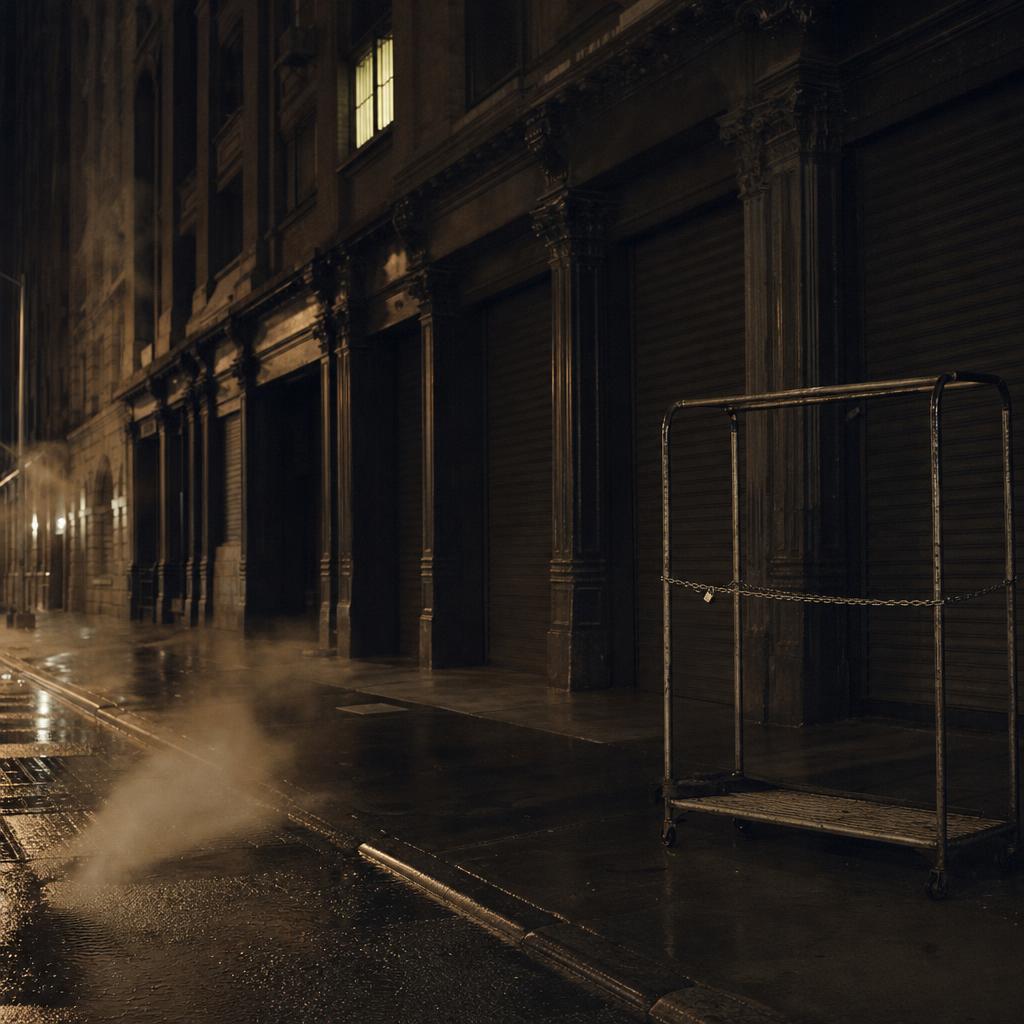
A mile or so southwest of Meridian’s own address, the garment district still worked for a living in 1989. Seventh Avenue between Thirty-Fourth and Forty-Second Streets, spilling east toward Fifth and west toward Eighth, held a functioning manufacturing economy inside prewar loft buildings whose wood floors carried decades of dye and machine oil worked into the grain. Racks of plastic-sheathed clothing rolled down the sidewalks on their own wheeled pipes, pushed factory to showroom to truck by men who read foot traffic the way a driver reads a lane change; freight elevators ran without pause through the working day; the block smelled of solvent and steamed fabric and the specific warmth of a floor where machines had been running since six that morning. Something on the order of ninety-five to a hundred thousand people worked the city’s garment shops that year,7 most of them immigrant women — Chinese workers concentrated in Chinatown’s shops, Dominican, Puerto Rican, and Mexican workers spread across Midtown and the outer boroughs, smaller numbers of South Asian and Eastern European workers alongside them. The International Ladies’ Garment Workers’ Union had represented this workforce for most of the century, but its density had been falling for years, eroded by an industry that increasingly contracted its sewing out to shops the union could not easily reach or enforce against.
The cause was not mysterious, even if the pace surprised the people living through it. In 1961, something on the order of one garment in twenty-five sold in the United States had been made abroad; by the mid-1990s, well over half was.7 Manufacturers followed the same reasoning in every case: identify a country where labor and regulation cost less, establish the contractor relationships, and wind the New York floor down rather than close it outright, so that the shrinkage arrived as attrition, one contract at a time, rather than a single announced collapse. Southeast Asia, China, Mexico after the 1994 trade agreement linking it to Canada and the United States, Central America — each destination offered the same trade at a different address, and the employment curve tracked the migration decade by decade.
The Garment Workforce’s Retreat7
| Year | NYC apparel and textile employment (estimate) |
|---|---|
| 1989 | 95,000–100,000 |
| 1996 | ~72,000 |
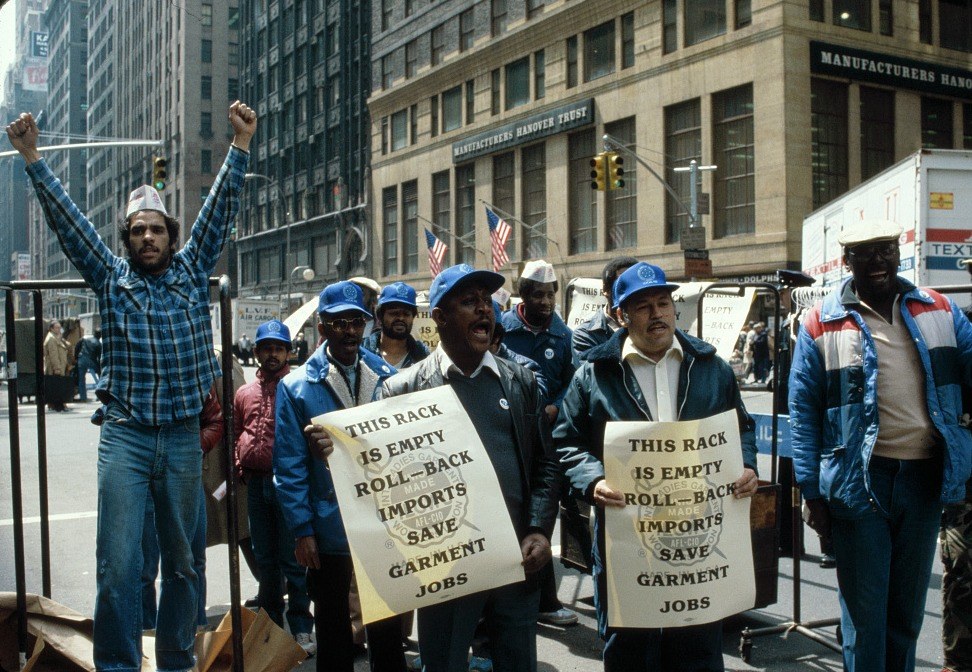
The unions answered the shrinkage the way declining unions generally do: by merging. In the summer of 1995, the ILGWU joined the Amalgamated Clothing and Textile Workers Union to form UNITE, the Union of Needletrades, Industrial and Textile Employees — an act of institutional survival rather than strength, meant to share overhead and consolidate jurisdictions that made less sense to keep separate as both trades kept contracting. Jay Mazur, the ILGWU’s final president, led the merged union from its founding.8 The city’s own regulatory apparatus retreated on a similar schedule: enforcement of the zoning rules reserving the district’s floors for manufacturing had effectively lapsed by the early 1990s, and loft space that had run sewing machines began filling with desks instead. By the last years of the period, industry observers who had assumed the decline bottomed out in the late 1990s were describing the exodus instead as accelerating — a shock precisely because it followed a stretch that had looked, briefly, like a floor. A walk from Penn Station into Midtown in 2001 still passed a rack or a loading dock somewhere in the Thirties, but fewer of them, and busier ones harder to find, the dye-stained floors visible through more open doors than closed ones.
A Union for Everyone Except the Editors
Meridian’s own floor stood outside all of this, and had never seriously tried not to. Its editorial staff was not organized — a fact so ordinary inside the building that it rarely surfaced as a fact at all. The Newspaper Guild had represented the Times’s newsroom since the early 1940s and the Daily News’s reporters and editors through the very strike that had just cost them so much.9 The culture of magazine editorial ran the other way. An editorial assistant earning well under twenty thousand dollars a year thought of herself as a writer serving an apprenticeship, not a worker inside a labor market, and the prestige of a masthead line under her name did a great deal of the work a raise would otherwise have had to do. Nobody had to argue her out of organizing. The idea did not present itself as a live option, and the culture around her confirmed, gently and constantly, that it should not.
What non-union status meant in practice was concrete rather than abstract. Dismissal required no cause and no notice period. Salaries were negotiated one on one, with no published scale, which let two people doing the same job under the same masthead earn different amounts with no mechanism to compare them — a gap that fell, more often than not, along the lines it usually falls along. Overtime went uncompensated, because editorial staff were salaried professionals exempt from the labor law that would have paid an hourly worker for the same midnight hours; those hours were treated inside the building as a mark of seriousness rather than as labor performed. None of this was distinctive to Meridian. It was the ordinary condition of magazine employment across the period, understood by nearly everyone inside it as simply how the trade worked, the same way a newsroom two floors down understood a Guild card as simply how its trade worked.
The Doorman’s Contract
Set the editorial floor beside the building that housed it, and the contrast came into focus. The doormen, porters, and superintendents who ran Meridian’s building — and every comparable office tower and apartment house across Midtown and the Upper East and West Sides — belonged to Service Employees International Union Local 32BJ, one of the largest private-sector union locals in the country by the late 1980s, with something on the order of seventy thousand members across the metropolitan area. The local’s own history ran through two earlier unions: Local 32-B, chartered by men in the building trades in 1934, and Local 32-J, chartered by women in the same industry two years later; the two merged in 1977, well before Meridian’s period opens, into the single local that bargained through the 1990s against the Realty Advisory Board on behalf of building owners citywide.10 Residential building workers had last struck the city in 1991, twelve days that left garbage piled on sidewalks while sanitation crews refused to cross the picket lines;10 the threat of a repeat after that was taken seriously by every co-op board and management company in Manhattan, because a doorman’s job — holding a door, screening a lobby, knowing who belonged and who did not — had no obvious substitute at scale.
The union contract set a formal wage, on the order of twenty-five to thirty thousand dollars a year for a doorman in the early 1990s and rising through the decade,10 along with pension contributions, health coverage, and job categories the contract defined rather than the building’s own management. Layered on top of the formal wage was the holiday tip, an unwritten but firmly expected supplement that ran, by common report, from a hundred to several hundred dollars per apartment, pooled and divided among a building’s staff by hierarchies the staff worked out among themselves — supers generally ahead of doormen, weekday staff ahead of weekend relief. In a fifty-unit building the pool could run into the thousands, occasionally into five figures, collected once a year in a transaction that was intimate, uneven, and entirely outside any contract either party had signed.
The superintendent stood apart from this arrangement in one further way: he usually lived in the building, in a basement apartment smaller and plainer than anything above it, reachable at three in the morning for the emergency no other tradesman would take at that hour. He knew which pipe fed which riser, which unit still paid a rent fixed a decade or two earlier, which tenant kept a second household nobody upstairs discussed at dinner. None of that knowledge appeared in any personnel file anywhere. It simply accumulated, year after year, in the person paid least to notice it and positioned best in the building to see it — a fact every resident depended on constantly and considered rarely, if at all.
Every one of these arrangements occupied the same city in the same years, and almost none of them touched. A senior editor could work a full career inside a building whose union contract she had never read, protecting a doorman whose annual wage she could likely have guessed within a few thousand dollars had she ever tried to guess it. She could decide, once and quietly, whether to buy a struck newspaper, and never revisit the question, while nine unions absorbed a hundred and forty-seven days of it in printing plants she had no reason to picture and would not have been able to place on a map. She could walk to lunch past the rolling racks on Seventh Avenue without registering that the industry moving them still employed more New Yorkers than her own profession ever had, and that it was disappearing at a pace her own profession would never be asked to survive. None of this took malice, and not much inattention either — a city this size organizes an enormous amount of its work into parallel lines that share little beyond the name of the place, each one running under its own contract, its own law, its own clock. It is not a trick this trade performs alone. It is closer to the trick the whole city performs, on every block, without anyone having to ask it to.
The Daily News strike would have run in The City as a company-town story: a replacement staff assembled months before the walkout, the plants ringed by private guards, a settlement that would have arrived at a closing table rather than a bargaining one when Tribune sold to Maxwell. The same section, within the same three years, would have taken Stanley Hill’s break with an administration DC 37 had backed as its own City piece, and would have carried Local 32BJ’s twelve-day strike against the buildings that housed the floor’s own address — three stories that would have run under one header without anyone on the masthead remarking on the coincidence of the address.
Maxwell’s death off the Canary Islands, and the pension draining that would have surfaced behind it once the estate’s books came open, would have gone into The Feature Well — a reversal with enough scale and enough distance from the newsstand fight to sit at length rather than in a paragraph. The sale that followed, Zuckerman and Drasner buying a bankrupt paper out from under Conrad Black’s bid, would have opened The Front: a third owner in three years, announced in the pages built to announce such things.
A different pitch would not have cleared the room. The ILGWU’s merger into UNITE, argued as a piece about the garment trade’s slow institutional folding, would have run into the same doubt that met most labor coverage pitched to that floor: whose reader, exactly, would have wanted a union merger explained to them.
Footnotes
-
New York Civil Service Law, Article 14 (the Taylor Law), enacted 1967. ↩
-
Joshua B. Freeman, Working-Class New York: Life and Labor Since World War II (The New Press, 2000). ↩ ↩2 ↩3 ↩4 ↩5 ↩6 ↩7
-
Richard Vigilante, Strike: The Daily News War and the Future of American Labor (Simon & Schuster, 1994). ↩ ↩2 ↩3 ↩4
-
“Second Day of Bitter Daily News Strike Erupts in Violence,” UPI Archives, October 26, 1990. ↩
-
Tom Bower, Maxwell: The Final Verdict (HarperCollins, 1995). ↩
-
“N.Y. City’s Budget Pact Falters Amid Criticism,” The Washington Post, July 2, 1991. ↩
-
Nancy L. Green, Ready-to-Wear and Ready-to-Work: A Century of Industry and Immigrants in Paris and New York (Duke University Press, 1997). ↩ ↩2 ↩3
-
ILGWU Digital Archive, “History: Merger with ACTWU,” Cornell University ILR School, Kheel Center. ↩
-
The NewsGuild of New York, “Guild History at The New York Times.” ↩