
Healthcare Beyond AIDS, 1989–2001
Subscribe
https://meridian-archive.com/feed.xmlOpen in your app, or paste the link above into any other:
The Logic of the Card
A doctor covering a health maintenance organization’s enrollees in New York by the early 1990s stood to earn more, on the plan’s own arithmetic, from a patient she did not see than from one she did. The term for the arrangement, capitation, ran through insurance contracts, trade journals, and hospital finance offices as ordinary vocabulary, not scandal: the plan paid a fixed sum per enrollee per month, whether that enrollee saw a doctor once or nine times, and the fee changed for neither outcome. A doctor treated a patient at his own expense, in effect; a doctor who did not treat a patient kept the difference — a structural fact standard enough, by the time the decade turned, to be a routine clause of a physician’s own employment contract rather than a subject requiring comment. The relationship it inverted had held, with local variation, for most of the century. Under the indemnity insurance that had covered most working New Yorkers into the 1980s, a doctor was paid for what she did: an office visit, a test, a procedure, billed and reimbursed piece by piece, with the patient free to see any physician who accepted the plan.1 The health maintenance organization, chartered as a matter of federal policy under the HMO Act of 1973 and slow to take hold in a city with New York’s density of specialists and its attachment to fee-for-service medicine, made the primary care physician — the “gatekeeper” — the fixed point controlling every referral onward.2 The incentive had not existed under indemnity insurance in that form, and its arrival did not require a single dramatic reform. It arrived plan by plan, employer by employer, open-enrollment season by open-enrollment season, as companies facing rising premiums offered the cheaper HMO option alongside the traditional one and watched employees choose the lower monthly cost without always registering what the choice implied for the next time they were sick.3
New York lagged the rest of the country in making the switch. The city’s oldest HMO, the Health Insurance Plan of Greater New York, had run on a staff model since shortly after the war, its salaried doctors practicing out of clinics rather than private offices, but it drew mainly a working- and middle-class membership and had never displaced the indemnity carriers — chiefly Empire Blue Cross Blue Shield — that dominated Manhattan’s prestige employers. Oxford Health Plans, founded in Connecticut in 1984 under Stephen Wiggins, built its New York-area enrollment from a standing start into the region’s fastest-growing plan across the early and middle 1990s, offering the broader physician networks that made HMO membership tolerable to patients used to choosing their own doctor.3 Nationally, enrollment in HMOs climbed through the same years from a figure holding near one worker in six through most of the 1980s toward something closer to a third of all insured workers by 1994, with looser forms of managed care already covering a majority and the share climbing further as the decade went on.4 The reasons New York moved more slowly were structural rather than sentimental: more doctors per capita than almost any American city, an insurance market built for decades around indemnity carriers, and employers slower to force the choice on a workforce that could, in a labor market that favored it, simply object.
By the time the pattern had a name — “the managed care backlash” entered the trade press around 1995 — the daily friction it described was already familiar to anyone holding one of the new cards: the referral phone call, the prior-authorization form faxed between offices, the “explanation of benefits” that arrived weeks later captioned, misleadingly to a first-time reader, this is not a bill.
The Plan That Could Not Pass
The nearest the decade came to resolving the confusion by statute arrived in the first year of the Clinton administration and failed in its second. Hillary Rodham Clinton was named in January 1993 to chair a Task Force on National Health Care Reform that worked through the spring largely in closed session, more than five hundred people organized into working groups whose deliberations leaked in fragments the opposition could characterize before the plan itself was public.5 The bill that emerged that November — the Health Security Act, built around an employer mandate, regional purchasing pools called Health Alliances, and a national health-spending cap enforced through “managed competition” among insurers — ran to well over a thousand pages, dense enough that critics could quote any single provision out of the structure that justified it and make it sound like bureaucratic overreach on its own.
The opposition organized faster than the bill could be explained. The Health Insurance Association of America, representing the small and mid-size insurers who stood to lose the most under a restructured market, funded a national television campaign built around a fictional middle-class couple, Harry and Louise, worried at their kitchen table about a plan neither of them could summarize; the ads ran for the better part of a year and became shorthand, on both sides of the debate, for the plan’s failure to explain itself in thirty seconds.6 William Kristol, running the Project for the Republican Future, circulated a memo in December 1993 arguing that Republicans should not negotiate a compromise bill but defeat the Clinton plan outright, on the theory that any Democratic health care victory — even a diluted one — would restore the party’s claim to be the guarantor of economic security for a generation.7 Momentum never returned; New York’s senior senator, Daniel Patrick Moynihan, chairman of the Finance Committee, had already broken with his own party to question publicly how urgent the crisis being described in the White House really was. On September 26, 1994, Senate Majority Leader George Mitchell announced that no floor vote would occur that year, and six weeks later Republicans took both houses of Congress for the first time in four decades.5
Nothing at the scale of the Health Security Act was attempted again before the century’s end. What followed instead was incremental: the Health Insurance Portability and Accountability Act of 1996, which let workers changing jobs carry prior coverage without a new waiting period for preexisting conditions, and the same year’s welfare-reform law, which — among its more contested effects — severed Medicaid eligibility from receipt of cash assistance, a change that expanded, rather than narrowed, who could technically qualify for the program even as it dismantled the entitlement it had once been paired with.8 For Meridian’s readership, largely covered through employer plans regardless of the outcome, the failure registered less as a personal emergency than as a generational political fact — the year the country decided, without quite framing the decision that way, that it would keep managing the coverage gap piecemeal rather than close it by law.
New York felt the plan’s death differently than the country as a whole. Roughly two and a half million New Yorkers were without health coverage of any kind by the time the Senate abandoned the bill — a population the city’s own officials could not agree on how to count precisely, let alone insure. Mayor David Dinkins had supported the plan through his final year in office; his successor, Rudolph Giuliani, sworn in that January, was preoccupied with the city’s own finances and treated national health reform as someone else’s fight. In Albany, Governor Mario Cuomo had backed the plan too, and his defeat that November brought in Governor Pataki, a Republican opposed to it on the same grounds as his party in Washington. For most Meridian readers the loss was intellectual rather than personal — employer coverage held regardless of what Washington did — which was itself the fact the failure exposed: the country’s most articulate, most politically engaged class had the least at stake in whether the reform passed.
The City’s Own Hospitals
New York ran, in the city’s Health and Hospitals Corporation, the largest municipal hospital system in the United States — eleven acute-care hospitals in 1990, from Bellevue on First Avenue to Lincoln in the South Bronx, financed through a braid of Medicaid, Medicare, city tax revenue, and the federal disproportionate-share payments that offset a public system’s disproportionate share of patients who could not pay at all.9 The corporation’s hospitals carried the two burdens the private system was structured to avoid: the uninsured patient who had nowhere else to go, and — through the first half of the decade especially — the tuberculosis and AIDS caseload that returned some wards, Bellevue’s among them, to an intensity of infectious-disease nursing the system had not carried in a generation.
The corporation’s finances were a standing target for a mayoralty determined to shrink the city’s involvement in running hospitals at all. In 1995 the city began drawing up terms to lease or sell three of the eleven hospitals — Coney Island, Elmhurst, and Queens Hospital Center — to private operators, and by November of the following year the corporation’s board had authorized a ninety-nine-year sublease of Coney Island Hospital to a private nonprofit system. A state trial court found the sublease legally improper within two months, an appellate court affirmed the finding the following summer, and the city pressed on regardless, through further rounds of layoff threats and service consolidation that the municipal hospital workers’ union, Local 1199, mobilized against at every stage.10 The New York Court of Appeals settled the matter in 1999, ruling that the city could not privatize its public hospital system without the state legislature’s approval — a decision that left the eleven hospitals, battered and underfunded, in municipal hands through the end of the period.11
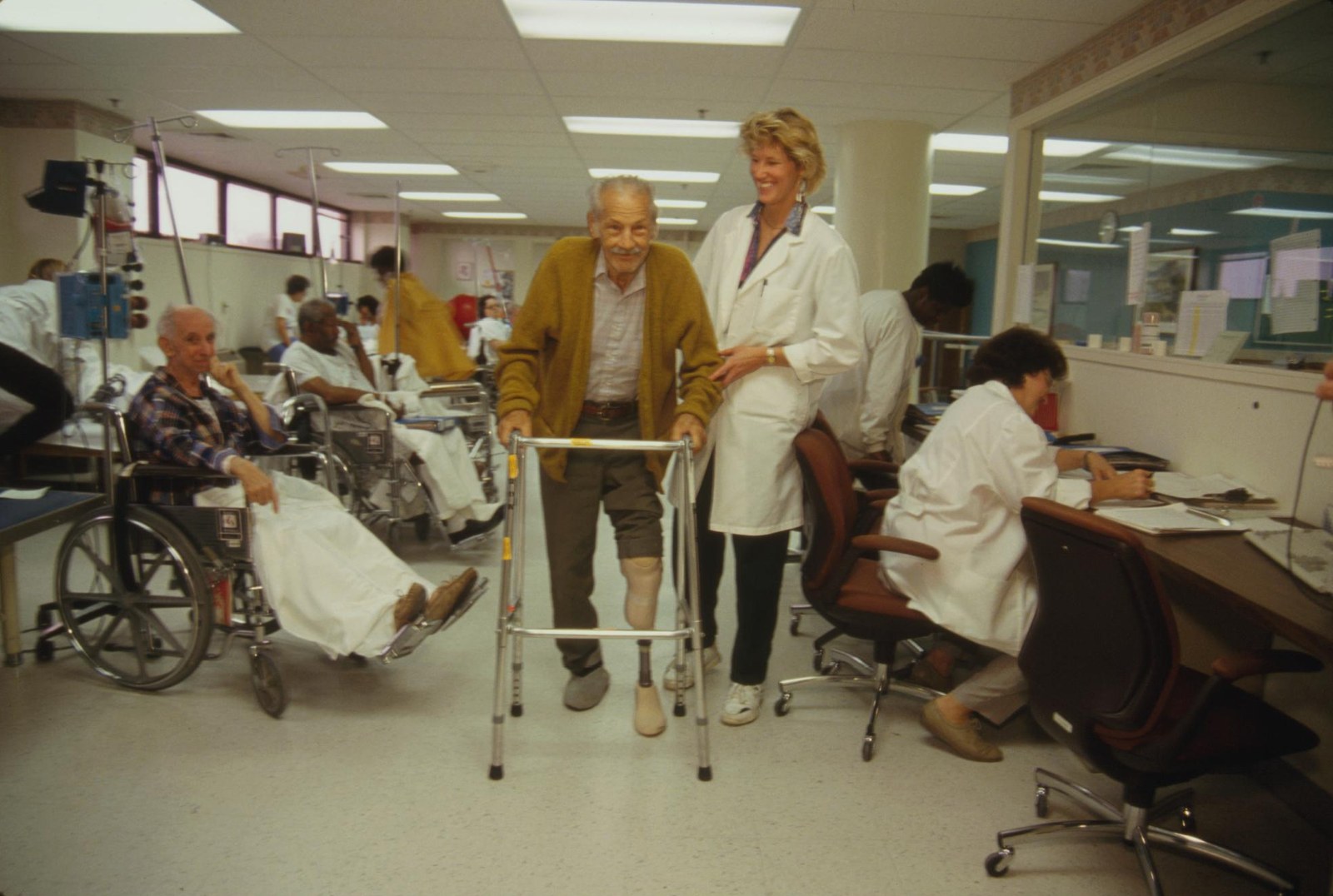
What a patient encountered inside that system differed from private care by measures that had nothing to do with the competence of the staff. An emergency-room wait at a public hospital ran six to twenty-four hours against one to four at a comparable private institution; wards ran four beds to a room where private hospitals had gone to two;9 medical residents, rotating monthly, provided the continuity of care that a private attending physician offered by staying on the same case for years. The trauma care was, by wide agreement, exceptional — Bellevue, Kings County, and Lincoln absorbed the city’s gunshot and highway wounds with a volume few private trauma centers matched — and it sat inside a system whose outpatient waits for a routine referral could run months. Elmhurst Hospital Center in Queens, drawing patients from more than a hundred countries and running an interpreter line around the clock, was known within the system as the hospital of the world; at Harlem Hospital, the surgeon Harold Freeman built a screening and treatment program for Black women with breast cancer that became a model cited well beyond the corporation that employed him.9
Registered Nurse Wages, New York City, 1989–2001
Approximate annual base pay, hospital staff nurse, before night and weekend differentials — order-of-magnitude figures reconstructed from period wage surveys and union contract records, not a single verified series.
| Year | Public hospital, starting | Public hospital, 5 years | Private hospital, starting | Private hospital, 5 years |
|---|---|---|---|---|
| 1989 | $28,000–32,000 | $36,000–42,000 | $32,000–38,000 | $42,000–48,000 |
| 1992 | $34,000–38,000 | $44,000–50,000 | $38,000–44,000 | $50,000–56,000 |
| 1995 | $36,000–40,000 | $46,000–52,000 | $40,000–46,000 | $52,000–60,000 |
| 1998 | $40,000–46,000 | $52,000–58,000 | $46,000–54,000 | $60,000–68,000 |
| 2001 | $48,000–55,000 | $60,000–68,000 | $55,000–65,000 | $70,000–82,000 |
The nursing shortage that shaped those wages ran on its own cycle, distinct from the hospital-privatization fight but felt on the same wards: severe through 1988–91 as an aging workforce retired and AIDS-era attrition thinned the ranks; easing through the middle of the decade as pay caught up and nursing-school enrollment recovered; briefly in surplus during the consolidation years of 1996–98; and short again by 1999, as demand from an aging patient population outpaced a nursing-school pipeline that had never fully rebuilt itself. Local 1199, the union that organized most of the corporation’s nurses and support staff alongside tens of thousands of other health care workers across the metropolitan area, functioned as both a bargaining agent and, in a workforce as multilingual and multiracial as the city’s public hospital system, one of the only citywide institutions built by and for it. On the floor itself, the union’s fights over staffing ratios and mandatory overtime were the same fights year after year: a public-hospital nurse on nights routinely carried seven to ten patients where a private hospital held the line closer to five or six, and a shift that ran long did so because the contract allowed the hospital to require it.12
The Gap Below Medicaid
New York’s Medicaid program was, in dollar terms, the most generous in the country across the period — broad optional benefits, a mandate that reached deep into the working population, and, for a great many middle-class families facing a parent’s nursing-home costs, the de facto long-term-care insurer of last resort once savings ran out.13 What the program did not reach, for most of the decade, was the single adult without children: federal Medicaid law before the mid-1990s made virtually no provision for childless adults regardless of how little they earned, a gap New York could not close on its own budget. Children fared better: the 1997 federal Children’s Health Insurance Program let the state expand its existing Child Health Plus program well beyond its original income ceiling, years before Family Health Plus, enacted at the decade’s end, began phasing in comparable coverage for their parents.14 Somewhere between one in seven and one in five New Yorkers went without any coverage at all across these years — a range wide enough that no single citywide number captured it precisely — concentrated most heavily among restaurant, day-labor, and off-the-books workers whose jobs simply did not carry insurance, and, after the 1996 welfare law imposed a five-year bar on federal Medicaid for new immigrants, among recent arrivals in particular.
For a person in that gap, the emergency room functioned as the only guaranteed door. Under the federal Emergency Medical Treatment and Active Labor Act of 1986, a hospital emergency department had to screen and stabilize anyone who came through it regardless of ability to pay, which made the ER — never designed for the purpose — the closest thing many uninsured New Yorkers had to a primary care physician.15 A sore throat, an untreated hypertension, a diabetes gone unmanaged for lack of a regular doctor: each arrived at Lincoln or Jacobi or Bronx-Lebanon as an emergency because it had nowhere else to be treated until it became one, was stabilized, and was discharged with a referral to a clinic the patient often could not get back to before the same condition returned. The cost of that pattern fell on the hospitals themselves, partially offset by the state’s indigent-care pool, and on nobody’s ledger as a savings, since a hypertensive crisis treated in an emergency bay cost the system many times what the same condition, caught early in a doctor’s office, would have.
The Bronx carried the sharpest version of this arithmetic. Alongside the corporation’s own Lincoln and Jacobi hospitals, the borough’s uninsured and underinsured relied on a scatter of nonprofit clinics built explicitly to absorb what the hospitals could not: Morris Heights Health Center, sliding its fee to what a patient could pay since 1981, and Urban Health Plan in Hunts Point and Mott Haven, founded by Dr. Richard Izquierdo, a South Bronx native who grew his original storefront medical practice, over the following decades, into one of the borough’s largest primary care networks.16 Neither replaced a hospital. Both existed because the hospitals, alone, could not absorb the borough’s need.
The Wards That Emptied
The other structural story of the period had begun decades earlier and simply continued through it: the emptying of New York’s state psychiatric hospitals, whose combined census had fallen from roughly ninety thousand patients in the middle 1950s to a small fraction of that by 1989, discharged under a deinstitutionalization policy that had never been matched by the community treatment infrastructure it assumed would replace the wards.17 The visible consequence, through the late 1980s and into the 1990s, was a population of untreated serious mental illness on the city’s streets and in its subways, and a running argument — never fully resolved — over how far the city could go in compelling treatment without violating the civil liberties of people who had not been convicted of anything. What community infrastructure existed ran thin against the need: Fountain House, the West Side clubhouse that had offered work and daytime structure to people with serious mental illness since 1948 and whose model had since been exported to other cities,17 remained one of the only programs of its kind in Manhattan, while the psychiatric emergency room on Bellevue’s nineteenth floor absorbed whoever the rest of the system could not hold, on seventy-two-hour holds that ran, by every account, chronically over capacity.
That argument had a documented flashpoint the decade inherited directly. In October 1987, under a Koch-administration outreach program authorized to remove severely mentally ill people from the street for evaluation, a woman known publicly as Joyce Brown, and by the pseudonym “Billie Boggs” in the court record, was involuntarily committed to Bellevue; the civil-liberties lawyer Norman Siegel took her case, and in January 1988 a court ordered her release, a ruling later affirmed on appeal.18 The case became the era’s reference point for the tension between a right to refuse treatment and a city’s obligation to intervene, and it stayed unresolved, in practice, for the rest of the decade — a shortage of outpatient clinics, day-treatment slots, and the still-new assertive-community-treatment teams meant that even a patient who wanted ongoing care after a hospital stay often could not get it quickly enough to matter.
The argument was finally forced into statute by a subway platform. On January 3, 1999, Andrew Goldstein, a man with a documented history of untreated schizophrenia and repeated hospitalizations, pushed Kendra Webdale in front of an oncoming N train at 23rd Street.19 Governor Pataki signed what became known as Kendra’s Law that August, establishing court-ordered outpatient treatment for patients with a demonstrated pattern of dangerous non-adherence to medication — the state’s first statutory attempt to compel care outside a hospital’s walls rather than simply commit or release. Insurance coverage for the treatment such patients needed remained, throughout the period, structurally thinner than coverage for physical illness: a 1996 federal parity law barred health plans from setting lower annual and lifetime dollar caps on mental health care than on medical care, but left visit limits and higher mental-health copayments untouched, so that a plan could comply with the letter of parity while still capping outpatient therapy at a number of sessions a year that a course of treatment for depression or schizophrenia could exhaust by summer.20
What AIDS Taught the Other Patients
The one AIDS-adjacent story in this decade’s health care reckoning is the one that ran outward from the epidemic rather than through it. ACT UP New York, founded in March 1987 after the writer Larry Kramer called for it from the floor of the Lesbian and Gay Community Services Center, built a template for patient advocacy that had no real precedent in American medicine: its members learned the science of the disease killing them well enough to critique clinical-trial design as equals, and they took that literacy directly to the Food and Drug Administration and the National Institutes of Health, most visibly in the “Seize Control of the FDA” demonstration in Rockville, Maryland, on October 11, 1988, which blocked the agency’s entrances for hours and ended with roughly a hundred and seventy-five arrests.21 When the group’s own treatment specialists split in January 1992 to found the Treatment Action Group, members including Mark Harrington, Peter Staley, David Barr, Spencer Cox, and Gregg Gonsalves carried that literacy into direct, ongoing relationships with FDA Commissioner David Kessler and Anthony Fauci, director of the National Institute of Allergy and Infectious Diseases — activists sitting across the table from officials who had once refused to meet with them at all.21 The reforms that followed — an accelerated-approval pathway allowing the FDA to approve a drug on the strength of a surrogate marker rather than a completed survival study, expanded early access to drugs still in trials, and patient representatives seated for the first time on the agency’s own advisory committees — were built for AIDS treatments specifically, and none of them stayed there.
By the middle of the 1990s, the same accelerated-approval standard that had been fought for on behalf of a disease killing gay men in their twenties and thirties was approving cancer drugs on the same surrogate-marker logic, and organizers explicitly citing ACT UP as their model — the National Breast Cancer Coalition, founded by Fran Visco in 1991, chief among them — were bringing the same patient-as-expert posture, if rarely the same street tactics, to a disease with an entirely different constituency and an entirely different public sympathy.22 The lesson the epidemic had forced onto American medicine — that a diagnosis could be the beginning of a patient’s education rather than the end of her agency — outlived the crisis that had taught it, and it is one of the only places in this decade’s health care history where an argument won on behalf of the most stigmatized patients in the country visibly improved the terms available to everyone else.
The referral gatekeeping described at the outset reached even a patient with the best coverage in the city. A specialist referral for a bad knee, worked through a primary care physician and a prior-authorization form, could land at the Hospital for Special Surgery on the East Side — the city’s top-ranked orthopedic institution through most of the decade — and the codes on the bill there were the same codes charged at a community hospital across town; what differed was the waiting room, not the price.
The Cost of a Bad Knee, 1995
Approximate charges and typical patient share, orthopedic care, in 1995 dollars — illustrative ranges reflecting the era’s uneven billing and reimbursement practice, not a single verified schedule.
| Service | Charged | Patient share, indemnity/PPO | Patient share, HMO |
|---|---|---|---|
| Primary-care visit | $80–120 | $16–24 | $10–20 copay |
| Knee X-ray | $100–150 | $20–30 | $10–25 copay |
| MRI, knee | $1,000–1,500 | $200–300 | $50–100 + prior authorization |
| Orthopedic specialist visit | $150–250 | $30–50 | $20–35 copay, referral required |
| Cortisone injection | $200–300 | $40–60 | $20–30 copay |
| Physical therapy visit | $70–100 | $14–20 | $20 copay, capped near thirty visits a year |
| Knee arthroscopy | $5,000–8,000 | $1,000–1,600 | $500–1,500 |
None of this arrived as a single reform or a single collapse. It arrived as paperwork — a card, a list, a form the color of the walls it was filled out against — and the paperwork rearranged something more basic than which specialist a patient could see: it changed who decided whether a person was sick enough to be treated, and on what evidence. Congress spent the better part of two years trying to settle that question by statute and produced a bill so large that any single page of it, read aloud in a living room, could defeat the whole argument on its own terms. The city’s public hospitals absorbed what a market organized around insurance cards would not, at four beds to a room, and prevailed in court in 1999 on the narrow question of who was even allowed to sell them. New York’s Medicaid program was, on paper, the most generous in the country, and a childless adult working nights in a low-wage job rarely qualified for it under the law as it stood. Only one part of this decade’s health care story ran the other direction — a lesson forced by the sickest, least protected patients in the country outward to everyone else — and it suggests that the argument over who gets treated, and by whose authority, was never a settled feature of American life. It was being fought, on these very terms, in exactly these years.
A pitch tracing the Treatment Action Group’s 1992 founding into direct dealings with the FDA and NIH would have gone into The City, sourced to activists literate enough in trial design to sit across the table from the officials who ran it. The fight to keep the city’s own eleven hospitals — the Court of Appeals ruling that closed out five years of leases and lawsuits — would have carried into The City as well, told as a system left, battered, in municipal hands. The Health Security Act’s collapse, and the year the country would have chosen to keep managing the coverage gap piecemeal rather than close it by law, would have gone into The Essay, sourced to the same economists quoted in every other outlet covering it.
A shorter item on the new portability law letting a worker changing jobs keep prior coverage would have gone into The Front. A piece following one uninsured winter through a Bronx emergency room, pitched more than once, would have died at the water cooler — not for any weakness in the pitch but because a senior editor would have soured, over reasons that outlasted the story, on the freelancer who would have kept bringing it back. The hospital fight above would have reached a night nurse on one of the corporation’s own wards before it would have reached the stable’s pitch meeting at all; her local would have mobilized against every round of the cutbacks the dailies described only from outside the ward, and her daughter, who would have been checking copy two floors above Midtown, would have heard the shape of it by phone before it would have crossed a desk.
Kendra’s Law, signed that August after a death on a subway platform, would have gone into The City — the state’s first attempt to compel psychiatric treatment outside a hospital’s walls rather than simply commit or release.
Footnotes
-
Paul Starr, The Social Transformation of American Medicine (Basic Books, 1982). ↩
-
Health Maintenance Organization Act of 1973, Pub. L. No. 93-222. ↩
-
George Anders, Health Against Wealth: HMOs and the Breakdown of Medical Trust (Houghton Mifflin, 1996). ↩ ↩2
-
John K. Iglehart, “Physicians and the Growth of Managed Care,” New England Journal of Medicine 331 (1994): 1167. ↩
-
Theda Skocpol, Boomerang: Clinton’s Health Security Effort and the Turn Against Government in U.S. Politics (W.W. Norton, 1996). ↩ ↩2
-
Haynes Johnson and David S. Broder, The System: The American Way of Politics at the Breaking Point (Little, Brown, 1996). ↩
-
William Kristol, “Defeating President Clinton’s Health Care Proposal,” memorandum to Republican leaders, Project for the Republican Future, December 2, 1993. ↩
-
Personal Responsibility and Work Opportunity Reconciliation Act of 1996, Pub. L. No. 104-193. ↩
-
Sandra Opdycke, No One Was Turned Away: The Role of Public Hospitals in New York City Since 1900 (Oxford University Press, 1999). ↩ ↩2 ↩3
-
Leon Fink and Brian Greenberg, Upheaval in the Quiet Zone: 1199SEIU and the Politics of Health Care Unionism (University of Illinois Press, 2009). ↩
-
Council of the City of New York v. Giuliani, 93 N.Y.2d 60 (1999). ↩
-
Linda H. Aiken et al., “Hospital Nurse Staffing and Patient Mortality, Nurse Burnout, and Job Dissatisfaction,” JAMA 288, no. 16 (2002): 1987–93. ↩
-
Michael S. Sparer, Medicaid and the Limits of State Health Reform (Temple University Press, 1996). ↩
-
Lawrence D. Brown and Michael S. Sparer, “Poor Program’s Progress: The Unanticipated Politics of Medicaid Policy,” Health Affairs 22, no. 1 (2003): 31–44. ↩
-
Emergency Medical Treatment and Active Labor Act, 42 U.S.C. § 1395dd (1986). ↩
-
Lloyd Ultan and Barbara Unger, Bronx Accent: A Literary and Pictorial History of the Borough (Rutgers University Press, 2000). ↩
-
E. Fuller Torrey, Out of the Shadows: Confronting America’s Mental Illness Crisis (John Wiley & Sons, 1997). ↩ ↩2
-
In re Boggs, 136 A.D.2d 1 (N.Y. App. Div. 1988), affirming the release ordered in the case of Joyce Brown, committed under New York City’s Project HELP outreach program in October 1987. ↩
-
New York Mental Hygiene Law § 9.60 (“Kendra’s Law”), signed August 27, 1999, following the January 3, 1999 death of Kendra Webdale. ↩
-
Mental Health Parity Act of 1996, Pub. L. No. 104-204. ↩
-
Steven Epstein, Impure Science: AIDS, Activism, and the Politics of Knowledge (University of California Press, 1996). ↩ ↩2
-
Maren Klawiter, The Biopolitics of Breast Cancer (University of Minnesota Press, 2008). ↩