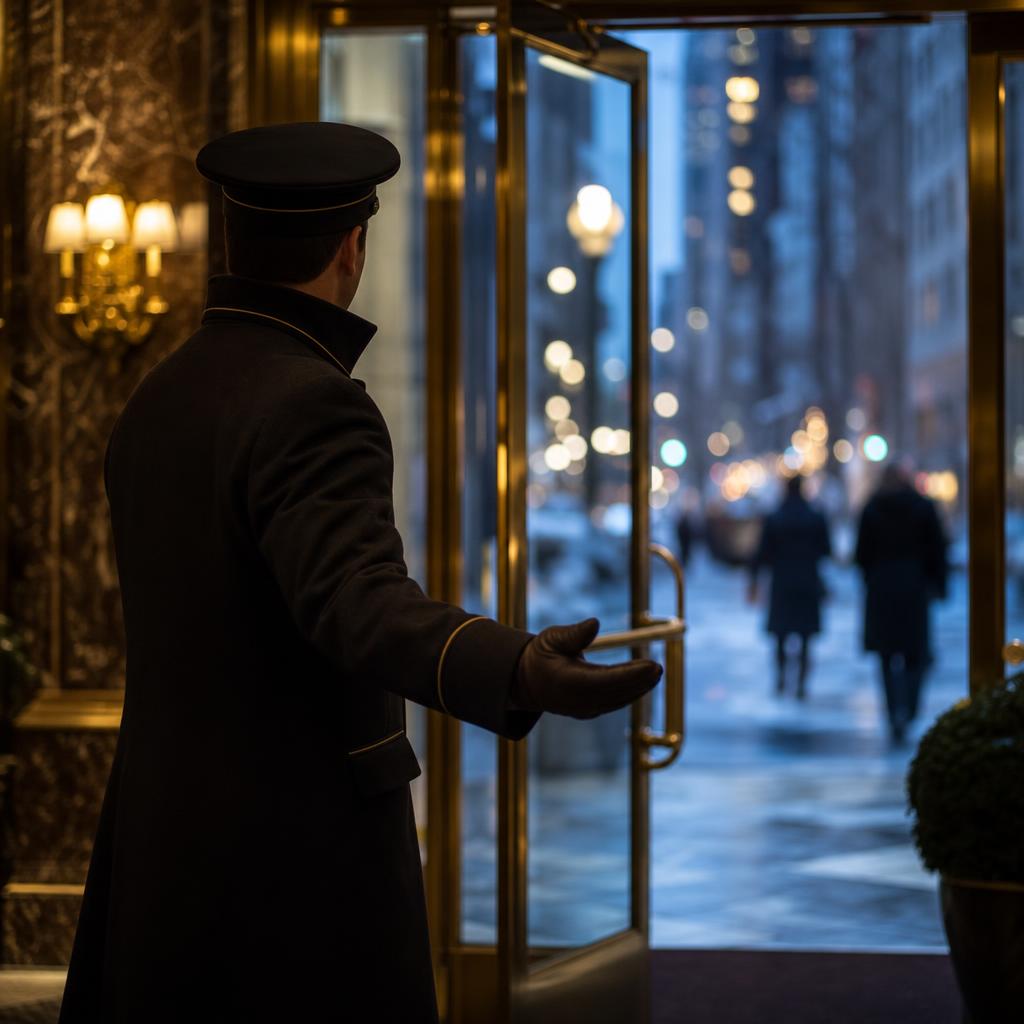
Inter-Class Contact: The Doorman, the Bodega, the Holiday Tip
Subscribe
https://meridian-archive.com/feed.xmlOpen in your app, or paste the link above into any other:
The Referral
A doorman’s post in a good Manhattan building was, by the measure of the men who held it, one of the better jobs in the city’s service economy — union wage, indoor work, tips on top that could run to a fifth of the year’s pay by December — and it was, for that reason, a job almost never gotten by answering a posted opening. Peter Bearman, who surveyed and interviewed the city’s residential doormen for the most thorough study the occupation received, found that the overwhelming majority had gotten theirs through a cousin or a friend already standing in a lobby, the vacancy passing hand to hand along a network of relatives and countrymen before the building’s management ever had cause to advertise it.1 The tenants upstairs, who screened their own incoming neighbors through a co-op board and a stack of financial statements, had no equivalent view of how the staff below them had been assembled, and no occasion to wonder.
It was the plainest version of a closed system the sorted city ran at a dozen other thresholds, most of them dressed in more respectable clothes. The most formalized of these was the lobby itself, where the doorman in a good building knew which tenants drank, which were behind on the maintenance, which came home at four in the morning and with whom, and which marriage in the line was ending before either party had told a soul — and the tenants, as a rule, could not have said where the doorman lived or how he got to work. The relationship was intimate and it ran one way. Bearman found the asymmetry to be the structural fact of the job: the man at the door observed the private life of every apartment above him in continuous detail, while remaining, to the people he observed, a fixture of the lobby with no biography attached.1 The posture the work required he described in four words: close, but not too close.
It was the contact zone the city’s class structure produced in its purest form — two people in daily, obligatory, physical proximity across a gap that neither the proximity nor the years of it would close. The doorman held the door, took the packages, screened the visitors, hailed the cabs, and learned the household’s secrets as a byproduct of standing where he stood. He was, in the language of the buildings that employed him, staff. The word carried the whole arrangement. He was of the building without being of the class that lived in it, and the daily transaction across that line — cordial, dependent, entirely unequal — was one of the few places the sorted city required its fractions to meet.
The proximity did not translate into knowledge running the other way, because nothing in the arrangement asked it to. A tenant could ride the elevator with the same man five days a week for a decade and never learn that he had a second job, a bad knee, a daughter at Hunter, a commute from the far edge of Queens that started before six. The information moved from the apartments down to the lobby and stopped there. What the doorman knew, he kept; discretion was the load-bearing half of the job, and a man who traded on what he saw did not keep the job. The tenants, for their part, were not withholding so much as incurious. The man was where the mail was. He was not, in the ordinary run of the day, a person about whom there was anything to wonder.
The staff of a building was assembled the way the building’s residents were screened, by who knew whom — the same mechanism running on both sides of the door and sorting the two into permanently separate rooms.
The Envelope
Once a year the arrangement was made to state a number. The holiday bonus — the envelope handed to each member of the building staff in the two weeks before Christmas — was the moment the abstract relationship of tenant and doorman was converted into cash, and Bearman singled it out for extended treatment because it was where the whole structure became briefly visible to the people inside it.1 The anxiety it produced in tenants was real and specific: the sum had to signal neither cheapness, which the doorman would remember all year, nor a reach for status, which the neighbors would notice. Tenants managed the second risk by underreporting — telling other tenants they had given less than they had, so as to hold a private advantage with the doorman while not appearing to have bought it. The envelope was thus simultaneously a payment for the year that had passed and a retainer on the year to come, and everyone on both sides of it understood both meanings without either being said.
What a doorman could expect had no fixed answer, which was part of what made December fraught. The newspaper had been dispensing contradictory advice for decades, and the recommended range only widened as the years passed.1 At the end of the century a doorman at an ordinary building might see thirty or fifty dollars from a given apartment; at the wealthiest addresses a single envelope could run to several hundred, and a man on a well-tipped door could assemble, across a full line of grateful tenants, a December that materially outweighed a month’s wage. The sum was never posted, never negotiated, and never the same from one door to the next. It was the one figure in the building that everybody calculated and nobody disclosed.
The Recommended Envelope, by Year
The advice columns Bearman assembled show the going rate drifting upward and the counsel growing less certain as the decades passed.1
| Year | Doorman | Superintendent | Note |
|---|---|---|---|
| 1965 | $300–$350 (holiday total) | $700–$800 (holiday total) | Luxury building; at least $20 per tenant |
| 1972 | — | — | An East Side tenant set aside $80–$100 for the whole staff |
| 1975 | $10 per tenant | $20 per tenant | Porters $15 |
| 2000 | $30–$50 per tenant | $50–$100 per tenant | Range had widened; advice contradictory |
The men who took the envelopes belonged to a union, which is why the door was staffed at all and why the wage beneath the tips held. Local 32B, formed in 1934, and Local 32J, formed in 1936, had merged in 1977 into the entity that represented the city’s doormen, porters, superintendents, and cleaners, and it was among the more effective service unions in the country.2 Its leverage was the thing every tenant discovered the moment it was withdrawn. In the spring of 1991 the residential building workers struck for twelve days, and for twelve days the tenants of the struck buildings sorted their own mail, watched their own doors, and carried their own trash to the curb, where the sanitation trucks would not stop because their crews would not cross the line.3 The city’s most cushioned residents were returned, briefly, to the condition of doing for themselves, and the lesson of the interval was not lost: the invisible labor of the lobby was load-bearing, and it had a price that the envelope, however generous, did not set.
The Woman in the Park
The doorman was the most formalized of the contact figures, but he was not the most intimate. That distinction belonged to the woman who raised the children. The professional household that could afford it employed someone to do the childcare it did not have time for, and in the neighborhoods where that class was concentrating — Park Slope above all — the someone was, overwhelmingly, a West Indian woman.4 The British nanny was a status object and the East European au pair a fashion; the Caribbean woman was the reality, the person actually pushing the stroller through the playground on a Tuesday afternoon. The playgrounds of brownstone Brooklyn filled, on weekday afternoons, with Black women minding white toddlers, a tableau so consistent it read at a glance as the neighborhood’s demographic signature.
The terms were cash and off the books. The pay ran to a few dollars an hour, sometimes as little as a few hundred dollars a month for live-in work, and it came without health insurance, without a pension, without a record that any government held.4 Many of the women had no papers, and the arrangement’s asymmetry was enforced, where it needed enforcing, by the unspoken knowledge that a worker who asked for more could be reported to an agency with the power to remove her from the country. The intimacy here was total — the woman knew the child’s fevers, its first words, its parents’ fights through the bedroom wall — and the standing was the lowest on the whole contact map. She was raising the next generation of a class that would not have been able to name the parish she came from.
The Counter
At the other end of the city, in the neighborhoods the doorman went home to, the contact zone reversed its polarity. There the buildings had no lobbies and the tenants did their own doors, and the daily transaction with someone of another background happened at the bodega counter — where the barrier between the classes was not a uniform but a sheet of Plexiglass. In a neighborhood like Morris Heights the corner stores outnumbered the supermarkets many times over, and behind the scratched acrylic a Dominican or Puerto Rican or, increasingly, a Yemeni owner sold the neighborhood the things it bought in the amounts it could buy them: a quart of milk, a can of Goya, a lottery ticket, the loosie.5
The bodega was the working city’s version of the same institution the lobby was: a threshold where money crossed a barrier between people who did not otherwise mix, transacted through a slot, and parted. The turntable in the Plexiglass rotated the change out and the cash in, and the courtesy across it was as real and as bounded as the doorman’s. What the two contact zones shared was the barrier itself. In the good building the barrier was manner and uniform; in the bodega it was bulletproof plastic. In both, two people met daily across a line the meeting was structured never to erase.
The sorted city could not sort itself completely, because the households at the top of it could not run without the labor of the people at the bottom, and that labor had to be performed in person, in the home, at the door, in the park. So the fractions that the co-op board and the masthead and the private school kept carefully apart were pressed together again at a handful of daily thresholds — the lobby, the stroller, the counter — where a tenant and a doorman, a mother and a nanny, a customer and a shopkeeper met across a gap that all the intimacy in the world would not close. The striking thing was how little of the person came through. A doorman could know a household for a decade and remain, to it, the lobby; a nanny could raise a child and stay, to its parents, the help; a shopkeeper could sell a block its milk for years from behind the same pane of plastic. The contact was constant and the knowledge ran one way, and the barrier — a uniform in one place, a sheet of Plexiglass in another — was the city’s way of having the labor without having to see the person who supplied it.
The twelve-day strike in the spring of 1991 would have arrived in The City as the piece that wrote itself: doormen, porters, and supers off the line, and half of Manhattan’s better buildings reduced overnight to carrying their own trash to the curb and answering their own doors. The June close would have caught it near enough to still be live — sanitation crews refusing to cross a residential picket, tenants of the struck buildings learning in a dozen small failures of function what the daily presence of the staff had been absorbing without a name for it. The piece would have needed no invented frame; the strike would have supplied its own, and material already standing on doormen and nannies and bodega counters would suddenly have had a news peg under it.
The inversion made visible for twelve days would have been the point of the piece: the households that could not tell you where their doorman lived would have found out, that spring, what his absence cost them. The City’s June pages would have carried it. The strike would have ended, the sides would have settled, and the piece would have gone to press with the picket lines already broken up and the men back at their posts, envelope season eight months off.
Footnotes
-
Peter Bearman, Doormen (University of Chicago Press, 2005). Bearman’s survey and interviews establish the knowledge asymmetry, the “close, but not too close” posture, and the referral-network path into the job; his chapter on the Christmas bonus reproduces the advice-column figures and documents the tenant practice of underreporting. ↩ ↩2 ↩3 ↩4 ↩5
-
“Inside SEIU Local 32BJ,” CooperatorNews New York. Local 32B (1934) and Local 32J (1936) merged in 1977; the union represents doormen, porters, superintendents, and cleaners across the metropolitan region. ↩
-
Reporting on the 1991 residential building-workers’ strike: “Inside Story: ‘91 Doorman Strike Wasn’t That Bad,” Brick Underground, April 2010; “Doorman strike looms in New York City,” NBC News, 2006. The 1991 walkout ran twelve days; the union sought a cost-of-living increase and no employee health-insurance contribution, while owners sought a first-year wage freeze and a shift toward employee health contributions and 401(k) plans. ↩
-
Tamara Mose Brown, Raising Brooklyn: Nannies, Childcare, and Africanized Domestic Workers in New York City (New York University Press, 2011), on the West Indian childcare workforce of brownstone Brooklyn, its off-the-books cash wages, and the absence of benefits or legal protection. ↩ ↩2
-
On the single-cigarette trade and its spread through low-income New York in the crack era, see “‘I’m gonna get me a loosie’: Understanding single cigarette purchases by adult smokers in a disadvantaged section of New York City,” Preventive Medicine Reports (2018). The bodega texture — the Plexiglass barrier, the loose cigarette, the lottery ticket, the density of corner stores relative to supermarkets — is drawn from period neighborhood field description. ↩